Dr Karen McAulay explores the history of Scottish music collecting, publishing and national identity from the 18th to 20th centuries. Research Fellow at Royal Conservatoire of Scotland, author of two Routledge monographs.
My talk for the Scottish Graduate School of Arts and Humanities was incredibly well-attended. It was lovely to be able to talk about one of my specialisms to people who were genuinely interested. My thanks to you for attending, if you were one of those people! At least one individual had just started their bibliography, so hopefully I was able to share some useful tips.
I’ve uploaded my PowerPoint and text to my Conservatoire Pure account – our institutional repository – please click here.
If anyone tried to sign up, but experienced a problem getting into the meeting, please contact me via the SGSAH Summer School organisers.
An entirely new venture for me: I’ve offered to give a talk at the Scottish Graduate School for Arts and Humanities Summer School later this month – next week, to be precise! It’s a summer school for all Arts and Humanities doctoral researchers in Scotland. When the opportunity came up to participate, I initially wondered if I had any expertise that I could share, leaving aside my own niche research interests. But then it occurred to me that people seem to enjoy my talks and writing about the process of research, as much as my talks about the research itself, so the obvious thing was to talk about one of my favourite things – bibliography. A lot of people have signed up – I’m so pleased.
Today felt like a good day to get it written, powerpoint and all.
I might share the talk later, after it has actually taken place. For now, here’s a taster for any Scottish postgraduate researcher deciding which talks to attend!
“Have you ever forgotten where you read something useful? You know the scenario – whilst you’re searching for something, whether on the web, in the library or in a database, you flick past something that’s perhaps only of tangential interest, only to realise later that it was more significant than you thought. Or you’re just killing time, so you’re not in full scholar-mode, and you find something interesting that is so relevant that you just know you’ll be able to find it again? But you can’t.
Isn’t it an awful feeling?”
When I submitted my proposal for this talk, I had to describe the learning outcomes. Here’s what I’m aiming to do:-
Learning Outcomes:- By the end of this session, participants will have a greater understanding of the options available to them, in terms of building, maintaining and deploying a bibliography in scholarly writing. By the end of this session, participants will also understand the importance of starting to build one’s bibliography at the earliest opportunity.
Composer Chris Hutchings established an organisation called Choirs For Climate, using choral music to raise awareness of environmental issues arising from climate change. After an initial workshop last autumn, a choral concert of 55 voices took place in Edinburgh’s Greyfriar’s Kirk on Sunday 5 March. It was funded by Creative Scotland, and attracted about 150 in the audience raising several hundred pounds for Greenpeace.
I was delighted that my own Extinction Calypso was included. Although I wasn’t able to attend last week, Chris has shared the video with me, and I have his permission to share it here. The video is the work of Andy Henderson of ah-media.co.uk. Video of the entire concert will appear on Choirs for Climate in due course.
I had the opportunity to attend an event sponsored by AHTV and the Arts and Humanities Research Council this week. It took place at the Barbican Centre on Wednesday 5th February, so I travelled down the previous evening, and back to Glasgow on Thursday. The whole purpose of the event was to provide academic researchers with an opportunity to meet with TV professionals, and to learn more about getting one’s research discovered and disseminated through the medium of television.
It was a most informative day. I must confess to feeling a little star-struck when I realised that the keynote address was by Bettany Hughes, whom I’ve seen and admired on television history programmes. Similarly, hearing about the making of ‘Suffragettes’ with Lucy Worsley was fascinating – even if Lucy herself wasn’t actually there! I also availed myself of the opportunity to have a speed meeting with a TV professional.
I’d genuinely love to have the opportunity to get the Claimed From Stationers’ Hall network research out to a wider audience, but my first problem is the fact that we need big names or significant events to hang our story on. However, our primary heroine – Elizabeth Williams, nee Lambert – was, on the face of it a complete nonentity in terms of big names or big achievements. It goes without saying that she wasn’t a nobody in my opinion! (See A Labour of Love for MissLambert, also on this blog.) Of course, we know that her music catalogue was significant and highly useful to the music lovers of St Andrews in the late Georgian era. It made the collection much more easily navigable, and hence more useable.
In the wider scheme of things, it demonstrates the importance of work that goes on behind the scenes in libraries to this day. Very few professional cataloguers have a prominent public profile, and Miss Lambert certainly wasn’t a professional of any kind – she was paid a tiny amount for producing a catalogue, and that appears to be the sum total of her ‘official’ involvement. She married at a fairly late age and went off to join her husband, his mother and brothers, in Islington – and there’s not a lot more known about her life apart from her gift of her shell collection to the Natural History Society of Northumbria not long before her death. You could say that her life went as unnoticed as the vast majority of women of her era (and indeed subsequent eras), and yet those two handwritten music catalogue volumes do have significance in their own way.
We have to bear in mind that this veritable mountain of legal deposit music wasn’t exactly what most Georgian university officials wanted in their libraries – it was the books on law, theology, medicine and science that they had their eyes on. The St Andrews professors maybe took a different attitude to most, in allowing non-university music lovers to borrow music through the good offices of their professorial friends. The collection that was clearly important to Miss Lambert was heavily used by both men and women – I interrogated the music in terms of what was most borrowed by various categories of readers. Considering that there were parallel collections in several other legal deposit libraries, we were keen to compare what survived elsewhere, but nowhere else are there borrowing records or evidence of such intensive use. So many stories – but can I argue the case for a television documentary? Well, let’s see!
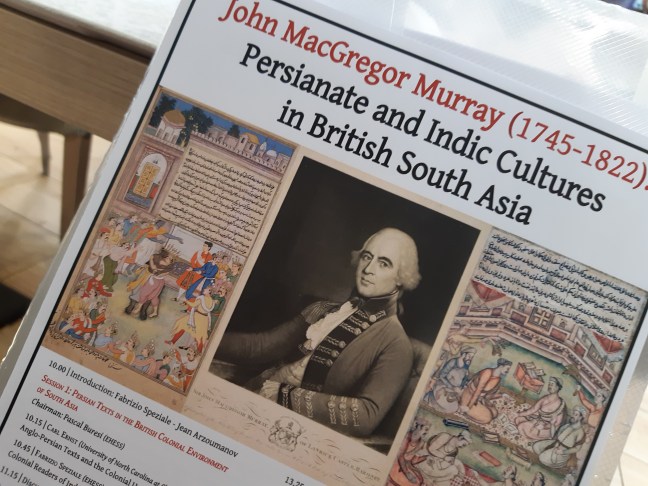
Monday last week saw me flying to Paris, to talk about the Highland/Gaelic cultural side of Sir John Macgregor Murray. Most of the workshop papers were about Persian manuscripts he had either commissioned or collected, but the interesting common thread was his careful collecting of information about different aspects of life in India, whether religious, agrarian or otherwise. My paper was paired with a paper about his correspondence concerning the preservation of the Taj Mahal. You might not imagine that Highland culture had much in common with an Indian mausoleum, but in fact the papers sat together really well. They show an awareness of the importance of cultural heritage, and an appreciation of the need for fieldwork to document different aspects of that heritage.
If you follow this blog, then you’ll realise that I had done quite a bit of digging around to find out more about his Highland/Gaelic activities, since I previously only really knew of him in the context of his bringing Joseph Macdonald’s draft piping thesis back to Scotland, and assisting Alexander Campbell in devising an itinerary for his song-collecting expedition. I hadn’t intended to pursue his manuscripts etc any further after this week, but I suspect I may have to, since I can’t bear to think there could be something interesting lurking in some British or European archive or library that I haven’t unearthed yet. I haven’t yet found him writing ABOUT music other than reports of a few comments to the Highland Society of Scotland and their piping contestants – but what if there was something out there that I don’t know about? Oh, we can’t have that!
So, I’m very grateful to have been an invited speaker at the workshop, and to have been allowed an insight into the work people of other disciplines have been doing into the activities of this Highland chief, who is comparatively unknown today. Add to that a wonderful Italian evening meal at the end of the day, which had the added novelty of Japanese saki, brought by one of our session chairs from his home country.
(And I didn’t get myself lost on public transport, thanks to Google maps – remarkable for someone with absolutely no sense of direction. Not only that, but I found I was perfectly capable of buying beer and a bagel, coffee and a cake, en francais! I returned to Glasgow with my head held high … )
I’m a bit of a juggler at the moment! The Claimed From Stationers’ Hall network has a dedicated Brio issue forthcoming in November, which I’ll be co-editing with Martin Holmes, the regular editor. Various articles have been promised, and I need to do some writing as well. Not to mention needing to do some book-reviews. I have several ideas there – I need to order some books that I’ve recently come across, to decide if they’d be usefully reviewed for our music librarian audience.
I also need to revise an article for another journal – I first wrote it a couple of years ago – to reflect the fact that the network came into being and more work has since been done.
But before that – next week I’m heading to the Sorbonne in Paris, as an invited speaker, to talk about Sir John Macgregor Murray’s involvement in Gaelic culture and song-collecting. The man who got a couple of passing mentions in my thesis and book, has been a major focus for historians interested in his involvement in commissioning and collecting Persian manuscripts on Indian customs and culture, whilst he was active in the East India Company’s private army. I’ll be the only musicologist there – I’ve polished my paper within an inch of its life, so hopefully it will be of interest to scholars from a different discipline and with a different focus. I made a page about Sir John, which you can visit if you’d like to know more about the man.
I’ve been awarded an Athenaeum Award by the Royal Conservatoire of Scotland, to enable me to attend the whole of the International Society of Eighteenth Century Studies conference in Edinburgh in July, where I’ll be joining a panel on paratext. I think paratext is probably one of my all-time favourite research topics, so this is very exciting.
But to clear the decks for some serious writing about paratext, I got my next speaking opportunity all written up and timed well ahead of schedule: I’m talking about copyright and John Cage in a Pecha Kucha presentation at the CILIP Icepops seminar on copyright literacy education towards the end of June. Writing to fit 20 slides each lasting for 20 seconds is a rather different challenge to writing a conference paper! Here’s a hint: if you Google it, you’ll find yourself recommended to write 60 words per slide. However, if you use a lot of long words, then this advice is not for you!! Take it from one who [now] knows!
I’m attending the Icepops conference in Edinburgh with my librarian hat on. In fact, I was at Edinburgh a couple of weeks ago for the National Bibliographic Knowledgebase roadshow – an interesting update – and a couple of days ago, I went to Dundee for a Rare Books Scotland meeting. Again, I wore my librarian hat, but had the opportunity to share an update on the Claimed From Stationers’ Hall network whilst I was at it.
And what else? As I mentioned, I have a glorious idea for a new grant application … but I’ll keep that under my hat until plans are a bit more advanced….
In preparation for a lecture I gave at the Sorbonne at the end of May 2019, I returned to an individual who appeared in my doctoral research – Sir John Macgregor Murray. I gave him a page on this blog because all my up-to-date research appeared here. If you’re interested, you’ll find the new page here.
NEWS! I’ll be publishing an article based on this lecture, in the Folk Music Journal in 2026.
Another invitation: I’m also part of the EAERN Network (Eighteenth-Century Arts Education Research Network), and EAERN members have just been notified of an event taking place in Sheffield. Perhaps it might interest a few members of the Claimed From Stationers’ Hall music research network, too?
:-
Registration is now open for ‘Women and the Arts in the Long Eighteenth Century’. EAERN members would be very welcome to join us at the University of Sheffield for this event on Friday 8th March. Further details available via the registration link below:
Followers of this blog may like to sign up to news briefings from the Institute of English Studies’ School of Advanced Study at the University of London. The latest briefingincludes news about fellowship opportunities, and advance information about the London Rare Books School in June, with a course run by our friend Giles Bergel (Oxford/UCL) and Elizabeth Savage (IES) – about printing of an earlier era than we normally concentrate on, but very interesting nonetheless!
I’m delighted to introduce today’s blogpost by Andrea Cawelti, who is the Ward Music Cataloger at Houghton Library, Harvard University. Andrea attended a course at the American Rare Book School a couple of years ago, and is keen for everyone to know what a wonderful opportunity it would be for anyone who could attend this year’s course. I shared a link to Andrea’s reflections on the course, which she authored for the Houghton Library blog last year – you’ll find the link in the posting below. Now you can read more about it – if you manage to get there, do please consider sharing your own experiences here!
Philadelphia skyline (Pixabay image)
Fellow readers of Claimed from Stationers’ Hall may be aware that the American incarnation of Rare Book School has offered a course on the Stationers’ Hall since Peter Blayney, one of the stalwart fathers of research on the Stationers, taught the course in the 1990s. But I see that applications have been opened today for this summer course, now taught by Professor Ian Gadd, so I’d like to share a bit about my excellent experience in taking this course in 2016, as prompt applications are usually the most successful.
This term, as in 2016, the course will be held in Philadelphia, June 2-7, at the Kislak Center for Special Collections, Rare Books and Manuscripts at the University of Pennsylvania, with reasonably-priced and comfortable dorm space available within easy walking distance through the picturesque Penn campus. As this course represented my first experience at the Kislak Center, I was delightfully surprised by our genuine welcome, and helpful assistance by the staff, both of the library and those in attendance from the Rare Book School, even though this wasn’t their turf. The Center holds significant hand-press material for examination and project fodder, and Penn Libraries holds a complete set of microfilms of the Stationers’ Company registers and archives, which we consulted extensively for our work.
As with all RBS courses, ample opportunities are presented for individual discussion, questions, and networking, including regular morning and afternoon breaks, lunches, and receptions. Evenings often include programmed activities from lectures to film presentations, and during my course, there was an excellent presentation by Lynne Farrington, senior curator at the Kislak, on American subscription publishers and their German-American readers. Dr. Farrington provided a fascinating overview of the American subscription publishing industry, and how it was utilized for foreign-language titles to be sold through the subscription network. The lecture was accompanied by a hand-on exploration of subscription samples from several of the Kislak’s collections.
Enough of that, you may say, what about the course itself?!?!?! Well, first of all, I should mention that I arrived with a specific agenda, which was to familiarize myself with the Registers, what was in them of a music format, and to learn how to use the microfilms most effectively (Harvard, too, holds a complete set of these microfilms).
Like many of you I’m sure, I’ve had cases where I’d hoped to find a specific date in the 18th century when something had been published, or to establish some kind of sequence for several publications, and had been frustrated by my inability to harness these resources. Now of course, newer products are available, including the Literary Print Culture online access, which Professor Gadd has now incorporated into the course. Still, the navigation of this product isn’t straightforward, and one really needs to know what one is doing before attempting to use, or it is easy to get completely lost.
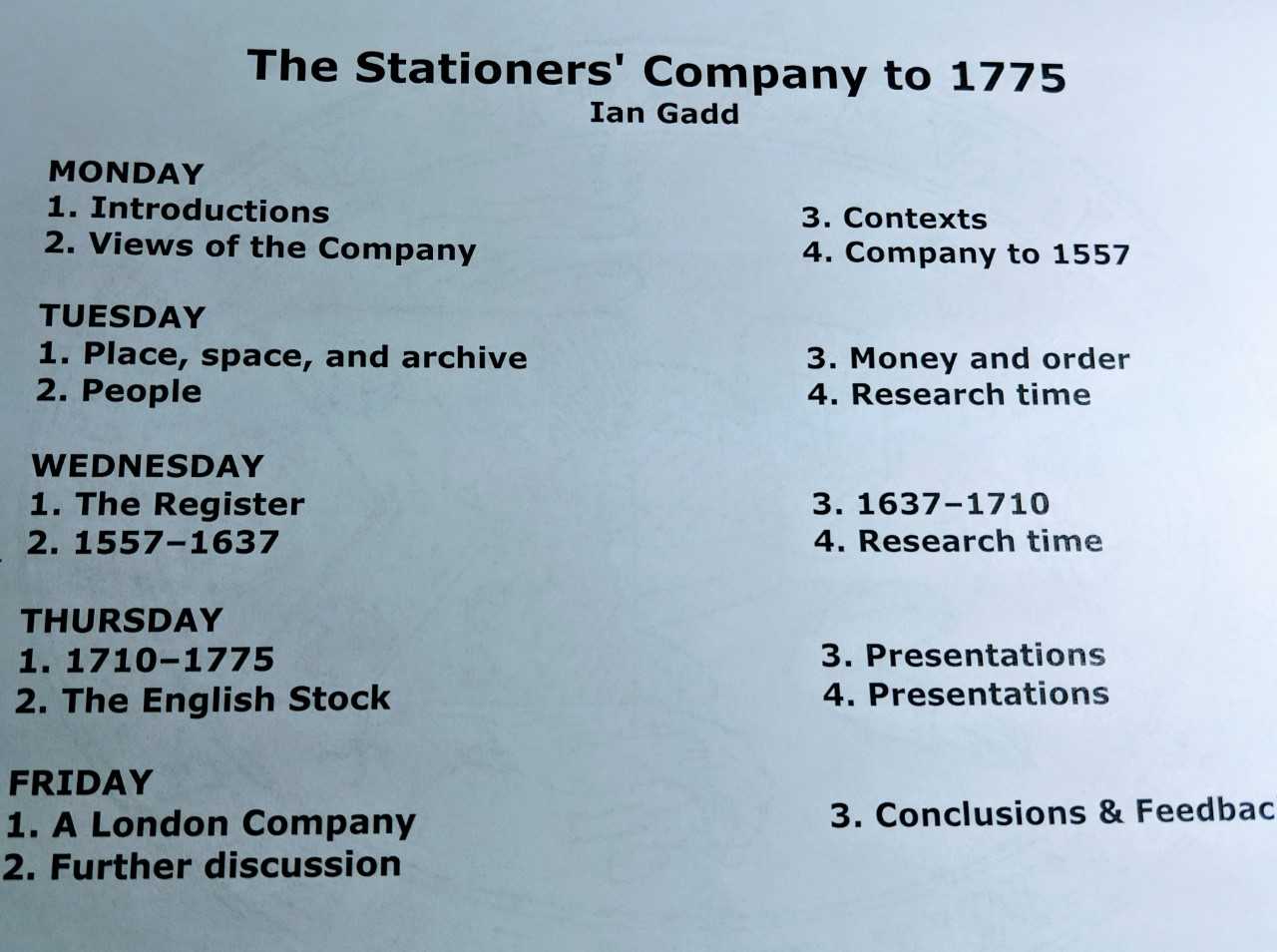
Course schedule
As you can see, the schedule was laid out to allow us a proper introduction to the history of the company and its archives: Professor Gadd offered spirited presentations on each aspect, as well as providing references to online and printed documentation which would be of use later in our explorations. Each of us was then tasked to research and present on some topic of particular interest to us (see “research time” and “presentation time” in the daily schedule). I chose a particular segment of time and explored all of the Registers chronologically to gain an idea of what music was being brought to the Stationers for registration between 1799 and 1804. Several of my discoveries ended up in our Houghton Blog, which presents a bit more information for those who are interested.
I had honestly come into this course completely unaware of how extensive the Stationers’ archives were apart from the Registers! Learning more about the “people” documentation was particularly eye-opening, and quite helpful in my cataloging. The online index to the London Book Trades for instance, based on the Stationers’ archives is great for finding more information on printers when researching, creating authority records, or for investigating connections between people. As always, Professor Gadd provided helpful hints: don’t use the “search” box, just go directly to the “index – names”. There were so many trails of bread crumbs offered to us, that who could remember them all (certainly not I!) Knowing this, the professor provided us with an extensive workbook to take home, complete with bibliography and most useful for me after the fact, an overview of the most important copyright legislation affecting just what was registered with the Company.
Workbook table of contents
While this course only goes up to 1775, and consequently doesn’t cover some of the most influential music-related legislation, suggested readings within provide an appendix as it were, and after going through the history before 1775, reading forward into the 1790s was not difficult. Additional revealing segments covered what species of books were included in the English Stock and why this was important, and an introduction to Edward Arber’s term catalogues – keyword-searchable, and covering (among others and appendices) periods into the 18th century. A mind-boggling amount of work, which doesn’t include that much music but is well worth a look.
Two and a half years later, am I glad I took the course? You bet I am; it has proved to be perhaps one of the most useful courses I’ve taken at RBS. Possibly more so for me, because I was essentially ignorant of so many details of the Stationers’ history, but I would heartily recommend this to anyone preparing to work with, or already working with 17th to 18th century music. The context will provide you with an invaluable overview of how printing functioned in Britain, and how and why and what was registered. I hope that I’ve given something of the flavor of the course, and if anyone has questions about how RBS works, please do ask the RBS:-
If you’re considering attending, you can find out more about the RBS on their website. The homepage explains, “Rare Book School provides continuing-education opportunities for students from all disciplines and skill levels to study the history of written, printed, and digital materials with leading scholars and professionals in the field.”
Be quick! The early bird catches the worm, as they say.
Good luck and good researching!
Andrea Cawelti Ward Music Cataloger Houghton Library Harvard University






 (And I didn’t get myself lost on public transport, thanks to Google maps – remarkable for someone with absolutely no sense of direction. Not only that, but I found I was perfectly capable of buying beer and a bagel, coffee and a cake, en francais! I returned to Glasgow with my head held high … )


 Followers of this blog may like to sign up to news briefings from the Institute of English Studies’ School of Advanced Study at the University of London. The


 Karen McAulay, Musicologist