Dr Karen McAulay explores the history of Scottish music collecting, publishing and national identity from the 18th to 20th centuries. Research Fellow at Royal Conservatoire of Scotland, author of two Routledge monographs.
We are delighted to announce that the Icepops 2019 call for contributions is now open. The conference is taking place on 26th June 2019 at the University of Edinburgh and you have from now until the 4th February to come up with an idea for your presentation.
We are looking for speakers on all aspects of copyright education from a variety of different perspectives. Last year we attracted expert speakers from educational & cultural institutions, publishing houses and government departments as well as an impressive number of international delegates. Our first keynote this year is composer, publisher and scholar Simon Anderson, who will be opening the conference with a musical theme. We particularly welcome sessions that might compliment this. However, we also retain the playful learning theme from last year and our afternoon keynote, the award-winning Charlie Farley from the University of Edinburgh will be leading an interactive workshop.
We would like to encourage presenters to address one of the themes of this year’s conference:
– Universal Copyright Literacy: bridging the gaps between lawyers, IP teachers, specialists and copyright muggles
– Engaging and creative approaches to copyright education including using games, music and performance
– Copyright education as part of digital and information literacy initiatives
– Copyright education in the cultural heritage sector
– Teaching copyright as part of scholarly and open practices
However, we wouldn’t want you to feel constrained if you have a great idea relating to copyright literacy that doesn’t fit 100% into any of the above. Please just let us know and we’ll see if it fits in the programme.
I’m pleased to be sharing this call for essays, which I saw on a mailing-list to which I subscribe. I’m just quoting the entire call, by permission of the editors:-
Call for Essays
Impressions, Vol. 2: Essays on the Art of Printing, The Legacy Press
The Impressions series encompasses all the printing arts: relief, intaglio, lithographic, serigraphic, and digital, as well as related arts, such as stamping, stenciling, and pochoir.
Vol. 1 has filled, and we are taking essays for Vol. 2, which is open to any Impressions topic. Impressions welcomes published scholars, new authors, established areas of inquiry, and topics not previously addressed in other publications. Impressions is particularly interested in studies that use images both as evidence and examples for visual learning.
printing and printmaking
book arts
practical printing
bibliography
history and criticism (book, printing, literary, art, cultural)
interviews
digitization and the printing arts
conservation
archives, collections, libraries, information
collecting
If you have an essay in preparation or if you would like more information about Impressions, please email series editor Rebecca Chung: chung.rm@gmail.com
I am a Performing Arts Librarian 3.5 days a week, and a Postdoctoral Researcher 1.5 days a week. In this self-imposed annual review, I’m not listing routine activities conducted in either capacity; it goes without saying that I’ve answered queries, catalogued, delivered library research training to a number of different class groups, attended meetings, and pursued research-related activities and fieldwork.
From September 2017 to September 2018, I was the AHRC-funded Principal Investigator for a new research network, the Claimed From Stationers’ Hall music research project. Since then, I have continued to conduct research and network with the various scholars and libraries involved with this project, and in the new year shall be pursuing further grant-funding in order to extend the reach of the project.
As someone who continually asks themselves, “Am I doing enough?”, I feel that even I can be reasonably content with this year’s outputs!
JANUARY
Chaired sessions at Traditional Pedagogies, international conference at Royal Conservatoire of Scotland
Book chapter, ‘Wynds, Vennels and Dual Carriageways: the changing Nature of Scottish Music’, in Understanding Scotland musically: folk, tradition and policy. Abingdon, Oxon: Routledge, p. 230-239.
MARCH
Claimed From Stationers’ Hall Workshop, Royal Conservatoire of Scotland, (26 Mar)
Scottish Library & Information Council (SLIC) From PGCert to PG Certainty: Enabling the Distance Learner (invited talk, sectoral organisation) (March 2018)
APRIL
IAML(UK & Irl) Annual Study Weekend, invited talk, Pathways, outputs and impacts: the ‘Claimed from Stationers Hall’ music project takes wings
IAML(UK & Irl) Annual Study Weekend From PGCert to PG Certainty: Enabling the Distance Learner (quick-fire session) (April 2018)
EAERN (Eighteenth-century Arts Education Research Network), ‘Claimed From Stationers’ Hall: But What Happened Next?’ (University of Glasgow, 6 June)
Romantic Song Network steering group seminar at British Library
JULY
IAML/AIBM Annual Congress, Leipzig, ‘A Network of Early British Legal Deposit Music: Explored through Modern Networking
SEPT
RMA Conference, Bristol, ‘Overlapping Patterns: the Extant Late Georgian Copyright Music Explored by Modern Research Networking’
NOV
Field-trip to King’s Inns and Trinity College Dublin Libraries, and British Library
EFDSS Conference, London, ‘National Airs in Georgian British Libraries’
ARLGS (Academic and Research Libraries Group Scotland) Teachmeet at Glasgow University Library – speaker
Article, Trafalgar Chronicle, New Series 3 (2018), 202-212, jointly authored with Brianna Robertson-Kirkland, ‘My love to war is going’: Women and Song in the Napoleonic Era’.
DEC
Article, Information Professional, Nov-Dec 2018, ‘Coffee and Collaboration’ [teaching electronic resource strategies]
Additionally, I have authored 79 blogposts and 5 Newsletters in connection with the Claimed From Stationers’ Hall research project.
William Hawes (1785-1846) was a singer, conductor and composer in a variety of high-profile institutions, beginning with his appointment as a chorister at the Chapel Royal. Work as a deputy lay vicar at Westminster Abbey was followed by his becoming a Gentleman of the Chapel Royal, later becoming Master of the Choristers at St Paul’s and Master of the Children at the Chapel Royal. He was also an associate of the Philharmonic Society, a leading light in the Regent’s Harmonic Institution, a lay vicar of Westminster Abbey, conductor of the Madrigal Society, and organist of the Lutheran Chapel. And then there was his work with the operatic scene, too. He was clearly quite an important person on the contemporary London musical scene.
For some reason, William Hawes had the Stationers’ Hall music registrations from 1789 to 1818 copied into a manuscript, A List of Music Entered at Stationers’ Hall, from January 1 1789, to January 1, 1819. 1818 had seen the inception of the Regent’s Harmonic Institution, and Krummel suggests in Kassler’s edition of Music Entries at Stationers’ Hall 1710-1818 (2004) that the manuscript was probably connected with establishing when music would go out of copyright (after twenty-eight years), becoming legally reprintable. (Kassler, ix)
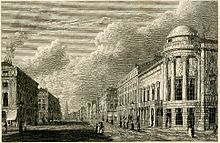
By Charles Heath, after William Westall
You can read more about the Regent’s Harmonic Institution in Oxford Music Online. It’s an institution I’d like to learn more about in due course:-
“Regent’s Harmonic Institution [ Royal Harmonic Institution ] English firm of music publishers . It was founded in London in 1818 as a joint-stock company of 23 (then 21) professional musicians, including Attwood, Ayrton, J.B. Cramer, William Hawes, Ries, George Smart, Thomas Welsh and Samuel Wesley, to finance reconstruction of the Argyll Rooms, Regent Street…” Leanne Langley (2001)
But I digress. When Kassler produced his edition of Music Entries, he combined his own transcriptions from the Registers with those of Don Krummel and Alan Tyson, as far as the year 1810, but used Hawes’ transcription for the years 1811-1818. This became the cut-off point for Kassler’s edition, in order to restrict the work to one volume.
Now, I should like to extend transcriptions forward to 1836. That’s the year when new legislation changed the legal deposit stipulations, reducing the number of legal deposit libraries and for those that lost their privilege, instituting a new system of granting library book-budgets instead. How to make my idea happen is the question that is exercising me at the moment!
On this day … ballads, rondos, anthems, glees and variations on operatic themes
19th December 2018 is a significant day in Claimed From Stationers’ Hall terms, because the very last transcribed entries in William Hawes’ manuscript were those originally entered exactly 200 years ago. And it was a good day for music, albeit a busy one for warehouse keeper Mr Greenhill – no less than sixteen musical entries. Five from publisher Goulding, followed by six from Power, two from Birchall, one that may have been from Chappell alone (it’s hard to tell in Copac), one from Clementi, and one published by both Clementi and Chappell. This last isn’t in Copac, but a copy can be traced in Berlin via WorldCat.
Goulding
Samuel Webbe, Jr’s Edward, a ballad – surviving in the most likely copyright libraries:- Aberdeen, the Bodleian, the British Library, Glasgow and St Andrews.
Ferdinand Ries’ When the wind blows, rondo, no.1, op.84, surviving in Aberdeen, the British Library and Glasgow.
Ries’ Popular French air with variations, no.4, op.84 – the same five libraries above.
Henry Rowley Bishop’s I have kept the ways of the Lord, anthem (in memory of Queen Charlotte [died 17.11.1818]) – same five libraries, and also in Edinburgh (whose copy isn’t yet catalogued online)
Bishop’s Hark! The solemn, distant bell (again, in memory of Queen Charlotte [died 17.11.1818]) – same five libraries, and in Edinburgh (as above)
Power
Thomas Simpson Cooke’s The dandy beau: a song – Aberdeen, British Library, Glasgow and St Andrews
Thomas Attwood’s Her hands were clasp’d (a Thomas Moore text from Lalla Rookh) – Aberdeen, British Library, Glasgow and St Andrews
John Clarke’s The Peri pardoned (song from Lalla Rookh) – Aberdeen, Bodleian, British Library and St Andrews
Frances L Hummell, or Hunnell’s My love is like the red, red rose – only in the Bodleian and the British Library
Joseph William Holder’s La belle Hariette [Henriette] with variations – Aberdeen, British Library and St Andrews
Thomas Howell’s Six progressive sonatinas for piano forte – Aberdeen, the Bodleian, the British Library, Glasgow and St Andrews
Birchall
Carlo Michele Alessio Sola’s – Amabili Britanne, canzonetta – the same five libraries
Sola’s Amor possente amore, canzonetta – the same five libraries
Chappell?
Ries’ La charmante Gabrielle, with variations [cannot trace Ries’s piece in Copac, but maybe it could be a piece indexed as by Onslow, published by Chappell]
Clementi
Ries’ Venetian air, with variations – Aberdeen and the British Library
Clementi, Cheapside, and Chappell, New Bond Street
Ries’ Air from Griselda (by Ferdinand Paer) with variations [again not in Copac but in Worldcat we find: A favorite air from Paer’s Celebrated Opera Griselda. Can only trace in the Berlin Staatsbibliothek – and digitised under the auspices of the Europeana project.
Considering what was registered, it’s not surprisingly a very typical collection of pieces for the era. I’ve found the library locations of surviving copies listed online, generally using Copac but occasionally also resorting to WorldCat – but this doesn’t mean that a few more might not yet turn up in collections not fully catalogued online to date. I wonder if anyone would like to check their card catalogues?! You’ll observe that there’s a fairly clear pattern of which libraries kept their legal deposit music. In the ensuing 200 years, it isn’t too surprising that the numbers of surviving copies varies just a little. Indeed, I find it quite remarkable that as many copies do survive!
Season’s Greetings to all followers of the Claimed From Stationers’ Hall music research project. I bring you pictures of Edinburgh in festive mode, after yesterday’s trip to the University Library! There’s a big posting coming up tomorrow – do check back in to see!
JISC mail members of the Claimed From Stationers Hall network can look forward to the latest issue of the Newsletter hitting their in-boxes any minute now! But if you’re not signed up to this, then don’t worry – you can read it right here instead.
Put the kettle on, put your feet up, and enjoy!
As always, the link to the Newsletter has been added to the Newsletter tab on our homepage, too.
On the left – Dr William Kitchiner, lecturing on optics
Since my kitchen is littered with (most of) the ingredients for our Christmas cake, it seems appropriate to devote a short post to a significant publication from 1817 (yes, my new favourite year!) – Dr William Kitchiner’s The Cook’s Oracle. We’ve encountered Dr Kitchiner before, on account of his patriotic and sea song books. They weren’t particularly well-received.
Dr Kitchiner had other interests, though. He lectured on optics, and was a published expert on cookery and nutrition. He hoped that his cookbook would provide good, solid nutritional guidelines. Wikipedia reports that he was an exceptional cook, and his was a household name. I haven’t gone so far as to check this out, but I’ve found you a simple suet pudding to try!
You can read the ENTIRE book online, if you’re so inclined:-
(The 2nd edition even begins with an Anacreontic Song, if you please, combining his passions for music and food.)
Whilst checking the King’s Inns guardbooks for national songbooks, I naturally looked for Kitchiner, though I didn’t really imagine there would be much appetite for English national songs. I was unsurprised to find it absent from the catalogue – but there was clearly an appetite for Apicius Redivivus! There it was, in the guardbook under Kitchiner’s name. Perhaps struggling to decide where to shelve it, the Victorian librarians ended up putting it in the “literature” section – the same as the minstrelsy material.
But it wasn’t on the shelves. (Someone kindly checked for me!) Who borrowed the cookbook and didn’t return it? Or misshelved it? Or dropped it in the broth, or used it until it fell to bits? I have a good imagination, but maybe I should stick to hard facts. And, tempting as it is to try the recipes straight away, I should probably bake our own Christmas cake first! My family will probably be glad to learn that Dr Kitchiner only mentions Christmas in connection with the seasons for oysters and House Lamb – which differs from Grass Lamb , and is eaten from Christmas until Lady-Day. So their annual treat won’t be any different from previous iterations!
Ask any librarian: the number of, “I guess you must stamp a lot of books” jokes are nearly as many as “How lovely to spend all your time reading …”. They drive us insane!
However, when it comes to library history, book-stamps become almost interesting, because the use of one library property stamp or another may shed light on when a book came into the library. So you begin to see where I’m coming from, when I say that I requested photographs of bindings and any stamps or ownership marks in the music and minstrelsy I’d traced at King’s Inns.
Unfortunately, whilst Edinburgh and St Andrews University Libraries stamped their textbooks if they were “From Stationers’ Hall”, this wasn’t always the case with music – certainly not in St Andrews, and apparently not generally in Edinburgh – and it turned out not to be the case at all in King’s Inns!
Unless a stamp actually SAYS that the book came from Stationers’ Hall, then its only use for book detectives is in the possibility of linking particular stamps with particular timespans. In King’s Inns, a handful of books yielded three different stamps, but only one bore a date – 1955 – and that just means it was processed in some way at that time. It doesn’t tell us when the book came into the library. Similarly, whilst I was looking for evidence of library bindings or provenance notes, there wasn’t really enough to go on. And I say that because we don’t actually know if these items came by the Stationers’ Hall route, where unbound books were quite common, or by nineteenth century donation.
Crosby – The Irish Musical Repository. Pictures all courtesy of King’s Inns Library.
What we do know, however, is that the majority of this little batch of King’s Inns minstrelsy, whether poetry or with music, was classed in the “Literary” section. One can only conclude that these were for recreational use – I like the mental picture of a Georgian or Victorian lawyer sitting by his fireside with his feet up, and a copy of Motherwell’s Minstrelsy, Crosby’s The Irish Musical Repository(the spine title is just, “Crosby’s Irish Songs”, in what looks like a twentieth century binding) , Bunting’s A General Collection of the Ancient Music of Ireland, or Ritson’s A Select Collection of English Songs(2nd edition, 1813) on his lap. Some are graced with charming engravings, whilst Clementi’s London edition of the Bunting collection has a particularly nice title-page. This last title was held by almost every legal deposit library, so there’s more chance of that one being a legal deposit arrival, especially since one would have expected the original Irish edition to be a more likely holding than a later, English one. However, even in this case, we cannot say for sure that it arrived by this route. Donations to the library were very common in the nineteenth and twentieth centuries. At the end of the day, the minstrelsy material is probably more of interest as indicative of nineteenth-century readers’ leisure reading, than as evidence of traffic from Mr Greenhill and the network of London legal deposit agents!
My thanks to the time-consuming and painstaking work of staff at King’s Inns Libraries for taking these photographs for me.
Footnote: There was one pedagogical music item which seems to have been missing at least since the 1990s, but possibly a century or more longer: Charles Mason’s, The Rhythm, or, Times of Musical Compositions Explained and Reduced… a skinny score, it could have fallen victim to any number of fates, but it means we couldn’t examine it for library stamps or indeed anything else! Whether misshelved, bound in a bigger volume, or unreturned, let’s hope someone benefited from it first, and that one of the Dublin lawyers or their families gained a suitable understanding of musical rhythm and times!
A few weeks ago, I had what was effectively a week-long fieldtrip. Well, two short ones – first to Dublin, then to London. I’ve already blogged about the trips to King’s Inns and Trinity College Libraries, where I was hunting down national songbooks – neither expecting to find, nor actually finding, very many Georgian-era music scores or textbooks, but chancing across a few surprises, and also discovering that balladry – poetry – was rather more popular. I should explain that collecting policies in Trinity at that time are known to have precluded much music being kept, whilst one would not perhaps expect any music to turn up in a law library unless it was donated!- but there was still a literary interest in the words of national ballads, in both institutions.
Anyway, back I flew to Glasgow, did a day’s work and an evening rehearsal, then got the overnight sleeper to London so that I could visit Stationers’ Hall, meet my music librarian opposite number at the British Library, and speak at the English Folk Dance and Song Society Conference.
I hadn’t had the opportunity to visit Stationers’ Hall before. It’s very grand – used as a venue for conferences and weddings – but I was there to visit the archivist, and to have my first look at one of the Georgian era registers.
Faced with the choice of many years’ Stationers’ Hall registers, I had to make a choice. My time was limited, and there was no hope of looking at more than one or two volumes. I made my choice based on the fact that Kassler’s Music Entries at Stationers’ Hall lists full entries from 1710 to 1810, but the appendix (based on William Hawes’ summary listing for 1810-1818) gives much less information – most noticeably, no publication details and no library locations. If I was going to spend a few hours looking at anything, I would look at a volume from the later era, to see how easy it was to spot music entries, and to get a bit more information about anything I found.
1817*
I was also curious to see how long it would take to glean this information. I wondered about actually transcribing the entries, but once I saw them, I realised that this was going to get me a limited amount of information with which I could do very little – I’d get more by taking a broad sweep. Accordingly, I took my own copy of Kassler, and annotated the entries from June 27, 1817 to June 24, 1818 – this was a full year from the start of one of the register volumes, and also conveniently encompassed some royal events that I already knew were memorialised in song – the deaths first of Princess Charlotte of Wales in 1817, and then of her grandmother Queen Charlotte the following year. I was able to note the publishers, look out for anything surrounding these events that I had not yet spotted in Hawes’ abbreviated listing, and I also spotted another royal event – Queen Charlotte’s visit to Bath, literally a couple of days before her grand-daughter died in childbirth. Seeing the music in the context of all the other entries showed me just how much literature proliferated to commemorate the deaths in particular – elegies, other poems, a multitude of published sermons … if you remember the outpourings of grief when Diana, Princess of Wales died, then you can imagine similar outpourings back in 1817-18, using the media that was available at the time.
Stationers’ Hall
But an equally interesting discovery was the realisation that Mr Greenhill the warehouse keeper also recorded how many copies of any particular title were handed in. Chappell always handed in just one copy, whether or not the legislation required eleven. One assumes that the libraries requested his works from the lists that Greenhill sent them, because (although I’ve only checked a handful of titles from June to early July so far) they did actually get the music, presumably collected via agents rather than directly from Greenhill at Stationers’ Hall. Other publishers might hand in one copy, or the full eleven, and I begin to think that the smaller publishers or self-publishers might have tended to hand in the latter.
Here’s the challenge – a whole year’s music is quite a lot of music! From the little I’ve checked so far, the libraries that I expected to have a lot of the registered music, had nearly all of it. Those that I thought would have less, do indeed seem to have less. But – I’ve only checked in Copac. Until we check the “not catalogued online” holdings, we will not have the full picture. So the next challenge is a logistical one: how to get the checking done! This might require another grant application. Certainly, it requires more conversation with network members!
I’m toying with the idea of creating a Mendeley bibliography of the whole year’s output. It’s a lot of work, but it might help at a later stage in the project: a decent bibliographic listing will have so much more information, even if a parallel Excel spreadsheet offers different benefits by way of comparing library holdings.
* Incidentally, the idea of taking one year and researching its story has already been done, albeit not in musical terms: a couple of years ago, Turtle Bunbury published 1847: A Chronicle of Genius, Generosity and Savagery– so when I found out about it last week, I ordered a copy. I’m really looking forward to reading it. But finding out that someone else has not only had the same idea as me, but published it, doesn’t mean there isn’t mileage in exploring 1817. Indeed, I would argue it just goes to show that the idea is a good one!
And What Next?
The next challenge, of course, is what to do with the data. At the very least, it would indicate what survives for one notable year. And there are other questions, too:-
Is there a pattern as to which publishers deposited single or multiple copies?
Is there a pattern as to what was more likely to be retained, in those libraries that retained less?
Out of interest, how much of what was submitted, was composed by women?
How many compositions/publications were prompted by significant occasions of whatever kind?
Would anyone be interested in a performance opportunity based on the output of that particular year? Or in facilitating a workshop locally?
If we then took another year later in the century – possibly after the Queen Anne copyright act had been superceded – could we compare repertoire patterns, perhaps also comparing what survived in Oxford and Cambridge, or looking for pedagogical material?
Lastly , of course, there is the possibility of creating further bibliographical listings. At the moment, the Adam Matthews’ digital offering is beyond our means. It offers digital images, not full-text searching capabilities, but further grant funding might make it possible to create listings using the digital substitute, rather than having to travel to London to consult the registers themselves.
There’s a lot to think about, isn’t there? As always, all comments and suggestions are very welcome!
You probably didn’t expect to find a link to the latest edition of the Harvard Gazette on this website! Nonetheless, it contains an interview with Professor Derek Miller, author of a new book about copyright and performance rights from 1770-1911 – so there’s bound to be matter of interest to our networking project.
I haven’t yet got hold of the book itself, so I don’t know how much it focuses on European versus American copyright law, but I must confess I’m keen to find out. It’s fascinating to learn more about the philosophy and the reasoning that led to legislation developing the way it did.
Derek Miller, Copyright and the Value of Performance, 1770–1911 (Cambridge University Press, 2018) ISBN 9781108425889. Publisher’s link
And now I’ll add both to my Mendeley bibliography, pending the next time I update the network bibliography listing that appears as a separate page on this very blog.


 We are delighted to announce that the Icepops 2019 call for contributions is now open. The conference is taking place on 26th June 2019 at the University of Edinburgh and you have from now until the 4th February to come up with an idea for your presentation.
 I am a Performing Arts Librarian 3.5 days a week, and a Postdoctoral Researcher 1.5 days a week. In this self-imposed annual review, I’m not listing routine activities conducted in either capacity; it goes without saying that I’ve answered queries, catalogued, delivered library research training to a number of different class groups, attended meetings, and pursued research-related activities and fieldwork.
 Institutional Repository: Pure. My profile:-


 You probably didn’t expect to find a link to the latest edition of the Harvard Gazette on this website! Nonetheless, it contains an interview with Professor Derek Miller, author of a new book about copyright and performance rights from 1770-1911 – so there’s bound to be matter of interest to our networking project.
 Karen McAulay, Musicologist