Dr Karen McAulay explores the history of Scottish music collecting, publishing and national identity from the 18th to 20th centuries. Research Fellow at Royal Conservatoire of Scotland, author of two Routledge monographs.
To say that an expert on the Aberdeen copyright music collection lives less than fifteen miles away from my mother in Norfolk sounds too coincidental to be true. But retired special collections cataloguer Richard Turbet does indeed live in Holt, which is where we met this morning. A small market town, buildings faced with traditional Norfolk flints, it wears its age well, many of the properties as old as the music we had met to talk about.
Richard was able to tell me the names of some people who had worked with him, or just after him, when he was occupied cataloguing the University of Aberdeen’s old legal deposit music online, in the days when original cataloguing was more usual, and dowloaded records were just becoming a possibility. The names of cataloguers and university librarians now retired, served to remind me that the histories of collections have a lineage leading right up to the present day. Time didn’t just stand still after the tide of historical copyright music stopped flowing to the Scottish university libraries.
Richard also confirmed an interesting difference between the bound collections of music in Aberdeen and St Andrews. The latter were at least roughly categorized before binding. However, Aberdeen’s collections were apparently completely randomly bound. We also know that, unlike the steady borrowing of music from St Andrews’ University Library, access to the library at King’s College was so severely restricted at that time, that any borrowing would have been limited, still less of the musical collection. (If there are loan records, I urgently need to find out about them and to seek them out!)
This was a thoroughly enjoyable, as well as an informative meeting. Driving back through heavy showers, I was largely oblivious to the weather. I had a pageful of notes to think about and follow up, and the possibility of further future contact. The Aberdeen-Norfolk connection is indeed a good thing, and I’m delighted to have made contact again after a gap of several years.
I’ve just written a blogpost about one of the Copyright Music borrowers, to go on the Eighteenth-Century Arts Education Research Network blog. It’s not published yet – but won’t be long. Watch this space! We’re looking at mid-September.
There will be more on this topic in due course, but for now, why not listen to a podcast about a group of music borrowers united in a rather unusual way … in a collection of watercolour sketches!
A few days ago, I offered to read and review a new book being produced by Fast Track Impact – I can’t think of a better way of ensuring I’m thinking along the right lines with regard to this crucial aspect of a research project! I can’t wait to read it.
Meanwhile, we’ve been planning for the first steering group meeting for the network, and I’m looking forward to see the project being fleshed out as we pool ideas and discuss the various activities and actions that I’ve either embarked upon or promised to do as part of the network!
I’ve also recently been in touch with two scholars who between them have years of experience and knowledge about the early legal deposit collections at the University of Aberdeen. Reading about King’s College and Marischal College’s library provision led me to investigate reports and evidence provided by various libraries firstly in response to a Parliamentary Select Committee on legal deposit in 1817-18, and secondly to a Royal Commission on Scottish universities and their management, in the late 1820s.
As far as legal deposit was concerned, it’s fair to say that music was the Cinderella category, along with juvenile literature and ephemera. Sometimes music was singled out; maybe we can use this to read between the lines in other responses to the official questions?
1817 – Trinity College Dublin tells their London agent “to claim neither music, novels nor school books”
1818 – St Andrews fills in a return to the Select Committee, alluding to “works of little utility“, saying they’ve recently been receiving only “those of the most trifling and useless description”. Scholar Elizabeth Ann Frame observed from their records that,”A small proportion of the contents of every parcel, chiefly of children’s books and books of mere amusement, is laid aside in a separate bale accompanied with an exact list, besides being referred to in the Register. All these bales are arranged in regular order, in a room adjoining to the Library”. But was music “mere amusement?” It’s hard to say. Most of it would not have been in “books”, for a start. Also, there’s plenty of evidence of the music being used – a lot!
1826 – Aberdeen informs the Royal Commission that, “trifling or pernicious works are sent in great abundance.”
1826 – Dr McGill, Glasgow professor of Divinity, advises that “The Stationers’ Hall privilege is not at all effective: we get very few valuable books comparatively, we get a great many idle books” (whatever he may have included under this term) “and it is very expensive to bind them.” Further to this, the author of a book about Glasgow University Library (Dickson, The Glasgow University Library, 1888 p.16), concluded that, “The working of the privilege was in reality far from satisfactory. The library freely obtained its share of the works of fiction, juvenile literature, fugitive poetry, and music that were issued yearly from the press; but the books were procured with ease in the inverse ratio of their value, and continuations, periodicals, and works with expensive plates, especially if issued in parts, were either not procured at all, or supplied imperfectly.”
In a report published in 1837, King’s College Aberdeen alluded to what Barrington Partridge (The History of the Legal Deposit of Books p.128) called “shoals of useless publications … including children’s primers, and labels for blacking.” (Barrington Partridge cites Parliamentary Papers (1837), xxxviii, p.64. He similarly cites an 1826 Edinburgh allusion to “a great deal of trash“, although it would be imprudent to assume that this embraces music. However, we do know that the University of Edinburgh sold at least some of its legal deposit music, as it would appear did King’s College Aberdeen, judging by evidence that I blogged about last week and the week before.
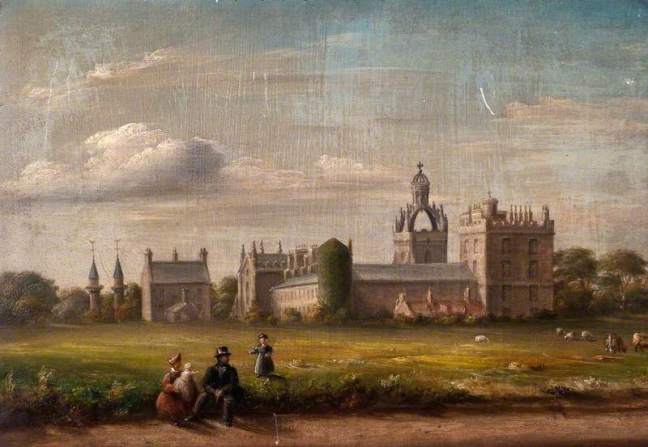
Looking into the history of the copyright music collection at the University of Aberdeen, there’s a wealth of information about the history of the two university colleges – King’s College and Marischal College – and their endless dispute about who should receive the legal deposit books from Stationers’ Hall.
Iain Beavan published a great article in Library and Information History in 2015: ‘Marischal College Library, Aberdeen, in the Nineteenth Century: an Overview’ (LIH 31:4, pp.258-279)
I have in front of me a magnificent tome published in 2011: The Library and Archive Collections of the University of Aberdeen: an Introduction and Description, edited by Iain Beavan, Peter Davidson and Jane Stevenson.
There’s also an article by Richard Turbet listing which music was received by King’s College prior to 1801 – not much of the repertoire survives now – ‘Music deposited by Stationers’ Hall at the Library of the University and King’s College of Aberdeen, 1753-96′, in the Royal Music Association Research Chronicle no.30 (1997) pp.139-162
As part of this project, I’ll be compiling a bibliography of literature and sources pertaining to the historical copyright music claimed from Stationers’ Hall – these are the kinds of materials that will be going into it! The bibliography might appear in this blog, or perhaps in our institutional repository. Or I could try to publish it in a journal: what would you find most useful?
This week, I’ve been reminded that one can’t focus on the copyright music in Aberdeen without being aware of the animosity between King’s College, who received the copyright deposits – and Marischal College, which didn’t, but technically had access to them. Access? That’s a moot point. Access to the college libraries was exceptionally restricted!
So we find ourselves not only looking at listings of the kind of publications that this project concerns, but also at documented arguments between institutions, and public demands for more access to the materials paid for out of public moneys and by student fees. It’s very easy to disappear down a rabbit warren of Royal Commission reports, appendices and memoranda, learning more and more about the seemingly endless circling that preceded the union of King’s and Marischal into the University of Aberdeen, and – of course – the library provision. This is all fascinating stuff, but leads one away from the main project question: What happened to the copyright music?
Iain Beavan pointed me to the ‘Evidence’, from one of the professors interviewed by a Commission in 1827. Reverend Professor William Paul was librarian for a year at some earlier point. Asked if legal deposit books were sold, he was clear that they were not, but that some music had been sold in the past:- “I believe a little time before I came into the College the music was sold.” He actually came to the College in 1811, and the Copyright Act Revd Paul referred to elsewhere in his evidence was that of 1814.
Commissioners for Visiting the Universities and Colleges of Scotland, Evidence, Oral and Documentary, Taken and Received by the Commissioners … for Visiting the Universities of Scotland. Vol.4, Aberdeen (London: HMSO, 1837)
We might note that Revd Paul is alluding to a time prior to 1811, whilst ‘Caleb Concord’ (actually John Jaffray), whom I blogged about last week, raised the issue of what happened to the copyright music at King’s College, in the Aberdeen Censor in 1824. However, the long-lived Jaffray’s much later obituary reveals that he went to Edinburgh in 1811 to work for the Church of Scotland’s Missionary schemes – not his first church appointment – suggesting that both Reverend gents were alluding to something that happened in the early years of the 19th century.
(I’ve just recorded a podcast about the Claimed From Stationers Hall music research project. You might care to listen to it here.)
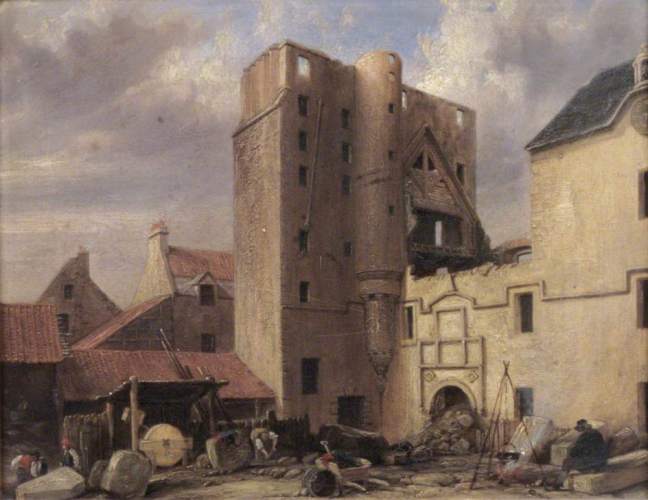
Demolition of Marischal, 1837 Painting by Patrick Campbell Auld, from Art.uk
In historical musicological research, sometimes apparently inconsequential names assume disproportionate importance. This was the fate of Caleb Concord this week. Apparently a contributor to the Aberdeen Censor – a journal which only lasted 13 months from January 1824 to January 1825, Dominie (schoolmaster) Concord submitted his autobiography in four lengthy letters, and in one of them, he opined that the Marischal students should be more concerned about what had happened to the Stationers’ Hall music.
This raised more questions than answers. I went to read the journal at the National Library of Scotland. Concord appears several times in the journal, including a couple of letters to the editor, quite apart from his autobiographical contributions. The pieces are very tongue in cheek (viz, his wives’ names, their characterisation – and a flattened cat!). His name also appears in another contemporary Aberdonian book by someone else delighting in not one but two pseudonyms (a common enjoyment in the 1820s). But you won’t find Concord in genealogical or newspaper sources online, and I’ve been fortunate to have made contact with perhaps the only person who could immediately provide an identification. Behind the pseudonym lurked a very real person, but not the person I thought!
Concord claimed to be a good singer and piper, teacher not only in school but also of songs and psalmody on Thursday nights!, and a kirk session clerk. Last week, I conjectured that he could have been the schoolmaster of Footdee and session clerk of St Nicholas Parish, one William Smith, in the 1824 Aberdeen post office directory, maybe even a brother of the publisher, bookseller Lewis Smith. I was completely wrong! Iain Beavan has generously provided a positive identification, which we’ll divulge in due course. Whether ‘Concord’ was musical remains to be seen!
Now, one might ask whether his identity actually matters one iota?!
Illustration at front of Aberdeen Censor
The most important thing about “Caleb Concord” is his observation about the Marischal students, and it’s intriguing because at that time, the Marischal students had virtually no access either to their own college library or to the library of King’s College Aberdeen – and it was King’s College that received the Stationers’ Hall legal deposit materials. Last year, Iain Beavan wrote a fascinating article, ‘Marischal College Library, Aberdeen, in the Nineteenth Century: an Overview’, in Library and Information History 31:4 (258-279). It is clear that students in the early to mid 19th century had a very raw deal as far as libraries were concerned, and the animosity between the two colleges extended for many decades on account of King’s College’s determination to keep hold of the legal deposit books.
What we do know, from Barry Cooper and Richard Turbet’s bibliographical work on the Aberdeen early music holdings, is that not much survives from before 1801, and some 4000 items survive from after this. Iain Beavan has found reference to the possibility that some of the Stationers’ Hall music might have been sold, and that’s a matter of some interest. Certainly, the debate was raging about legal deposit holdings in Aberdeen, and it is not surprising that the public debate should be referred to in a local journal.
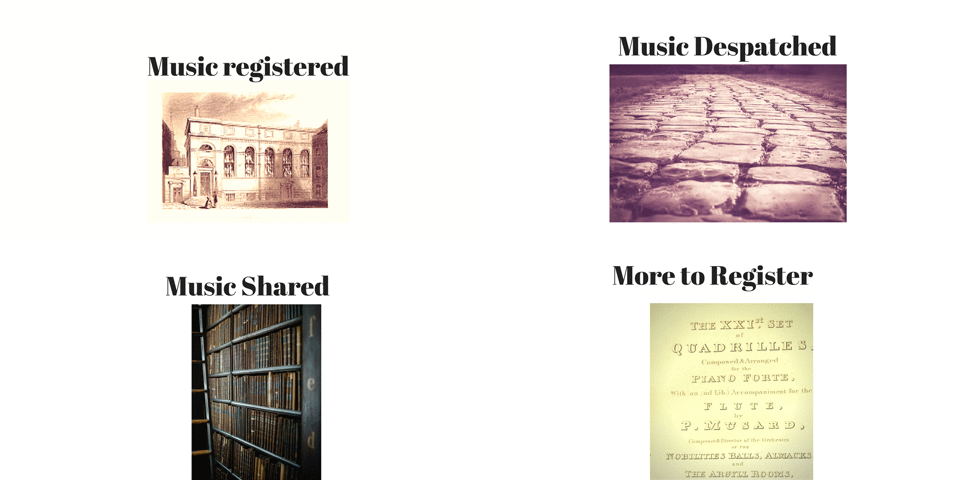
So you’re a composer in Regency Britain, say 1813, and you want to claim copyright in your music. What do you do? Well, if you have a publisher, they might submit it to Stationers’ Hall, where it would be registered. They might not, though. (Some publishers thought they’d have the best of both worlds – they’d print a copyright statement to the effect that it had been entered at Stationers’ Hall, but they wouldn’t actually bother doing so.) In any event, it’s a bit hit or miss.
If you’re self-publishing, then you might consider it in your own interest to register your copyright in the work. After all, by now it’s at least accepted that composers’ work did count as intellectual property and deserved protection. That wasn’t necessarily the case in the mid-18th century!
Copies of music registered at Stationers’ Hall would then be sent to all the legal deposit libraries – the British Museum (which became the British Library), Sion College in London, the Universities of Oxford, Cambridge, Edinburgh, Glasgow, St Andrews, Aberdeen and Trinity College Dublin, the Advocates’ Library (which became the National Library of Scotland), and Kings’ Inns, also in Dublin. Whether the music gets to all these places is also a bit hit or miss! It’s not always sent, not always kept methodically upon arrival, and some libraries don’t want all this music anyway.
Tracing It Today
The Claimed from Stationers Hall project sets out to find out more about what happened to all the Stationers’ Hall music. This is Week 2 of the network’s existence, so you’ve come in right at the start. If you’re interested in early music publishing, library history, or the social, cultural side of the music borrowed from these libraries, then this network is right up your street. Please follow this blog, and the Twitter @ClaimedStatHall, and do let us know if you’re working on anything in any way related to this repertoire!
St Andrews and now Aberdeen
Karen has spent some time exploring the rich archival resources at the University of St Andrews, where the Stationers’ Hall music was sifted through, much was catalogued, and then it was eagerly borrowed by a number of people via the professors’ library memberships. We can trace what was received, find it in a fascinating handwritten catalogue, and even observe who borrowed what.
But what of the other libraries? This week, the magnifying glass focused on the parallel collection in Aberdeen. Work has been done on the documentation of what was received by the library in the 18th century by former librarian and research scholar Richard Turbet, and we can now see what was received in these early years, even if it doesn’t all survive today. (Turbet, ‘Music Deposited by Stationers’ Hall at the Library of the University and King’s College of Aberdeen, 1753-96′, RMA Research Chronicle 30 (1997) pp.139-162)
Roughly half of the surviving copyright music is now in the online catalogue there: at the time of writing, 2062 of an approximate 4400 items in the entire bound Stationers Hall Music collection. How was it used by the community in contemporary Aberdeen, though? The next question is to establish where there are comparable loan records to those in St Andrews. We do know, through Richard Turbet’s work, that there were concerns as to what had happened to the Stationers’ Hall music, in the Aberdeen Censor of 1826. Intriguing!
Catalogues and Conundrums
The union catalogue of UK University and national libraries makes it easy to trace most things so long as they have been catalogued online. However, differences in cataloguing mean that it’s not always as easy as you’d think. Take Gesualdo Lanza’s Elements of Singing in the Italian and English Styles.
Different cataloguing approaches make it a little difficult to untangle, but if you search Lanza, Elements of Singing, you retrieve 16 entries, one of which is just a print portrait. It was published in 1813 – different catalogues have it self-published, published by Button and Whittaker, or indeed printed and sold by Chappell. Around 1819-20, an abridged version appeared, again by Chappell (though the catalogue records don’t all state this the same way), and apparently again in 1826.
So there are at least two if not three basic versions, and you’d expect them each to appear in all the copyright libraries? Think again! Differently styled catalogue records reveal copies of the 1813 publication in Glasgow, St Andrews, Aberdeen, the British Library and Oxford Bodleian, and a copy in York, which was not a copyright library. The other legal deposit libraries don’t have it, unless it’s still not catalogued online. (That’s another interesting question. Some pre-1801 material is definitely not yet catalogued – grant-funding for retro-conversion theoretically took care of (most of) the post 1801 material, just over a decade ago.) In total, the two or three versions of 1813, 1820 and perhaps 1826 yield 16 entries in Copac, which equates to slightly more than 16 copies.
This Was Week 2 of the Project
Besides looking at work already done on the Aberdeen collection, this week has also entailed documentation of some of the conferences and other networks that touch upon the subject of Regency music or library history – see our Useful Linkspage, and do please contact us if there are others we’ve missed! And of course, we’ve been networking. We’ve tweeted and we’ve emailed, and we’re loving the responses we’ve received. Keep in touch!
Karen’s research persona is most active on Wednesdays and Thursday mornings, so a certain amount of networking has already taken place on Twitter, email and by phone this week.
Looking for role models, we’ve eagerly noted some highly successful ones – Sound Heritage, operating from the University of Southampton; The Ladies Magazine, at the University of Kent; and the new EAERN (Eighteenth-Century Arts Education Research Network) at the University of Glasgow. All have an interest in eighteenth and nineteenth century culture, and all are great at networking, so we hope they’ll soon be our new best friends!
We’ve also been looking for conference CFPs, and have noted a new one which looks eminently suitable – Collage, Montage, Assemblage: Collected and Composite Forms, 1700-Present. Taking place 18th-19th April 2018 in Edinburgh, a quick read of the conference’s scope makes the bound volumes of St Andrews’ Copyright Music Collection very appropriate artefacts to talk about! An abstract is already being stitched together in mind, if not yet words on paper.
Much of this week’s research time has been spent going through every word of the AHRC application, and listing every outcome that we aspired to in our documentation. A beautiful spreadsheet has thus been born, and will be nurtured most carefully in coming months. The newborn network has a number of conferences in its sightline, but we can’t run before we can walk, so we’ll check some dates and deadlines before we do anything else!
Meanwhile – if you like what you’ve seen here, please do follow the blog, befriend us on Twitter @ClaimedStatHall, get in touch with Karen by email at RCS or even pick up the phone!
This is officially the start of the new AHRC-funded network, Claimed From Stationers Hall. A fuller blogpost will appear within the next 24 hours. Have a wander round the website, and please do get in touch if you’d like to be added to the email mailing list. The topic is the music that was registered at Stationers’ Hall in the eighteenth and early nineteenth centuries up to 1836, so if you have an interest in music publishing of that era, or indeed anything involving British-published sheet music and its performance, or its documentation whether through conventional bibliographic means or in the context of digital humanities … then we’d love to hear from you!
(Never let a musicologist near a gif! I promise to do better ….)
You might imagine that not a great deal is happening in the months leading up to a new networking initiative – but actually, quite a lot’s going on. It’s just beneath the surface, like a duck paddling!
For example, yesterday I attended a meeting of librarians about collaborative collection management. I was there with my librarian hat on. (At this point, I must issue a health warning – be prepared for acronyms. Librarianship is full of them!) The meeting was followed by a workshop led by three colleagues from JISC. It proved very interesting indeed – surprisingly interesting, since I imagined it was primarily for librarians whose collections are in Copac, and ours currently are not. However, my interest was double-edged, because I could see that the application I was being shown might actually be interesting to my researcher-self as well as in my role as a librarian. What’s more, the facility clearly was of potential use to our library for stock management activities. Indeed, Copac will eventually be superceded by a newer, bigger database called the National Bibliographic Knowledgebase (still with JISC), and that could offer fresh opportunities again. However, I digress.
Now, JISC exists to ‘provide digital solutions for UK education and research’. As such, it is the organisation running Copac – the great union catalogue of British university, research and national library collections. It’s one of my go-to websites in many contexts, both professional and scholarly – I couldn’t do what I do without it. Yesterday, we were learning about CCM tools, which is a new initiative from Copac. The abbreviation stands for Copac Collections Management. It’s a little bit tricky to find (it comes under ‘Innovations’ on the Copac website), but it’s basically a tool for librarians managing their physical book-stock, not something many scholars would be spending time on.
CCM isn’t a completely perfect fit for what I would like to do – which is to compare the whole huge corpus of historical British legal deposit music across between nine and eleven research libraries – because it works best with batches of ISBNs (International Standard Book Numbers), which hadn’t been invented in the Georgian era! CCM does also work on subject headings, though these are probably more relevant for print books than for music, which isn’t always keyword-indexed in catalogues.
However, Georgian era music is listed in another online resource, RISM, which begs the question, do any libraries routinely apply RISM numbers to historic British music publications? If this category of music had RISM numbers, a CCM-type search of vast series of RISM numbers would reveal where the historical legal deposit libraries had the most or least repertoire in common.
In short, the historical legal deposit music of the United Kingdom and Ireland represents a vast, vast amount of metadata, but it exists in various places. The question is, how to bring it all together to get meaningful results. And that means big data, with a vengeance. This is something I’d love to develop into a much larger project in the future, having seen the work that the British Library has already done using an even more massive corpus of music metadata in their own collection.
So what did I do yesterday? I networked! Potential networkers can be found in a wide variety of places – not just academic departments or university libraries. We need people with technical skills every bit as much as we do researchers and librarians.
This morning, I sat down to deal with a few emails. By lunchtime, I’d done most of what I intended to do, but felt somewhat uneasy that all I had to show for my morning was a series of carefully-worded emails. Until the glorious realisation dawned on me that actually, what I’d been doing was exactly what I’m supposed to be doing – networking and making connections. From that point of view, today has been well-spent. I’m forging new contacts, and building upon existing relationships with other people whom I hope will share my enthusiasm for this new network.


 Driving back through heavy showers, I was largely oblivious to the weather. I had a pageful of notes to think about and follow up, and the possibility of further future contact. The Aberdeen-Norfolk connection is indeed a good thing, and I’m delighted to have made contact again after a gap of several years.
 ere will be more on this topic in due course, but for now, why not listen to a podcast about a group of music borrowers united in a rather unusual way … in a collection of watercolour sketches!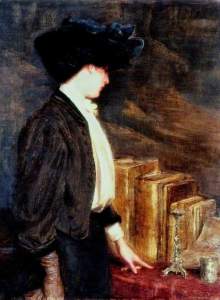
 your music. What do you do? Well, if you have a publisher, they might submit it to Stationers’ Hall, where it would be registered. They might not, though. (Some publishers thought they’d have the best of both worlds – they’d print a copyright statement to the effect that it had been entered at Stationers’ Hall, but they wouldn’t actually bother doing so.) In any event, it’s a bit hit or miss.
 So what did I do yesterday? I networked! Potential networkers can be found in a wide variety of places – not just academic departments or university libraries. We need people with technical skills every bit as much as we do researchers and librarians.
 Karen McAulay, Musicologist