Dr Karen McAulay explores the history of Scottish music collecting, publishing and national identity from the 18th to 20th centuries. Research Fellow at Royal Conservatoire of Scotland, author of two Routledge monographs.
Followers of this blog will already know my penchant for anniversaries. This festive season, I’ve decided to indulge myself – and you, dear reader – with the kind of trivia that doesn’t make it into my research writing.
90 years ago today, Thomas Nelson editor Richard Wilson was languishing in hospital. (On Boxing Day – how miserable!) His daughter had been handling his correspondence whilst he was ill, so he could keep in contact with his boss. But by Boxing Day, he’d been able to check the page proofs of the Music Guide (a teaching manual) from his hospital bed.
Now, I know he was a dedicated soul – but I also know that the series editor (not his boss) of the teaching series, ‘Music Practice’, was agitating to get these books published as soon as possible. Sooner, if at all feasible!
Let’s hope Wilson’s efforts didn’t delay his recovery …
170 years ago today, antiquarian ballad and song collector William Chappell sent an unintentionally incendiary letter to Andrew Wighton!
It is difficult to find really good tunes of this early date, because there is so little genuine Scotch music in print – although plenty of Anglo-Scottish.
Sparks flew in Dundee. How dare Mr Chappell suggest that much of Scotland’s song repertoire wasn’t really Scottish, but some kind of English-worked mishmash? Sparks also flew in Aberdeen, when Chappell’s song-collection was published, on account of his extensive annotations.
This is actually part of a larger story, which I explored in the final chapter of my first book, Our Ancient National Airs: Scottish Song Collecting from the Enlightenment to the Romantic Era. Chapter 8 is headed,
William Chappell, English antiquarian and song collector; author of Popular Music of the Olden Times;
Andrew Wighton, Scottish shopkeeper and song-collector in Dundee (his amazing collection was bequeathed to the city, and The Wighton Collection is now in the Central Library);
James Davie, crusty old Aberdonian musician and song-collector, fiercely patriotic and with a strong dislike of Chappell and all that he stood for;
David Laing, Edinburgh librarian, authority on Scottish literature and songs, and altogether good chap, generous in sharing his knowledge.
If you’re interested in learning more, my book is available in quite a few libraries or in paperback, e-book or Kindle format. Chappell’s collection is also readily available.
As I’ve already mentioned, I am currently a Heritage Collections Fellow at IASH – the Institute of Advanced Studies in the Humanities, at the University of Edinburgh. I’m halfway through my Fellowship, and (hopefully) halfway through my trawl of the Thomas Nelson publishers’ archives in search of correspondence about their music publications in the 1940s to 1950s. The book I’m primarily interested in has presented me with a few surprises and thoughts of new directions to pursue, but I shall plough on through the archives until I am sure I’ve captured every whisper about these four little school books.
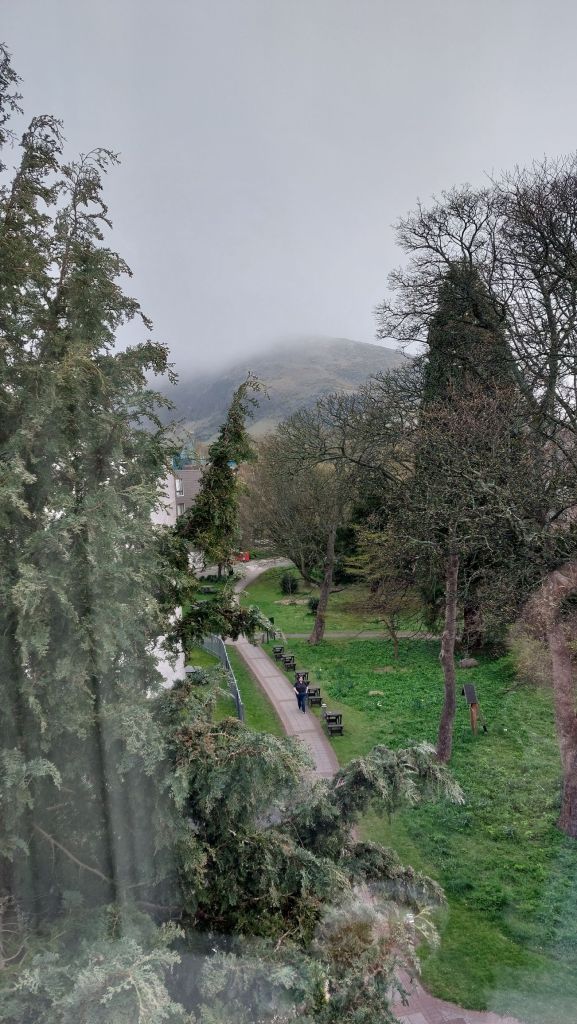
View from the Scholar Hotel
This week, we had the Institute’s 55th Anniversary celebrations, with a focus on Decoloniality. The Institute has just concluded a two-year project on this theme. There was also a session on motherhood and reproductive justice.
Now, you’d think, perhaps correctly, that my Scottish song book and music education focus has little connection with either decoloniality or motherhood. But I did put a lot of effort into broadening the scope of the music collection to include more music by women and composers of colour, whilst I was a Performing Arts librarian at the Royal Conservatoire of Scotland, so I was keen to find out what other scholars in more directly related disciplines have been doing.
I think it’s fair to say I felt a bit overawed! IASH is very interdisciplinary, so there were contributions from all corners of the humanities, and by scholars with far more extensive experience in their fields than I have in mine. But there were contributions from the performing arts, and from heritage collections and archives – I felt more comfortable in these areas, and a bit less out of my depth.
I stayed in Edinburgh overnight to make it less of a rush from Glasgow for the second morning.
In the final session, with contributions from past and present directors, I was impressed by the sheer reach and achievements of this amazing institution, and both proud and humbled to be a Fellow here.
O wad some Power the giftie gie us,
To see oursels as ithers see us!
In the context of Robert Burns’s poem, those lines are exhorting us not to get above ourselves, but taken in a different context, they perhaps offer reassurance that others see something in us that we can’t necessarily see ourselves.
‘They thought I was worthy to be a Fellow – in a very competitive application process?’, I mused. But yes, they did indeed select me, which is a vote of confidence in itself. Sometimes, you need validation by others – it’s hard to be objective about oneself!
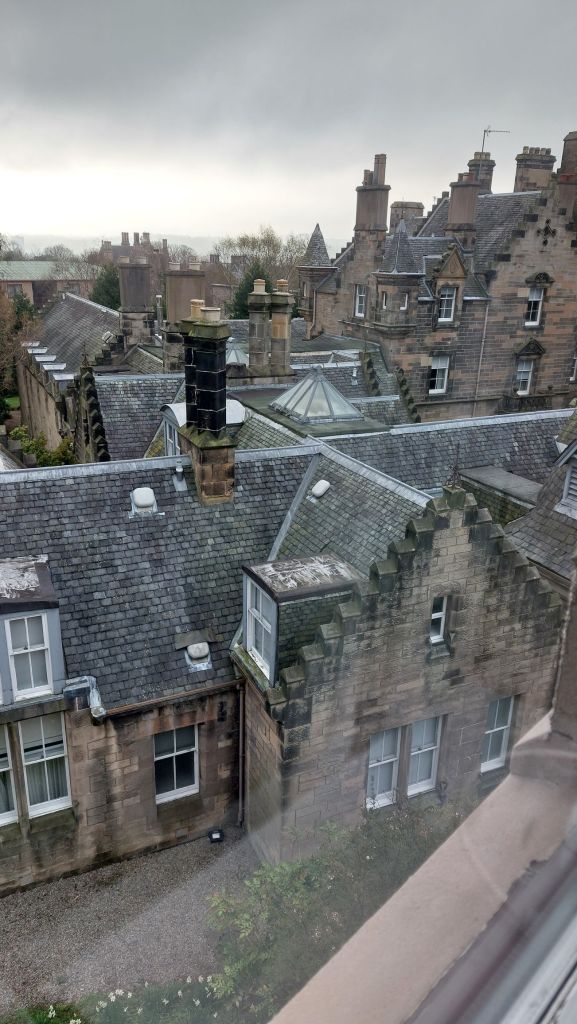
Another view from the Scholar Hotel
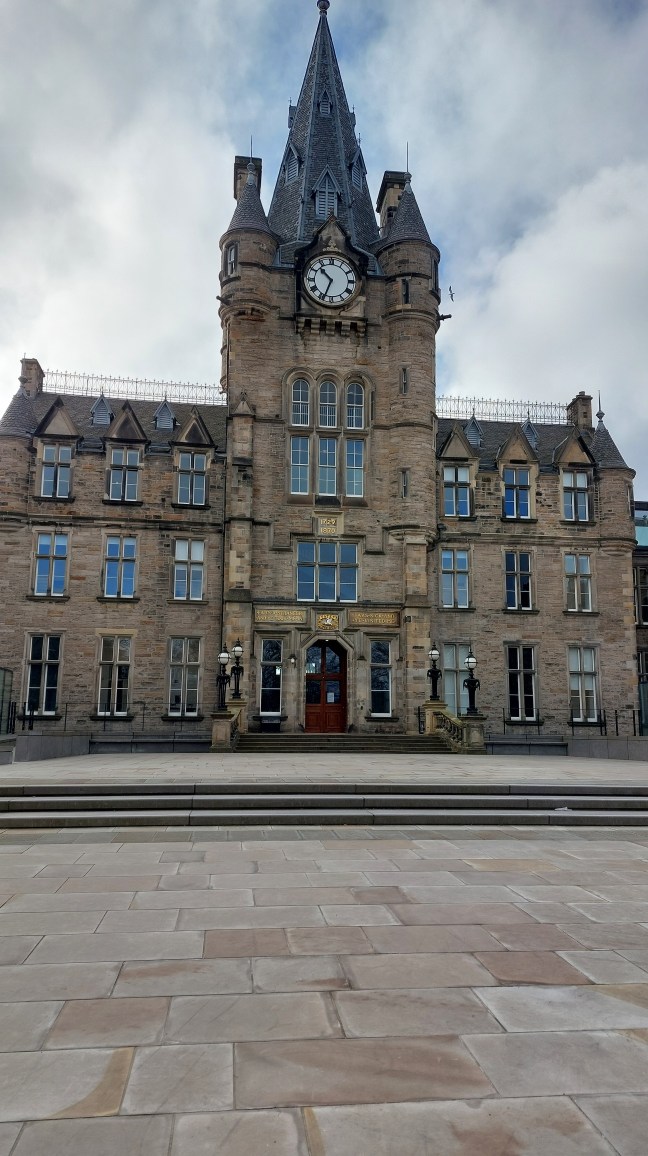
Image at top of post: The Edinburgh Futures Institute
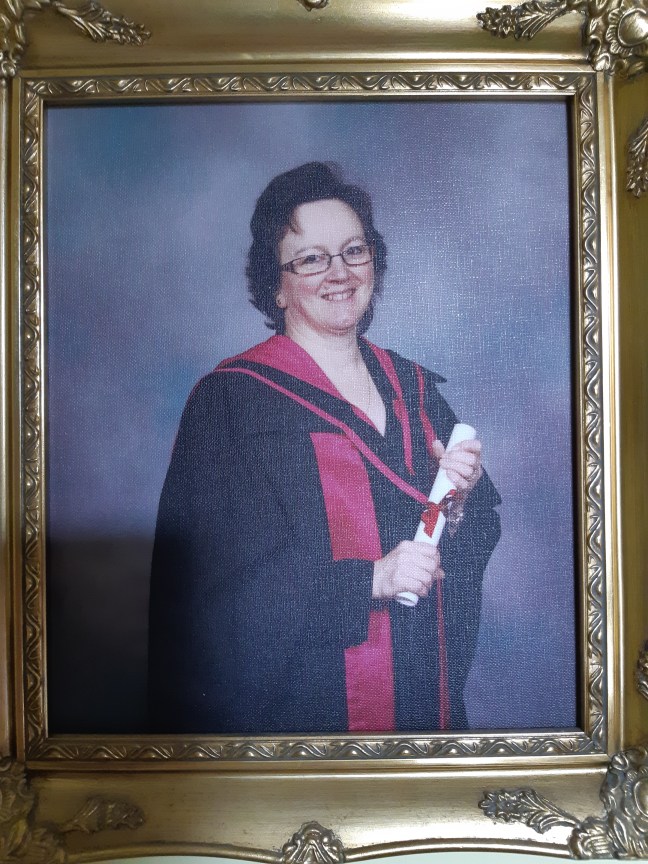
Facebook has just reminded me it’s 15 years since my doctoral graduation. Heavens, where did the time go?
Two Knees and a PhD
Summer 2009 was quite a summer! I submitted my thesis. He had two knee replacements, three months apart. He walked comfortably at my graduation ceremony.
Baking is not really one of my strengths!
Since then? Too much to enumerate. The thesis became a book. I contributed chapters to others’ essay collections. I published another book last month.
Why would a Librarian want a PhD?
Someone asked that, before I even started. I think I’ve demonstrated why.
Why would a Librarian want a PGCert?
Someone asked that, too. It seemed a good move at the time, and I have recently been doing a little teaching cover, proving that this wasn’t such a bad idea, either.
If one thing is certain, I wouldn’t now have a semi-retired existence as a postdoctoral research fellow, if I hadn’t found three old flute manuscripts in a cupboard that was being dismantled, a couple of years before I started the PhD.
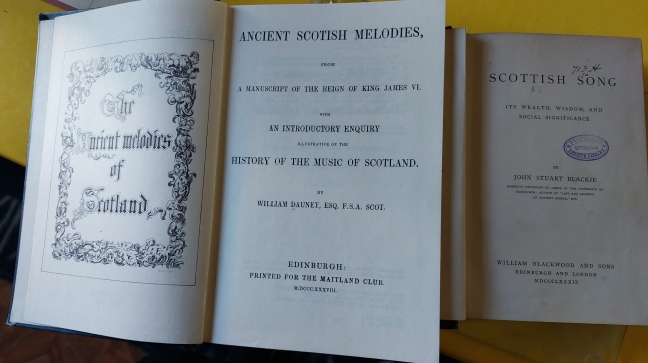
Nice to realise that, the day after submitting my 2nd book MS, today is the 180th anniversary of William Dauney’s death & 214th anniversary of John Stuart Blackie’s birth.
Dauney was in my PhD, and Blackie is in my second book. Pictured, are Dauney’s, ‘Ancient Scotish Melodies’; and Blackie’s, ‘Scottish Song’.
Incidentally, my book draft now has to get reviewed, so please do keep your fingers crossed for me! I shall be on tenterhooks for the next few weeks.
I omitted to note that this week is my 35 year anniversary of being in the same library post at RCS. Having said that, I have …
Had 3 children (minimum maternity leave each time) and seen them grow up.
Done a self-funded PhD in my spare time; also gained Fellowship of CILIP and Advance HE. Nearly forgot – I did a PGCert too. My commitment to CPD is, I suggest, exemplary!
Published a book;
Written a number of articles and papers etc;
Nearly finished the second book;
Am looking forward to a part-time visiting fellowship in my part-time research secondment.
I just haven’t managed a promotion 😕. Still, apart from that big fail (a single, male former colleague once said that anyone who didn’t move on and up was not a success), at least I have some other successes to my name!





 Karen McAulay, Musicologist