Wonderful! Look! A Gift of a Book

A couple of days ago, I wrote,

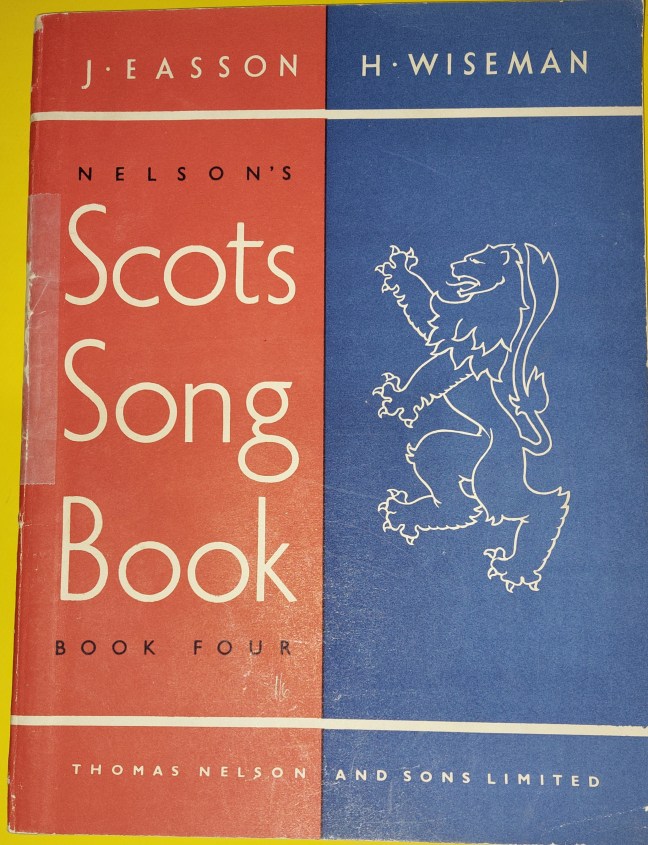
I would dearly love to trace a child, or children, who sang from these books. I think these books were aimed at children probably between eight to twelve years old, so the oldest children were born circa 1936-1946.

Well, I have! Five people have reached out to me already – one of them a prize-winning singer.  However, it appears I underestimated this title’s longevity.  I guessed,

I don’t know how long the books would have remained in use, but my guess is that they’d probably have fallen to bits by the late 1950s. In that case, the youngest users would have been born round about 1950. And that would make them baby-boomers, but several years older than me

I got that wrong! Two (as I predicted) are a bit older than me. Two a little younger. And the very youngest tells me they were at school in the 1980s – still singing from Nelson’s Scots Song Book.

Four are Scots. But the other (one of those a little bit younger than me) was in …

South Wales! (Now I’m curious to know – any more distant sightings, anyone?)

I’ve also, tonight, been gifted a copy of Book 4.  I got home and sat down at the piano straight away! What an exciting present. And I can play away to my heart’s content, since it’s all in the name of research.

Wednesday 26 March, 1 pm

But I won’t pre-empt my Work in Progress talk at IASH next week. Would you like to hear it? It’s online as well as in person. Click here.

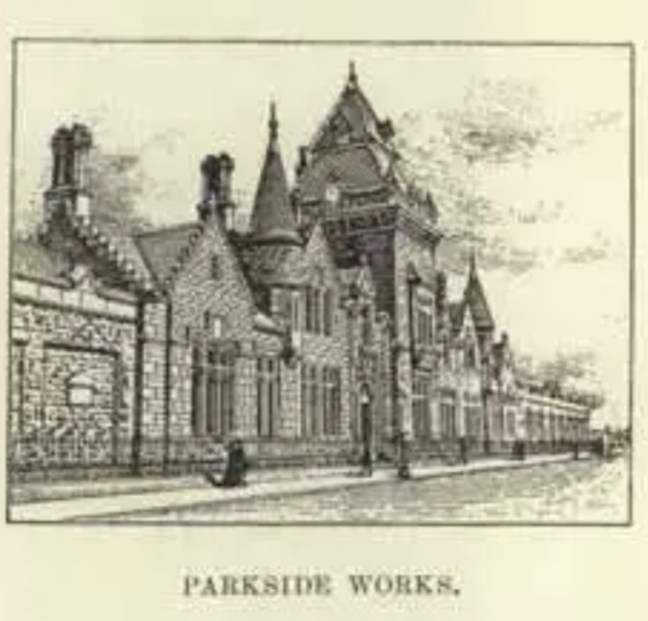
Seminar, Weds 26 March, 1pm:- Perusing the Papers from Thomas Nelson and Sons’ Parkside Works (Research into Nelson’s Scots Song Book – Work in Progress)

Through the archway into the courtyard at IASH

As I’ve mentioned, I’m currently Heritage Collections Research Fellow at IASH, the Institute for Advanced Studies in the Humanities, at the University of Edinburgh. All guest fellows are invited to give a work-in-progress seminar, and it’s my turn on Wednesday 26 March at 1 pm. You can attend in person, or online – more details on the link below. The abstract tells you what my talk is about.

Abstract and Zoom link

I’ll explain what I’m looking for, and introduce you to some of the individuals I’ve been finding out about.  The one thing I can’t predict, is whether I shall by then have found the answer to my prime question!

Nelson's Parkside Works - old engraving
Hope Park Square, home of IASH
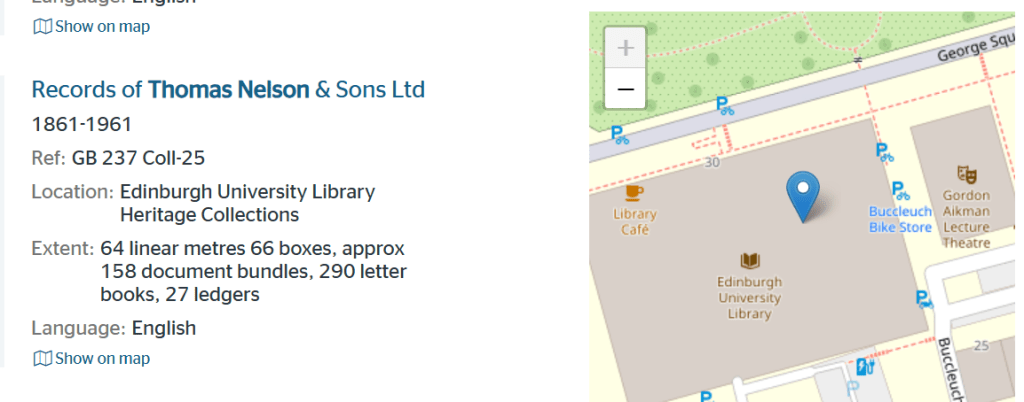
The ArchivesHub entry for the collection

Knowing When to Stop

The mystery teacher – photo from British Newspaper Archive

There are times when our insatiable curiosity leads us ‘up the garden path’, aren’t there? For me, it’s when I decide to pursue the life history of characters that really aren’t central to what I’m researching.

Take this weekend: I’m currently researching the pedagogical output of a Victorian Edinburgh music teacher, and I discovered his daughter collaborated on some of his publications. (This is confirmed by a letter that her sister wrote to a music journal later.) The collaborations appear to have been before she married.

I found a newspaper article about a story she had written for a women’s magazine called The People’s Friend in 1906, and this gave me her married name, but also informed me that she was working as a head teacher in a village quite a way from Edinburgh. It was definitely her – it named her father and his achievements.

Oh, my goodness. I wrote a number of stories for that magazine myself, some decades ago, so that made me sit up and look, straight away!

More interestingly, though – for a married woman still to be working, was a red flag in itself, because it was usual for a woman to stop working when she married. I traced her marriage certificate on Scotland’s People, and only noticed at the last minute that there was an amendment attached. She divorced her husband – whereabouts unknown – in 1912. Perhaps she had found it expedient to continue working, notwithstanding having a young child, if there had already been marital discord for a while. But who knows?!

I found the mother, a nine-year old son and a servant living back in Edinburgh in 1911. The census described her just as a teacher – no mention of headship here.

Really, my only interest at this point – whether or not she continued to collaborate with her father after she married – was my curiosity about a woman working as a teacher after marriage. Not long ago, I researched a late Victorian woman called Clarinda Webster, who was a music teacher, head teacher and ultimately a divorcee, so there was a human interest in finding someone else whose circumstances might have been vaguely similar …

After a few hours delving into Ancestry, Scotland’s People and the British Newspaper Archive, I made myself stop. I don’t know where this woman and her son ended up. Maybe they left Scotland or emigrated, who knows? At the end of the day, it doesn’t make any difference to my research into pedagogical music publications in the late Victorian and Edwardian eras.

On the other hand, stories of working women professionals in that era continue to interest me, whether musicians, teachers or both. It wouldn’t take much to convince me to keep looking…