The Ketelbey Fellow’s Last Latte

Being a Fellow has been a sheer delight. I’ve met a lot of interesting people; heard interesting research papers; given a public paper (in the Laidlaw Music Centre) and a research paper for the Institute of Scottish Historical Research (ISHR); and availed myself of the invaluable resources of the University Library. As a result, I’ve been able to explore a couple of specific aspects of my research topic – resulting in facts and findings that I’ve incorporated into my book revisions. 

Desk cleared …

I said I would get on with monograph revisions, and I have done so – I’ve written a new Preface, and revised the Introduction and first four chapters. There are three more to go, but I’ve broken the back of it, because Chapters 2, 3 and 4 are the longest ones.

Those are tangible outputs. But for me personally, the Fellowship has also been an opportunity to embrace my research scholar identity a bit more, before I retire from the Whittaker Library in July 2024 and become solely a (part-time) researcher. The experience has in that sense given me a powerful sense of endorsement: that another insitution has embraced me as a scholar, and given me a chance to enjoy that status. For that I am very grateful indeed.
Farewell to St Katharine’s Lodge

Here for the final day, I’ve nipped into the Martyr’s Kirk Research Library to look at a couple more old classroom music texts. (I had a little argument with myself about the dates of a few titles advertised on the back of one particular text, but finally concluded that the date of a preface inside a book doesn’t mean that everything advertised on the back outside cover was available at that date. The copy in my hand could, after all, have been printed several years after the text itself came out, and the adverts might well have reflected the later date when the copy was printed, not the date when the text was published.)

I was looking for Scottish song texts, whether ‘folk songs’ or fin-de-siecle songs written for educational purposes. I must confess, I expected to find more than there actually were in these two sources. Still, with glee, I pounced upon ‘My heart’s in the Highlands’. 

Too soon. The compiler had set it to … a tune by Mozart! (Very curious, considering the patriotic attitudes of that particular compiler! Why ever did they think that was a good idea?)

I met a colleague and one of their friends for lunch, to discuss a research idea.

And (besides taking my library books back), I started a preliminary check of Chapter 4 of my book, which has grown a little during its revisions.

I don’t want to leave!
A Fellow Back in 1901

This is the third week of my Ketelbey Fellowship, and I arrived at St Andrews in pouring rain yesterday morning. Fortunately, it had subsided to a drizzle by the time I made my way to Martyrs Kirk, where materials from the Library special collections can be consulted. I didn’t get wet enough to risk dripping onto rare Victorian pamphlets! (I only know they were Victorian by the fact that the earlier numbers included God Save the Queen rather than the King – so they were published before January 1901.)

I had a ball! They each began with an editorial introduction – I love these. They’re so informative about the thinking behind whatever is in the book. Intriguingly, the editor seemed not to be the prime contributor, but all was revealed when I did some Googling later. Good old Baptie (Musical Scotland) informed me that the editor had two middle names, and used them as a nom de plume. No mystery after all! Moreover, one particular collaborator, more involved than most, was …

His daughter.

I didn’t quite get through the pile I’d called up, but I’m making good progress. And I encountered some interesting glimpses into social and political history. What’s more, if ever I needed proof that little girls’ education had a subtle difference to that of little boys, I found it today. It shouldn’t come as a surprise – I know it happened. But I wasn’t expecting to find this in a Sol-Fa song book!

It is such a luxury to have a desk in an office just a couple of minutes from a big university library. This morning, I snatched a quick coffee before I went back for another session with more of these instruction books. What’s more, I feel more a dedicated researcher here, compared to being ‘the librarian that also does research’ in Glasgow. It’s easier to focus, somehow. And tonight, I’m going to a research seminar, so I’ll get to meet some more historians then. Good times.

Aspiring to be a ‘Jolly Good Fellow’

Week 2. My second visit to St Andrews this autumn literally flew by. I borrowed AND returned a book from the library; continued my literature search; finished reading a fascinating series of letters in a journal; had myself a library induction (setting a good example, since I’m always urging newcomers to attend their library induction!); and met some members of the Institute of Scottish Historical Research for lunch.

If in doubt, ask!

This last was the challenging bit. How do you identify a historian? They don’t have obvious ‘tools of the trade’ like musicians or artists. I hovered outside the hostelry, peeped in and couldn’t decide who was a historian, and finally solved the problem by asking at the bar! The bartender seemed to find this an entirely reasonable question, thankfully.

Image by 1195798 from Pixabay

A Fellow’s First Steps

I like to think I made an exemplary start!

I’ve activated my email and library account. I’ve made contact with the library, and I’ve called up a book to be fetched for next week. I’ve also started a literature search for the topic I’m hoping to explore. Half of me considers it unlikely that the general topic hasn’t been covered, and the other half thinks it’s highly unlikely that my specific niche has been written about! If I can research and write an article during this Fellowship, I’ll have a significant output that will have drawn on St Andrews’ admirable library resources.

And of course, I don’t yet know what/how much will need revising in my book! That could be another major task for this autumn.

So far, so good. I have also achieved another personal goal. I wanted to see the sea at lunchtime. I did that, too!

Lunchtime Wandering
En route from the Castle
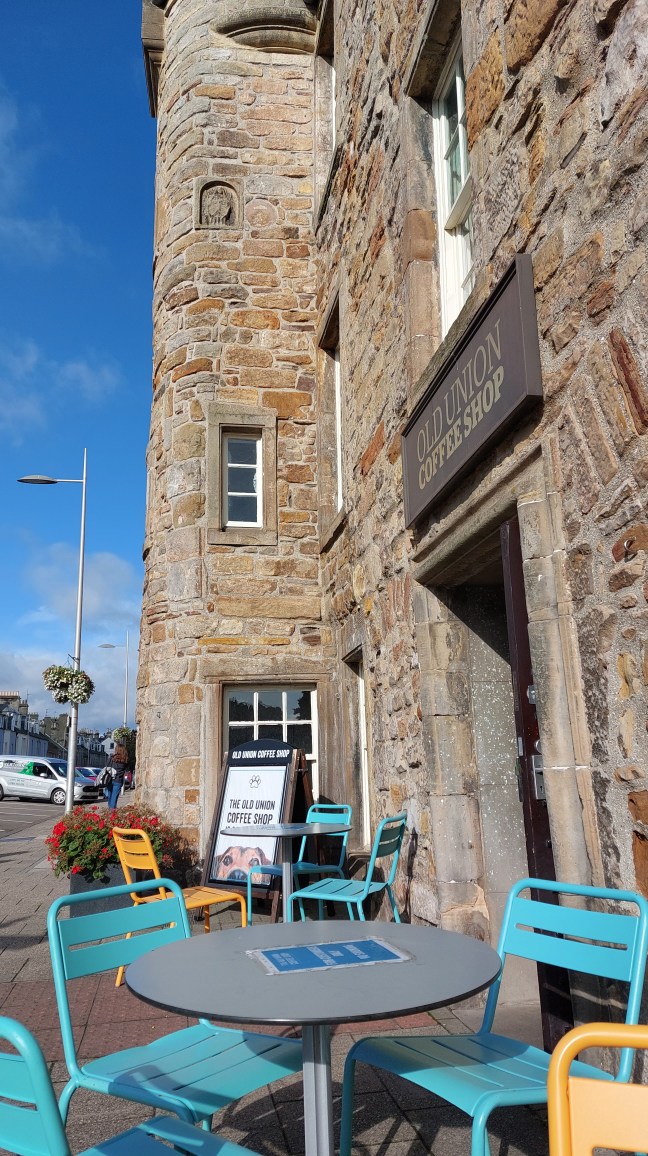
Outdoor Coffee Break
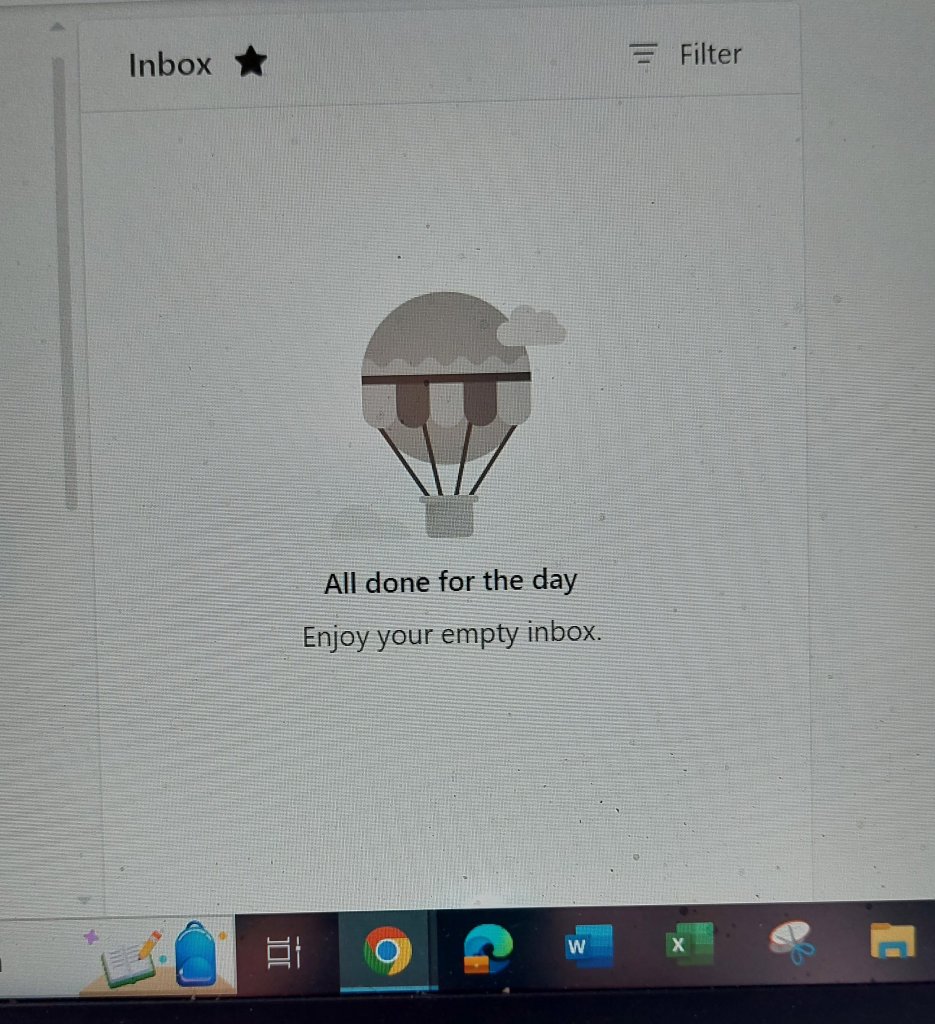
A rare sight! (New email account)

Room with a View

They say a picture speaks a thousand words. Well, in that case, here’s a full-length article! I’ve had a great first day as inaugural Ketelbey Fellow in Late Modern History, in the University of St Andrews’ School of History: sociable, welcoming and productive. I’m looking forward to tomorrow. For now, I need to sleep, so I’ll spare you a detailed account of ‘What Karen Did’, and ‘What Karen did Next’!

(Find out more about the Fellowship here, posted when I got news of it earlier this year.)

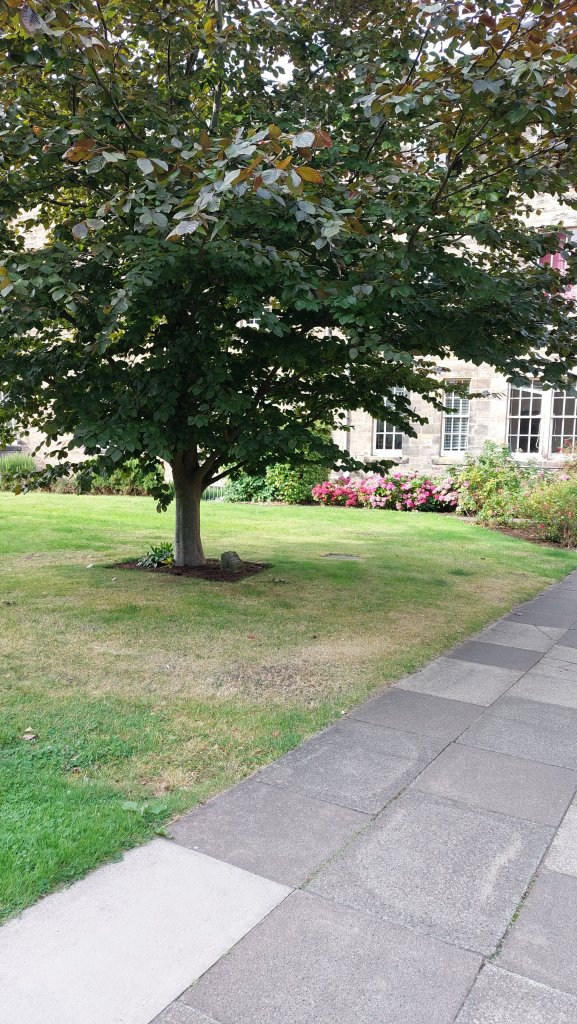
The Room, the View … and beyond the Trees, the Sea!
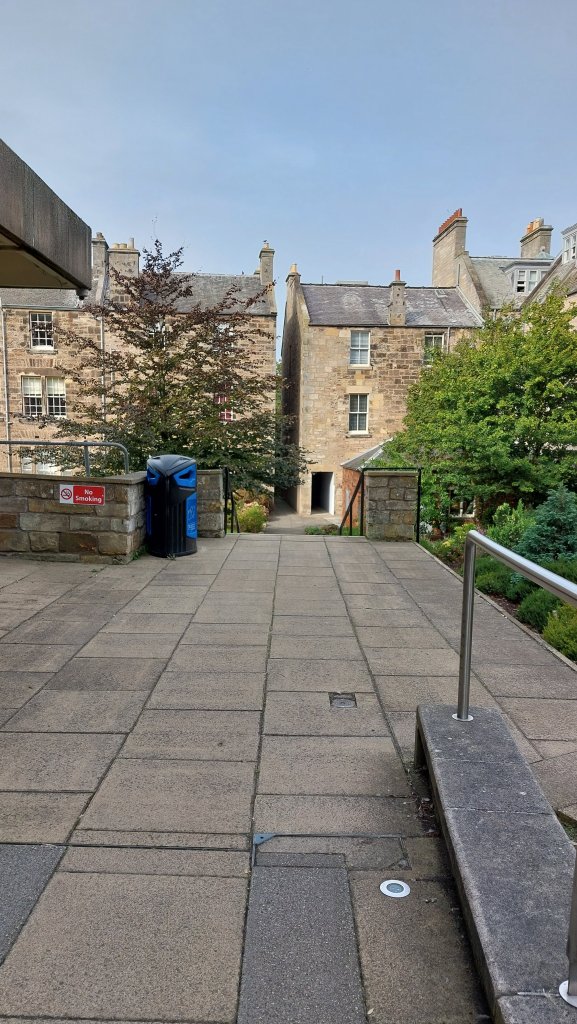
Walking from St Andrews University Library to St Katherine’s Lodge
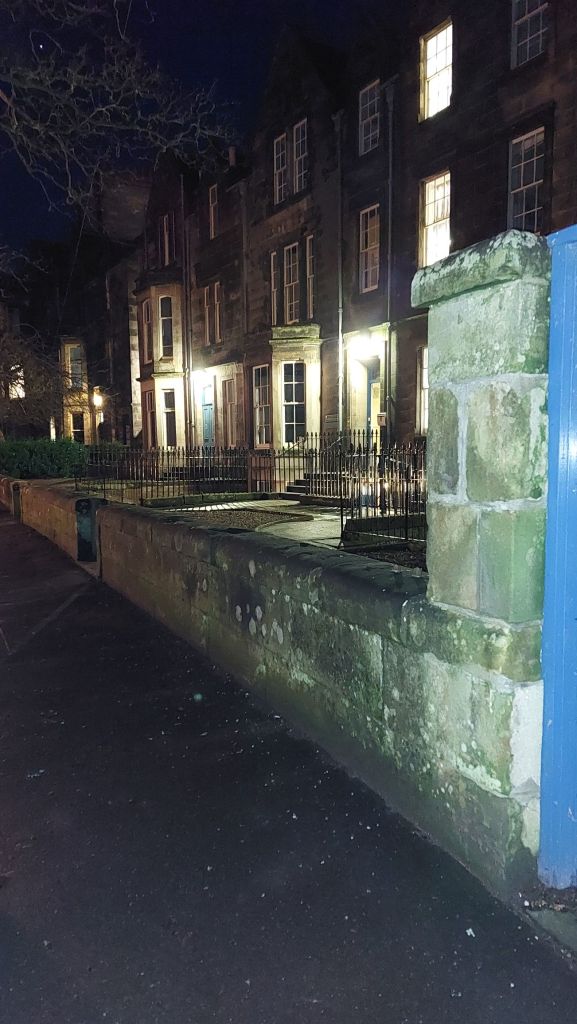
Walking towards St Katherine’s Lodge

Articulating Your Research

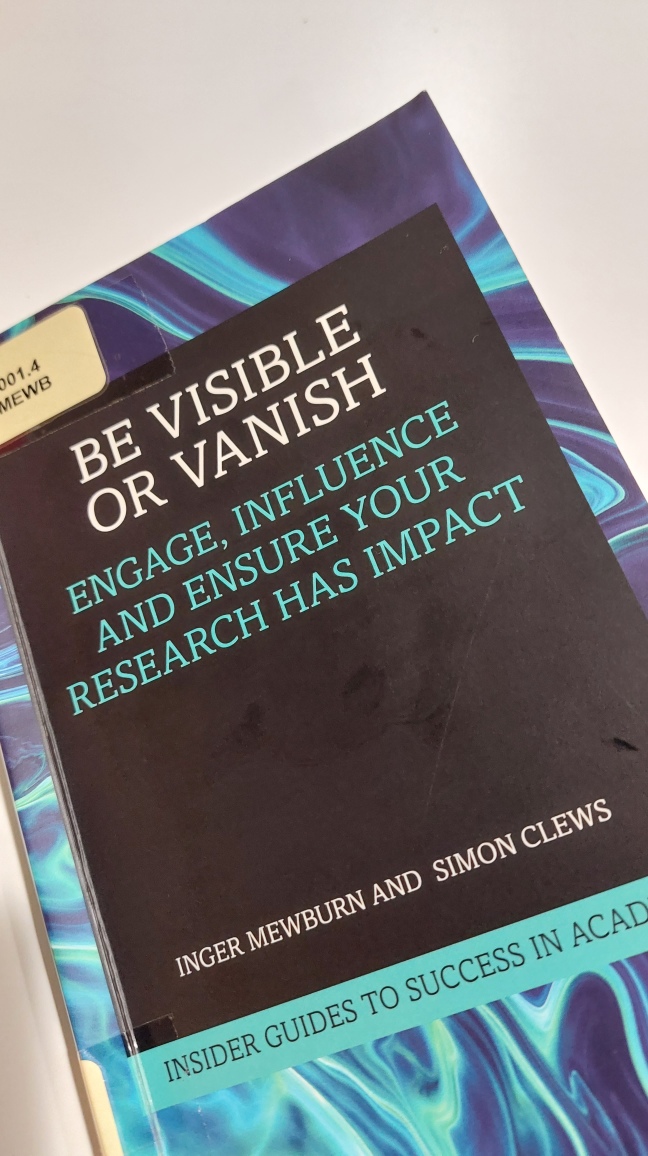
I’m currently reading a new book in the Routledge Insider Guides to Success in Academia series:

Be Visible or Vanish: Engage, Influence and Ensure your Research has Impact (Routledge, 2023)

The authors are Inger Mewburn and Simon Clews; since I’ve followed Inger’s work for a number of years, I knew it would be good, and I got it for RCS Library recently.

It’s an approachable guide, and the kind of book you can tuck into a bag or pocket to read at free moments during the day. This morning as I drank my pre-work latte, I was reading the chapter on making academic small-talk, and being ready with an answer to the inevitable question:-

So, what is your research about?

(A reasonable question in any situation!)

It particularly resonated for me this morning, because I take up my honorary Ketelbey Fellowship at St Andrews tomorrow. Not only that, but a family member had been asking me the same question last night! What are you studying there? Why there? How are you going to benefit from the experience? It wasn’t intended as preparation for the sort of questions I should be anticipating, but I nonetheless took it as a prompt to think carefully about how I shall be introducing myself when I meet new colleagues!

I’ve also heard this described as an ‘elevator pitch’ – though in my case, I would need the elevator to travel more than one floor! As I’ve said before, the title of my recently-submitted book doesn’t exactly trip off the tongue. However, it outlines what my research has been about in recent years so I have to be able to trot it out.

  • A social history (yes, that describes it well)
  • of amateur music-making (make no mistake, that’s what we’re talking about – it’s not generally about serious, cutting-edge classical music)
  • and Scottish national identity (this is such a big deal, that it’s inextricably interwoven throughout the whole book)
  • [And then there’s the subtitle!] : Scotland’s printed music, 1880-1951 (I’ve been looking at the output of Scottish publishers during this era, which proved much more interesting than even I had ever imagined. When I got to 1951, I got to fever-pitch excitement. You’ll have to wait for the book to find out why!)

But, back to the questions of last night. I’ll be revising the book when it returns from the reviewer(s). I’ll also be investigating a particular aspect of my research that still merits even deeper investigation. I’ll be exploring a bigger, richer library collection than I usually have access to, and I look forward to engaging with a lot of different research scholars, hopefully gaining fresh ideas and maybe ideas for new directions or collaborations.

Most of all, I’ll be settling into my academic role – yes, I know, I’m a seconded researcher back in my home institution, but it’s new for me to be a Fellow for a few months – and I’ll be thinking about my future ‘second career’ as a researcher once I retire from music librarianship next summer.

Now, where was I with Be Visible or Vanish …?

First Ketelbey Fellowship at University of St Andrews

Here’s the big news I’ve been bursting to share! During Autumn 2023, I’m to be the first holder of the honorary Ketelbey research Fellowship in Late Modern History, in the University of St Andrews’ School of History. I’ll be there on Wednesdays and Thursdays for one semester, continuing to research and think about Scottish music publishers and other related topics, and enjoying the experience of being a research fellow in a very highly-rated university history department. St Andrews was rated the top UK university in the Times and Sunday Times Good University Guide last September, and the School of History came top in both the Times and Sunday Times rating, and the Guardian University Guide 2023 – so I’m dead chuffed! I’m an academic librarian and musicologist – I guess this means I can call myself halfway to being a historian, too.

The Fellowship is named after Doris Ketelbey (1896-1990), who was the first female academic in the School of History; a respected author; and had a phenomenal career for a woman of her times. Aileen Fyfe has written a blog post about her, which you can read here:-

Doris Ketelbey, 1896-1990 (in the series, ‘Women Historians of St Andrews’) by Aileen Fyfe

Interestingly, Ketelbey taught at St Leonard’s School at one point. A few years ago, I wrote a blogpost for the EAERN Network about about the very first owner of a private school in the same premises, in the early 19th century: Mrs Bertram’s Music Borrowing. But the St Leonard’s that Ketelbey taught at would have been a more sophisticated institution than Mrs Bertram’s doubtlessly estimable establishment!

– and yes, she was the sister of composer Albert Ketelbey, who wrote an enormous quantity of lighter music and songs. I bet he was proud of his determined, high-achieving sister!