Dr Karen McAulay explores the history of Scottish music collecting, publishing and national identity from the 18th to 20th centuries. Research Fellow at Royal Conservatoire of Scotland, author of two Routledge monographs.
At Tuesday’s Women who Dared book launch, mention was made of the Wikipedia ‘Women in Red’ project, to which I once attempted to contribute. It’s a valuable project; there’s no denying far too few women are represented in Wikipedia.
I got nowhere with my own attempt, as I was the only person who had researched and written about ‘my’ Elizabeth Lambert (married name Williams), so I couldn’t provide the requisite references by respectable authors. She wasn’t ‘daring’, but she definitely made a worthwhile contribution to St Andrews University Library, in cataloguing their legal deposit music so borrowers knew what was available to borrow. (Her other private interests were interesting, too. She was an acknowledged expert in conchology.) I’m pleased to see she at least has a Wikidata entry now! Anyway, thwarted in my Wikipedia ambitions, I posted a biography on the present blog.
You might also find my article about St Andrews’ Copyright Collection of interest. Again, Miss Lambert gets several honorable mentions. And I found another posting that I’d forgotten all about, this time in 2021 for a University of Stirling research project. I might as well share details of these pieces, to get her a bit more exposure!
‘A Music Library for St Andrews: use of the University’s Copyright Music Collections, 1801-1849’, in Journal of the Edinburgh Bibliographical Society no.15 (2020), 13-33.
I’ve written quite a bit about women in musical history, so I’m adding something to the top of this post every couple of days during Women’s History Month – mostly flashbacks to women musicians I’ve researched, but some other discoveries too. (I’ve been shifting things around to a more chronological order, but I’ve always added the new bit first!) You’ll find more musicians than composers in this posting, just because of my own recent research.
Sometimes I look at the history of women musicians from the point of view of good library provision for our readers, whilst at other times my own research interests are foremost. It just depends on the day of the week, because I currently occupy two roles in the Royal Conservatoire of Scotland. For 3.5 days a week, I’m a librarian. For 1.5, a postdoctoral researcher.
15. The Ketelbey Fellowship
It’s a whole year since I learned that I had been awarded the first Ketelbey postdoctoral research fellowship at the University of St Andrews. Scholar Doris Ketelbey was a significant figure in the history of the department. I felt highly honoured to have been the first Ketelbey Fellow from September to December 2023.
14. Representation of Women Composers in the Library
I couldn’t resist adding the open access article I published about my EDI activity in our own Whittaker Library:-
It’s a privilege to shape a library collection, so I’m pleased to have just ordered and catalogued several relevant books this month.
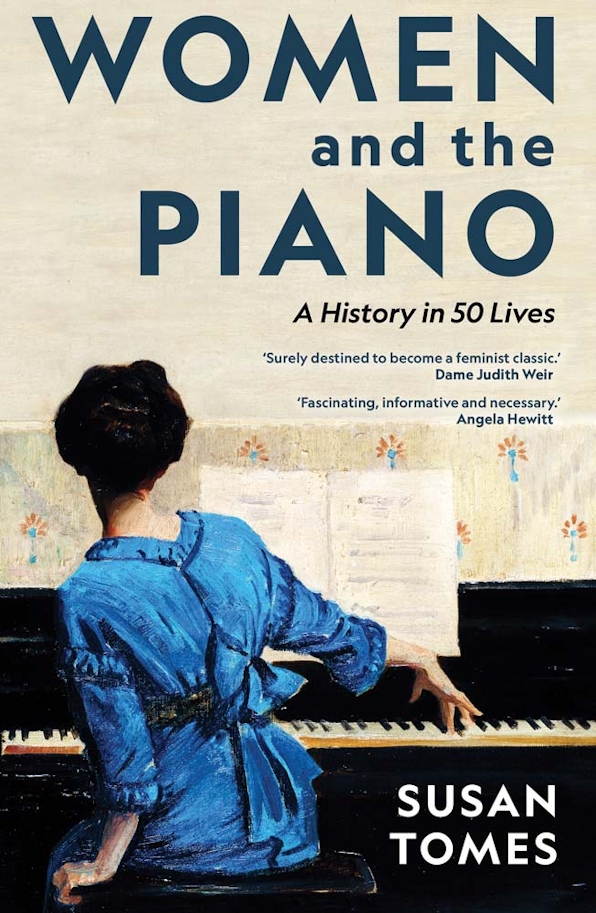
Susan Tomes, Women and the Piano: a History in 50 Lives (Yale University Press, 2024) Read more about it on the publisher’s website, here. In actual fact, it’s the fourth title by this author that we now have in stock. So if readers like this, they might like the earlier three, too!
Margaret C. Watson, Women in Academia : Achieving our Potential. (Market Harborough : Troubadour, 2024). Not a book about women in history, but very much for women in the present day!
Gillian Dooley, She played and sang: Jane Austen and Music (Manchester University Press, 2024). Back to history again.
Women and Music in Ireland / ed. Jennifer O’Connor-Madsen; Laura Watson & Ita Beausang (Boydell Press, 2022)
Moreover, there’s a new Routledge book coming out this summer – I have ordered it for the Whittaker Library. Of course, I may have retired from the Library by the time it arrives. This just means I won’t need to catalogue it! I’ll still be a part-time researcher, so I’ll be able to read it:-
It’s some years now, since a single-minded schoolgirl decided action was necessary. In 2015, Jessy McCabe noticed that Edexel had no women composers in the A-Level Music syllabus, and successfully petitioned to rectify this, via Change.org. I found out about her impressive initiative when I was beginning to start serious work on building up our library collection to include more music – contemporary and historical – by women and people of colour.
Jessy is now a Special Needs teacher. I’m sure she’ll go far.
11. Forgotten Women Composers
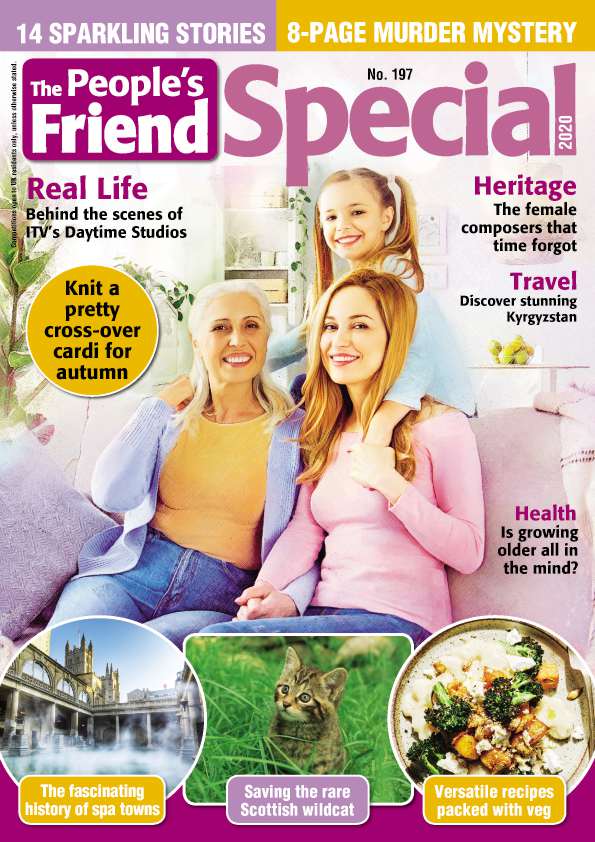
Part of academia entails sharing research outcomes beyond the ‘ivory walls’. It’s called public engagement, and that’s the opportunity I seized when my old friend The People’s Friend magazine commissioned me to write a feature back in 2020.
The sound of forgotten music: Karen McAulay uncovers some of the great female composers who have been lost from history’, in The People’s Friend, Special Edition, 11 Sep 2020, 2 p. (Dundee : D C Thomson). I blogged about it at the time (here).
10. Late Victorian Women Musicians
Since my more recent research has focused on the late Victorian era and the first part of the twentieth century, you’ll not be surprised to find that I found some interesting Scottish women musicians of that era! They are forgotten today – but I’ve done my bit to raise their profiles!
Newsletter article, ‘‘Our Heroine is Dead’: Miss Margaret Wallace Thomson, Paisley Organist (1853-1896)’, The Glasgow Diapason, March 2023, 10-15. (You can find this article in full on this blog)
‘An Extensive Musical Library’: Mrs Clarinda Webster, LRAM, Brio vol.59 no.1 (2022), 29-42 (a late Victorian head teacher who founded a music school in Aberdeen, and later did a national survey of music in public libraries – which she presented to the Library Association!)
In October 2023, I pondered about Mr *and Mrs* J. Spencer Curwen (amongst others) in another blog post, when I remarked upon early twentieth century attitudes to folk song.
9. In Praise of Music Cataloguers! Introducing Miss Elizabeth Lambert
Before I started the Claimed From Stationers’ Hall music copyright network, I had spent some months researching the wonderful late 18th and early 19th century music copyright collection at the University of St Andrews. A key resource was the handwritten catalogue in two notebooks, largely compiled by Miss Elizabeth Lambert (later to become Mrs Williams, when she married and moved to London.)
I just love the fact that this earnest young woman (I’m going out on a limb here, but I’m pretty sure she must have been earnest!) created a useful resource which would help everyone get maximum use out of the music repertoire that other libraries were less than impressed by. So we had Elizabeth cataloguing the collection, and numerous men and women, friends of the professors, making use of it. I blogged about her, and eventually wrote an article for the Edinburgh Bibliographical Society, mentioning her again.
‘A Music Library for St Andrews: use of the University’s Copyright Music Collections, 1801-1849’, in Journal of the Edinburgh Bibliographical Society no.15 (2020), 13-33.
The library’s copyright collection of music was a boon for middling class women like headmistress Mrs Bertram, her teacher daughters and their pupils. It does lead one to wonder if they had a harp at the school. I checked their borrowing records for more evidence. They certainly borrowed several volumes which included harp music.
7. Students but not at University? Educating Young Women
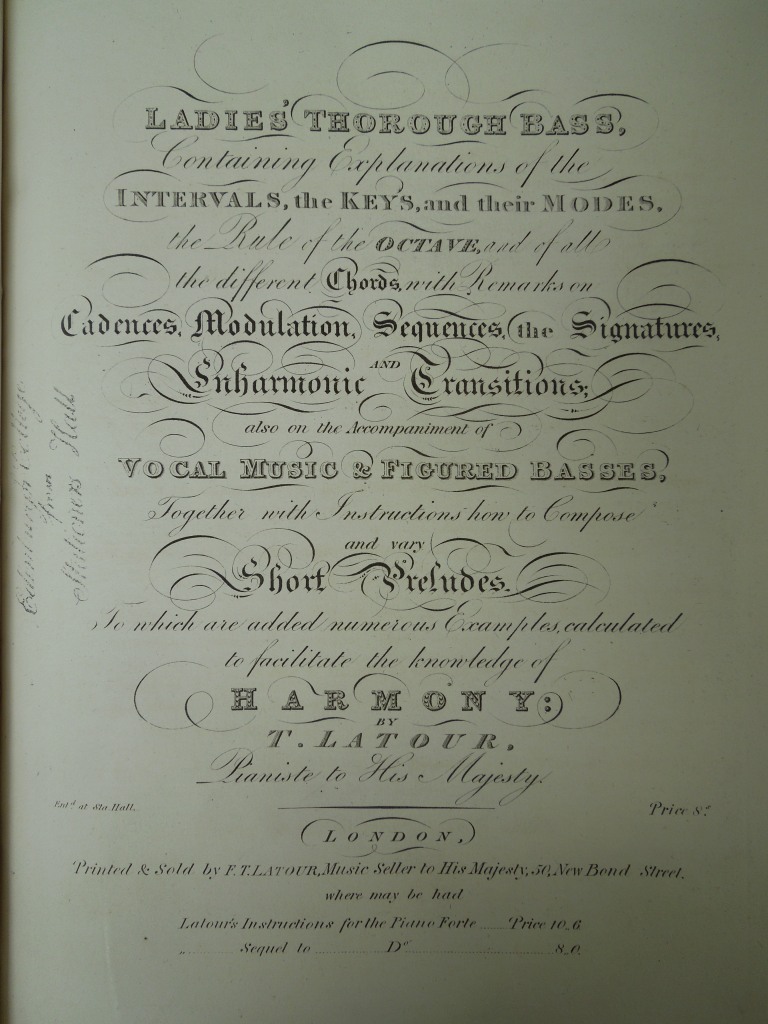
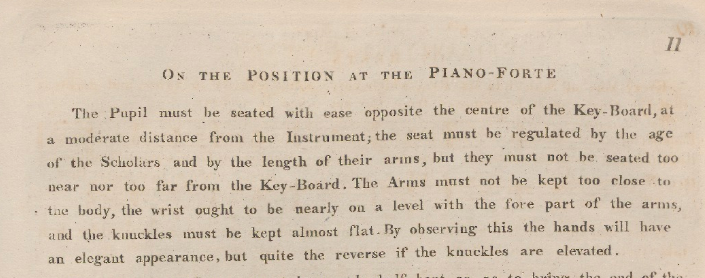
It’s time to turn to piano teacher Mr T. Latour. I’d like to refer you to my June 2018 blog post about women in St Andrews using pedagogical musical material in the early 19th century. Possibly the self-same young ladies attending, or having attended Mrs Bertram’s school?! The illustration features a young woman – probably just approaching or about marriagable age – at an upright piano. The abundant floral arrangement atop the piano (quite apart from sending shivers down the housekeeper’s spine every time the young pianist played too enthusiastically) suggests a well-to-do household. Following Latour’s instructions, the pianist has elegantly flat hands …..
T. Latour – Ladies’ Thorough Bass
Latour advises on the seating position, and how to hold ones hands elegantly
6. Not my work – but very timely for WHM 2024]
I’m not posting anything relating to my work today, but I saw mention of a great new article by Dominic Bridge the other day, so I thought I’d share details here. It’s a fascinating read. The Journal for Eighteenth-Century Studies is part of the Wiley Online Library:-
Back in 2018 when I was awarded the AHRC networking grant for the Claimed from Stationers Hall network, I drew up a list of women composers from the Georgian era. There were more than one might have expected – perhaps they only composed a handful of pieces, in many cases, but nonetheless – they composed. You can find the list on a separate page on this blog, here. And you can read more about it in the blogpost I wrote in July 2018,
This lady ran a girls’ school at St Leonard’s in St Andrews. This was NOT the famous and long-established private school that has long stood there, but an earlier enterprise. And Mrs Bertram and her daughters subsequently moved to Edinburgh, to the disappointment of parents of daughters in St Andrews!
The photo portrays a Mrs Bertram of Edinburgh. Chronologically, she could well be ‘our’ Mrs Bertram, and a scholarly bent is suggested by the pile of books at her hand.
2. The Accomplished Ladies of Torloisk
I almost forgot about the musical Maclean-Clephane ladies of Torloisk, which is a stately home on the island of Mull. But how could I forget about them, considering I published a lengthy article about them some years ago?! Luckily, a book of letters by Sir Walter Scott crossed my library desk, and even though it didn’t contain those particular letters, this did remind me of his musical friends in Torloisk!
Karen E. McAulay, ‘The Accomplished Ladies of Torloisk‘, International Review of the Aesthetics and Sociology of Music, Vol. 44, No. 1 (June 2013), 57-78
Today, I’d like to introduce a woman composer who predates most of the individuals I’ve encountered. Professor James Porter applies his considerable intellect to produce this in-depth article:-
‘An English Composer and Her Opera: Harriet Wainewright’s Comàla (1792)’, Journal of Musicological Research Feb, 2021. Published online: 16 Feb 2021.
The story of a very early female music cataloguer at the University of St Andrews
by Dr Karen E McAulay, Royal Conservatoire of Scotland
Introduction
Prior to her marriage to George Williams, Elizabeth Lambert (1789-1875) produced a handwritten catalogue of the University of St Andrews legal deposit music collection, which was accumulated by legal entitlement from the 1790s to 1836. Elizabeth was paid a nominal sum (one shilling) for producing the first catalogue volume in 1826, and continued adding to it, commencing a second volume which someone else presumably completed after she married and moved to London in 1832. [1] This youthful involvement with the University of St Andrews’ Library music collection is more significant, and had a more far-reaching effect, than has hitherto been recognised, for her catalogue would have significantly contributed to the use and enjoyment of the University Library’s music collection. Her subsequent married life in London is minimally documented.
This article would have been added to the Wikipedia Wiki Project, Women in Red, which is promoting entries about women to redress the current male/female balance; however, since the present narrative is based on new research – and there are no books with biographical details of Miss Lambert – it does not fit into the remit of that admirable project.
Childhood
Born in 1789, the year of the French Revolution, Elizabeth Lambert was the firstborn child of clergyman, Revd. Josias Lambert and Dorothea Lambert (née Rotherham). She was christened in St Mary’s Parish Church in Lancaster (Lancashire) on 13 June 1789. [2] Two brothers and two sisters followed in close succession, the youngest being born a few months after their father’s death in 1799. Their widowed mother sold their Yorkshire home, Badger Hall in Burneston, to Col. W R L Serjeantson that year, [3] and relocated the family to St Andrews in Scotland. There, they lived with her brother, Professor John Rotherham, until he died in 1804.
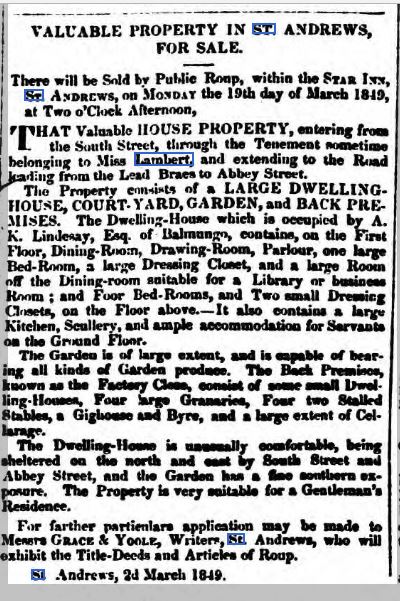
House in South Court, South Street, St AndrewsElizabeth’s mother originally hailed from Northumbria, but remained living in a house at South Court, South Street in St Andrews until her death in 1839. [4] Both of Elizabeth’s sisters died at St Andrews in childhood.
Teens and young adulthood
South Court from South Street, St Andrews
Elizabeth’s brothers attended the University, making use of the library facilities, but Elizabeth and her mother were also able to borrow from the library through the good offices of professorial friends. Elizabeth borrowed widely:- books on conchology, botany and horticulture, divinity and travel, as well as novels and music, and she continued to borrow on a visit to Scotland after her marriage. [5]
She borrowed sacred and secular vocal music – returning to borrow Mozart’s Masses more than once, and also enjoying operatic arias, and Irish, Scottish and Welsh songs – as well as piano music and piano duets. Instrumental music seems to have attracted her – one such book that she borrowed contained concertos, harp and guitar music as well a piano instructor by Cramer, and this wasn’t the only instrumental volume to have appealed to her. She also enjoyed a music journal called The Harmonicon, which enjoyed a brief but very popular run from 1823-33, and borrowed a book about Haydn and Mozart.
Elizabeth’s interest in conchology went beyond reading about the subject, for she was cited in several textbooks for having identified a particular shell (Patellaelongata) inProfessor John Fleming’s cabinet collection in 1814. [6]
Elizabeth built up a shell collection of her own, giving her collection of British and foreign shells to the Natural History Society of Northumbria in 1873 (foreign shells) and 1874 (British and foreign shells). The Society still has a record of her donation, although the collection has been integrated into their own larger collection and can no longer be identified. [7]
Involvement with the University of St Andrews Library
Elizabeth’s uncle John Rotherham had taken responsibility for organising an earlier book catalogue in the library, though it is unlikely that he would have done the cataloguing himself. Nonetheless, his interest, added to Elizabeth’s interest in conchology, does suggest a family disposition towards organising and codifying things!
Sederunt Dr Buist Rector, Principal Haldane, Drs Hunter, J. Hunter, Jackson and Briggs. University Library 29th August 1826. “There was laid upon the Table by the Rector a Manuscript Catalogue of the Music belonging to the Library made out by Miss Lambert. The Rector was requested to convey to her the thanks of the University for the great pains she had been at in making it out. [signed] Geo. Buist Rector. [8]
It is probably worth noting, as an aside, that 1826 was also the year in which the University of St Andrews published a proper catalogue of the entire library holdings – excluding the music, that is! See their Catalogus librorum in Bibliotheca Universitatis Andreanae, secundum literarum ordinem dispositus online via the Wellcome Collection website. (I noticed that the library had the 1788-93 edition of Linnaeus’ Systema naturae, a book which would have enabled Elizabeth to identify that sea-shell in Professor Fleming’s cabinet: “Patella Elongata”, aka “Ansates Pellucida” is none other than a special kind of limpet …)
Although Elizabeth was paid for cataloguing the St Andrews University copyright (legal deposit) music in 1826, the second catalogue book continued to be added to, presumably by someone else and with rather less care after she had married and moved away, until a change in legislation meant that the Library ceased to claim legal deposit books in 1836, instead being awarded a book budget, in common with the other Scottish universities.
Entries in the borrowing registers for 16 October 1827 and 22 May 1828 record Elizabeth taking music ‘to be arranged’, which can be interpreted as an involvement in assembling the music into usable volumes which would then be bound by a commercial bindery. [9] Different volumes were compiled for instrumental music, piano music, songs, harp music and so on.
Marriage
Elizabeth married George Williams in Islington in 1832, where they lived with his mother and brothers. [10] They had no children. George died in Halton Street Islington in 1853. [11] Elizabeth Williams died at 18 Well-Walk Hampstead, Middlesex, 23 years later on 16 February, 1875. [12] There is very little documentation of her life after her marriage.
Significance of Elizabeth’s Music Catalogue
Elizabeth was clearly not a University employee, but was nonetheless entrusted with the task of compiling this catalogue of the music, listing the contents of each numbered bound volume. This is very early documented evidence indeed, of a woman being involved in any way with the organisation of a university library sub-collection. Contributing factors are likely to have been the fact that she was a niece of a deceased professor who, himself, had taken an interest in the library, and also the fact that families and friends were entitled to borrow from the entire collection through association with the professors. Her reading matter shows her to have been an educated woman, and the library’s borrowing records [13] provide ample evidence of both unmarried and married women making use of the music collection – a category in which some of the other legal deposit libraries seemingly took little enough interest for much of the nineteenth century.
Elizabeth’s catalogue was hardly a detailed bibliography, generally listing only composer and title, and sometimes conflating several linked separate publications into one entry. There are occasional spelling errors, which led researcher Elizabeth Ann Frame to suggest that Miss Lambert was dictating entries to another individual. [14]. This cannot be conclusively proven either way. Nonetheless, it would have been very difficult for readers to select music with any degree of precision until the catalogue was written, presumably instead reliant on serendipity, or searching out the latest bound volumes back from the bindery.
Indeed, in this context Miss Lambert’s catalogue represents a kind of endorsement of the University of the value that they attributed to their music collection, since the catalogue facilitated the use of the entire music collection by professors, a few quite young male undergraduates, and friends and family of the professors. There is evidence of the catalogue itself being borrowed by a few keen male borrowers, whether for their own perusal or for consultation by their family or friends, and the music collection was heavily borrowed during the first four decades of the nineteenth century.
The present website was set up for the the British AHRC (Arts and Humanities Research Council) funded postdoctoral network, Claimed From Stationers Hall, which supported further research into legal deposit music collections across Georgian Britain. This research followed on from the present author’s research at the University of St Andrews Library, which has excellent archival documentation to support a well-organised collection.
If you have enjoyed this posting, you might also like to read about another Library reader from St Andrews – Professor Playfair and his family. He appears in another article about the Claimed From Stationers’ Hall network, on the Library’s Echoes From the Vault website.
And there’s more! A boarding school proprietress, and her three teacher daughters, also made use of the library. You can read about Mrs Bertram on another network blog, this time curated by EAERN (Eighteenth-Century Arts Education Research Network): Mrs Bertram’s Music Borrowing: Reading Between the Lines.
University of St Andrews Library Muniments UYLY108/1 – Music Catalogue, 1826
Dorothea’s obituary appeared in The Gentleman’s Magazine and the Perthshire Courier. She was described as the widow of the late Rev Josias Lambert, M.A., of Camp-hill Yorkshire. South Court, her address off South Street in St Andrews, is now passed by visitors to the famous Byre Theatre.
University of St Andrews Muniments UYLY 206/8 (1821-1832)
Professor John Fleming was a member of the Royal Society of Edinburgh and was later cited by Darwin (not in connection with shells). ArchivesHub describes him as Scotland’s first zoologist. An ordained minister, he was also appointed as a professor at Aberdeen in 1834. Edinburgh University holds his papers.
Transactions of the Natural History Society of Northumberland, Durham, and Newcastle upon Tyne. Vol.5 p.368. [List of donations], A collection of British and Foreign Shells. Mrs Elizabeth Williams, Well Walk Hampstead.
Senate Minutes, University of St Andrews Muniments UY452/14/145 University Library 29 August 1826.
University of St Andrews Muniments UYLY 206/8 (1821-1832)
13 September 1832: ‘George Williams, of the Parish of St Mary, Islington, married by Rev Dr Haldane, Principal of St Mary’s College, University of St Andrews’. Old Parochial Register, St Andrews and St Leonards, via Scotland’s People.
Probate. Effects under £6000. The Will with a Codicil of Elizabeth Williams late of 18 Well-walk Hampstead in the County of Middlesex Widow who died 16 February 1875 at 18 Well-walk was proved at the Principal Registry by Henry Cardew a Major in the Royal Artillery stationed with his Battery at Newhaven and Thomas Francis Leadbitter of 158 Leadenhall-Street in the City of London Gentlemen the Executors. Ancestry England & Wales, National Probate Calendar (Index of Wills and Administrations), 1858-1966, 1973-1995. https://www.ancestry.com/
University of St Andrews Muniments UYLY206/5 (1801-16), UYLY 206/6 (1814-19), UYLY 206/7 (1817-21), UYLY 206/8 (1821-1832)
Elizabeth Ann Frame, ‘The Copyright Collection of Music in the University Library, St Andrews: a brief account’, in Edinburgh Bibliographical Society Transactions, Vol.5, issue 4 (1985), pp.1-9






![House in South Court, South Street, St Andrews [2016-08-31]](https://karenmcaulay.files.wordpress.com/2019/11/2016-08-31-14.23.15.jpg?w=169)


 Karen McAulay, Musicologist