She Started Something! Bamboo Pipes – then the Pipers’ Guild

Front of The Pipers' Guild Handbook

Folks, I got distracted again tonight – beguiled by bamboo pipes, in fact. Let me explain!

Have you heard of Margaret James (1891-1978)? I wouldn’t be surprised if not, but believe me, she really started something in the 1920s. Someone gave the Gloucestershire school teacher a bamboo pipe from Sicily, and she realised this was something that kids could make at school.  They weren’t expensive to make, either.  (I read an observation that they were made from materials readily available in many homes.)**  It apparently took off! Kids liked actually making an instrument then learning to play it.  It was certainly another means of practical music-making. Crafting bamboo pipes briefly became the latest thing in classroom music, or so the literature would have us believe.  Although unmentioned in the Board of Education’s Handbook of Suggestions for Teachers in 1927, either in the music or the handcrafts sections, by 1933 the idea was being recommended in Board of Education literature and by HMIs (His Majesty’s Inspectors).  I do tend to wonder how many pipes were actually being made across the country – did the numbers match the rhetoric? Anyway, Margaret organised courses, wrote books and made at least one recording.  Judging by the number of publications, there surely must have been sufficient interest. This is a quick, but not exhaustive, list of works Margaret had a hand in:-

  • The adjusted treble pipe : the rhyme & reason of it, how to make it (Pipers’ Guild, 1933)
  • Directions for making the bass pipe, with diagrams by N. Gibbs (1936)
  • Directions for making the extended treble and alto pipes (Cramer, 1942)
  • Exercises and airs for pipes (Curwen, 1941)
  • Folk dance tunes : for bamboo pipes / transposed by Margaret James (Novello, 1934)
  • How to make a bamboo pipe [Diagram] (Published for the Pipers’ Guild, ca.1933)
  • The Pipers’ Guild handbook / Margaret James; with drawings and a chapter on decoration / by Nora Gibbs. Cramer, [1932]
  • Supplement 1 to the above, [1932-5]

Indeed, Vaughan Williams even wrote a Suite for Pipes (Oxford University Press, 1947), a quartet which was certainly more difficult than the average school pupil could attempt. Here it is, albeit played by a recorder quartet:-

The bamboo pipes do sound sweet, pastoral, traditional – very ‘English’. (I say that in inverted commas, because the question of what sounds ‘English’ is a whole dissertation in itself. I’m not going there.) Which makes it all the more ironic that her original gifted pipe was Sicilian! Anyway, we can agree that their folksy sound is part of their appeal.

Margaret herself started the Pipers’ Guild, which lasts to this day.  I did wonder if her bamboo pipe-making movement made it as far as Scotland  – was it something Scottish teachers were also doing? Judging by newspaper evidence, the Guild did have a small presence up here, but perhaps not quite as enthusiastically as in England. I won’t hunt further. 

Since my research interests are currently in a Scottish publisher producing educational music materials for a widespread market, then I thought maybe I should see if, or how often pipe-making got a passing mention – because their music editor/advisor was nothing if not on the ball. However, by 1939/40, it appears the humble (and ready-made!) recorder had gained supremacy. See this observation by one of Thomas Nelson’s authors:-

[…], who has done a lot of work on pipe playing in schools, composed pieces for them, and might be asked to write a first book on recorder playing, since they’re attracting more interest than pipes now. […] My own opinion is that there is already sufficient pipe music but not sufficient first stage recorder music.’

Similarly, Thomas Nelson’s four classroom books of My Music Guide (1953) mention recorders, but are silent on the question of pipes or pipe-making. Bamboo pipes evidently remained a minority interest, albeit for a long time.

** Glancing at my own garden canes, I doubt they’re wide enough to do anything with.  I don’t know if our toolbox is equipped for such a project, anyway.

Picture of Pipers’ Guild Handbook sourced from eBay. (I didn’t buy it.)

My Music Guide (1947): a Brave New Future

Thomas Nelson’s four-book set was for classroom use. Offering a mixture of history and theory (music-reading and tune-building), it even suggested pupils might plan a folk music concert. 

In this exciting, modern world, children were reminded that their parents’ music lessons consisted only of singing, whereas now they might also learn instruments like the recorder, and perhaps collect interesting clippings from the Radio Times.   (It sounds like another world, doesn’t it?)

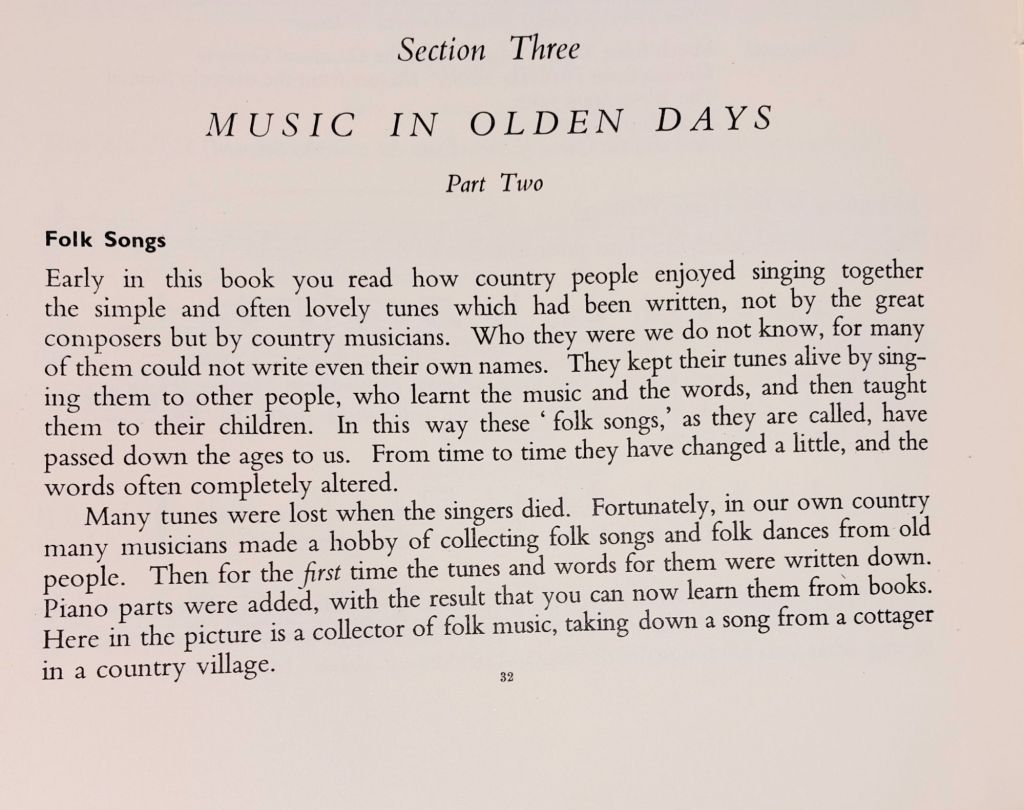
Meanwhile, diving straight into the history, children were immediately introduced to the concept of folk music.

This is an English book, but I only recognised two of the three songs from my own school days. ‘The Carrion Crow’ wasn’t one I knew.

I’m delighted to find that kids were also introduced to the role of a song collector.  Although I have to say that the child in the foreground on the right looks bored and unimpressed by the proceedings, in the illustration! Still, Nelson’s editors presumably commissioned the illustration rather than use a stock image, so they’re due some credit.

The song collector

They’re still holding onto the idea that folk music came from country folk. I wonder if pupils ever asked what city folk sang?!

Of course, it wasn’t all folk music.  Kids were also introduced to the likes of Brahms, Handel and Purcell. Today, I imagine only examination classes would have textbooks introducing the classical greats.  On the other hand, more time is probably spent on world music, and efforts are made to consider music by women and people of underrepresented communities.  Times have moved on!

Nonetheless, it’s interesting to see how much knowledge children would have acquired in general classroom music lessons, and to compare it with modern times.

Even the books are brighter and more appealing today, I must admit!

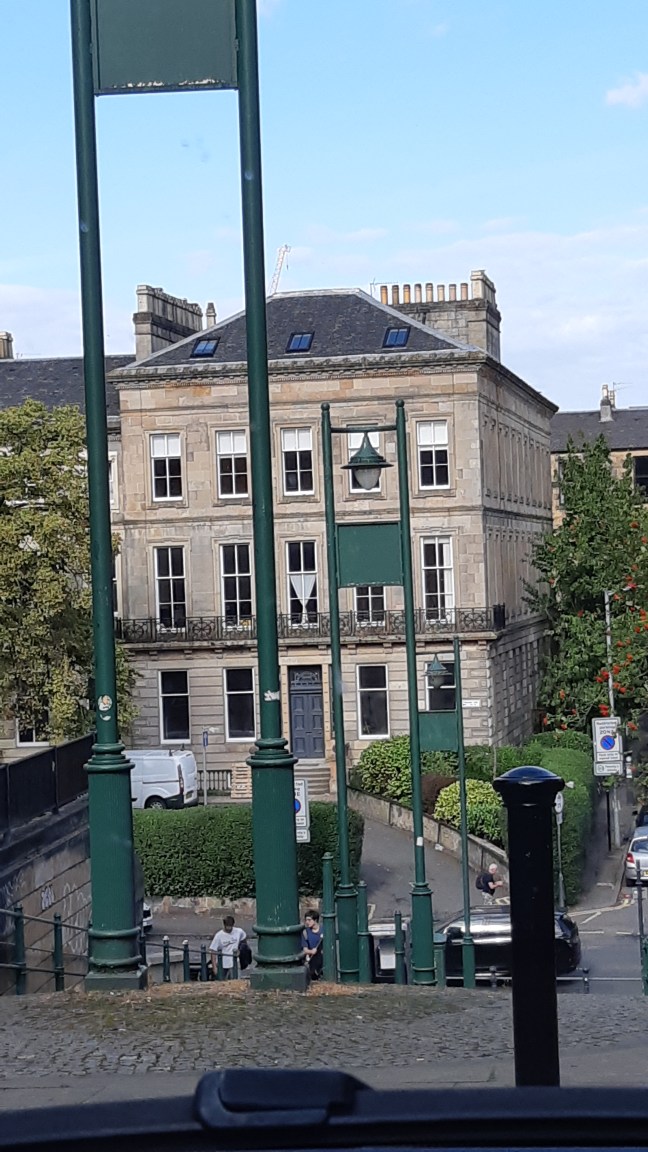
The Glasgow and West of Scotland Conservatoire of Music

It was a lovely sunny afternoon, and we felt like going out.

Let me show you the Glasgow & West of Scotland Conservatoire of Music (1889-1892). Musician Julius Seligmann had been running a girls’ school in the premises for some years. Aged 72, he reinvented it as the Glasgow & West of Sotland Conservatoire of Music! It only survived three years – it has absolutely no connection with today’s Royal Conservatoire of Scotland.

After that he went on teaching not only from his home (not far away) but he and his son also taught in the new Athenaeum School of Music. That institution did survive, eventually becoming the Royal Conservatoire of Scotland where I work today.

And does Mr Seligmann have anything to do with Glasgow music publishers? Not a lot, to be honest. But he did write a review for James S. Kerr’s Pianoforte Tutor.

Curation and Documentation

In our research into the legal deposit music collected in British libraries during the Georgian era, a key thread is obviously the histories of individual collections between then, and now.  Two hundred years is a long time, so contemporary evidence is significant.

For example, in 1826, the pseudonymous Caleb Concord wrote in the (short-lived) Aberdeen Censor that the students at Aberdeen’s Marischal College should be more concerned about what had happened to the legal deposit music that had been claimed by Aberdeen’s other higher education institution, King’s College.  Corroborating this, Professor William Paul, who had once been librarian at King’s College, told an official commission in 1827, that he believed some of the music had been sold at some time before he went to the college, ie, before 1811.  (Commissioners for Visiting the Universities and Colleges of Scotland, Evidence, Oral and Documentary, Taken and Received by the Commissioners … for Visiting the Universities of Scotland.  Vol.4, Aberdeen (London: HMSO, 1837).  There is evidence for Stationers’ Hall music having been sold at Edinburgh University in the late eighteenth century, too.

In St Andrews, by contrast, there are not only archival records documenting senate decisions about the library, but also the borrowing records, which I’ve written and blogged about quite a bit over the past couple of years – not to mention the handwritten catalogue by a niece of a deceased professor of the University.  A payment was made to her in the 1820s, but the catalogue continued to be updated until legal deposits ceased to be claimed by the University in 1836, when the legislation changed. (Miss Lambert married and moved to London in 1832, so the later years were not completed by her.)

Bibliographic Control

In the middle few decades of the nineteenth century, some of the libraries began to attempt better control and documentation of their music.  However, I don’t propose to write about every legal deposit library in this posting, because my main reason in writing today is to share a small but interesting excerpt from William Chappell’s first book about English national songs.  Now, in my own doctoral thesis and subsequent book, I focused on Chappell’s later work, Popular Music of the Olden Time (1855-1859), and its later iteration, Old English Popular Music.  I mentioned that PMOT had grown out of his earlier Collection of National Airs (1838-1840), and I highlighted a few key features of that work.

A Rare Find

2018-08-17 11.12.52Today, sifting through a library donation of largely 20th century scores, I was astonished2018-08-17 11.15.05 to lift two obviously older volumes out of one of the boxes.  We’re now the proud owners of the third set of Collection of National Airs known to be held in Scotland.  Since I haven’t looked at this title for a decade or so, I leafed through both volumes briefly, to remind myself what they were like.  (The volumes had belonged to a Mrs Chambers, and either she or a young relative had practised their drawing skills on the flyleaves, but we’ll overlook those for now!)
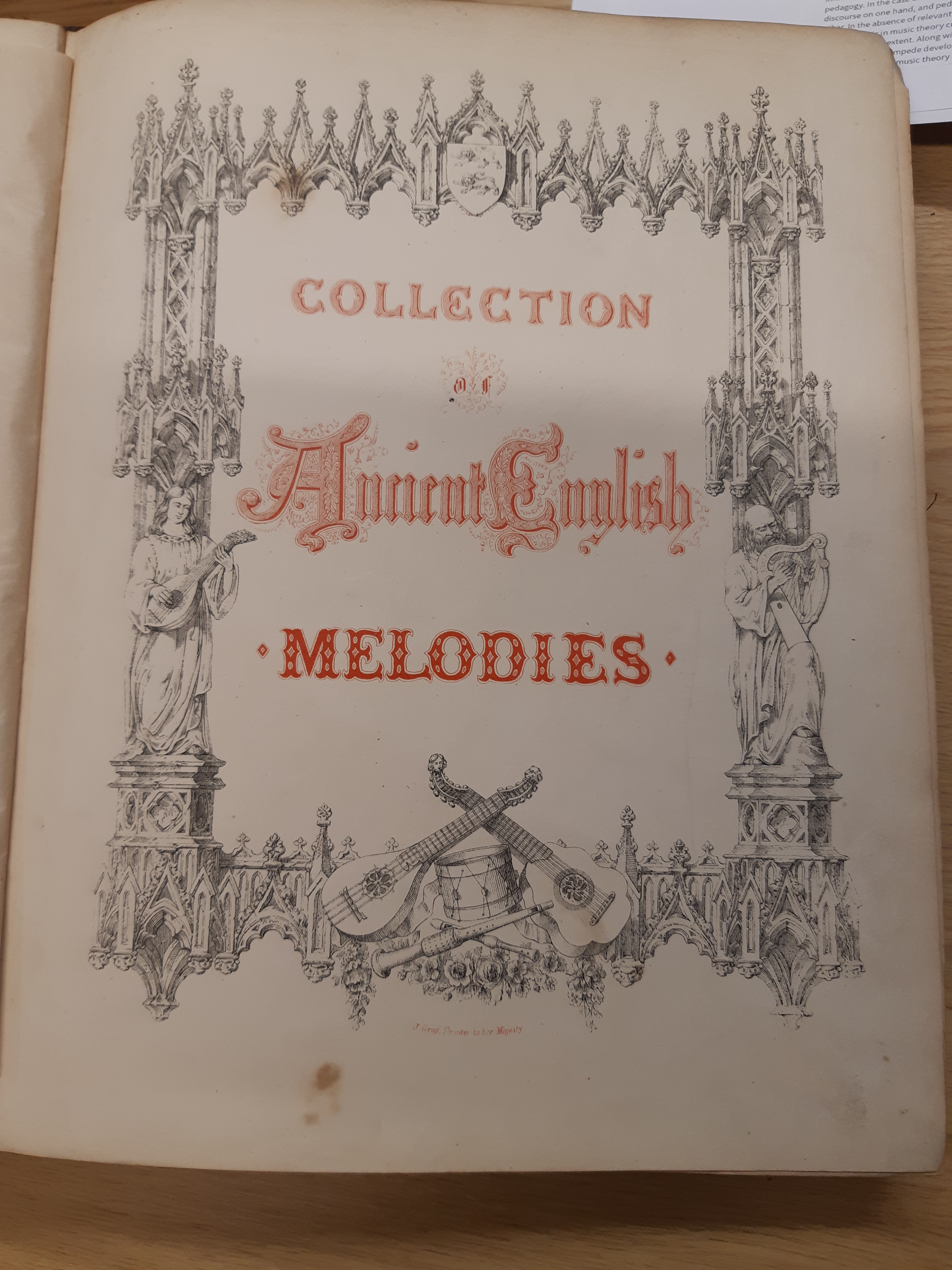
2018-08-17 11.13.56Chappell’s work is in two volumes: the first contains the subscriber’s list and a preface, with the rest of the volume devoted to the tunes themselves. The second volume contains commentary, winding up with a conclusion and then an appendix.
England has no National Music

The preface opens with the words which have echoed (metaphorically speaking) in my ears since I first read them:-

“The object of the present work is to give practical refutation to the popular fallacy that England has no National Music,- a fallacy arising solely from indolence in collecting; for we trust that the present work will show that there is no deficiency in material, whatever there may have been in the prospect of encouragement to such Collections.”

Of course, Chappell was preoccupied with national songs (“folk songs”) and ballads – as was I, at the time I first read it.  So I hadn’t paid attention to a footnote later in the Preface.  But, as I read on, there it was – William Chappell commenting on the legal deposit music in what is now the British Library!  It is clear that the music – in Chappell’s eyes, at any rate – was in need of organisation.  (We now know that  it was much the same in Oxford, Edinburgh or Edinburgh’s Advocates’ Library – the forerunner of the National Library of Scotland.)

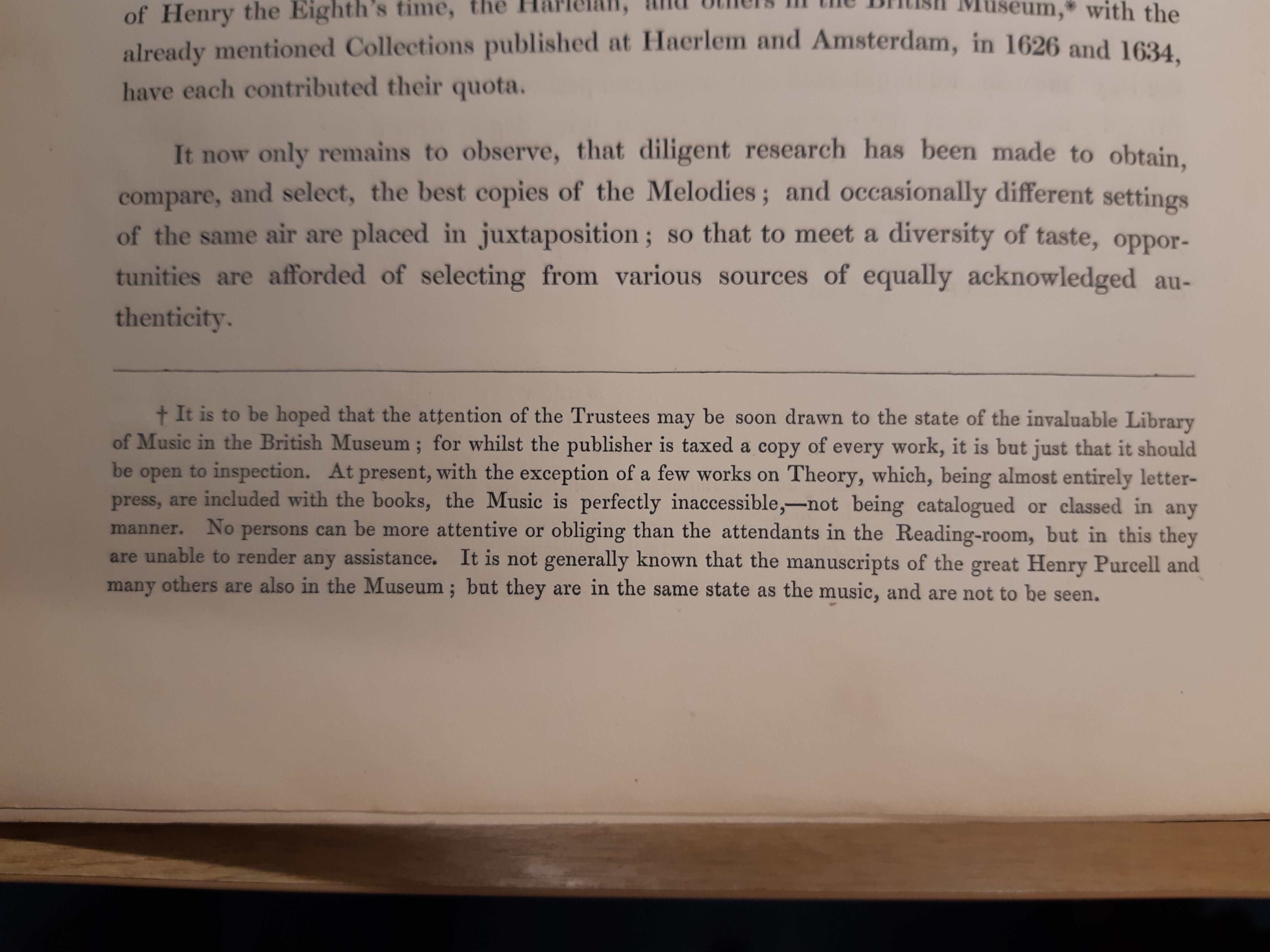
On page iv, Chappell named various key collections of British tunes, naming the British Museum (the forerunner of our British Library) as the repository for some of these collections.  A footnote afforded him the chance to make an aside about the contemporary custodial arrangements there.

Attentive, Obliging … Inaccessible, Not Catalogued

It is to be hoped that the attention of the Trustees may be soon drawn to the state of the invaluable Library of Music in the British Museum; for whilst the publisher is taxed a copy of every work, it is but just that it should be open to inspection.  At present, with the exception of a few works on Theory, which, being almost entirely letterpress, are included with the books, the Music is perfectly inaccessible, – not being catalogued or classed in any manner.  No persons can be more attentive or obliging than the attendants in the Reading-room, but in this they are unable to render any assistance.  It is not generally known that the manuscripts of the great Henry Purcell and many others are also in the Museum; but they are in the same state as the music, and are not to be seen.”

2018-08-17 11.09.45

Changing the subject, it’s interesting for us as modern readers to note that Chappell’s conclusion at the end of the second volume winds up with a sorrowful observation about the decline in musical education, since an unspecified time when music was a key part not only of a young gentleman’s education, but also of young children’s.

Merry England

“The Editor trusts, however, that he has already satisfactorily demonstrated the proposition which he at first stated, viz. that England has not only abundance of National Music, but that its antiquity is at least as well authenticated as that of any other nation.  England was formerly called “Merry England.”

Music taught in all public schools

“That was when every Gentleman could sing at sight;- when musical degrees were taken at the Universities, to add lustre to degrees in arts;- when College Fellowships were only given to those who could sing;- when Winchester boys were not suffered to evade the testator’s will, as they do now, but were obliged to learn to sing before they could enter the school;- when music was taught in all public schools, and thought as necessary a branch of the education of “small children” as reading or writing;- when barbers, cobblers and ploughmen, were proverbially musical;- and when “Smithfield with her ballads made all England roar.” Willingly would we exchange her present venerable title of “Old England,”, to find her “Merry England” once again.”

Chappell should read the commentary in today’s social media about the self-same topic!