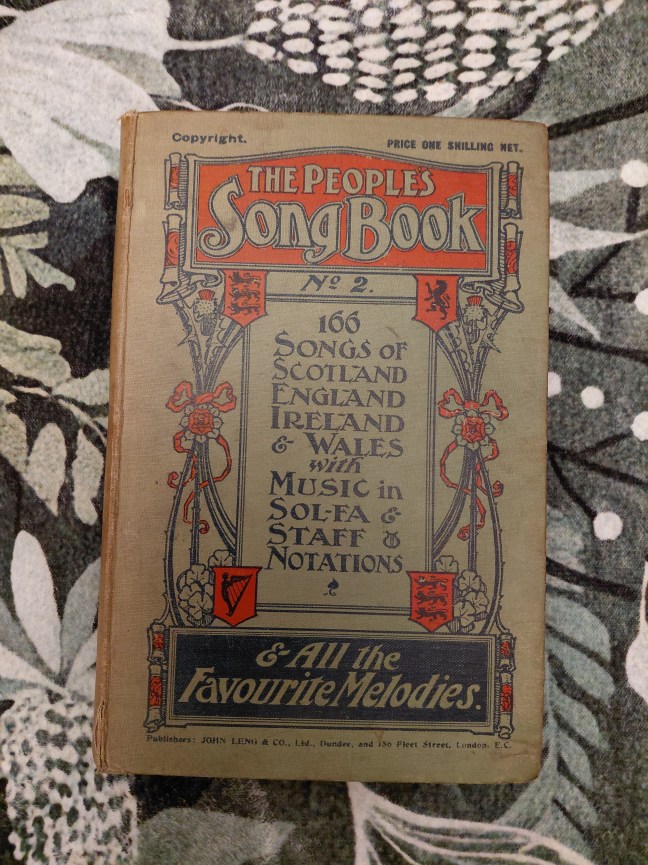
The People’s Song Book No.2 (published by John Leng)

It stands to reason. If I’m researching the John Leng Scots Song competitions, then I might also be interested in this firm’s publications. Not, of course, that there’s any direct link between Leng’s trust fund and the firm’s later publications.  They published general material, magazines and newspapers, and only a handful of music titles.  However, this means that what music they did publish would be of a kind suited to the mass market. 
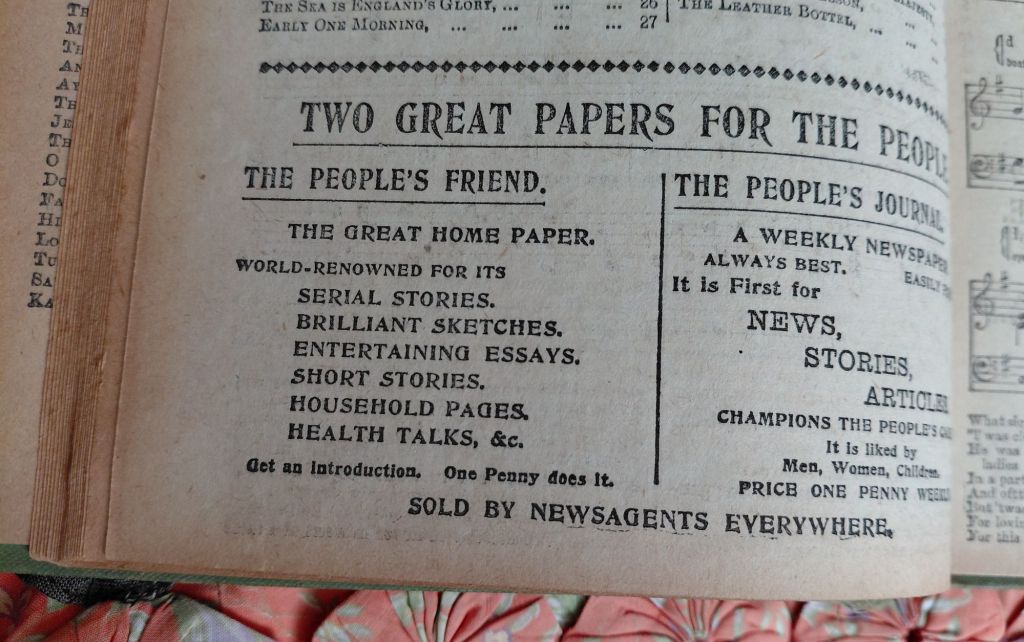
‘For the people’

Is it any surprise that, amongst the ‘Aunt Kate’s’ housekeeping and embroidery books, there might also be dance music and national songs? Which of course indicates their recognition of how popular national songs actually were.
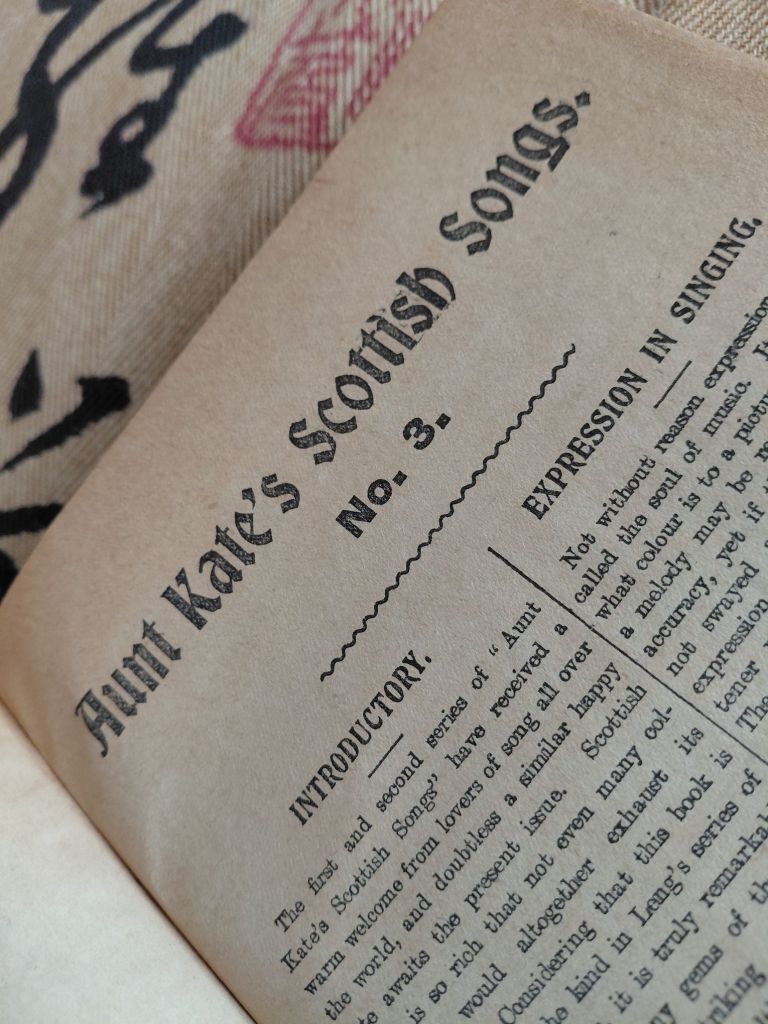
The mythical ‘Aunt Kate’ enjoyed a song!

This week, I bought the second volume of The People’s Song Book, published in 1915. It’s quite an attractive little book, containing 32 Scottish, 33 English, 35 Irish and 34 Welsh songs.

There’s also a section with 32 of the now distasteful genre of ‘minstrel’ songs at the back – blackface minstrelsy, not the homegrown wandering minstrel variety. They are described more insultingly than that, as was the unfortunate custom of that era.

Curiously, these are indicated as a third series of English songs, lower down the page.  (The second series appeared after the Scottish songs.  Remember, this was the second book, so the ‘first series’ of English songs is presumably there.)

Today, we recognise the English and American origins of the minstrelsy repertoire, but I doubt the compilers were hinting at that.  I have written at some length about such songs in my recent monograph – what’s in the present book is no different to those in the collections I’ve already examined.

Notwithstanding this – because we have to recognise that the book is a product of its age, whatever our more informed modern opinion – it would be a strange scholar that acquired book 2, but wasn’t curious about book 1, so I’m excited now to be repatriating the first volume from Virginia.  Perhaps some expat took it with them in their trunk, or had it sent to them as a keepsake?  And now it’s coming home – it feels appropriate.
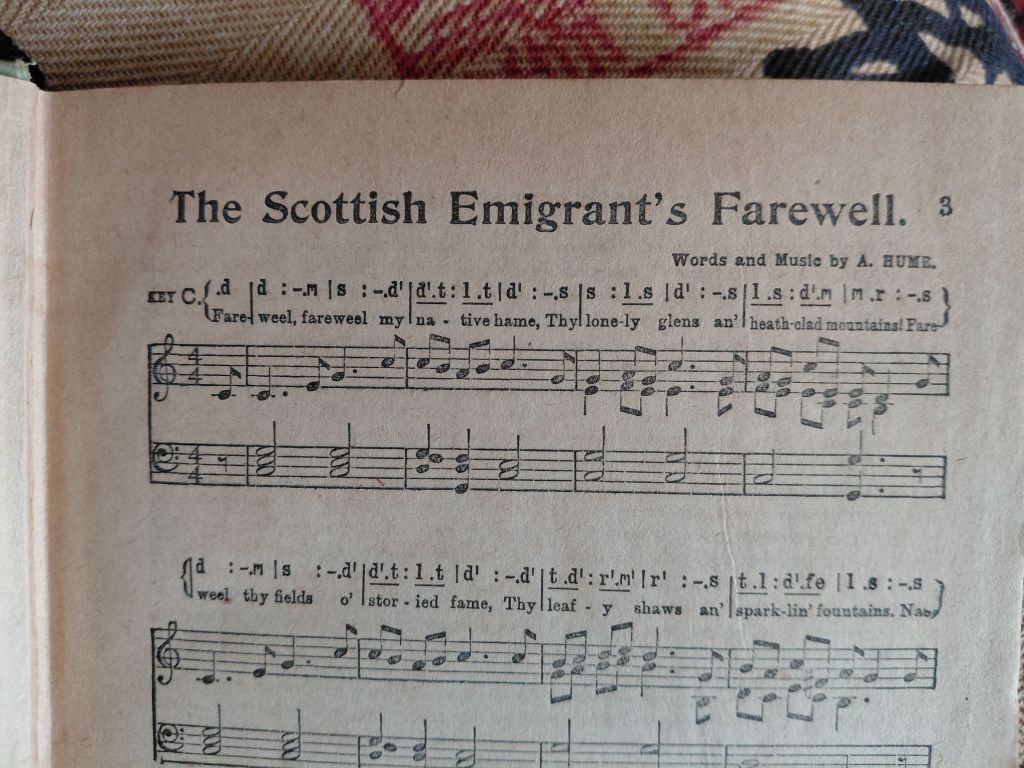
First song in the 2nd book – emigration!

The funny thing about Virginia  – on a completely unrelated note – is that, a quarter of a century ago, I attended a librarianship interview in Richmond. I didn’t succeed  – but I did start my doctoral studies at home in Glasgow, a year or two later.  None of what I’ve subsequently done, would have been done at all, if I’d become yet another emigrant like those of a century before.

And now a little national song book is making its way home to me.  I’ll be sure to make it welcome!

And More?

Book 1 may answer an intriguing question that arose yesterday. I’m impatient!

YouTube video of my recent RCS Exchange Talk

I’ve linked to this on my Publications page as a permanent record, but if you’re interested, you can see my talk on YouTube now:-

Engagement activity: RCS Exchange Talk, Monday 29 January 2024: ‘From Magic Lantern to Microphone: the Scottish Music Publishers and Pedagogues inspiring Hearts and Minds through Song’ – YouTube recording

Do You Own This Songbook?

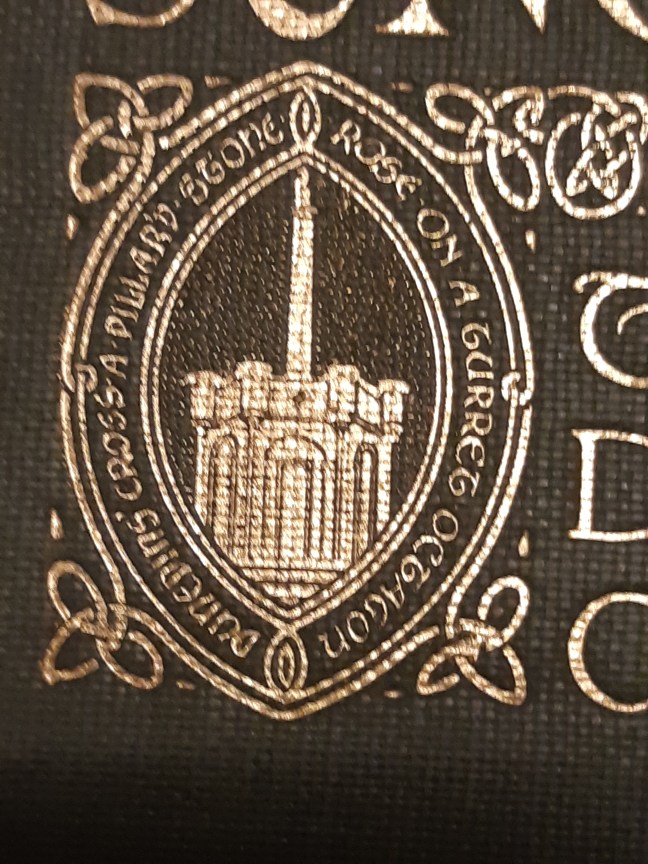
Song Gems (Scots) front cover
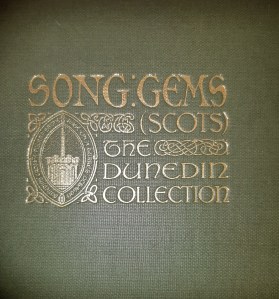
Song Gems (Scots) whole cover

If you’ve visited this blog before, you’ll know I’m writing a history book about Scottish music publishers. (58,000 words and rising!) But I’ve reached a point where I’m writing about a book COMPILED by Scots, PUBLISHED in England, but also DISTRIBUTED from Edinburgh and Boston, Massachusetts.

I know a lot about the anthology (as I should – I’m writing about it!), but I’m curious about its life in the Scottish diaspora – in other words, anywhere else in the world where Scots emigrated.

The Boston agent of the book was Thomas J. Donlan. His address was Room 831, Colonial Building, 100 Boylston Street, Boston. He moved to New York some time between 1910-1915.

Song gems (Scots) : the Dunedin collection

Authors: James WoodLearmont Drydsdale

Print Book, English, 

Publisher: Vincent Music Co, London, 1908

WorldCat bibliographical details

Now, I know from WorldCat and Jisc Library Hub Discover, that there aren’t many copies in libraries. My interest is more to see if there are many copies out ‘in the wild’ in people’s homes, and obviously it would be nice to discover that Mr Donlan imported and distributed lots of them. It was more of an ‘art music’ book than a book of simple folk melodies. The repertoire is non-standard. You’d probably have owned a piano, and been quite a good pianist – or had a good pianist to accompany your singing.

I’m not looking to buy copies – my own came from a dealer under 40 miles from Boston, and I don’t need another! I’m not a bookseller. I am literally just curious to find out if there are many survivors hiding in piano stools and under-stair cupboards. If you’ve got a copy, I’d love to hear from you!

Maybe you haven’t got this book, but you know more about Donlan the agent? If you are aware of archival data, please do let me know. My book is about Scottish publishing, but there’s room for a paragraph or two about the American distributor, if more information came to light. (I’ve already discovered that Colonial Building also housed the Colonial Theatre, and that there were a lot of music shops along the street – indeed, I know which organisation occupied room 831 after Donlan, and that’s another fascinating story, but really I can’t pursue that – it has nothing to do with Scottish music publishing!)

POSTSCRIPT, July 2024. This song-book is the subject of a chapter that I have contributed to an essay collection published by Lang, that is due out later this year.  It also gets mentioned in my own forthcoming monograph, again due out later this year. Do follow this blog if you want to keep updated!