


A whole room? Virginia Woolf asked too much. I sit at my desk in an alcove – an early Edwardian bed-recess, to be accurate – and from my vantage point, I survey the rest of the room. The smell of roast dinner – my efforts – drifting through from the kitchen. The ironing awaiting my attention. The table waiting to be laid. (I’m neither going to explain nor apologise why it’s all mine.) The piles of books which are meant to help me finish Chapter 6 and commence Chapter 7, but which I won’t be going near until later tonight or perhaps tomorrow. After all, tomorrow is the start of a week’s annual leave – so what could be more natural than to write? It can be hard to settle down to intellectual work with so many demands on my time, particularly when I’m technically seconded to be a scholar for just ten and a half hours a week. And yet, if I don’t take myself seriously, then how can I expect anyone else to?
Great Expectations?
Do people still, in 2023, have lower expectations of women? I grew up in a middle class family, simultaneously encouraged to do my best, remain modest, and not get upset if I was unsuccessful. Does that sound contradictory? When my 11-plus results came through the letter-box, I was warned, ‘Don’t be disappointed if you haven’t passed’. I got a County Scholarship to the best girls’ school in my home city. When I look back at my schooldays, there is one aspect for which I’m very grateful. It was an all-girls school, and I expect there probably were fewer distractions without boys around, but that’s not my point. My abiding memory is that there was NEVER any doubt, not the slightest shadow of a doubt, that girls could achieve every bit as much as boys. Indeed, it came as a bit of a shock at university to discover that there were boys who expected to be better than the girls. How could this be? We were equal, I’d been brought up to believe that, and I wasn’t intending to be bested.
One thing led to another, until I embarked on a PhD. ‘You’d better do secretarial training next, dear. In case you can’t find a job.’ Well, we compromised there – I took typing classes, so that I’d never again have to pay what it had cost to get my Master’s dissertation typed. (This was long before people had their own computers – yes, I’m that old. I learned on a manual typewriter.)
I didn’t complete that doctorate, which is largely my own fault – I started librarianship training before completing the PhD. Yes, it was a stupid move! However, academia didn’t appeal to me at the time – I had absolutely NO female peer models, was offered NO teaching opportunities, never so much as considered giving a conference paper; and was told by everyone (everyone being male, since there were no other women academics in my department, and precious few in the conferences that I attended) that it was virtually impossible to get even a short-term postdoctoral fellowship. I accepted this unquestioningly. It was the 1980s. I now ask myself, how would I have known, without trying? And surely it couldn’t have been harder than it is today!
I’ve already told the story of my much later part-time doctoral studies on a different topic, whilst working full-time and raising three children. (If I could do that, I could have completed the first one …. but let’s not go there!) When I asked about doing a PhD at work, I understand one of the academics queried why I would even want one.
‘What does a Librarian want with a PhD, anyway?’
I wanted it because I knew I was capable of it! Apart from which, I had just finished paying for nursery fees, and it was a perfectly logical time to divert those funds to something else worthwhile. I finished my PhD in 2009. I’ve turned it into a monograph, written a number of papers and articles, managed to get grant-funding once in my own right, and am currently completing my second monograph. I might be a part-time scholar, but I don’t consider myself a second-rate one. I am geographically restricted, true, but my achievements in 1.5 days a week are pretty good, though I say it myself. And I’m going to be a visiting postdoctoral fellow in the autumn – I can’t tell you how delighted that makes me!
Modesty
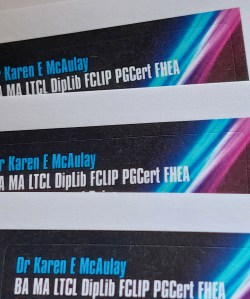
There are times when I feel I’m an embarrassment. ‘Are you writing fiction, or a Boring Book’, asks an elderly relative. Guilty as charged. And again, ‘You shouldn’t have your letters on your address labels, dear. No-one needs to know them – it’s just showing off.’ But what’s the point of being well qualified if no-one knows you are? ‘They said they didn’t want a string of useless qualifications like yours.’ Mmm, thanks!
In Scotland, there’s a phrase, ‘I kennt his faither’, which basically means, ‘I know his background – he’s nothing special and he shouldn’t have ideas above his station.’ I’m not Scottish myself, but I feel I’ve been on the receiving end of this attitude so often! She’s a librarian – why can’t she just be one?
Owning our Own Work
Last week, there was a conference in Glasgow. I didn’t speak at it – I was asked to, then uninvited six months later, for some unclear administrative reason. (I’m pretty sure it wasn’t anything personal!) I didn’t even get told about registration for the event. But to my surprise, I understand that the topic I was to have talked about, did get talked about. I’m grateful that the topic came up, and grateful if my peer-reviewed article was alluded to, but somewhat disappointed that it was relayed by a third party. Was the link shared? Will anyone be able to find it? Obviously, I was denied the chance to take questions, since I wasn’t even present.
Representation of Women Composers in the Whittaker Library’, Journal of Perspectives in Applied Academic Practice. Vol. 11 No. 1 (2023): Special Issue on Breaking the Gender Bias in Academia and Academic Practice, pp.21-26. (Paper given at the International Women’s Day Conference hosted by the University of the Highlands and Islands, 2022.) DOI: https://doi.org/10.56433/jpaap.v11i1.533
What do I mean, when I say that we women should ‘own’ our work? In an employed work context, ‘owning’ seems to mean taking responsibility for seeing something through to the end, but I suggest that actually it can, and indeed sometimes should mean more than that. I’m not thinking about ownership in the sense that a manager assigns you a project and empowers you to make all the necessary decisions to ensure its success, although that kind of ownership is certainly very agreeable. No, what I actually mean is that if you’ve done a significant piece of work, with results that are important enough to be worth sharing, then we should be much less reticent about saying, ‘Thank you, I am proud to have seen that through, and I wish to claim acknowledgment. Here’s where you can read my article. I’m happy to take questions. And if you’re interested, here’s where you can find more of my writing.’
No Apologies
So from that point of view, I’m resolutely determined that I will not apologise for having been ambitious. I will not apologise for realising that librarianship was not my sole raison d’etre, and that research had a louder, more urgent call for me. ‘You’re a bloody librarian, woman!’, I was once told. That, with respect, is incorrect. I’m a librarian and a scholar, inseparably. The librarian benefits mightily from the scholarship, the scholar has bibliographical skills second to none, and the combined finished product also provides pretty top-notch guidance about research skills.
I will not denigrate myself by fading into the background, nor by pretending I don’t have a string of qualifications after my name. Who do I think I am? I know who I am.
I have read about women scholars who always get humdrum administrative tasks dumped on them in their departments. (That hasn’t happened to me – I just sit and catalogue stuff on my librarian days, until I could scream with the tedium. It’s not a sexist thing, just an annoyance.) I’ve also read that when it comes to job applications, men are much more likely to apply for things where they might lack some of the required experience, whereas women will hesitate unless they can tick every box.
Women, we need to ‘own’ our achievements. There’s no sense in being reticent or humble. The other half of the human race aren’t going to give us a chance because we’re nice, gentle and conciliatory, or indeed because we let them go first.
I made a few adjustments to my Twitter profile today. Take a look at yours, and see if it does you justice!
My next post is about career women, ageing, and approaching retirement. Read on! https://karenmcaulaymusicologist.blog/2023/05/23/58-weeks-to-go-how-is-this-meant-to-feel/



 Karen McAulay, Musicologist