Book History: Scottish Airs in London Dress

Before establishing the Claimed From Stationers’ Hall network, I was a postdoctoral researcher on the Bass Culture project, which looked at Scottish fiddle tune collections largely from the Georgian era.  In that context, I read a paper at Musica Scotica in Spring 2014, about a couple of London-published music collections.  It has finally been published in Scottish Music Review Vol.5 (2019), 75-87, this week.

Sometimes when we look back at earlier work, we wonder if we’d have written it differently today, but I’m still pretty happy with this article.  If anything, I think it justifies my claim that the history of this kind of collection does indeed deserve to count as “book history”, even if it is music rather than literature. So, here it is for your enjoyment:-

Scottish Airs in London Dress: Vocal Airs and Dance Tunes in Two Eighteenth-Century London Collections

And … Send!

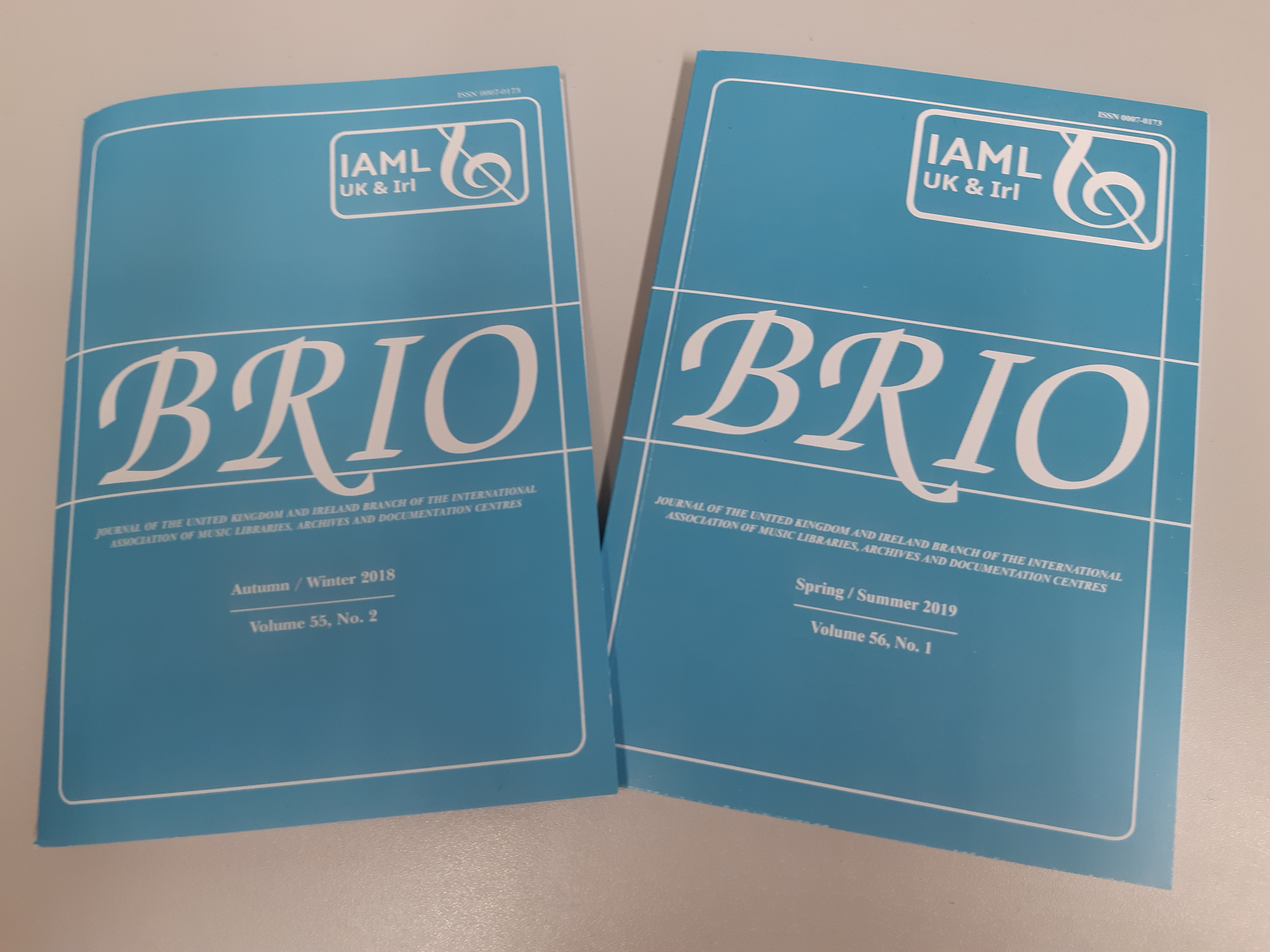
2019-08-08 10.06.13That’s it, folks.  Martin and I have given the Brio “Special Issue” proofs the final thumbs up, and they’ve gone off to the printer.  No going back now … your special issues are well and truly on their way.  (They look slightly different to those pictured here, but I won’t spoil the surprise!)
I Wrote a Grant Application …

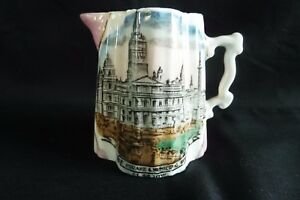
Of course, it’s a highly competitive world out there. I can’t attempt to rate my chances. But I rewarded myself for getting it written and submitted on time, by ordering a wee Victorian Glaswegian souvenir jug. And we’ll see what unfolds!

Where are they now?

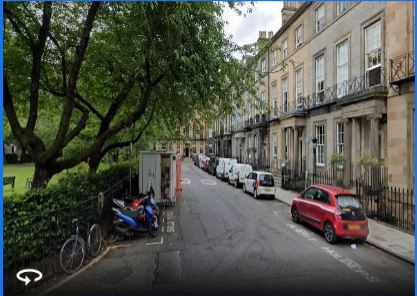
Meanwhile, I have amused myself by checking out some old Glasgow music publishers’ addresses. I wasn’t sure where they all were. And although the streets are still on the map, it was a strange feeling to see that places where businesses once thrived, have generally been replaced or kind of left behind by the passing of time. Only three addresses seem generally unchanged. Another – just a green patch of land – is on my morning bus-route, right beside an old public library.   (Physical and cultural landscapes have one big thing in common – they do change as the years go by!)


Book Reviews

Network members are enthusiastically typing away at the moment, as the deadline for our Brio special issue looms closer!  I’ve done a couple of book reviews, and have one more to tackle.  Today, I was thinking about matters as apparently disparate as copyright, romanticism, bootlegging and modern recording techniques.  Does that sound weird or intriguing to you?  I thought it was an excellent book – but you’ll have to wait until the next issue of Brio to read my review!!

Chapter in EFDSS Conference Proceedings

Dr Sue Allen has just alerted me to the very recent publication of the EFDSS conference proceedings we both contributed to. We each have a chapter in this great new folk song publication, from new publishing co-op The Ballad Partners. Only £12 plus p&p online from EFDSS Folk Shop:-

Old Songs, New Discoveries

  • Sue’s tweet gives pagination for the contents of the book, here.
  • Vaughan Williams Memorial Library catalogue entry here.
  • ISBN: 9781916142411.

So, suddenly there’s a new entry for our CFSH bibliography, too … 👍 (Now uploaded as the 7th Edition!)

  • McAulay, Karen, ‘National Airs in Georgian Libraries’, pp.104-114

Networking with Other Networks: Women’s Book History

Mrs Bertram by David Octavius Hill
A CFSH subject herself, Mrs Bertram by David Octavius Hill

How I’ve managed to get through this networking project to date without encountering this group is beyond me, but now I’ve found them on Twitter, I want to share their details with other Claimed From Stationers’ Hall network members:-

WomensBookHistory

@GrubStreetWomen


“Bibliography of sources on women’s writing and labor. We tweet CFPs, conferences, etc. in gender and #bookhistory#dh & textual studies.”

Pomona, CA

womensbookhistory.org

So there you are – introductions performed!  I look forward to following the twitter feed and shall keep an interested eye on the website!


The Wrath of George Thomson Revealed!

Back in January, I started thinking about the repurposing of tunes by Georgian composers – whether arrangements, piano variations or other interpretations.  Rossini particularly came to mind, because his operatic airs were so very heavily used – but it wasn’t just Rossini’s rights that intrigued me – what about all the other instances of repurposed tunes?  I blogged, and then I threw the question open to the Claimed From Stationers’ Hall network, and – as I’ve already posted – Paul Cooper of RegencyDances.org and German folklorist Jürgen Kloss enthusiastically joined in the discussion, sharing some useful links to articles and postings that I’ve since incorporated into the 5th edition of our bibliography.

George_Thomson_(1757–1851)_by_Henry_Raeburn_(1756-1823)
George Thomson, by    Henry Raeburn

The conversation continued.  Last week, Jürgen shared evidence that Scottish music publisher George Thomson became very concerned by the upstart Joseph Dale pirating piano music by Ignaz Pleyel that he, Thomson, had originally published.  (I’ve used the Copac spelling of Pleyel’s forename here.)

German folklorist Jürgen’s thread was so intriguing that I offered to blog it in its entirety, and what follows is his input.  I’d like to thank him for so graciously allowing me to reproduce his narrative on this blog.

Guest Blogpost by Jürgen Kloss

Kloss Hennef


Kloss 1 Morning Chronicle Thomson warning re Dale
Morning Chronicle, 27.3.1794, BBCN

@juergenkloss (Jürgen Kloss) 12 Feb:  Further to our early copyright discussions as to who “owns” the music?,  I found this ad: “Musical Imposition”, in which George Thomson – editor and publisher of Scottish songs – warns against a “spurious” ed. of sonatas by Pleyel, publ. by J. Dale:-


Kloss 2 Dale advertisement
OAPA, 12.3.1794

Indeed, Thomson regarded Dale’s ed. (ad in OAPA, 12.3.1794) as an attack on his own investment: “G. Thomson, who, having paid a very great price to Mr. Pleyel, for the property of these Works, will certainly defend his right against every attempt, however artful, to deprive him of it.”


Of course Mr. Dale kept on publishing these works: Twelve Grand Sonatas for the Piano Forte or Harpsichord […] In Which are Introduced a Variety of Scotch Airs, Book 2 (1798) (this copy in the University of Iowa Digital Library):- http://digital.lib.uiowa.edu/cdm/compoundobject/collection/pleyel/id/8775 … And he claimed to have the original editions:-

Kloss 3 Pleyel published by Dale
Pleyel – Twelve Grand Sonatas

Even several years later, in some editions of his Select Collection, Mr. Thomson still warned against the “wretched imitation” published by Dale.

Kloss 4 Thomson later warning

https://archive.org/details/selectcollection00pley/page/n9 … 

Kloss 5 Reeve and Braham Robin AdairAnd here’s another disputed instance: that of “Robin Adair”.  (See Jurgen’s blog of 2014, link below.)  This old tune was revived in 1811. Composer William Reeve wrote a new arrangement and John Braham sang it with a new text. The new “Robin Adair” was a great hit…  https://hummingadifferenttune.blogspot.com/2014/02/john-brahams-robin-adair-1811-original.html … 

…and of course other publishers quickly offered their own editions. But Mr. Reeve sent letters to newspapers warning against “spurious” editions. This letter even appeared on the title-page of the sheet music, see below: https://archive.org/details/sheet-music-RobinAdair-Braham-London1812 …

Kloss 6 Reeve about copyright

Interestingly, composer J. Mazzinghi couldn’t resist publishing an answer to Mr. Reeve’s claims in his own edition of “Robin Adair”. He said it was a big success because of the tune and Braham’s performance (and Reeve had no rights to the song)! http://digitalcollections.baylor.edu/cdm/ref/collection/fa-spnc/id/8566 …

Kloss 7 Mazzinghi

Of course: songs are money, especially popular hits like this one. Later it was claimed that “in one year, […] upwards of two hundred thousands copies” of the sheet music were sold. Therefore it is understandable that Reeve was a little bit nervous about competing editions:-

Kloss 8 Aileen Aroon

There is much fascinating detail to absorb in these stories that  Jürgen has generously shared with us.

MAYBE YOU’D LIKE TO LEARN KNOW MORE?

Jürgen’s newspaper references are available via these electronic resources:-

Kloss sources

Kloss HennefJürgen also traced a reference to a paper that Claire Nelson gave at the International Musicological Society’s 17th Congress in Leuven, in 2002.  Here’s the abstract:-

Claire Nelson paper International Musicalogical Society 17th Congress 2002 Leuven

The paper wasn’t published in its entirety that year – just the abstract, in the conference programme above – but the good news is that it became a chapter in Nelson’s doctoral thesis in 2003, when she completed her DMus at the Royal College of Music.  The thesis can now be downloaded free of charge via the British Library’s EThOS service.

Nelson, Claire M., Creating a notion of ‘Britishness’ : the role of Scottish music in the negotiation of a common culture, with particular reference to the 18th century accompanied sonata (Royal College of Music, 2003, Access from EThOS:-                     https://ethos.bl.uk/OrderDetails.do?uin=uk.bl.ethos.489910         

Go to page 240 of Nelson’s thesis to read more about George Thomson’s disgust at Joseph Dale’s shameful piracy.  She quotes (and provides an English translation) from a letter that Thomson wrote to Pleyel in 1794:-

“Dale has done something most shameful and most offensive. He has published three sonatas with Scottish airs, exactly on the same plan as mine, and their title is engraved in the same way and almost in the same words, your name is given as the composer! His intention is evidently to deceive the public and without regard to my sonatas, pass a work supposedly of your composition, I have published an advert revealing the fraud, and hope that you have had no part in the work of Dale.”

Thesis footnote 102, translating the French original reproduced in Pincherle’s 1928 article,  (Marc Pincherle,  ‘L’Edition Musicale au dix-huitieme siecle: Une letter de Thomson a Ignace Pleyel’, Musique i (1928), pp.493-498), p.496.


Earlier Claimed From Stationers’ Hall Blogposts that you might enjoy:-


And of course there’s much more to be found in the network Bibliography!

Of particular interest in this context are the articles by William Lockhart ( ‘Trial by Ear: Legal Attitudes to Keyboard Arrangement in Nineteenth-Century Britain’, Music & Letters, 93.2 (May) (2011), 191–221 https://www.jstor.org/stable/41684166 [accessed 31 January 2018]) and Charles Michael Carroll (‘Musical Borrowing: Grand Larceny or Great Art?’, College Music Symposium, 18.1 (1978), 11–18 https://www.jstor.org/stable/40373912 [accessed 12 January 2019]) – but seriously, there is a lot more to read if you’re keen to find out more!  And of course, don’t forget that Jürgen Kloss and Paul Cooper have both written extensively on the subject – their blogposts are also listed in the bibliography, naturally.

(I must confess that I’m eager to download Pleyel’s Twelve Grand Sonatas – whatever the edition! – to see what they’re like, too!)

Research Outcomes

At a time when all researchers earnestly and diligently record and submit outcomes and fishmosaicoutputs for ResearchFish, I wonder how I could intimate the activities that have been initiated for 2019 as well?!  This month, I’ve submitted abstracts in response to FOUR conference calls for papers.  I’ve started thinking about another potential project.  But I’ve also got several things already in the pipeline, written during the research grant for Claimed From Stationers’ Hall – and indeed, a few that have been in the pipeline for much longer than that!  (Inspired by ResearchFish – not that this particular piece of writing has anything to do with my present research – I have just enquired about some encyclopedia entries that I wrote in 2016, and was relieved to hear that publication is (in encyclopedic terms) imminent.  It’ll be good to strike them off my “pending” list!)

Isn’t it frustrating when your outputs are significantly greater than have actually reached fruition or publication!

Ah well, back to ResearchFish, and I’ll see if I’ve missed anything off the present list!

2018 Round-Up: the Scholar-Librarian

Annual Review, 2018

St Pauls SilhouetteI am a Performing Arts Librarian 3.5 days a week, and a Postdoctoral Researcher 1.5 days a week.  In this self-imposed annual review, I’m not listing routine activities conducted in either capacity; it goes without saying that I’ve answered queries, catalogued, delivered library research training to a number of different class groups, attended meetings, and pursued research-related activities and fieldwork.

From September 2017 to September 2018, I was the AHRC-funded Principal Investigator for a new research network, the Claimed From Stationers’ Hall music research project.  Since then, I have continued to conduct research and network with the various scholars and libraries involved with this project, and in the new year shall be pursuing further grant-funding in order to extend the reach of the project.

As someone who continually asks themselves, “Am I doing enough?”, I feel that even I can be reasonably content with this year’s outputs!

  • JANUARY
  • Chaired sessions at Traditional Pedagogies, international conference at Royal Conservatoire of Scotland
  • FEBRUARY
  • Blogpost: Copyright Literacy: Legal Deposit (Copyright Behind the Scenes) – and Scores of Musical Scores  https://copyrightliteracy.org/2018/02/21/legal-deposit-copyright-behind-the-scenes-and-scores-of-musical-scores/
  • Initial iteration of Claimed From Stationers Hall Bibliography, (since updated regularly) https://claimedfromstationershall.wordpress.com/bibliography/
  • Book chapter, ‘Wynds, Vennels and Dual Carriageways: the changing Nature of Scottish Music’, in Understanding Scotland musically: folk, tradition and policy. Abingdon, Oxon: Routledge, p. 230-239.
  • MARCH
  • Claimed From Stationers’ Hall Workshop, Royal Conservatoire of Scotland, (26 Mar)
  • Scottish Library & Information Council (SLIC) From PGCert to PG Certainty: Enabling the Distance Learner (invited talk, sectoral organisation) (March 2018)
  • APRIL
  • IAML(UK & Irl) Annual Study Weekend, invited talk, Pathways, outputs and impacts: the ‘Claimed from Stationers Hall’ music project takes wings
  • IAML(UK & Irl) Annual Study Weekend From PGCert to PG Certainty: Enabling the Distance Learner (quick-fire session) (April 2018)
  • MAY
  • Blogpost based on the session I gave at the IAML(UK & Ireland) Annual Study Weekend 2018 for the IAML(UK & Ireland) blog, http://iaml-uk-irl.org/blog/libraries-reaching-out-distance-learners
  • JUNE
  • EAERN (Eighteenth-century Arts Education Research Network), ‘Claimed From Stationers’ Hall: But What Happened Next?’ (University of Glasgow, 6 June)
  • Romantic Song Network steering group seminar at British Library
  • JULY 
  • IAML/AIBM Annual Congress, Leipzig, ‘A Network of Early British Legal Deposit Music: Explored through Modern Networking
  • SEPT
  • RMA Conference, Bristol, ‘Overlapping Patterns: the Extant Late Georgian Copyright Music Explored by Modern Research Networking’
  • NOV
  • Field-trip to King’s Inns and Trinity College Dublin Libraries, and British Library
  • EFDSS Conference, London, ‘National Airs in Georgian British Libraries’
  • ARLGS (Academic and Research Libraries Group Scotland) Teachmeet at Glasgow University Library – speaker
  • Article, Trafalgar Chronicle, New Series 3 (2018), 202-212, jointly authored with Brianna Robertson-Kirkland, ‘My love to war is going’: Women and Song in the Napoleonic Era’.
  • DEC
  • Article, Information Professional, Nov-Dec 2018, ‘Coffee and Collaboration’ [teaching electronic resource strategies]

Additionally, I have authored 79 blogposts and 5 Newsletters in connection with the Claimed From Stationers’ Hall research project.

Bat printed cup and saucer possibly New Hall £2-00Institutional Repository: Pure.  My profile:- https://tinyurl.com/KarenMcAulayPureInstRepository

I’ve blogged elsewhere about my musical and sewing activities – both essential to me in terms of relaxation and balance!  You’ll find it here:-

https://karenmcaulay.wordpress.com/2018/12/22/2018-round-up-in-creative-mode/

Collage map golden triangles legal deposit

The Elocution Teacher’s Daughter: a Moral Tale

Before you get too excited about the idea of an immoral daughter, I should let you down gently: the moral doesn’t concern this young lady at all – rather, it’s a warning of what a few holiday hours’ google-searching can turn up!

Brown, Mather, 1761-1831; The Battle of the Nile: Destruction of 'L'Orient', 1 August 1798
Battle of the Nile, destruction of L’Orient 1.8.1798, by Mather Brown (Artuk.org)

All I wanted was to find out was the identity of the young lady music teacher who composed a particular song.  A colleague and I are working on a paper about women who composed Napoleonic songs, and I found another which looked chronologically timely, and potentially interesting.  Musically, it truly isn’t a great song in the slightest regard.  The lady didn’t appear to have much clue about harmony, harmonic progressions or satisfactory cadences, and expected her singer to reach a top B twice, not to mention five As!  The British Library has it online – I don’t think anyone will want to perform it, which leaves musicological detectives like me to pore over it and explore its context!

I was curious as to who she was, nonetheless, and equally curious as to the poet who supplied her with the words.  (He probably also published it, since it was later advertised in a novel that he’d published.)  It referenced the Battle of the Nile, and – in a nutshell – the poet believed he’d be able to forget his wounds when his beloved shed tears over them.  It’s a sentimental, human take on the horrors of war – I imagine our young composer would have enjoyed the thought that the protagonist was simply yearning for the sympathetic embrace of his sweetheart.

How the composer encountered the publisher/poet is something we’ll never know.  He was based in London, she in Edinburgh.  Along with literature and a bit of poetry by famous names, he had also already carved a reputation for himself as the pseudonymous “Thomas Little”, editing and publishing illustrated books about – ahem! – romantic love and reproductive anatomy.  (I’m trying not to attract the bots here!)  Shall we just say that the illustrations were detailed, and some years later, one of his books was found being circulated and well-thumbed by the occupants of a prison.  There was also a court-case about the Hansard reporting of this.  John Joseph Stockdale unknown artist image courtesy of British Museum Public DomainAnother of his disreputable triumphs was the publication in 1826 of  a very famous courtesan’s autobiography. Harriette Wilson had been one of Wellington’s mistresses.  So now you know where the phrase, “publish and be damned” comes from – Wellington said it when his identity was revealed.

What does this have to do with a young music teacher composing a setting of a Napoleonic song?  Absolutely nothing!  Her publisher/poet’s first troublesome publication had been released in 1811; perhaps she knew nothing about it.  Her own song was published five years later in 1816.  She married an Edinburgh artist in 1818, probably lived near Dollar in Clackmannanshire when he became art professor at Dollar Academy in 1824, and was widowed in 1829, with three young daughters to look after. (Their only son had died in infancy.)

During her lifetime – before and after marriage – she published ten musical pieces, at least a couple of hymn-tunes, and a melodrama.  Four of her pieces were settings of Scottish songs, and one of them was dedicated to Sir Walter Scott’s daughter, a distant relative.  It’s possible that one of the other songs may also have a Napoleonic theme, but until I go and see the sole surviving copy, I can’t really be sure.  I discovered that she was “a very fine harpist”, but the observation was unreferenced.  (As we all know, you need a CITATION!)

Howe Street Mrs GibsonOne of the hymns – appropriately named with an Edinburgh location – was “Howe Street”, which appeared in Sacred Harmony for the Use of St George’s Church Edinburgh.  You can find this book on IMSLP, or see an abc transcription of the tune on Jack Campin’s Embro, Embro website.  But – as final demonstration that I’ve probably spent too long on the internet today – you can also find the tune used for a psalm-like modern interpretation of a Georgian herbal by scientist Elizabeth Blackwell – with musical adaptation by Frances M. Lynch.  If our lady music teacher doesn’t turn in her grave at the exposure of her Napoleonic poet for what he was, then she will certainly rise to haunt the imaginative interpreters of her psalm-tune!

Curious Herbs (With Mary’s love without her fear)

And the moral of the tale? Sometimes it’s better to take the evidence at face-value.  A composer, a poet, a Napoleonic song – the rest makes for a great day’s Googling, but really has little bearing on the topic in hand!