‘You should find that the system is very user-friendly …’

I wrote an article. Revised it. Revised the revisions. I have no problem with this – it’s all intended to make it a better article, and hopefully it is now better. However, I feel less positive about the mechanics of submitting it! You have to use a platform called Manuscript Central. Manuscript Central is a product of the ScholarOne platform.  (It was owned by Thomson Reuters, then Clarivate and is now owned by Silverchair.  Still with me?) I Googled it, and one journal publisher described it as user-friendly.

I’ve used it before. Indeed, I’ve uploaded revisions before.  But today, I couldn’t work out how to do all my re-revisions within the platform. After much huffing and puffing, I did submit a manuscript. I’m less confident as to whether I submitted it correctly! And I dislike feeling thwarted by technology. It doesn’t encourage me!

Confused – but no hair was torn out!

On the positive side – I normally have the greatest difficulty stopping research activity when I stop being a part-time researcher for the day, but today I was more than happy to close the document. Gently, if metaphorically shutting the door behind me!

On Thursday, I’ll turn to the next article for submission.  Hmm, which platform for this one …?

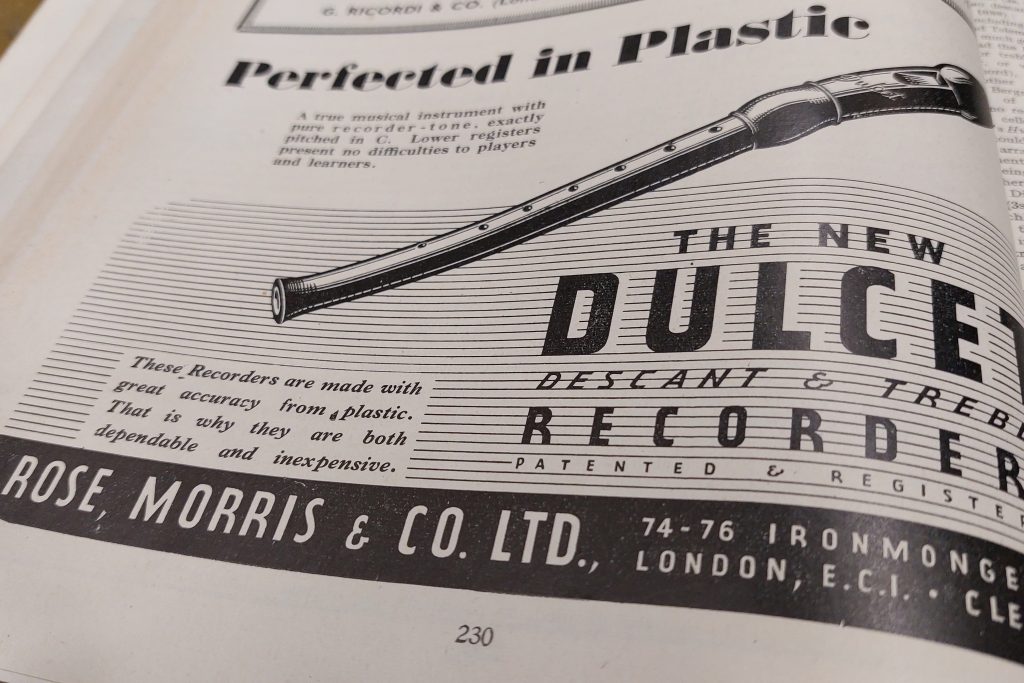
New Technology! From Early Plastic Recorders to Tape Recorders and Long-Playing Records

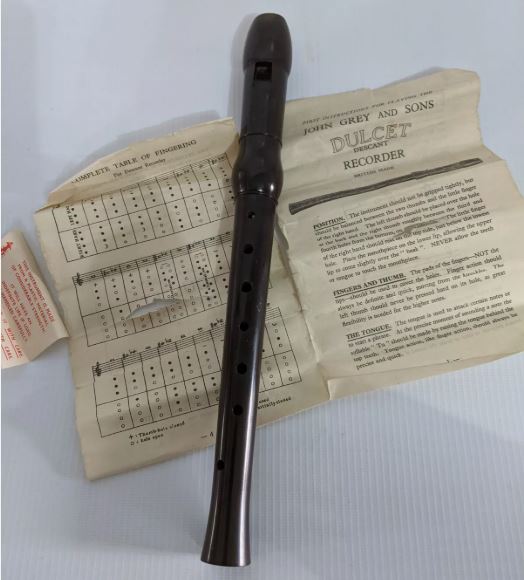
Dulcet plastic recorder by John Grey and Sons

They wondered where I was in the Uni Library this morning  – I was off looking at old magazines in the National Library of Scotland!

Queuing for 10 am!

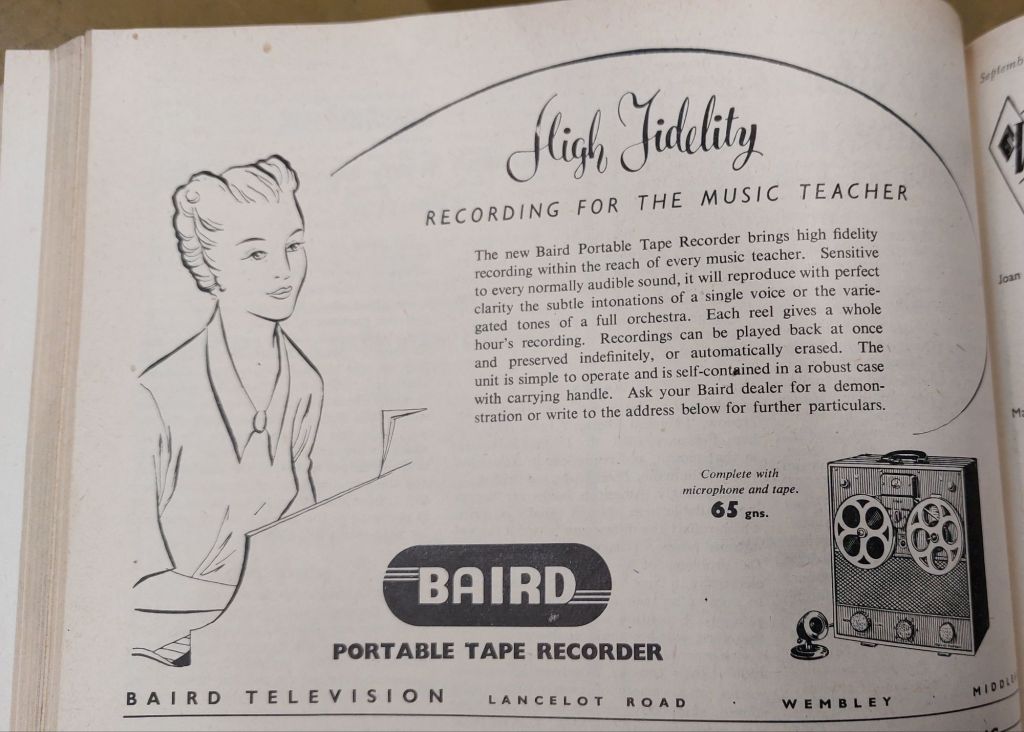
High Fidelity

I did find a couple of book reviews and an advert, which is what I was looking for. But I was also drawn to other adverts for long-playing records, tape recorders and plastic recorders! Here we are today, with our phones, mics, streaming services and laptops, whilst a wooden recorder is much more eco-friendly, not to mention authentic. But in post-war Britain, all this shiny new stuff was the last word in modernity! 

As for a record that held four times as much music as a 78? Who wouldn’t want such an innovation?! 

Oh, and I spotted another ‘innovation’: folk songs with guitar chords. The times they certainly were a-changing. (And this was a decade before Bob Dylan’s song!)

Anyway, I filled in a couple of gaps in my knowledge by ploughing through eight years‘ worth of bound, unindexed magazines (we forget how amazing digitised journals are!), and answered another question with a microfilmed reel (urgh, old technology!) of another journal.  To think that microfilms were comparatively modern when I was a postgrad the first time round.  Today, I used a shiny new microfilm reader – very techie – but it’s still a linear way of storing data. Luckily, I found what I was looking for towards the end of the first reel.

And had a thoroughly modern iced latte before heading back to the Uni Library!

Moving with the Times: from Silent Movies to (oh, Gosh!) British Pathe Shorts

A tangle of movie film roll

You can tell I’ve spent too long in the late nineteenth century – in the research sense, that is.  Dizzy with excitement at the thought of seeing a silent movie – yes, it might actually come to pass, albeit not for a few months – I was almost deliriously pleased to discover that one of my research interests made British Pathe ‘shorts’ during the Second World War.  My aim is to contrast two singing careers, started only a decade apart – and here’s the first contrast. One began their career during the First World War and the silent movie era. The other made British Pathe shorts during the Second.

We think we’re so advanced, with our internet and our AI, electric cars and digital sound … but anyone born in the late nineteenth or early twentieth century might have been amazed by their own advances in technology.  A fin-de-siecle child treated to a magic lantern show, might have sung along to hymn or Scottish song texts projected on a magic lantern screen, the singing led by whichever grown-up had been co-opted in to help. When silent film came along, any music would be provided by a cinema pianist or a small ‘orchestra’ – possibly no more than a piano trio. What you heard would partly depend on who was playing and the bundle of music they’d brought with them.

But when the children became adults, they would would find themselves listening to the wireless or going out to ‘talking’ movies.  Watching, in adulthood, a short film performance by a contemporary star vocalist would have been unimaginable a decade earlier.

However, I must still cool my heels as I wait to see if (and when) the silent movie that I need to see, can be converted into a modern format.  Meanwhile, I’m trapped in the nineteenth century with the printed novel that gave rise to the movie.  As I read, I wonder how they managed to condense the story into a couple of hours, and then convey the whole plot by wordless gestures. 

I can’t wait to see.

Accessing Silent Films

Lucerna: a Magic Lantern Database

LUCERNA is an online resource on the magic lantern, an early slide projector invented in the 17th century.

‘For more than 350 years the magic lantern has represented and fed into every aspect of human life and every part of the world. It is still used today, both in its original form and through direct descendants like the modern data projector.

LUCERNA includes details of slide sets, slide images, readings and other texts related to slide sets, lantern hardware, people and organisations involved in lantern history, and much more.’

(Introduction to the Lucerna database)

Cover Image from Pixabay

We’ve been Spoiled! (Virtually)

It’s Sunday evening, when anyone with any sense is sitting with their feet up, relaxing before the next week starts. So what do I do? I attempt to sort the vacuum cleaner and order it some new filters; eye the ironing basket balefully; and try but fail to contact the dishwasher warranty people. Yes, I know – it’s a Sunday – but the website categorically said there was someone to help me from 8 am to midnight every day of the week. They didn’t say that the ‘someone’ was a bot, who would advise me to phone a particular number, which in turn would require me to answer loads of questions and then tell me they were closed. Technology and online services are conspiring against me tonight.

So, I thought, I’d go over tomorrow’s talk one more time. Inevitably, even though I’ve successfully given my talk once ‘in real life’, I still found things I thought I could improve upon. The only problem was, I’m sitting at home, and what I needed was neither on my shelves nor available digitally.

  • A three-volume book of Scottish songs, which I can see in the library at RCS tomorrow. But there’s only one ‘pupil edition’ book of ONE of the volumes available for purchase anywhere online, and I rather think I’d like the whole set of the teacher’s edition, for myself. In my dreams!
  • So … I had already worked out that the title hadn’t made much of a stir in the contemporary press. Indeed, I think I’ve returned to this question several times, so I needn’t have imagined I would reach a different conclusion today. I searched again. I failed again. We’re not used to searching and not coming up with results!
  • Ah, of course. There’s a particular magazine which might have a review in it. I have a rare copy of the first issue, which I found on eBay a couple of years ago. But my copy is a bit too early to hold the review I’m hoping for. Where is this magazine to be found? One library, in Edinburgh.
  • Not to be found in electronic format.
  • And … no direct trains to Edinburgh this week – they’re clearing up after last week’s storms – whilst I’m tied up all February.
  • So … A couple of desperate emails on the off-chance that they might yet be in other libraries, albeit not in an online catalogue. And I wait. Because it’s Sunday night, isn’t it? And I hope they’re nowhere near their laptops!

When I think that, doing doctoral studies the first-time round, I would have looked things up in books and journals in the library, or gone home and written a letter to ask if I could visit another library half-way across the country – then waited for a reply – and even the second, completed doctoral attempt was fitted in around full-time employment – I can’t help feeling a little guilty that I’ve become so impatient. In any case, the paper is good enough. I changed a few words, and I’ll print it out again tomorrow. 

(Moreover, in my early postgrad student days I washed things up in a wash-hand basin, so dishwasher repairs weren’t even on my radar! There are advantages to being in employment.)

Some things don’t change, though. I still need to do the ironing. Gah!

Image by Capucine from Pixabay