Read about Song-Collector Alexander Campbell, in ‘Thirsty Work and Other Heritages of Folk Song’ Conference Papers

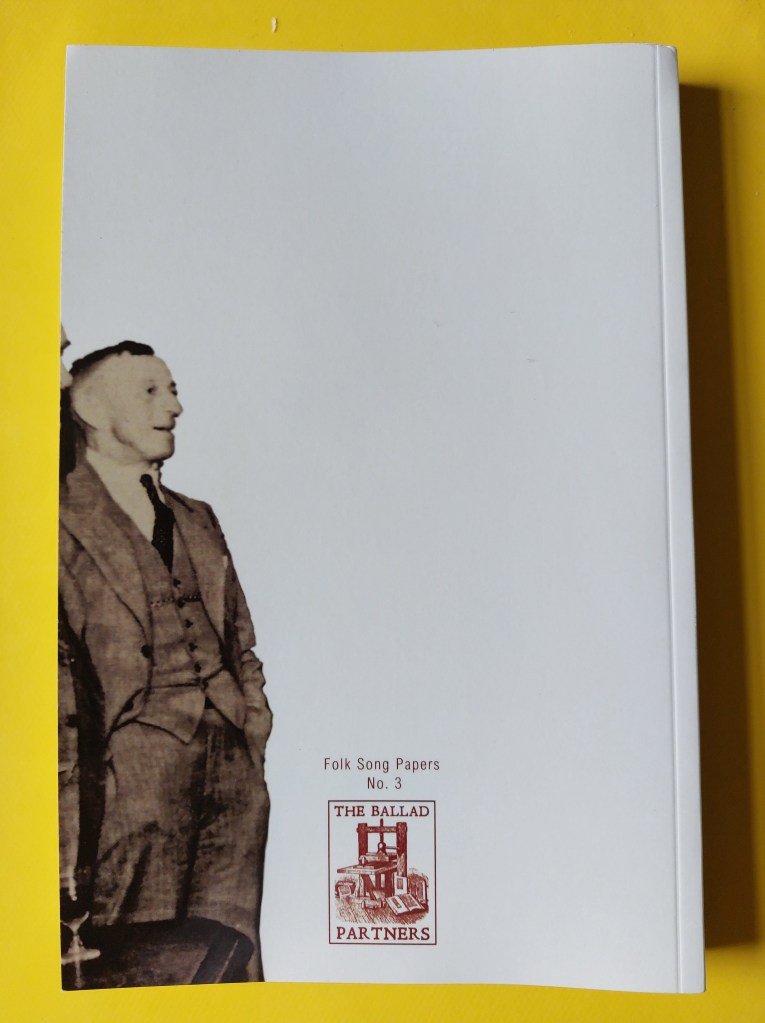
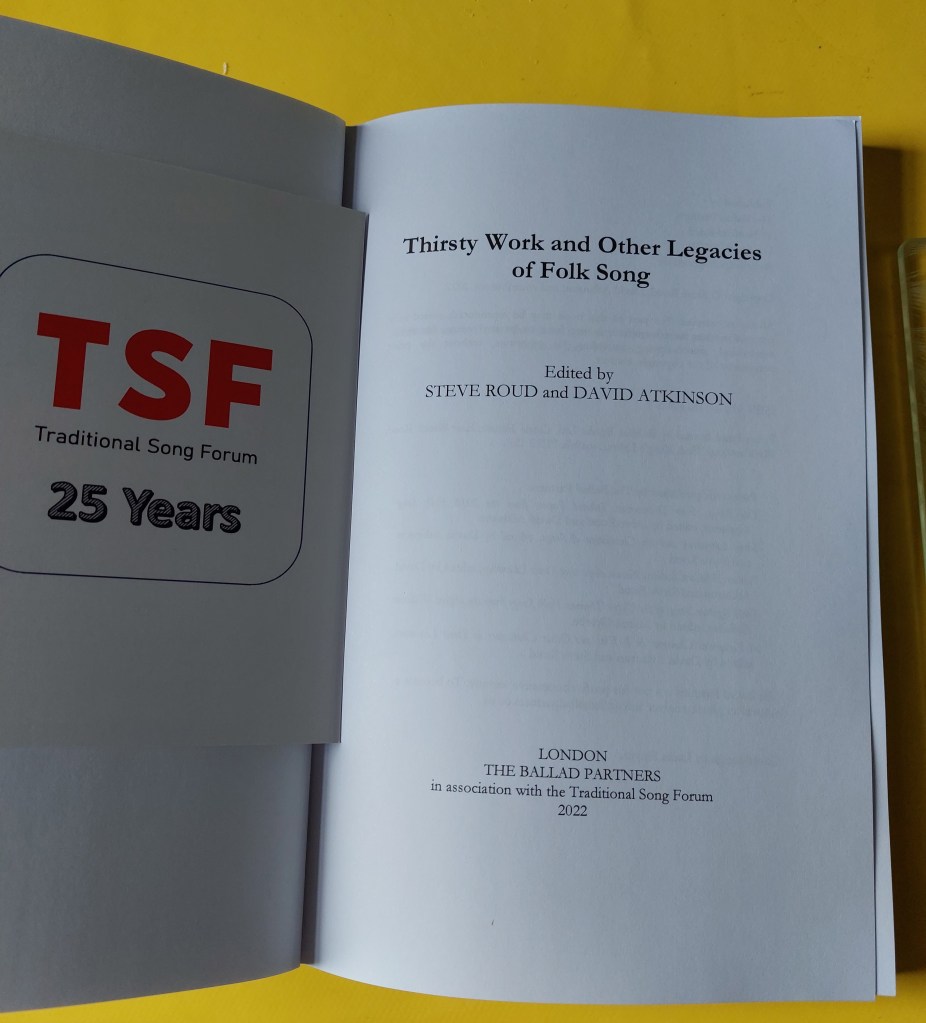
I’ve just received my own copy of a new publication by Ballad Partners, Thirsty Work and Other Heritages of Folk Song, which contains my most recent Alexander Campbell article: ‘Alexander Campbell’s Song Collecting Tour: ‘The Classic Ground of our Celtic Homer’. There’s a section on Campbell and his musicianship – an entirely new angle which I spent some time contemplating during lockdown.

The book is Ballad Partners’ third book of Folk Song Studies.

I have just catalogued a copy for the Royal Conservatoire of Scotland Library – I listed the contents there, so I’ll repeat the list here for your interest. If you would like to purchase a copy of the book, please visit the Ballad Partners’ website. (I’m unconnected with the publishers – I am just one of the contributors!)

CONTENTS

Thirsty work: traditional singing on BBC Radio, 1940-41 / Katie Howson — From Tyneside to Wearside: in search of Sunderland songs / Eileen Richardson — Sam Bennett’s songs / Elaine Bradtke — Newman and Company of Dartmouth and the song tradition of Newfoundland’s South Coast / Anna Kearney Guigne — Railwaymen’s charity concerts, 1888-89 / Colin Bargery — Picturing protest: prints to accompany political songs / Patience Young — ‘That is all the explanation I am at liberty to give in print’: Richard Runciman Terry and Songs from the Sea / Keith Gregson — Drawing from the well : Emma Dusenberry and her old songs of the Ozarks / Eleanor Rodes — Alexander Campbell’s song collecting tour : ‘The Classic Ground of our Celtic Homer’ / Karen McAulay — ‘Don’t let us be strangers’ – William Montgomerie’s fieldwork recordings of Scottish farmworkers, 1952 / Margaret Bennett — ‘No maid in history’s pages’ : the female rebel hero in the Irish ballad tradition / Therese McIntyre — Who is speaking in songs? / David Atkinson

My Article about a Remarkable Victorian Music Teacher: ‘An Extensive Musical Library: Mrs Clarinda Webster, LRAM’

Brio electronic archive for IAML(UK & Ireland) members

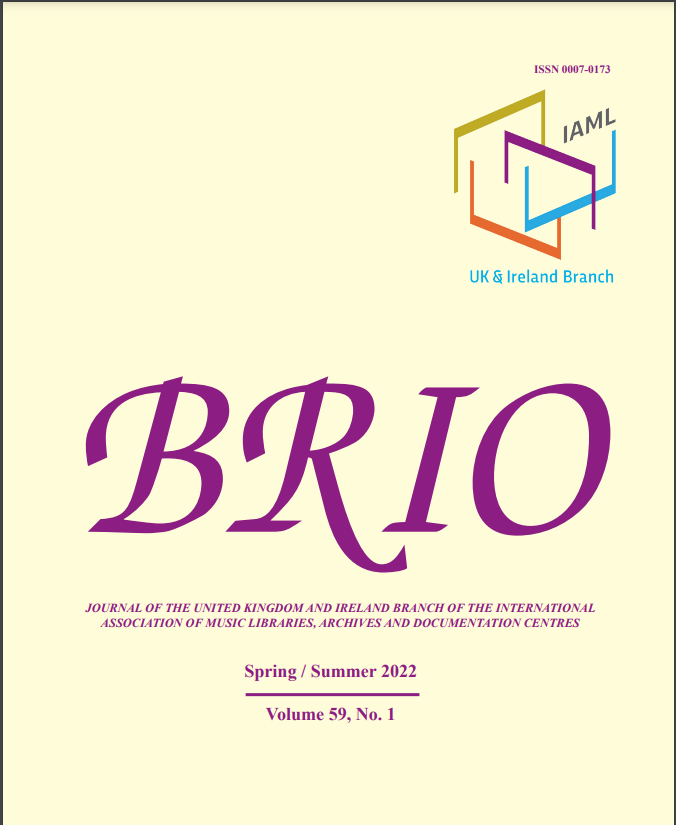
My latest article is on the IAML(UK & Ireland) website, in the members’ area, but paper copies will land on subscribers’ doormats and music library shelves this week! It’s about a strong and determined Victorian music teacher, who survived domestic abuse and made a remarkable career for herself – and I reveal her survey of music in Victorian public libraries, that I discovered literally by digging around online. (I’m rather pleased with this one – and it’s illustrated!)

Here are the details and the abstract:- 

McAulay, Karen E., ‘An Extensive Musical Library’: Mrs Clarinda Webster, LRAM, in Brio Vol.59 no.1, 29-42

Although there has been the perception that middling-class women’s lives were confined to domestic circles, there are plenty of examples that directly challenge this idea. The late Victorian Clarinda Augusta Webster ran a music school and a school for young ladies. She escaped domestic violence, overcame personal tragedy, and created a highly successful career first in Aberdeen and then in London. She published, gave talks, was active in professional circles, and travelled both to Europe and America. She also conducted a ground-breaking survey on music library provision in late nineteenth century Britain, delivering her findings to the Library Association. Although her report has not been traced in its entirety, many of its findings were reported in newspapers, enabling us to piece together the results of her investigations.  This article celebrates the sheer determination of a talented woman to make the most of her skills and create opportunities for advancement. It also demonstrates the perceived importance of music in wider late Victorian life. 

It should be possible to read this Brio article in a music library somewhere near you, and it will also eventually appear on the RCS research repository (Pure). But if you can’t get sight of a copy, please feel free to message me and I’ll share the proofs.

Am Writing: New Book Contract

Yes, folks, there really is going to be another book. Following on from my first one, date-wise, but with more social history, more about publishers, and more about amateur music making between 1880-1950.

Exciting? You bet!

Provisional Title

A Social History of Amateur Music-Making and Scottish National Identity: Scotland’s Printed Music, 1880-1950

Which half of me is winning?

Librarian. Time mainly spent cataloguing and working on the library equality and diversity project. In connection with this, I’m commited to giving a talk next month, and to submitting a librarianship-related journal article arising from a talk I gave earlier this year.

Musicologist. [2nd] book proposal submitted. Already committed to producing two book chapters for essay collections being edited by other folk.

Librarian meets Musicologist. Article straddling both worlds, due out in the next month or so. Also giving a talk in Edinburgh in June, in my capacity as Honorary Wighton Librarian.

If only I had a garden big enough for a secluded Writing Shed!

First publication of 2022 – a chapter

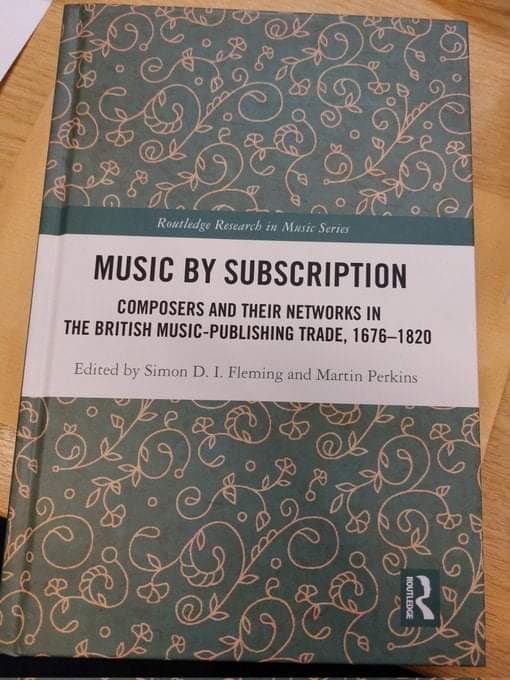
I have just catalogued a book containing my chapter on music subscribers to published strathspey and reel collections in the late 18th to early 19th centuries.  (Not every author gets to catalogue what they contributed to! Still, it means it’s now available in the library at RCS.

 Here it is:-

Chapter 10. ‘Strathspeys, Reels, and Instrumental Airs: A National Product’

And the book itself:

 Music by subscription : composers and their networks in the British music-publishing trade, 1676-1820 / edited by Simon D.I. Fleming, Martin Perkins.  (Routledge, 2022)

When Less is More (Blog to Book)

Returning visitors to these pages may find the content thinner than it used to be. Now that I’m working on my next book, I want my best content to be honed to perfection and triple-checked before I commit it to print. Rather than leave extended writings – which I posted as ‘work in progress’ – sitting on the internet, I’ve pruned what is here. In general, I continue to research the topics I posted here (Scottish music publishers James Kerr, Mozart Allan and many others, and interrogations of cultural issues), and any new details or dates which I didn’t know at the time of blogging, could potentially change what I originally wrote. And also, of course, I want readers of the book to be surprised and delighted by new insights that no-one knew before!

I shall continue to blog, of course. How could I not? I have so many ideas buzzing round my head that it’s hard keeping them all to myself!

Chasing Research Grants

Also posted on Facebook, 26 May 2021

Hello again, dear followers! I’ve heard of a research grant that I am eligible to apply for. It’ll receive applications from many researchers, so I haven’t got a particularly strong chance of succeeding, but it would be nice to get a research grant to help me get on with writing my book, so … I shall have to see what’s involved in making an application!

I thought I’d share my current plans for the book. So far, I’ve written some of the introduction, and most of the first chapter.

This is the shape of the thing:-

  • 1. Cheap music for all: James S. Kerr and Mozart Allan (history)
  • 2. Enduring Kerr and Mozart Allan titles, what was in them and why they were so successful.
  • 3. Organisations (Glasgow and Scotland-wide) concerned with music making and with promoting Scottish music
  • 4. Educational connections
  • 5. Educationalists and how they fit into the scene
  • 6. Overseas.
  • 7. Spin-offs and tie-ins
  • 8. Publishing “classical” music in Scotland
  • 9. Domestic music-making in Glasgow

Considering how long it has taken just to get the first chunk written, you see what I have got ahead of me. Some chapters will be longer than others, and some of these topics may get merged. Who knows?!

(The image here is from Glasgow Museums Collection:- collections.GlasgowMuseums.com)

The 2nd Monograph

I’ve been busily posting away on the Facebook page, so I thought I’d better update the blog as well. These few lines are taken from the FB page.

YESTERDAY there was a slight hint of despair as I wrote,

My second book is going to take quite a while to write! I’m only technically a postdoctoral researcher for one and a half days (10.5 hours) a week. I told myself I had to write 250 words a day, five days a week.But factoring in answering emails, attending the odd meeting, doing the odd bit of research, ordering the odd book or downloading the occasional article, and how much time do I have in which to actually write? So the first week of this bold resolution has resulted in …? Not exactly 1250 words for the introductory chapter. Oh, they’re good words, in the right order, but nonetheless … I shall have to pull my finger out tomorrow morning!!

TODAY, things started to look up:

ONE DAY THERE WILL BE A SECOND BOOK. I’ve redeemed myself. I set out to write 250 words a day, five days a week. I didn’t manage that in the first week. However, on the first day of the second week, I do now have a total of 1500 words – mathematicians will work out that I’ve caught up before the Easter break. This may be the only time that it happens, of course …

Clattering keyboard

Apologies if it’s a bit quiet round here at the moment. I was all set to take a deep breath and [inhales] … start writing the first chapter for my next book, when I received the peer-reviewed chapter that I wrote for someone else’s book a couple of months ago.

Call them improvements, corrections or revisions, what you will, this means rather a lot of work before I can get back to my original plan.

And then there are the talks I’m giving in the next fortnight! It’s a busy time. Please bear with me. I’ll be back …

Well, that’s Another Chapter Over

This has also been posted on Facebook, on my Glasgow Music Publishers page.

Well, that’s it done. I was invited to contribute a chapter to a book, and after quite a bit of research – and 34 hours’ writing in the past week – I have submitted it! Such a relief. I admit, I was a bit chastened to realise that I had just spent a whole week of Actual, Genuine Holiday sitting at my desk writing a book chapter – which constitutes actual, genuine intellectual work. Oh well, it had to be done!

This also means I can sidle out of the eighteenth century and back to the twentieth, to continue my researches into Scottish music publishers from the late Victorian era onwards.

Because of Covid, I still can’t do what I’d like to do next. I’d like to speak to very elderly people, to see what they can tell me about the Scottish music they and their parents enjoyed in the days before the folk revival. To do this properly, I’d have to get ethical clearance from my department, and then I’d need to reach out to the generation whose memories I’m particularly interested in. Obviously, Covid means I can’t go physically interviewing frail old people anywhere, so I’m a little bit stuck, and there’s no point in seeking ethical clearance to do anything of the sort, even when everyone’s had their vaccination.

But if you’ve got elderly relatives who enjoyed Scottish music in their youth, and they can remember particular books that they had in their music cabinets or piano stools, then do feel free to tell me what those books were! It might not be a formal, ethically-approved study, but even anecdotal stories help us document what was popular and, maybe, why it was. Maybe Great Auntie Doris always had a few songs that she sang at Hogmanay, or cousin Lottie used to sing from a certain book at Sunday School concerts? Or Bert next door was renowned for his bothy ballad renditions on the accordion? Do tell me! Otherwise, in another decade or two, we’ll have lost that generation and their stories with them.

The old accordion