Dr Karen McAulay explores the history of Scottish music collecting, publishing and national identity from the 18th to 20th centuries. Research Fellow at Royal Conservatoire of Scotland, author of two Routledge monographs.
I do have a first draft of my second book, it’s true. But it’s a bit too long, and I am sure it can be tightened up. So, I’ve devised a formula. I need to lose 11%, and I’ll try to apply that across the whole manuscript. I’ve tried it on the introduction, and it worked a treat. Start with a word count, reduce every thousand words by 11%. But that’s just a small part of a much longer thing!
I’ve taken the next fortnight off as annual leave. It won’t be a holiday! Ideally, I’d like to do this in under a fortnight, to allow time for any extra fact-checking or writing. I really need to work out how much I need to get through per day, too, if I want that writing time. This morning, I reduced approximately 6.5k words to 5.8k, which is not enough to allow for the bibliography required at the end of each chapter.
It probably sounds very formulaic. But I timetabled the writing of my PhD, and the revision of my first monograph. It works for me! So … watch this space.
The official deadline is the end of July 2023. Luckily, my editor is quite forgiving!
MONDAY. Introduction done. Chapter 1 done. Chapter 2? Getting there. And there I had to stop. Tomorrow is another day!
I finished the Conclusion of my second monograph today! I really should have celebrated this, but – well, it was lunchtime and I checked my emails, and … shall we say that I forgot about celebrating by the time I’d finished answering the email?
Never mind. I’ll celebrate tomorrow instead. Before I start the revision process. This evening, I read through all my publisher’s guidelines. I read about endnotes (bye-bye, beloved footnotes. You’re no longer the flavour of the month). I read about chapter abstracts, and formatting, and a whole lot of other stuff. Saved it all in a folder, and reached for my MHRA Guidelines. This is where I remembered that it could take quite a while!
The good thing, I suppose, is that my cataloguing background makes me quite attuned to the fine detail required in formatting references and so on, and pretty well prepared for the routine-ness of it all. I’m more concerned about ensuring everything’s consistent between chapters, and – the worst bit – tightening up the prose. I need to jettison quite a few words, to get within the word-limit.
What a blessing that I’ve got two weeks’ holiday coming up. No proper vacation for me, this time. But I do look forward to getting the manuscript submitted later this year!
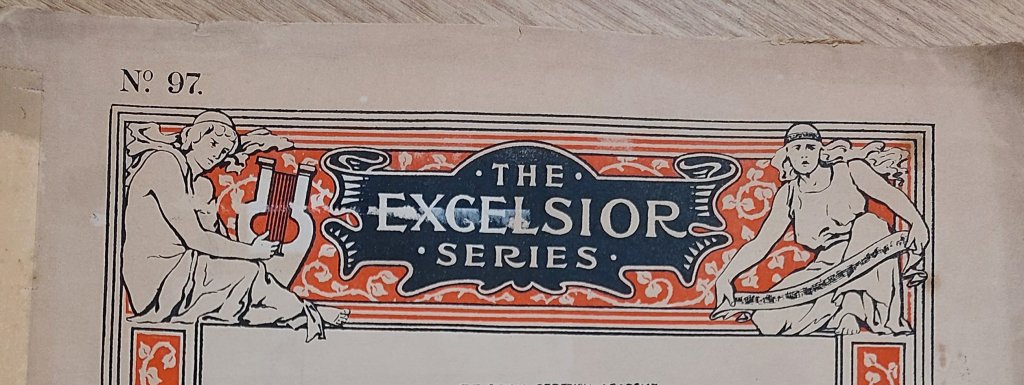
Bayley & Ferguson’s Excelsior series, another iteration
Wednesdays are research days – or, at the moment, writing days. I was going to work on my Conclusion, but decided to go back through the last couple of chapters, just to incorporate a few snippets of extra information that I’ve gleaned over the past couple of days. Scribble, scribble, away I went … until I got to one particular point where I had a nice, interesting fact to incorporate.
Except it dawned on me that something was missing. This wouldn’t do! How could I write the bit I had in mind, without the requisite lead-in?
That was the afternoon gone, I’m afraid! I checked in one index. Maybe it just didn’t include what I was looking for? I checked in Jisc Library Hub Discover – every single composer’s name, one by one. Nothing. I looked in the British Newspaper Archive for a handful of names … still nothing.
Then I consulted a fairly recent book surveying Scottish music as a whole. I think I can safely say that what I was looking for, didn’t exist. And THAT was part of the larger problem 🙄 That’s what I must write about. So …
‘Stop’, said a voice. ‘It’s time for supper.’ (I didn’t scream. I didn’t even mutter. This happens.)
But at least I know where I’ll be starting tomorrow morning!
Now, this doesn’t concern my own book. Oh no! This was a chapter I wrote as a guest contribution for an essay collection.
To understand my jubilation fully, you have to know that my last contributed chapter (different publisher, different editor) had HUNDREDS of edits requested. So today, I opened an email relating to another contributed chapter, with some trepidation.
But all was well – the most minimal changes were required. Blink, and you’d miss them. Ten minutes later, they were done ✔️
I expect the finished product will appear well before my own monograph – which is good, because on the face of it, I’ve published very little recently. Book-writing is all-consuming when you can’t do it every day!
This morning I read through Chapter 7 of my monograph again, tweaked it minutely, then opened a new document: the conclusion! (And 33 days to go until my submission deadline. The work ahead of me might just exceed that.)
Up to that point, I really hadn’t much idea what I would write there. A summary of all that I’ve written about, obviously. I was once told, in connection with public speaking or lecturing, that what you have to do is:-
Tell them what you’re going to tell them
Tell them it
Tell them what you’ve told them
It sounds glib, but it’s actually a pretty good reminder of how to structure a piece of writing.
Today, since this is my second monograph, I added an extra bit at the beginning. My first book was about song-collecting, but it wasn’t the end of the story. The present book has continued from that point – albeit with a slightly different slant …
I still have a few things more that I want to read, before revisiting the last chapter. And then comes the editing. Getting rid of a few words. Finishing the introduction. Checking the formating of the endnotes, and deciding what goes in the bibliography. However, seeing that “Conclusion” and a few hundred words beneath it already?
You know the story of the shoemaker and the elves? He goes to bed, exhausted, and wakes to find the little elves have done all his outstanding work? Oh, I wish!
Technically, my book is meant to be finished by the end of July. I’ve written quite a bit of the last chapter, but it goes without saying that that’s not the end of the process!
Writing the conclusion;
Tidying the introduction;
Checking the whole thing – for content, and also against the style guide;
Converting footnotes to endnotes;
Sorting the bibliography…
I’m also handling the comms for an international congress – it begins on 31 July.
Of course, there’s also the day-job to be done! And domesticated things don’t just stop. Garden hedges grow regardless of everything. Aargh!
And I have a whole magazine issue to proofread ASAP. (This task was accepted on my behalf – literally nothing to do with me!)
Daily Countdown
Now, the book deadline has been engraved on my brain for a long time. I’ve also known the congress date quite a long time. But believe it or not, it’s only just dawned on me that both dates coincide, and that therefore 38 days’ countdown for one thing would be 38 days for the other. Strange how the realisation suddenly makes it all the more stressful! All I can do is keep doing what I can. A colleague asked me the other day, what were my plans for this summer … ?
‘Finish a book’, I whispered. One way or another!
Alas, I don’t feel indomitable today. More like, a bit hopeless, faced with the mountain in front of me.
My talk for the Scottish Graduate School of Arts and Humanities was incredibly well-attended. It was lovely to be able to talk about one of my specialisms to people who were genuinely interested. My thanks to you for attending, if you were one of those people! At least one individual had just started their bibliography, so hopefully I was able to share some useful tips.
I’ve uploaded my PowerPoint and text to my Conservatoire Pure account – our institutional repository – please click here.
If anyone tried to sign up, but experienced a problem getting into the meeting, please contact me via the SGSAH Summer School organisers.
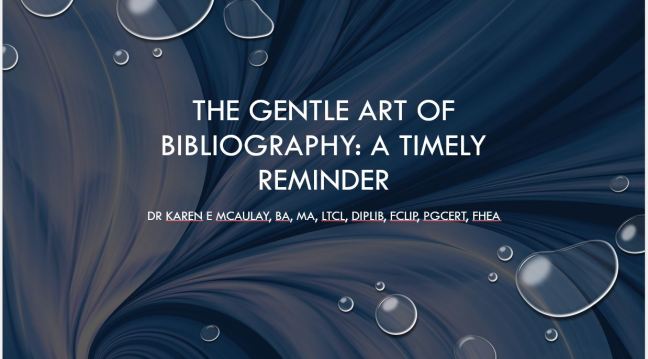
An entirely new venture for me: I’ve offered to give a talk at the Scottish Graduate School for Arts and Humanities Summer School later this month – next week, to be precise! It’s a summer school for all Arts and Humanities doctoral researchers in Scotland. When the opportunity came up to participate, I initially wondered if I had any expertise that I could share, leaving aside my own niche research interests. But then it occurred to me that people seem to enjoy my talks and writing about the process of research, as much as my talks about the research itself, so the obvious thing was to talk about one of my favourite things – bibliography. A lot of people have signed up – I’m so pleased.
Today felt like a good day to get it written, powerpoint and all.
I might share the talk later, after it has actually taken place. For now, here’s a taster for any Scottish postgraduate researcher deciding which talks to attend!
“Have you ever forgotten where you read something useful? You know the scenario – whilst you’re searching for something, whether on the web, in the library or in a database, you flick past something that’s perhaps only of tangential interest, only to realise later that it was more significant than you thought. Or you’re just killing time, so you’re not in full scholar-mode, and you find something interesting that is so relevant that you just know you’ll be able to find it again? But you can’t.
Isn’t it an awful feeling?”
When I submitted my proposal for this talk, I had to describe the learning outcomes. Here’s what I’m aiming to do:-
Learning Outcomes:- By the end of this session, participants will have a greater understanding of the options available to them, in terms of building, maintaining and deploying a bibliography in scholarly writing. By the end of this session, participants will also understand the importance of starting to build one’s bibliography at the earliest opportunity.
The government moved the goalposts – when I started work, I imagined I’d have retired by now. Instead, I’ve worked an extra five years, with one more to go. I shall hit 66 in summer 2024. I don’t want to retire entirely, but I must confess I’m utterly bored with cataloguing music! (Except when it turns out to be a weird little thing in a donation, perhaps shining a light on music education in earlier times, or repertoire changes, or the organisation behind its publication – or making me wonder about the original owner and how they used it … but then, that’s my researcher mentality kicking in, isn’t it?!)
Status Quo: Stability and Stagnation
Everyone knows I’m somewhat tired of being a librarian. Everyone knows that my heart has always been in research. Librarianship seemed a good idea when I embarked upon it, and it enabled me to continue working in music, which has always been my driving force. But the downside of stability – and I’d be the first to say that it has been welcome for me as a working mother – has been the feeling of stagnation. No challenges, no career advancement, no extra responsibility. Climbing the ladder? There was no ladder to climb, not even a wee kickstep! (I did the qualification, Chartership, Fellowship, Revalidation stuff. I even did a PhD and a PG Teaching Cert, but I never ascended a single rung of the ladder.)
In my research existence, I get a thrill out of writing an article or delivering a paper, of making a new discovery or sorting a whole load of facts into order so that they tell a story. I love putting words on a page, carefully rearranging them until they say exactly what I want them to say. I’m good at it. But as a librarian, I cannot say I’m thrilled to realise that I’ve now catalogued 1700 of a consignment of jazz CDs, mostly in the same half-dozen or so series of digital remasters. (I’d like to think they’ll get used, but even Canute had to realise that he couldn’t keep back the tide. CDs are old technology.)
The Paranoia of Age
But what really puzzles me is this: when it comes to the closing years of our careers, is it other people who perceive us as old? Is age something that other people observe in us? Do people regard us as old and outdated because they know we’re close to retirement age?
Cognitive Reframing (I learnt a psychology term!)
Cognitive reframing? It’s a term used by psychologists and counsellors to encourage someone to step outside their usual way of looking at a problem, and to ask themselves if there’s a different way of looking at it.
So – in the present context – what do other people actually think? Can we read their minds? Of course not. Additionally, do our own attitudes to our ageing affect the way other people perceive us? Do I inadvertently give the impression that I’m less capable? Do I merely fear that folk see me as old and outdated because Iknow I’m approaching retirement age? A fear in my own mind rather than a belief in theirs?
How many people of my age ask themselves questions like these, I wonder?
Am I seen as heading downhill to retirement? Increasingly irrelevant? Worthy only to be sidelined, like the wonky shopping-trolley that’s only useful if there’s nothing else available?
Is my knowledge considered out-of-date, or is it paranoia on my part, afraid that I might be considered out of date, no longer the first port-of-call for a reliable answer?
When I queue up for a coffee, I imagine that people around me, in their teens and early twenties, must see me as “old” like their own grandparents. And I shudder, because I probably look hopelessly old-fashioned and fuddy-duddy. But is this my perception, or theirs? Maybe they don’t see me at all. Post-menopausal women are very conscious that in some people’s eyes, they’re simply past their sell-by date. I could spend a fortune colouring my hair, and try to dress more fashionably, but I’d still have the figure of a sedentary sexagenarian who doesn’t take much exercise and enjoys the odd bar of chocolate! (And have you noticed, every haircut leaves your hair seeming a little bit more grey than it was before?)
Similarly, I worry whether my hearing loss (and I’m only hard of hearing, not deaf) causes a problem to other people? Does it make me unapproachable and difficult to deal with? I’m fearful of that. Is it annoying to tell me things, because I might mis-hear and have to ask for them to be repeated? Or do I just not hear, meaning that I sometimes miss information through no fault but my own inadequate ears? Friends, if you thought the menopause was frightening, then believe me impending old age is even more so. I don’t want to be considered a liability, merely a passenger. And I know that I’m not one. But I torment myself with thoughts that I won’t really be missed, that my contribution is less vital than it used to be.
Gazing into the Future
Crystal Ball Gazing
I wonder if other people at this stage would agree with me that the pandemic has had the unfortunate effect of making us feel somewhat disconnected, like looking through a telescope from the wrong end and perceiving retirement not so much a long way off, as approaching all too quickly? The months of working at home have been like a foretaste of retirement, obviously not in the 9-5 itself (because I’ve been working hard), but in the homely lunch-at-home, cuppa-in-front-of-the telly lunchbreaks, the dashing to put laundry in before the day starts, hang it out at coffee-time, or start a casserole in the last ten minutes of my lunchbreak. All perfectly innocuous activities, and easily fitted into breaks. But I look ahead just over a year, and realise that I’ll have to find a way of structuring my days so that I do have projects and challenges to get on with.
Not for me the hours of daytime TV, endless detective stories and traffic cops programmes. No, thanks! Being in receipt of a pension need not mean abandoning all ambition and aspiration. I want my (hopeful) semi-retirement to be the start of a brand-new beginning as a scholar, not the coda at the end of a not-exactly sparkling librarianship career. If librarianship ever sparkles very much!
I’m fortunate that I do have my research – I’m finishing the first draft of my second book, and looking forward to a visiting fellowship in the Autumn. As I wrote in my fellowship application, I want to pivot my career from this point, so that I can devote myself entirely to being a researcher, and stop being a librarian, as soon as I hit 66. And I want to be an employed researcher. I admire people who carve a career as unattached, independent scholars, but I’d prefer to be attached if at all possible!
Realistically, I will probably always be remembered as the librarian who wanted to be a scholar. At least I have the consolation of knowing that – actually – I did manage to combine the two.
This is not a spoiler alert! I haven’t finished yet; I’m just about at the end of Chapter 5, with two further chapters to go. I’m not about to reveal how it ends, either, because (a) I don’t want to spoil it for you and (b) what if the closing chapters end up in a different overall order?
I’m thinking about structure, really. When you’re writing about a subject that had a rise, a heyday and a decline, it’s going to be hard to end on a high. I’ve been pondering about which order to place the last three chapters in the book, and it came down to this:-
Option 1: Up-Down-Up (and Down)
Antepenultimate chapter: Hey look, they also did this!
Penultimate chapter: But they missed a trick here.
Ultimate chapter: Even though they also did THIS (and I find it so exciting), their heyday was over.
Option 2: Up-Up still Higher but Peaking – Down
Antepenultimate chapter: Hey look, they also did this!
Penultimate chapter: AND they engaged with this! It’s really exciting, but perhaps the writing was on the wall.
Ultimate chapter: And they didn’t do this. Would it have made a difference? Possibly not, in view of the wider context.
My instinctive feeling is that the Rise-Fall curve of the second option is going to be more satisfying for the reader. Indeed, as I was writing this post, I stumbled across a website about ‘story arcs’, with six different arc shapes being outlined. Admittedly, we’re only talking about my last three chapters, and I’m writing non-fiction, not a story with a plot. (In a previous existence, I wrote and published over thirty short stories, so I do have an interest in the genre, in a retrospective kind of way. But that’s irrelevant today.) Nonetheless, if we’re thinking about arcs, then …
My first option isn’t even described, so it can’t be a recommended option! Let’s call it the Tennis Ball Bounce. On the other hand, my second option is a classic ‘Icarus / Freytag’s Pyramid (rise then fall)’ arc.