Dr Karen McAulay explores the history of Scottish music collecting, publishing and national identity from the 18th to 20th centuries. Research Fellow at Royal Conservatoire of Scotland, author of two Routledge monographs.
Followers of this blog will know that you can look at historical piano teaching materials in the libraries that hold legal deposit collections. Nowadays, there are a handful of big national and university libraries in the UK that still receive one copy of everything published, under statutory legislation. But there are other libraries – especially in Scotland – that also received this material, until the beginning of Queen Victoria’s reign.
Theodore Latour was pianist to King George IV – Victoria’s uncle. He taught privately and at girls’ schools, played and composed, and also wrote some piano tutor books. As it happens, Emily Bronte had music by Latour in her collection, including one of his books of progressive exercises, although I haven’t examined that particular publication. (Robert K. Wallace mentions it, in his Emily Bronte and Beethoven: Romantic Equilibrium in Fiction and Music.)
It’s possible to find copies of some of Latour’s works online via Google Books, IMSLP or Archive.org, so if you’re interested, we could point you in the right direction.
I have been experimenting with other ways of talking/writing about the Stationers’ Hall Georgian legal deposit music corpus. Here are my Saturday afternoon efforts. Have you tried any such audiovisual presentations in your own research? Do you find them helpful?
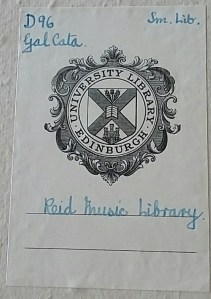
Hans Gal (1890-1987) catalogued Edinburgh University’s Reid Music Library during the summer and autumn of 1938, at the instigation of Sir Donald Tovey. The latter was keen to find work for the gifted composer and musicologist, who had emigrated from Vienna when Hitler annexed Austria. (Here’s a recording of his earlier Promenadenmusik for wind band, which he wrote in 1926. ) A grant from the Carnegie Trust enabled Gal’s catalogue to be published in 1941. When the Second World War ended, Gal joined the University music staff, and remained there beyond retirement age.
The reader is referred to the Hans Gal website for further biographical information (I am checking this weblink, which occasionally falters):- http://www.hansgal.org/
Gál, Hans, Catalogue of manuscripts, printed music and books on music up to 1850 : in the Library of the Music Department at the University of Edinburgh (Reid Library) (London, Edinburgh: Oliver and Boyd, 1941)
(Partially) catalogued by Gal
The catalogue is in three parts, listing manuscripts, printed music, and books on music. Gal did not list every individual piece of music in the library, but prioritised more serious classical music, whether vocal or instrumental. One might suggest that there were various reasons for Gal’s decision.
In his preface, he explains that, ‘for practical reasons I confined this catalogue to the old part of the library, namely the manuscripts, printed music and books on music up to 1850, which is the latest limit of issues that might be looked upon as of historical importance’. [Gal, vii]
However, this was not the only limitation placed on the listing. Gal omitted many of the pieces of sheet music that must have arrived as legal deposit copies during the Georgian era, until copyright legislation changed in 1836. The Reid music cupboards contained a number of Sammelbänder, or ‘binder’s volumes’, ie, bound volumes of assorted pieces of music. Occasionally Gal made oblique reference to these, eg, to cover the 44 items in volume D 96:-
“Songs, Arias, etc., by various composers (Th. Smith, D. Corri, Bland, R. A. Smith, Rauzzini, Davy, Kelly, Urbani; partly anon.) Single Editions by Longman & Broderip, Urbani, Polyhymnian Comp., etc., London (ca. 1780-1790). Fol. D 96″ [Gal, 44]
Longman & Broderip were prolific music publishers, amongst the most assiduous of firms making trips to Stationers’ Hall to register new works. They published a lot of theatrical songs and arrangements, and much dance music, as well as the more serious, ‘classical’ music repertoire. The catalogue entry cited above details some more commonly known composers of decidedly middle-of-the road, if not downmarket material. One does not need to speculate as to whether Gal considered such material less respectable, for he made no secret of his disdain for much of the music published in this era! In the preface, he asserts that,
“The gradual declining from Thomas Arne to Samuel Arnold, Charles Dibdin, William Shield, John Davy, Michael Kelly, is unmistakeable, although there is still plenty of humour and tunefulness in musical comedies such as Dr Arnold’s “Gretna Green”, Dibdin’s “The Padlock”, Shield’s numerous comic operas and pasticcios.
“After 1800 the degeneration was definitive, in the sacred music as well as in songs and musical comedy. […] It is hardly disputable that the first third of the nineteenth century, the time of the Napoleonic Wars and after, was an age of the worst general taste in music ever recorded in history, in spite of the great geniuses with which we are accustomed to identify that period.” [Gal, x]
Faced with several hundred of such pieces in a number of bound volumes, and quite possibly a limited number of months in which to complete the initial cataloguing, it is hardly surprising if Gal was content to make a few generic entries hinting at this proliferation of ‘bad taste’. (One might add as an aside, that Gal’s wife at one point observed that Gal ‘hated swallowing the dust in archives’, in connection with an earlier extended project in the late 1920s – clearly, he was able to overcome his distaste when the need arose! (See http://www.hansgal.org/hansgal/42, citing private correspondence of 10.10.1989)
Interestingly, it is evident that Edinburgh, like several other of the legal deposit libraries, must have been selective in what was retained, but it’s significant that national song books were certainly considered worth keeping. Gal, in turn, included some of the prominent titles in his listing.
Thus, Gal’s catalogue is another reminder to us that the history of music claimed from Stationers’ Hall under legal deposit in the Georgian era, actually and actively continues beyond the Georgian era, for the material has already been curated by musicologists and bibliographers prior to our own generation. In St Andrews, Cedric Thorpe Davie took an active interest, whilst Henry George Farmer was involved in curating the University of Glasgow collection.
Meanwhile, in connection with the current Claimed From Stationers’ Hall network research, the priority is to establish which volumes – formerly in the Reid School of Music cupboards, but now in the University of Edinburgh’s Centre for Research Collections – were received under legal deposit. Two spread-sheet listings enable us to examine the contents of different volumes, by volume:-
Where publication dates are not given in the spread-sheet, they can be looked up in Copac, and even if there are no decisive dates, then their presence in other legal deposit collections will suggest that these copies arrived by the same route. If music predates 1818, then works can be looked up in Michael Kassler’s Music Entries at Stationers’ Hall, 1710-1818, from Lists prepared for William Hawes, D. W. Krummel and Alan Tyson. (Click here for Copac entry.)
Essentially, the first task is to ascertain which volumes contain legal deposit music, and then to look not only at what survives, but whether there are any patterns to be discerned. In terms of musicological, book, library or cultural history, the question today is not whether the music was ‘degenerate’ or in ‘bad taste’, but to ask ourselves what it tells us about music reception and curation in its own and subsequent eras.
Postscript: as an interesting twist in the world of library and book history, my own copy of Gal’s catalogue was purchased secondhand – a withdrawn copy from a university library where the music department closed a few years ago. What goes around, comes around, as they say!
Could you use a couple of absolutely miniscule videos to tell people about the Claimed From Stationers’ Hall research network?
Educationalists don’t entirely agree with the concept of learning styles these days, but in my librarian-as-educationalist capacity I have learned that people do value having access to a variety of formats when it comes to learning about new stuff. The other day, I was experimenting with a newly-discovered facility for creating very short animated videos. (Yes, I spend my weekends in odd ways.)
I can see potential uses for Biteable.com, but the major hurdle is deciding which template to use. Although you start by deciding the purpose of your video, it isn’t immediately apparent how many screens each template offers you, nor what the images are going to look like! Maybe it’s because I was playing around with the free version.
[PS a few days later – I now know that starting a video from scratch means you get to choose how many frames to use, and you can also choose which templates to use, though you lose the chirpy little animated people. Moreover, you can upload your own music. THAT makes things much more fun!]
Anyway, my playful Sunday evening resulted in two short videos about the Claimed From Stationers’ Hall network.
Next came Out of the Stacks, which is about the repertoire itself, and its value. Trust me, the videoclip is as short as can be and takes only seconds to view! I managed to get my own images into this one, which was a bonus.
I’ve a feeling I can only create a few videoclips a month for free, so you have my assurance I won’t be cluttering this blog with Biteable videos!
This is a London event organised by one of the groups of the professional organisation that I belong to, CILIP. I’m taking the liberty of sharing details in case you know any librarians interested in attending.
“CILIP Rare Books and Special Collections Group (RBSCG) is pleased to be able to offer training on the cataloguing of rare music.
Date: Monday, 4 June 2018
Time: 10am – 4.30pm
Venue: The British Library
Cost: £50 (+ VAT) for CILIP members / £60 (+ VAT) for non-members
When is a sinfonia not a symphony? What is a trio sonata? When was this piece of music published?
This rare materials training day will introduce participants to issues specific to music publications, in the context of RDA (Resource Description & Access) and DCRM(M) – Descriptive Cataloging of Rare Materials (Music). You will be shown how to recognise and describe:
different score formats
types of notation
medium of performance
musical genres and forms
There will also be guidance on:
production methods, publishers’ plate numbers, and ways of dating music publications
the MARC music format and the use of MARC tags for describing music
when and how to create music preferred titles
The training is intended for those new to music or early music cataloguing but with some experience of AACR2 and/or RDA. The trainers will be the British Library’s Caroline Shaw (Music Cataloguing Team Manager) and Iris O’Brien (Early Printed Collections Cataloguing Team Manager).
Tea and coffee will be provided but attendees will need to make their own arrangements for lunch.”
To read the May 2018 Newsletter, click here. It’s not just about the workshop – there’s quite a bit more! If you have any impactful ideas or suggestions for activities or other avenues to explore, please do get in touch.
You may have wondered why our latest exhibition, in and around the Anderson Room, celebrating the work of female composers has the odd title of “Not worth a mention“. The idea for the exhibition came about through a chance conversation with a music librarian at another Legal Deposit library. Looking for some music that had been entered at Stationer’s Hall to show a researcher, the first score he plucked from the shelf had a piece by a little known nineteenth century composer, a Miss Heward. Researcher was delighted and wondered if the library had anything else by her. Librarian went confidently to the catalogue, and was puzzled to discover that there was NOTHING by Miss Heward, not even the piece he held in his hand. Perhaps it had been missed out of the electronic catalogue during the migration from cards? But no, there was no evidence of it…
Image from http://www.saint-andrews.info/features.html
Tweeted today! “At one point in the early 20th century, the #LegalDepositMusic@StAndrewsUniLib was in a doocot (dovecot) – would it be the one at 46 South Street, I wonder?”
— StationersHall Music (@ClaimedStatHall) April 18, 2018
I’ve been writing up notes from our March workshop. Surveying the list of unlikely places for music to be kept, I think St Andrews gets the prize for the unlikeliest – not in an attic or tower, nor in piles on the floor, but in a dovecot, of all places! And I think this is it … at the School of Divinity, St Mary’s College, in the University of St Andrews. Please correct me if I’m wrong!
Eamonn O’Keele tells me this incredible manuscript is ‘linked to a 1/34th Regiment fifer in India, c.1790-1805. Plenty of great tunes and watercolours…’
It’s amazing. Do take a look!
Before you get too excited about the idea of an immoral daughter, I should let you down gently: the moral doesn’t concern this young lady at all – rather, it’s a warning of what a few holiday hours’ google-searching can turn up!
Battle of the Nile, destruction of L’Orient 1.8.1798, by Mather Brown (Artuk.org)
All I wanted was to find out was the identity of the young lady music teacher who composed a particular song. A colleague and I are working on a paper about women who composed Napoleonic songs, and I found another which looked chronologically timely, and potentially interesting. Musically, it truly isn’t a great song in the slightest regard. The lady didn’t appear to have much clue about harmony, harmonic progressions or satisfactory cadences, and expected her singer to reach a top B twice, not to mention five As! The British Library has it online – I don’t think anyone will want to perform it, which leaves musicological detectives like me to pore over it and explore its context!
I was curious as to who she was, nonetheless, and equally curious as to the poet who supplied her with the words. (He probably also published it, since it was later advertised in a novel that he’d published.) It referenced the Battle of the Nile, and – in a nutshell – the poet believed he’d be able to forget his wounds when his beloved shed tears over them. It’s a sentimental, human take on the horrors of war – I imagine our young composer would have enjoyed the thought that the protagonist was simply yearning for the sympathetic embrace of his sweetheart.
How the composer encountered the publisher/poet is something we’ll never know. He was based in London, she in Edinburgh. Along with literature and a bit of poetry by famous names, he had also already carved a reputation for himself as the pseudonymous “Thomas Little”, editing and publishing illustrated books about – ahem! – romantic love and reproductive anatomy. (I’m trying not to attract the bots here!) Shall we just say that the illustrations were detailed, and some years later, one of his books was found being circulated and well-thumbed by the occupants of a prison. There was also a court-case about the Hansard reporting of this. Another of his disreputable triumphs was the publication in 1826 of a very famous courtesan’s autobiography. Harriette Wilson had been one of Wellington’s mistresses. So now you know where the phrase, “publish and be damned” comes from – Wellington said it when his identity was revealed.
What does this have to do with a young music teacher composing a setting of a Napoleonic song? Absolutely nothing! Her publisher/poet’s first troublesome publication had been released in 1811; perhaps she knew nothing about it. Her own song was published five years later in 1816. She married an Edinburgh artist in 1818, probably lived near Dollar in Clackmannanshire when he became art professor at Dollar Academy in 1824, and was widowed in 1829, with three young daughters to look after. (Their only son had died in infancy.)
During her lifetime – before and after marriage – she published ten musical pieces, at least a couple of hymn-tunes, and a melodrama. Four of her pieces were settings of Scottish songs, and one of them was dedicated to Sir Walter Scott’s daughter, a distant relative. It’s possible that one of the other songs may also have a Napoleonic theme, but until I go and see the sole surviving copy, I can’t really be sure. I discovered that she was “a very fine harpist”, but the observation was unreferenced. (As we all know, you need a CITATION!)
One of the hymns – appropriately named with an Edinburgh location – was “Howe Street”, which appeared in Sacred Harmony for the Use of St George’s Church Edinburgh. You can find this book on IMSLP, or see an abc transcription of the tune on Jack Campin’s Embro, Embro website. But – as final demonstration that I’ve probably spent too long on the internet today – you can also find the tune used for a psalm-like modern interpretation of a Georgian herbal by scientist Elizabeth Blackwell – with musical adaptation by Frances M. Lynch. If our lady music teacher doesn’t turn in her grave at the exposure of her Napoleonic poet for what he was, then she will certainly rise to haunt the imaginative interpreters of her psalm-tune!
And the moral of the tale? Sometimes it’s better to take the evidence at face-value. A composer, a poet, a Napoleonic song – the rest makes for a great day’s Googling, but really has little bearing on the topic in hand!
This weekend, it’s the Annual Study Weekend for British and Irish music librarians, members of IAML(UK and Ireland). The study weekend is at the University of Edinburgh, so it’s not far for me to travel!
I was invited to talk about my research project, but I needed a new slant on it, since I gave a presentation about my St Andrews research (“Ghosts of Borrowers Past”) back in 2016. This time, therefore, I’ll be talking about the whole process of finding grant funding for projects. My talk (“Pathways, Outputs and Impacts”) is at 20.45 on Friday – after dinner, news and updates and another paper – so I hope I can be sufficiently entertaining to keep everyone interested. (In my mind’s eye, I see myself doing a quick tap-dancing routine, but sadly, I cannot dance at all …)



 Why not grab a coffee, and settle down to enjoy a good read?


 Another of his disreputable triumphs was the publication in 1826 of a very famous courtesan’s autobiography. Harriette Wilson had been one of Wellington’s mistresses. So now you know where the phrase, “publish and be damned” comes from – Wellington said it when his identity was revealed.
 One of the hymns – appropriately named with an Edinburgh location – was “Howe Street”, which appeared in Sacred Harmony for the Use of St George’s Church Edinburgh. You can


 Karen McAulay, Musicologist