Dr Karen McAulay explores the history of Scottish music collecting, publishing and national identity from the 18th to 20th centuries. Research Fellow at Royal Conservatoire of Scotland, author of two Routledge monographs.
Nothing is more satisfying than talking about one’s research passion. So, clearly, this announcement from the National Library of Scotland would prove irresistible:-
“The National Library of Scotland Slam Week offers a platform to tell an audience and a judging panel about your work.
“Compete in one of our slams and you will have three rounds (each two minutes long) to convince the judges that you are the worthy winner.There are two slams to choose from — research or poetry — and both are free to enter. “
I saw the announcement a few weeks ago, and initially hesitated. I could say plenty about our research network, but could I say enough about my research in NLS? But then I saw another online announcement, thought again, and realised that actually, there was plenty I could say. Without further ado, I signed up! I wonder if anyone I know will be there?
The research slam is on Wednesday night, 24th January, at 6 pm. Sitting here in Glasgow this weekend, and scowling balefully at the snow outside, I have been praying that the weather forecast will prove correct and that both the pavements and public transport will have returned to normal by Wednesday!
There are three rounds in the research slam, and we can now speak for a maximum of three minutes in each session (there are only seven entrants):-
Overview of research topic
Using the Library’s collections, and approach/methodology
Research impact
I’ve written my three contributions – and there’s still time to polish my prose! I felt a little wobble when I realised that the 2017 winner produced their contributions in poetry! I can only write limericks or metrical verse, and my last effort at poetry fell flat on its face, so I think I’d best stick to normal sentences for my own attempt!
Batt-printed porcelain contemporary with the copyright music era
No disrespect to my day-job, but years of cataloguing have trained me to tolerate repetitive tasks to a very high degree! Cataloguing can be repetitive and, I’m afraid, monotonous. However, in terms of endurance training, this background stands me in good stead. I just keep on going, like the Duracell bunny in the battery ads!
My innocent vacation amusement this week has been the rather slow-moving exercise of comparing one database with another. Why would anyone spend hours, days, starting to go through a list that amounts to some 2000 pieces of music? Ah, for a very good reason. This is the list of Edinburgh University Library’s Reid Hall Cupboard collection, and I’m finding out how much legal deposit music was actually retained. First, I compared it with the entire registered output of 1810 as listed in Kassler. Very little was there. Then with the registered output for 1818, the last year listed there. Possibly one match. Then I compared the Reid Cupboard contents with the material listed by the Advocates in 1830 – twelve years after the period itemised in Kassler. Very little correlation there, either.
A Significant Sample: 68 Hits
However, at different periods, copyright music WAS selectively retained at the University of Edinburgh. I concluded that there was nothing for it but to go through that a significant sample of that spreadsheet, just to begin with. Some music is continental (mainly French or German) in origin, and some is in manuscript; these categories don’t form part of my investigation. The problem is that no single approach can be taken to the whole corpus. We’re not comparing like with like, and different listings cover different periods, apart from any other considerations:-
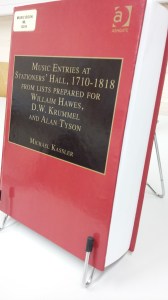
There is the option of checking Kassler’s listing (if Copac indicates that the piece was published before 1819); checking Kassler in digital format is generally easier than in the paper edition, because one can check by title in the e-book. The physical book has various indices, but there’s no alphabetical title listing, and only the composers’ names are listed, not their works.
The Advocates 1830 lists merely cover February to March of one year. Even if much of this material turns up in the Victorian catalogue at NLS, it’s not a huge sampling.
It’s marginally quicker checking the EUL Reid cupboard material against the St Andrews copyright music spreadsheet (which did arrive by the legal deposit route) than it is checking against Copac, but it has to be said that checking Copac is the more thorough way. Having said that, we can’t be totally certain that the Copac-listed material was registered at Stationers’ Hall if it postdates 1818, short of actually checking the Stationers’ Hall records. An item appearing in the British Library, and one or more of the other copyright libraries, was probably accessioned under legal deposit, but not categorically so. And not everything that should have been registered and legally deposited, actually was.
The St Andrews collection is only catalogued online for material dating from 1801 onwards, and of course, will not include items that were discarded rather than being bound in the big composite volumes.
After several lengthy sessions checking and cross-referring, I had nearly finished composers beginning with “G”!
Thursday – the brightness of a [rainy] new dawn …
Faced with a very large collection of Haydn publications, I concluded that although the most comprehensive approach would be a complete comparision of the EUL Reid Hall cupboard contents with Kassler, St Andrew’s online copyright collection, and items listed in Copac, maybe this isn’t necessary immediately. Instead, a few broad statistics give us an overview of what’s there.
Comparing Kassler’s listing for 1810 with the Reid Hall cupboard: a maximum of 9 matches, and possibly only 7.
Comparing Kassler’s listing for 1818 with the Reid Hall cupboard: possibly one match. It’s a very popular Irish selection, so it could have arrived by other routes than legal deposit, eg by donation.
Comparing the Advocates’ lists of February and March 1830 with the Reid Hall cupboard: only three matches, which are European editions.
Comparing an initial sample of 68 Reid Hall cupboard items matched either with the St Andrews copyright collection or Copac: obviously, percentages could only be calcuated if the entire list was compared; they’d be meaningless with a small sample. Nonetheless, we can observe that in Edinburgh, items seem to have been retained very intermittently between 1770 and 1811; there’s no real pattern. Between 1812 and 1821, noticeably more material was retained, although nothing like the St Andrews collection. After that it appears to be even more intermittent than in the earlier period.
A few months ago, I sewed a collage representation of the music from the Georgian copyright music era. Different media appeal to different people; not everyone will want to read the musicological detail of our research, but they might like some of the cultural history we’re unearthing: Napoleonic songs, lovesongs, piano music, Vauxhall Gardens theatrical material …
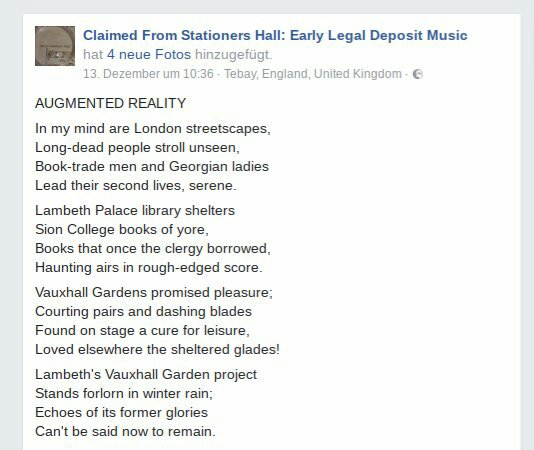
Then, a couple of weeks ago, I had another idea. This time, I whiled away some travelling time writing a short poem. Well, a verse, anyway. I can’t really privilege it by calling it a ‘poem’! Librarian B C Kaemper saved it as an image, which I share below:-
What do you think? Is there any merit in disseminating research findings this way in addition to the more conventional formats?
Whilst I was postdoctoral research assistant to the AHRC-funded Bass Culture project, I authored a blogpost about how/where to locate all the fiddle tune-books we were researching. I revisited that 2015 posting today, because the same resources are pertinent to the Claimed From Stationers’ Hall (CFSH) historical legal deposit music research network.
Bibliographic control of early printed and manuscript sources is key to historical research. In musicological discussions about British publications, it doesn’t take long before someone mentions Schnapper and BUCEM, although they’ve largely been superseded by RISM (the Répertoire Internationale des Sources Musicales). It was hardly surprising that RISM (UK) came up in conversation at the recent CFSH meeting that I attended at the British Library just before Christmas, because our whole network centres around firstly tracing eighteenth and early nineteenth century British legal deposit music in libraries, and secondly raising the profile of this corpus of material.
Let’s set this meeting in context by explaining who Edith Schnapper was; what she achieved with BUCEM; and how it fits in with RISM.
1957 – Schnapper
British Union-Catalogue of Early Music / Schnapper
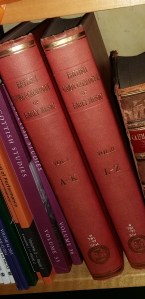
Dr Edith Schnapper was a bibliographer who listed British published music prior to 1801, in a two-volume bibliography entitled British Union-Catalogue of Early Music printed before the year 1801: a record of the holdings of over one hundred libraries throughout the British Isles (London: Butterworth Scientific Publications, 1957). Behind this huge undertaking was the Council of the British Union-Catalogue of Music, chaired by C. B. Oldman, with representatives from the great and the good of music and music librarianship of the time – ASLIB, the Bibliographical Society, the Bodleian, Cambridge University Library, the British Council, the British Museum, the Royal Academy of Music and the Worshipful Company of Musicians, along with other private individuals. Editorship had commenced with O. E. Deutsch in 1946, succeeded by Schnapper in 1950.
1912, 1940 – Squire, Smith
Around 60% of the material listed in BUCEM came from the British Museum (now the British Library), and Schnapper was able to draw upon an earlier publication for this:- W. Barclay Squire’s, The Catalogue of Printed Music published between 1487 and 1800 and now in the British Museum (2 vols, 1912) and William C. Smith’s supplement of 1940. For the rest, Schnapper consulted over one hundred other libraries, in person and through correspondence. Although inclusivity was key, a significant category was not fully listed. Oldman, in the preface to BUCEM, noted that,
“The only substantial exception consists of sheet-songs of the 18th century, which were published in vast quantities, especially from 1730 onward. While a considerable proportion of them has been catalogued in their entirety, notably the important early songs in the Chetham Library at Manchester, there remain several extensive collections mostly of the later 18th century, which had to be left uncatalogued through lack of time.“
The collections alluded to were other legal deposit libraries (Oxford, Cambridge, and the National Libraries of Ireland and Scotland), and two significant public libraries (Glasgow’s Mitchell Library and Manchester’s Henry Watson Library). Even though the British Museum probably had the largest and most complete collection of music deposited under legal deposit, we have to face the fact that not all music was actually registered or deposited. The unregistered material is an unknown quantity, and copies could be scattered pretty much anywhere.
1952 onwards – RISM
RISM logo
Contemporaneously with BUCEM, and eventually supplanting it for early British printed music, emerged RISM, a huge international undertaking which began in print and more recently moved over to digital format. RISM has been produced in various series covering different categories of musical material, both published and manuscript, and including writings about music as well as the music itself. See the RISM website for full details (http://www.rism.info/ ). Under Publications, the website summarises,
“The RISM publications represent RISM’s activities that began in 1952 and continue to the present day. The online catalog is the focus of RISM’s current activities and is freely available online. Series A documents musical sources in two parts: printed music (A/I) and music manuscripts (A/II). Series B is designed to cover specific categories of repertory. Series A and B are supplemented by Series C, the Directory of Music Research Libraries. Special volumes have also been published on the Tenorlied and RISM library sigla (now available as an online database).”
Different countries have branches of RISM, and the UK branch is of course highly pertinent to our present research: http://rism.org.uk. Since 1984, this branch has been run by the RISM (UK) Trust. Again, the opening summary is helpful,
“This database holds details of pre-1850 music sources preserved in libraries and archives in the UK. It includes manuscripts from national, public and academic libraries, county and city record offices, cathedral and chapel libraries and some private collections. It also now includes more than 300 printed anthologies from the 16th century, with links to digitised copies of the music in the Early Music Online collection at Royal Holloway. We estimate that about two-thirds of surviving manuscript sources in the UK have now been documented. Work has recently begun to document music sources in Ireland. Some music collections in Dublin libraries, notably the Mercer’s Hospital Collection at Trinity College, Dublin, are included in the present database. A new database dedicated to sources across Ireland has recently been launched by the RISM Ireland working group.”
See also the UK RISM page, ‘About RISM’, published in 2011:-
“The UK’s contribution to RISM is overseen by the RISM (UK) Trust, which was also historically responsible for documenting music source material in Dublin. An Irish working group has been set up to oversee the collection of data in the Irish Republic and Northern Ireland, and a new list of repository sigla has been drawn up (please see RISM Ireland’s webpage at http://www.musicologyireland.com/rism/index.html).
“Between the 1950s and 1990s, cataloguers in the UK concentrated largely on documenting printed music, along with manuscripts dating from before 1600. The data was published in RISM Series A/I and B. Work is now ongoing on the cataloguing of music manuscripts from the period 1600 to 1850, a key period in music history and one for which much significant material is held in the UK. That data is being made available via this website, as Music Manuscripts after 1600 in British and Irish Libraries.”
RISM A/1 for the UK was based on BUCEM, as is clear from Hugh Cobbe, ‘RISM A/II: The United Kingdom Contribution’, Journal of the Royal Musical Association Vol. 113, No. 1 (1988), pp. 146-148) http://www.jstor.org/stable/pdf/766276.pdf :-
“In the United Kingdom the national contribution to A/I was swiftly completed, largely thanks to the earlier publication of the pioneering British Union Catalogue of Early Music (London, 1957); all that was required were addenda et corrigenda, and it proved possible for librarians to provide these in the normal course of their work.”
As a trust, RISM (UK) is dependent on external funding. Between 2001 and 2007, AHRC funding supported the cataloguing of UK music manuscripts; and in 2011, JISC’s Rapid Digitisation Programme supported the digitisation and documentation of over 300 early printed music anthologies at the British Library. However, with no current funding, the work of RISM (UK) is currently dormant.
2017 – Legal Deposit Music: Visits to the British Library and Lambeth Palace Library
Prior to organising a workshop for stakeholders (those who curate or work with the historical legal deposit music collections) and other interested librarians, musicologists and historians, I’ve been meeting with key individuals and groups to talk about the aims and projected outcomes of the network. My meetings at the British Library and Lambeth Palace Library a couple of weeks ago were part of this process. At both meetings, I explained that the network has a steering group, which hopes to run a workshop for key players and other interested parties in Spring 2018. I also outlined the outcomes that I had committed myself to in the AHRC funding application:-
Blog, newsletters, social media. Guest blogposts. These are all well up to speed.
Conference papers
Workshop leading to published papers of some kind.
Journal articles
Raising the profile of collections by social media and by public events
Performing the collections – small-scale local events? Local history groups? At a National Trust property or another stately home? Ideally, it would be good to have at least one public performance or other event, volunteered by a participant, participant’s library or other group.
Bibliography (currently being compiled)
Various threads emerged, different at each meeting. At the British Library, the potential of such a large corpus of music for big data analysis was a significant interest, but it led on to discussion of the whole issue of bibliographic control, and the fact that RISM (UK) currently has no funding to continue bibliographic documentation beyond the present cut-off circa 1800. However, the situation is more complicated than you might think.
For example – leaving RISM aside for a moment – the British Library and Glasgow University Library have all their legal deposit music catalogued. I have yet to explore the situation at the Bodleian and the University of Cambridge. The University of St Andrews availed itself of funding for retrospective cataloguing of post-1800 material at individual libraries at the beginning of the present century; this way, they were able to catalogue a large proportion of their post-1800 copyright music collection, but not the earlier copyright music. Some of the University of Aberdeen’s copyright music is catalogued online – this is a work in progress. The National Library of Scotland still depends on the paper slip Victorian music catalogue for much of its nineteenth century printed music. Meanwhile, the University of Edinburgh has been able to undertake basic-level cataloguing of rare music materials that were in the Reid Hall collection, using volunteer assistance – it can be found on a spreadsheet on the University’s Research Collections website. Some of this material may well have arrived via the legal deposit route, though we don’t yet know which. However, these examples in themselves highlight the fact that uncatalogued material, material still catalogued on paper, or indeed, just not accessible via union catalogues such as Copac or WorldCat, is now effectively invisible, in an age where so much is catalogued online, or even available digitally. So, there’s a big research question – what do we do with analogue materials? What approaches could be taken, to the cataloguing of, and digital access to, the Stationers’ Hall copyright collections or indeed on a wider basis? This could form the basis for a much larger funding application.
If RISM (UK) had further funding, then the copyright music repertoire could be considered as a starting point for reviving RISM (UK) documentation activity. As a potential launchpad for a much bigger enterprise, the CFSH network acquires much greater significance!
We also talked about the “gap” between RISM with its detailed documentation, and IMSLP, with less detailed metadata but invaluable digital repertoire. How could we bridge the gap? (Could the early legal deposit music be digitised? There is a vast amount of it!)
This was by no means all that we talked about – another interesting strand was our discussion of a mass of music imported to Australia from the likes of Manchester and Liverpool in the late nineteenth century, and more recently acquired and repatriated by the British Library. The story of this separate corpus of material sounds fascinating!
Meeting at Lambeth Palace Library
Mention of Lambeth Palace inevitably conjures up pictures of the Thames and views of the Houses of Parliament; of archbishops and Anglican clergy; not to mention walled gardens, and impressive interiors literally oozing history. But of most importance to the present project is the fact that in 1996, the Palace Library took over the custodianship of Sion College Library’s pre-1850 materials, including some music.
Sion College was one of the legal deposit libraries throughout the eighteenth century until 1836, having been founded in the early seventeenth century:
“The Reverend Thomas White (c.1550 – 1624), Vicar of St Dunstan-in-the-West, Fleet Street, left £3000 in his will “for the acquisition of a house for the making of a College of Ministers, Rectors (Readers) and Curates within the City of London and the suburbs of the same.”
The most historical and valuable material from Sion College (just a handful of music falls into this category) is kept as a separate special collection, but there could be further material as yet uncatalogued apart from this.
Before the acquisition of this material by Lambeth Palace Library, its retention was sometimes threatened by financial exigencies, because books were occasionally sold to raise funds for the college coffers! This means that not all of the legal deposit books and music Sion College might have had, was still in their possession at the time when the surviving stock was transferred to Lambeth Palace.
Rather to my surprise, I learned that Sion College Library had provided its clerical readers with wide-ranging reading matter, and was by no means confined to sermons, lectionaries and theological treatises. So … did they keep secular as well as sacred music, for the enjoyment of the clergy? The four surviving early music rarities indicate that they did!
I was able to inspect the Sion Benefactors’ Book – a very old volume indeed, commenced in 1633 and maintained through the centuries, itemising books gifted to the library. This does include Stationers’ Hall material, but in the 18th century, it basically lists gifts and copyright material up to circa 1789; after that, “See” lists provide references to later gifts documented elsewhere.
I also learned that Lambeth Palace Library occasionally holds concerts and visits for various groups – including current members of Sion College, which now functions mainly as a sociable society for the clergy. And of course, the Palace is a near neighbour of the modern-day Vauxhall Gardens project. (I walked past it, in pouring rain – it’s very difficult indeed to visualise the eighteenth century gardens vibrant with theatrical, musical and sociable activity, such David Coke and Alan Borg describe in Vauxhall Gardens: a History.) In other words, there could be distinct audiences out there, if sufficient music could be pulled together into a programme or illustrated talk.
The big question first, though, is what can be identified apart from the four ‘special’ music books that were stored with the most valuable materials. Even if Lambeth Palace turned out not to hold very much historical copyright music, the library is still a stakeholder, insofar as it holds the rare books that once belonged to one of the copyright libraries. And so, too, in an indirect sense, are the members of Sion College itself. Wouldn’t it be exciting if a live music event could be coordinated? We’ll have to wait and see!
This is just a bit of fun – a WordPress challenge. I think my most meaningful project photo is probably the collage reflecting the variety of materials in the Saint Andrew’s copyright music collection. This is arguably not the ‘best photo’ in photographic terms! But it was another of my attempts to interpret research creatively.
Last week, I attended two very fruitful meetings at the British Library and Lambeth Palace Library – the modern incarnations of two libraries receiving the old copyright music. The British Library was previously The British Museum Library, and Lambeth Palace Library inherited Sion College’s library. I’ve yet to finish writing up my notes from the second of these meetings, but there will eventually be a blogpost about what we discussed. Most crucially, we discussed possible dates for a workshop in Spring 2018, and I’ve since set the ball rolling back here in Glasgow, so watch this space!
Whilst in London, I made a quick pilgrimage to Stationers’ Hall, but since this was an unscheduled detour, I didn’t make myself known there. Definitely somewhere for my itinerary next time I’m down, because Stationers’ Hall recently brought their archives back in house. This is certainly something worth investigating!
I’ve experimented with different ways of interpreting research in an effort to reach out to different audiences. I’ve sewn an abstract and I’ve made podcasts and even a videocast. On the train home, I attempted a poem. (Well, an 8787 verse, at any rate!) If you’d like to see it, please visit our Facebook site, which seemed a more appropriate place for my amateur scribblings!
We tend to take catalogues for granted. We expect them to tell us everything about a book, score or recording – author, title, publisher and publication date, pagination, unique identifying numbers (ISBN, ISMN or publishers’ code), and the contents of an album or collection of pieces. We look for the author or composer, the editor(s) – and expect to be able to know which is which. In modern, online catalogues, this metadata is all carefully entered into special machine-readable fields as a “MARC record”. That’s a MAchine-Readable Cataloguing record.
Not so Long Ago
When I began work as a librarian, I was taught how to catalogue onto pre-printed MARC data entry forms which the library assistants then entered into the library computer system. Computer tapes were run overnight to upload the data to a cooperative system hosted in the Midlands, and shared by a number of libraries. Things are more streamlined now!
A Couple of Centuries Ago
But what about our Victorian forefathers or the Georgians before them? By the early 19th century, library catalogues of books were often prepared as printed volumes, but this wasn’t the case for the music I’ve been looking at. Take the University of St Andrews’ handwritten catalogue made by Miss Elizabeth Lambert in the 1820s. If there were (for example) three completely separate pieces making up a set of sonatas or songs, then it was not unusual for her to write a composite entry: “Three sonatas”, “Six Quadrilles on airs from Le Comte Ory” or whatever.
In 1831, a meeting of the Curators at the Advocates’ Library – the precursor to the National Library of Scotland – agreed that their copyright music had been handled with a worrying degree of laxity, and decided that things had to be tightened up by appointing a music committee. Rules were drawn up regarding the handling and curation of this material, from arrival through to borrowing (yes, borrowing! It wasn’t yet a national reference library, after all) – not to mention calculating replacement costs and barring readers who had lost books, until they paid up!
However, it took until 1856-7 – by which time John Donaldson had become the Fourth Reid Professor at the University of Edinburgh – for the committee to decide that formal cataloguing rules were needed. Donaldson was at least a musician. Several committee members seem to have been in the legal profession. They spent a week thinking about how to set about it, debating whether to enter items under the composers’ names, or the publishers. And then they asked the experts at the British Museum. They received, by return, the rules used for cataloguing music, and adopted them for their own use.
This week, I looked at the National Library of Scotland’s Victorian Catalogue. I was trying to identify items on those two mysterious lists of music from 1830. They presumably wouldn’t have been catalogued until after 1857, if I’m interpreting the facts right. It took a little while before I realised just how far things have come since then!
Filing Systems
In the Victorian catalogue, music is entered alphabetically by composer, and then alphabetically by title within each composer’s output. However, the alphabetical titles were often alphabetical by genre rather than by exact title, so Selected Marchesmight be followed by Fourth March then Fifth March and then would come Favorite Quadrilles on airs from Rossini’s Le Comte Ory. (“Quadrilles” are alphabetically after “Marches”, and never mind about the words before them in the title!) Today, we create “uniform titles”, which standardise titles for filing purposes. By comparison, the Victorians had uniform titles in their heads but nothing like that on the catalogue slip!
Statements of Responsibility (aka, Entry Points)
This is modern library-speak for the names of people involved with creating the book or composition, whether they wrote, edited, or arranged it, or supplied some specialised service such as the fingering or bowing in a piano or violin piece, or indeed, writing an introduction or compiling an index at the end. Things are sometimes a bit more complicated than that.
For example, if Halevy wrote a piece, then clearly he was the main author. If he wrote a duet arrangement of themes in someone else’s overture, then in today’s parlance, he’d be the arranger. If he wrote variations on a theme, then you could argue that he was an author in his own right – the variations wouldn’t exist without him writing them. Thanks to online cataloguing, you’d find the piece regardless of what his contribution was, and in the case of sets of variations, the original composer of a theme would probably get a mention too. (The rules are clear, but if you check Copac, you find that sometimes the same piece has been catalogued by different libraries with either composer as the main entry, because it’s admittedly a slightly grey area – it doesn’t matter hugely, so long as the piece can be found!)
Anglo American Cataloguing Rules 2nd Edition (AACR2)
AACR2
IMAGES FROM AACR2 (Anglo American Cataloguing Rules 2nd Edition)
Now, in the days before online cataloguing, say, fifty years ago, an arranger or editor would have had an “added entry” with his name above the name of the original composer, so two catalogue cards would have been typed, and one filed under each individual’s name.
However, in the Victorian catalogue, you’d find Halevy’s compositions, sorted from A-Z, as I’ve just described, and then a second series of pieces sorted from A-Z, that he’d edited or arranged in some way. And the second sequence weren’t always complete entries. Sometimes, the card was just a cross-reference: it didn’t tell you which volume the piece was in, but the original composer’s name was underlined. So you’d then go and look under their name, to find out which volume contained the piece you were seeking.
As for publication and physical details – most records in the Victorian catalogue seem merely to inform us that the work was published in London, and was folio size. Not really very informative!
Those two lists from 1830 contained some 147 pieces, a few of which I had been unable precisely to identify. I made a valiant start trying to see how many of the identifiable ones could actually be traced in the Victorian catalogue. I didn’t get to the end of the lists! However, it did look as though the majority were there in some form. Had I been prepared to spend quite a few more hours on the task, looking for cross-references and arrangements in other places, maybe I’d have found more of them. I was at least able to establish that these lists seemed to be of pieces that the Advocates wanted to keep, rather than pieces they intended to sell. The lists didn’t look like Mr Greenhill’s lists from Stationers’ Hall; the Stationers’ Hall lists came quarterly, in books, and more closely written, whilst the Advocates’ lists were on loose sheets of paper, more spaced out, and dated as consecutive months: February and March 1830.
Of the pieces that I managed to trace in my two-hour session, most appeared to be bound into music volumes numbered from 1 to 68. I traced a handful in later-numbered volumes, but it was a bit difficult to be certain, when the handwritten lists themselves had given me little to go on!
It always pays to enquire whether there are other old card catalogues that may not be on general public access. The National Library of Scotland’s Victorian catalogue, and Glasgow’s main public reference library, The Mitchell’s Kidson collection, are just two examples. Because they’re paper slips in long trays, you have to be a bit careful with them, and access may have to be arranged under supervision of a member of staff. But these are valuable resources, and may be the only way of accessing a historical collection of music. Who would have thought it, in these days of online catalogues – or OPACs*, as we fondly refer to them.
*Online Public Access Catalogues, to those in the trade!
It is with great pleasure that we share our second guest blogpost, this time by Dr Kelsey Jackson Williams, Lecturer in Early Modern Literature at the University of Stirling, and Printer, The Pathfoot Press. If you’ve ever wondered what the process of music engraving actually entails, then your questions are about to be answered here.
One of the vast treasure trove of musical scores which falls within the remit of the Claimed from Stationers’ Hall project is the imposingly named A Collection of the Ancient Martial Music of Caledonia, called Piobaireachd as performed on the Great Highland Bagpipe. Now also adapted to the Piano Forte Violin and Violoncello. With a few old Highland lilts purposely set for the above modern instruments. To which is prefixed a complete tutor for attaining a thorough knowledge of the pipe music, compiled by the Skye native and prominent bagpipe-maker Dòmhnall MacDhòmhnaill (1766/7-1840) and published in Edinburgh in 1820.
Like many musical scores of the period, MacDhòmhnaill’s work was reproduced through copperplate engraving, a process which remained a mainstay of music publishing until the dawn of the twenty-first century (I was surprised to discover in the process of my research for this blogpost that even the Henle Verlag scores I practiced from as a teenager were still made by this traditional process!). Copperplate engraving, as the names implies, involves the etching of the image, in this case a score, on a copper plate with a stylus known as a burin. For musical publishing, it offered what could often prove to be a more economical, cleaner method of producing a score than the setting of music in moveable type, a slow, expensive, and painful process at the best of times.
But copperplate engraving was also a highly specialised skill, only invented in the fifteenth century and slow to spread across Europe. As late as 1732 Alexander Munro’s Collection of the Best Scots Tunes escaped the net of the 1709 Copyright Act because it was printed not in Edinburgh, as might have been expected, but in Paris, quite probably because the engravers of Edinburgh were not yet up to the task of preparing forty-five pages of music for the press.
How, then, did Edinburgh music publishing make the leap from the Parisian workshop of Jacques Dumont in the 1730s to the Edinburgh offices of Walker and Anderson in the 1820s? Many aspects of that story remain, as yet, unknown and I don’t propose to answer this question here, but rather to digress somewhat – in typical academic fashion – and look at the origins of the Scottish engraving industry, the same which would eventually produce craftsmen able to create such polished and elegant pieces as MacDhòmhnaill’s Piobareachd.
That industry had its origins in the Scottish early Enlightenment. Only a handful of engravers were active in Scotland in the latter part of the seventeenth century, though some of those produced work of a very high standard. Beginning around 1700, however, the Scottish engraving market began to expanded exponentially with somewhere in the region of fifteen to twenty engravers being active in Edinburgh alone during the first quarter of the century. It was no coincidence that this coincided with a shift in the Scottish printing economy. Beginning with the 1707 publication of volume one of George Mackenzie’s Lives and Characters of the Most Eminent Writers of the Scots Nation, Scottish printers and booksellers turned to a subscription model for producing specialist, high-cost works, whether those were antiquarian, literary, or musical in their contents. By shifting the economic risk from the printer to the individual subscribers, the Scottish book trade was suddenly able to produce far more of these works than it had before and this, in turn, led to the creation of a niche but growing market for print luxuries like engraving.
While Munro’s Collection fits within this narrative – boasting as it does an impressive subscription list of the great and the good of early eighteenth-century Scottish society – it was by no means the first time that engravers had been co-opted into the subscription publication model. Instead, this had previously happened with works on antiquarianism, particularly heraldry. Scholars such as Alexander Nisbet (1657-1725) had come close to bankrupting themselves commissioning lavish engravings for their works, engravings which offer some of our best evidence for the extent and skill of the trade at the time.
Robert Wood’s engraving of the heraldic achievement and probative quarters of the Duke of Queensberry, commissioned by Alexander Nisbet.
It was no surprise that Edinburgh engravers were more comfortable with heraldry than with music. Some of our earliest evidence for Scottish engraving comes in the form of heraldic bookplates and it seems likely that the first growth of the trade in Edinburgh was in response to the growing fashion for bookplates amongst the middle- and upper-class reading public of Enlightenment Scotland. As private libraries grew apace, their owners looked to the urban luxury trades – whether engravers, book binders, or others – for ways to distinguish theirs from the mix.
What the ultimate origins of Scottish engraving were – whether lying with Scots training on the continent or continental engravers immigrating to Scotland – and how it first developed its musical side are areas which remain to be studied. I’ll happily leave the latter to other, more knowledgeable scholars than myself, but I’m currently working on the former as part of a larger project on the arts and thought of early Enlightenment Scotland (which you can read more about here). I’ll sign off for the moment, though, with the reflection that, odd as it may seem, the origins of Scottish musical engraving lie in the production of bookplates for aristocratic readers in the intellectually teaming environment of Edinburgh at the turn of the eighteenth century.
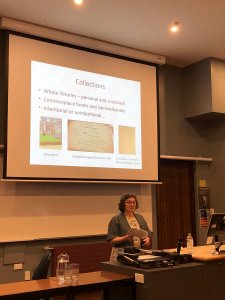
I returned from New Zealand yesterday morning. If you’d like to read about the University of Otago’s Centre for Book Research Seminar and the UNESCO Creative Cities Southern Hui, please follow this link. (And here’s a quick YouTube flick-through of my slides– don’t worry, it’s not the whole presentation!)
We’re delighted to share our first guest blogpost, by Dr Brianna E Robertson-Kirkland. It’s fascinating to read about this Georgian musician’s passionate interest in copyright!
Figure 1: Portrait of Venanzio Rauzzini with his dog Turk. At the Herschel Museum of Astronomy. Wikimedia Commons.
As the reigning primo uomo at the King’s Theatre from 1774-1778 (and then briefly again in 1784), Venanzio Rauzzini enjoyed many privileges. A handsome salary, opportunities to compose his own arias and some pull when it came to casting; the castrato used all of his clout to demonstrate his versatility in the music industry. Prior to his London residency, he had shown an enthusiasm for composition as well as singing, having composed the opera Piramo e Tisbe, performed for the Bavarian court in 1769 and ‘two or three comic operas […] which has been very much approved’ (Rice, 2015: 6 & Burney, 1775, 1:128). His passion for composition did not diminish as he continued to write opera, songs and even instrumental music after his immigration to Britain. Composing opera in which he starred also gave Rauzzini the opportunity to showcase the talents of his young students. Vocal teaching was just another strand in his multidimensional musical career. One such student, Nancy Storace, debuted on the operatic stage as Cupido in Rauzzini’s L’Ali D’Amore at the tender age of 11 as well as performing alongside her master in the cantata setting of La Partenza in 1777.
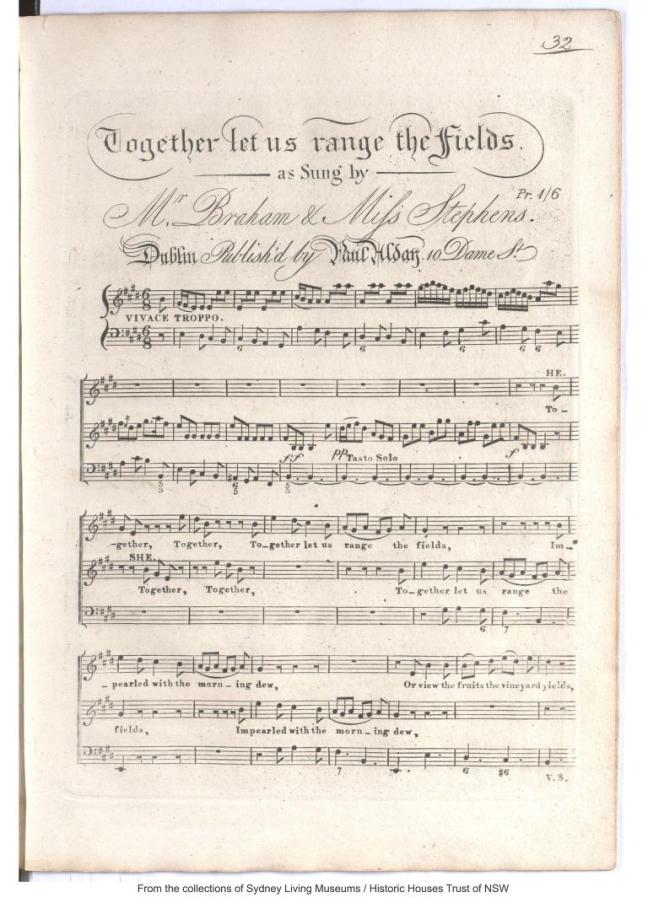
Opera in London was constantly surrounded by gossip and scandal. Moreover, claims of copyright were a tricky, controversial subject. Arias and songs were frequently removed from one opera and inserted into pasticcio. Such light-hearted theatre entertainments resembled a patchwork of favourite operatic numbers held together by a somewhat loose and generally absurd plot. While one arranger would oversee such a production, lyrics and occasionally the music were altered, blurring the lines between arranger, editor and composer. Expectations from singers added an extra complication since they frequently added their own unique flair to arias to ensure originality. If a singer was known for singing a particular aria, it was generally expected they would utilise it as a suitcase aria, inserting it into operas at their demand. The composer’s name usual appeared, even when a suitcase aria was performed, but when singers names were branded on title pages, often in a bigger font, it is not too far of a leap to assume the singer felt an equal sense of ownership.
Figure 2: Singers John Braham and Catherine Stephens names appear but in this example no composer is even listed. This was not an uncommon sight. Together let us range the fields [words by Edward Moore ; composed by William Boyce [c. 1815]. [Available from: https://archive.org/details/RangeTheFields46587 ]This is perhaps why the controversy between Rauzzini and fellow composer Antonio Sacchini became so heated. Not only had the two written an opera of the same name, L’eroe cinese, the similarity between the two was remarkable, leading to gossip that Rauzzini had ghost-written the original for Sacchini (Rice, 2015: 126). There was a further claim that Rauzzini had composed most of his own arias when playing the leading role in Sacchini’s operas. This was not uncommon, as Rauzzini often composed his own arias, though it was unusual that Sacchini should gain the credit. Neither benefitted from the controversy and afterward Rauzzini was far more diligent in claiming authorship over his work.
Michael Kassler’s comprehensive list of Music Entries at Stationers’ Hall, 1710–1818 reveals from 1795 onwards Rauzzini regularly entered his compositions into Stationer’s Hall including all 14 songs appearing in A Periodic Collection of Vocal Music published in two volumes in 1797. However, Rauzzini neglected to enter his Twelve Solfeggi or exercises to be sung by the voice (1808) – a final publication that provided a legacy for over forty years’ experience in vocal teaching. In his preface, Rauzzini writes:
I think that after a practice of thirty four years in England, during which time, I have had the opportunity of reflecting on the different dispositions and abilities of a great many Pupils professional as well as Dilettanti, my opinion may be relied on, and my advice followed, therefore, confiding on that Experience (1808: 1).
If this treatise was to be his legacy, why not enter it too? Did he not fear that his work could be stolen or claimed to be someone else’s work? The solfeggi are excellent examples of vocal exercises, but they lack an indicative style (which was perhaps the point of such exercises) that could make it more difficult to identify them as Rauzzini’s work. That being said, Rauzzini died just two years after this publication and before his second volume A second sett of solfeggi for the voice was published. Perhaps, he was simply too old to care. Or perhaps, there was a different attitude towards singing treatises in terms of copyright? Though there are some entries for music treatises listed by Kassler, compared to song compositions they are relatively few. This begs the question: why were music treatises not regularly entered?
While Rauzzini’s treatise continued to be recommended by other masters as late as the 1830s, his original treatises was manipulated and bastardised creating Exercises for the Voice, consisting of various solfeggi, collected from manuscripts of the late Venanzio Rauzzini (1817). While the title was careful not to claim Rauzzini as the creator a quick read of the preface reveals its origins – none other than Rauzzini’s 1808 publication with several alterations to make it more appealing to a ‘beginner’ consumer. This had never been Rauzzini’s intended clientele having written his original for more advanced students.
So what was the relationship between copyright and the education manual? I have to admit prior to this Stationer’s Hall project, I had not thought very much of it. Then again, treatises were being churned out at such a rapid rate with every teacher claiming a unique or original method of teaching perhaps it is an area that begs for further research.
References
Burney, Charles. 1775. The Present State of Music in Germany, the Netherlands and United Provinces, second ed. London: T. Becket, J. Robson and G. Robinson
Rauzzini, Venanzio. 1808. Twelve Solfeggi or Exercises for the Voice to be Vocalised, London: Goulding and D’Almaine
Rice, Paul 2015. Venanzio Rauzzini in Britain. Castrato, Composer and Cultural Leader, New York: University of Rochester Press
Brianna is Lecturer in Music (Historical Musicology) at the Royal Conservatoire of Scotland, and Course Convenor (MCLNC) and Performance Course Facilitator at the University of Glasgow.


 was published before 1819); checking Kassler in digital format is generally easier than in the paper edition, because one can check by title in the e-book. The physical book has various indices, but there’s no alphabetical title listing, and only the composers’ names are listed, not their works.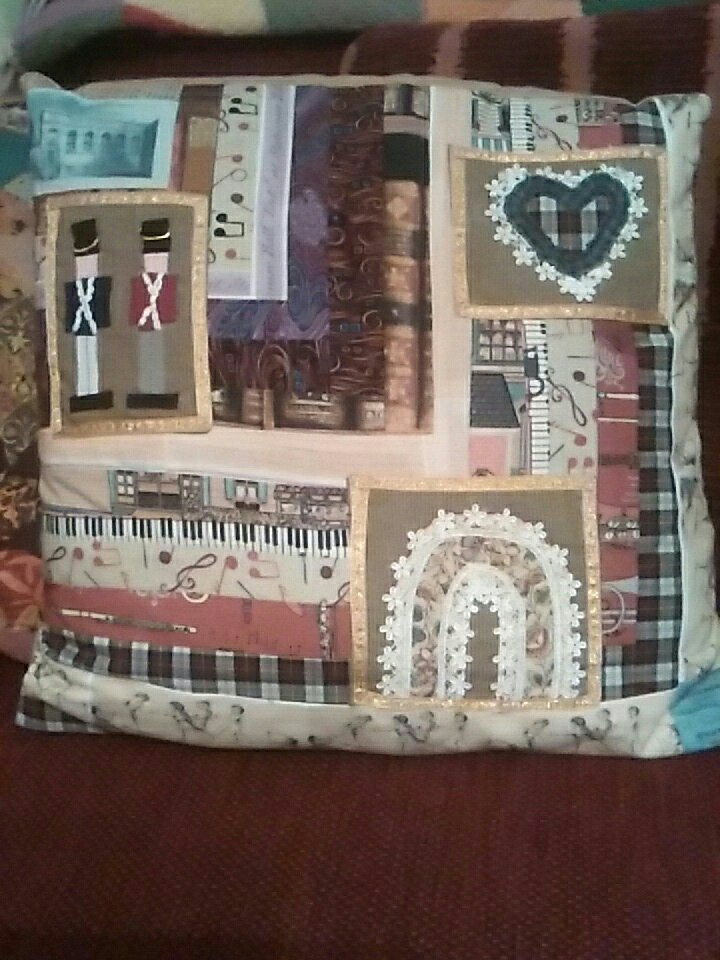
 Around 60% of the material listed in BUCEM came from the British Museum (now the British Library), and Schnapper was able to draw upon an earlier publication for this:- W. Barclay Squire’s, The Catalogue of Printed Music published between 1487 and 1800 and now in the British Museum (2 vols, 1912) and William C. Smith’s supplement of 1940. For the rest, Schnapper consulted over one hundred other libraries, in person and through correspondence. Although inclusivity was key, a significant category was not fully listed. Oldman, in the preface to BUCEM, noted that,
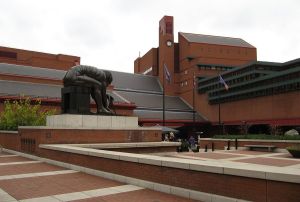 and Lambeth Palace Library
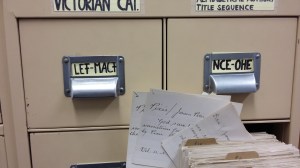 The National Library of Scotland still depends on the paper slip Victorian music catalogue for much of its nineteenth century printed music. Meanwhile, the University of Edinburgh has been able to undertake basic-level cataloguing of rare music materials that were in the Reid Hall collection, using volunteer assistance – it can be found on a spreadsheet on the University’s Research Collections website. Some of this material may well have arrived via the legal deposit route, though we don’t yet know which. However, these examples in themselves highlight the fact that uncatalogued material, material still catalogued on paper, or indeed, just not accessible via union catalogues such as Copac or WorldCat, is now effectively invisible, in an age where so much is catalogued online, or even available digitally. So, there’s a big research question – what do we do with analogue materials? What approaches could be taken, to the cataloguing of, and digital access to, the Stationers’ Hall copyright collections or indeed on a wider basis? This could form the basis for a much larger funding application.
 Mention of Lambeth Palace inevitably conjures up pictures of the Thames and views of the Houses of Parliament; of archbishops and Anglican clergy; not to mention walled gardens, and impressive interiors literally oozing history. But of most importance to the present project is the fact that in 1996, the Palace Library took over the custodianship of
  king of a College of Ministers, Rectors (Readers) and Curates within the City of London and the suburbs of the same.”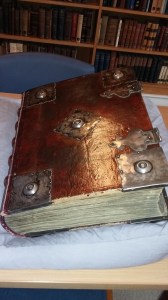

 Last week, I attended two very fruitful meetings at the British Library and Lambeth Palace Library – the modern incarnations of two libraries receiving the old copyright music. The British Library was previously The British Museum Library, and Lambeth Palace Library inherited Sion College’s library. I’ve yet to finish writing up my notes from the second of these meetings, but there will eventually be a blogpost about what we discussed. Most crucially, we discussed possible dates for a workshop in Spring 2018, and I’ve since set the ball rolling back here in Glasgow, so watch this space!
 We tend to take catalogues for granted. We expect them to tell us everything about a book, score or recording – author, title, publisher and publication date, pagination, unique identifying numbers (ISBN, ISMN or publishers’ code), and the contents of an album or collection of pieces. We look for the author or composer, the editor(s) – and expect to be able to know which is which. In modern, online catalogues, this metadata is all carefully entered into special machine-readable fields as a “MARC record”. That’s a MAchine-Readable Cataloguing record.
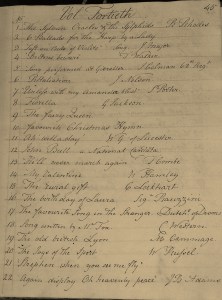 But what about our Victorian forefathers or the Georgians before them? By the early 19th century, library catalogues of books were often prepared as printed volumes, but this wasn’t the case for the music I’ve been looking at. Take the University of St Andrews’ handwritten catalogue made by Miss Elizabeth Lambert in the 1820s. If there were (for example) three completely separate pieces making up a set of sonatas or songs, then it was not unusual for her to write a composite entry: “Three sonatas”, “Six Quadrilles on airs from Le Comte Ory” or whatever.
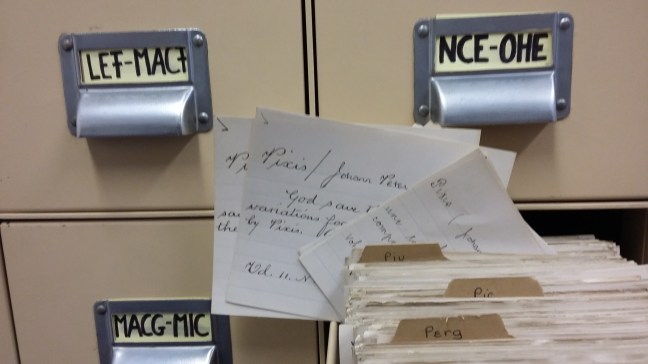 In the Victorian catalogue, music is entered alphabetically by composer, and then alphabetically by title within each composer’s output. However, the alphabetical titles were often alphabetical by genre rather than by exact title, so Selected Marches might be followed by Fourth March then Fifth March and then would come Favorite Quadrilles on airs from Rossini’s Le Comte Ory. (“Quadrilles” are alphabetically after “Marches”, and never mind about the words before them in the title!) Today, we create “uniform titles”, which standardise titles for filing purposes. By comparison, the Victorians had uniform titles in their heads but nothing like that on the catalogue slip!

 It always pays to enquire whether there are other old card catalogues that may not be on general public access. The National Library of Scotland’s Victorian catalogue, and Glasgow’s main public reference library, The Mitchell’s Kidson collection, are just two examples. Because they’re paper slips in long trays, you have to be a bit careful with them, and access may have to be arranged under supervision of a member of staff. But these are valuable resources, and may be the only way of accessing a historical collection of music. Who would have thought it, in these days of online catalogues – or OPACs*, as we fondly refer to them.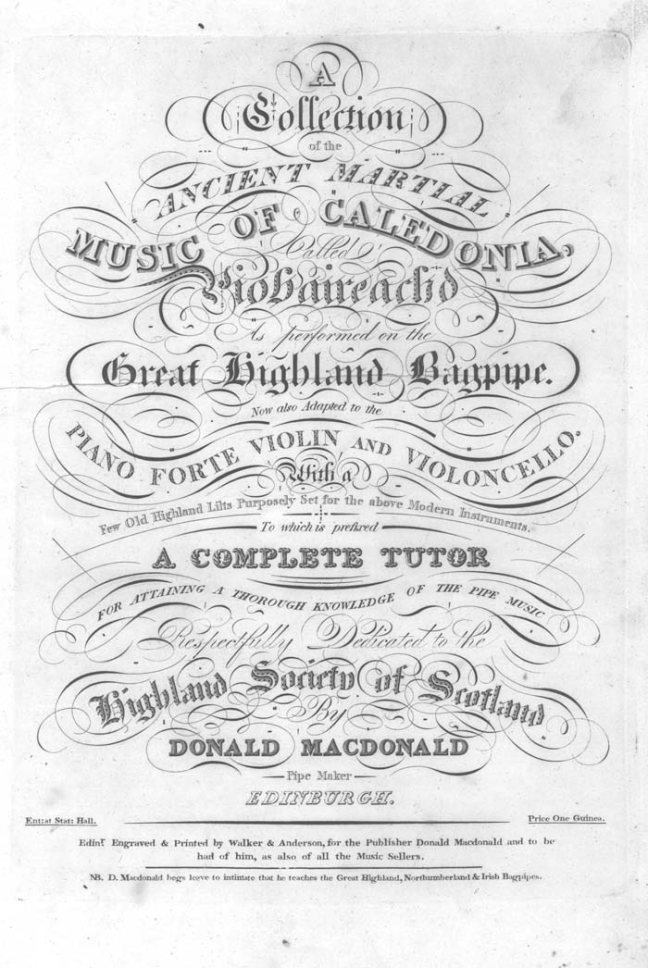


 I returned from New Zealand yesterday morning. If you’d like to read about the University of Otago’s Centre for Book Research Seminar and the UNESCO Creative Cities Southern Hui, please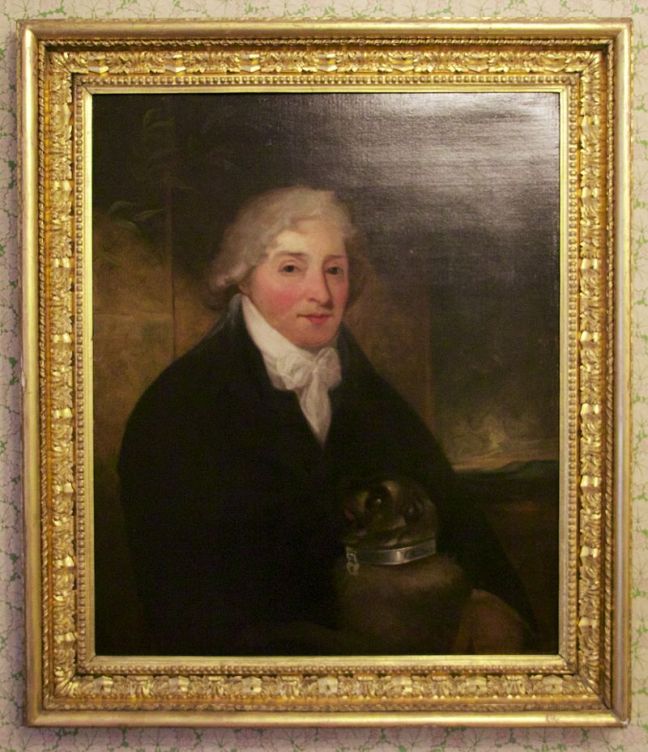
 Karen McAulay, Musicologist