Dr Karen McAulay explores the history of Scottish music collecting, publishing and national identity from the 18th to 20th centuries. Research Fellow at Royal Conservatoire of Scotland, author of two Routledge monographs.
I couldn’t find a nice anniversary for yesterday, but I certainly have one for today, 28th December.
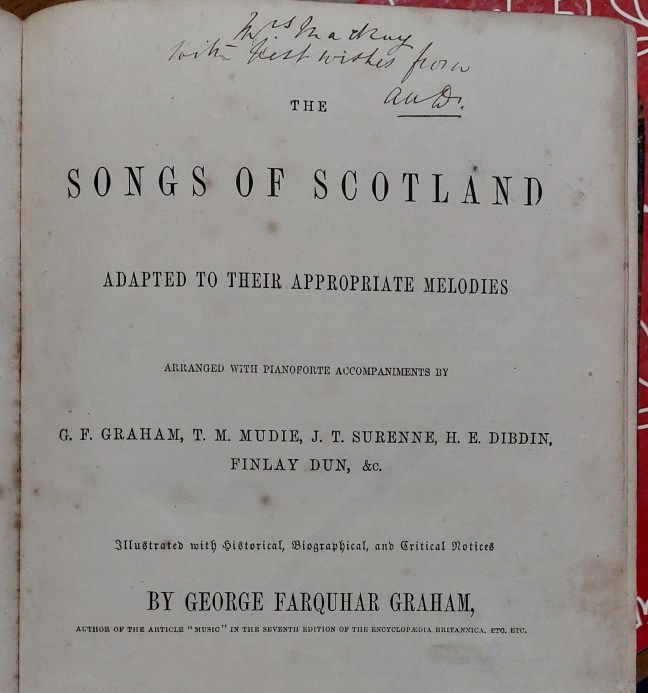
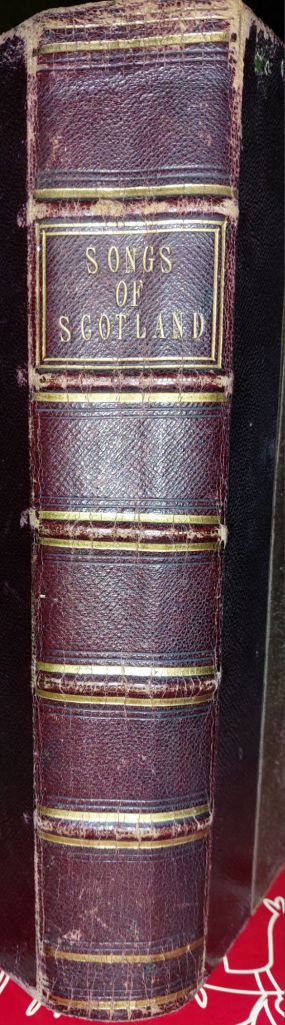
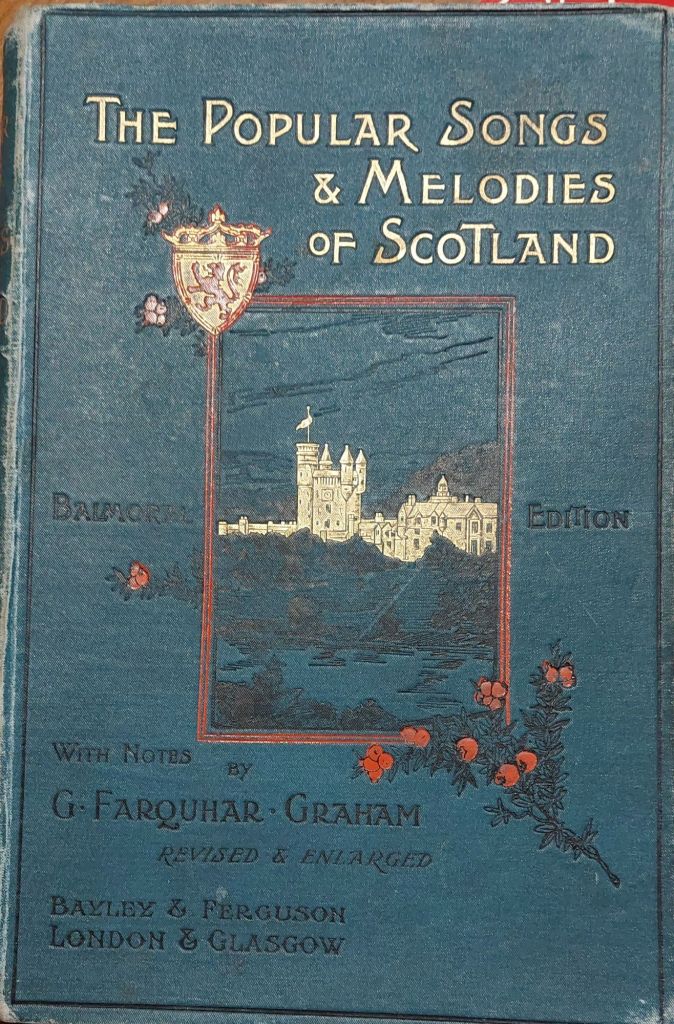
Journo, music critic, and Scottish song compiler George Farquhar Graham (1789-1867) was the editor of John Muir Wood’s long-lived song collection, Songs of Scotland, first published in 1848. As such, he featured heavily in my Our Ancient National Airs. But the book enjoyed an afterlife as one of Bayley and Ferguson’s handsome reprints – The Popular Songs and Melodies of Scotland – thus getting a mention in A Social History of Amateur Music-Making and Scottish National Identity, too.
Where’s all this going? Well, today is Graham’s 236th birthday – ‘Many happy returns, Sir!’
I’m honoured to have been awarded the Mervyn Heard Award by the Magic Lantern Society (UK) in recognition of my research into Scottish publishers Bayley and Ferguson’s Services of Song for magic lantern shows in the late-nineteenth and early-twentieth centuries. Their booklet, Wee Davie, containing a script for a reader, and suitably religious songs, was possibly the first thing they published – or certainly one of the first.
The Mervyn Heard Award is awarded for any written work, archival research or smaller-scale digitisation project.
I’ve talked about these service books in research lectures as honorary Ketelbey Research Fellow at the University of St Andrews in 2023, and at the Royal Conservatoire of Scotland’s Exchange Talks series. The discovery of these wee books certainly inspired me to delve deeper into the social history around amateur music-making, other entertainments and educational or religious events, so I owe a debt to the original author Revd. Norman Macleod and his moralistic story, Wee Davie, for starting me off on this particular research strand.
In due course, I’ll be writing more about this topic, most particularly for the Magic Lantern Society itself.
I don’t go on shopping sprees. But let me loose on eBay, and who knows what I’ll buy? I came across a Bayley & Ferguson publication from ca.1894-6. It was published both in Glasgow and in London, and was performed in Bishopbriggs on the outskirts of Glasgow in January 1897. The London address confirms the earliest date. (John A. Parkinson’s Victorian Music Publishers: an Annotated List is invaluable here.*) The cover illustration caught my eye, and I must confess I was intrigued to find it was composed by a woman: Constance M. Yorke. In 1897-8, she also published Twilight Shadows with a London publisher, Larway, who again dealt with light musical fare. I haven’t attempted to get my hands on that one.
Constance M. Yorke: is this Constance Maria Yorke Smith / Scholefield?
I traced a Constance Maria Yorke Smith (1855-1936), who was a vicar’s daughter, originally from Loddon in Norfolk, but whose early adult years were spent in Penally, Pembrokeshire. Her late father was the Revd. J. J. Smith, latterly a tutor at the University of Cambridge. Constance in turn married a clergyman herself – James Henry Scholefield – in a very ‘society’ wedding in Cornwall in 1891. If I’m right, then this ‘humorous musical sketch‘ under her forenames but not her surname, could have been written when she was already married. (Her mother had given the happy couple a grand piano as a wedding gift – Constance would have been making good use of it!)
Rose Smith’s Mother, Mary Ann
This paragraph is newly added (March 2026). In the RMA Research Chronicle, you’ll find my recent article about five Scotswomen involved in and around music publishing in the late Victorian era and early twentieth century. The author of the musical sketch, M. A. Smith, was the mother of composer and self-publisher, Rose Smith. And whilst I can’t be 100% sure of the identity of Constance M. Yorke, I am 101% sure that M. A. Smith was Rose’s mother, and the author of Mr and Mrs Dobbs at Home. I’m still working on this, notwithstanding the fact that my article is now published, because I feel there’s more to be said about M. A. Smith. I’m fascinated by her, her views, and her writing. Bayley & Ferguson didn’t publish the sketch using the lilac-and-green colour scheme commonly associated with women’s suffrage, but the sketch is a somewhat tongue-in-cheek sideways glance at the suffrage movement. Read on, to see what I mean. The rather obnoxious heroine hardly sells the idea of women’s suffrage and equality to the average man – or woman – in the street.
Mr & Mrs Dobbs at Home: humorous Musical Sketch / (words by M. A. Smith; composed by Constance M. Yorke (London, Glasgow: Bayley & Ferguson, n.d.). Franz Pazdírek listed the piece in his Universal Handbook (1904-10), but erroneously attributed it to Caroline M. Yorke, and Twilight Shadows to M. Constance Yorke – rather confusing, Herr Pazdírek!
So, what of ‘Mr and Mrs Dobbs at Home’? Selina is a spoiled young madam. Mr Dobbs is hen-pecked to an insane degree, submissive beyond measure and seemingly incapable of standing up for himself. Selina says he has driven the maids and the nurse away, so it’s only right that he should do all their work. ‘Enter Mr Dobbs in shirt sleeves and kitchen apron, with broom in one hand, duster in the other, as if he had been sweeping.’ (Does he go out to work? No mention of it. And why have they all gone away? The poor man seems to have no spine, let alone any serious vices!) The baby cries. Who goes and fetches her from the nursery? Mr Dobbs. He says the child is teething. Selina instead accuses him of jabbing her with a nappy pin.
Ah, well. Having told him off for having a quick, sneaky puff of his pipe whilst she was getting herself ready, the pair and their baby set off for a day out to meet one of Selina’s friends. At this point, Mr Dobbs mentions that a ‘lady speaker’ has tried for the third time to see Selina, but he forgot to mention this before. (I missed this the first time I flicked through, but sat up straight when I realised that Selina was being courted by the Suffragettes, Suffragists, or similar.) Privately, he seems to think anyone involved in ‘Women’s Rights’ should be kept well away from his wife – it seems a little late in the day for that, considering Selina already has the upper hand! Of course, Selina sees things differently, and the rest of the sketch is basically a dispute as to whether women can, or cannot, ‘rule as well as the men’, with Mr Dobbs muttering that,
Shirts, vests, and ties and knickers, too, are all now female gear; our coats and hats will follow suit, and presently we’ll see the pater in the mater’s skirt, a-toddling out to tea.
Mr Dobbs’ complaint
It’s not a work of high artistic content! Not that it isn’t harmonically sound or averagely tuneful, but it was probably only ever intended for domestic or amateur entertainment. However, I do smile at the thought that whilst Revd. Scholefield was writing his sermons, Constance was sitting at the piano composing a musical sketch about role reversal – and then publishing it. (Or had a lyricist originally written it more as a conservative warning than eager anticipation of a brave new world?!)
You never know what you might find when, on a whim, you order something off eBay.
* John A. Parkinson, Victorian Music Publishers: an Annotated List (Warren, Michigan: Harmonie Park Press, 1990) – it is worth noting that Parkinson worked in the Music Room of the British Museum.
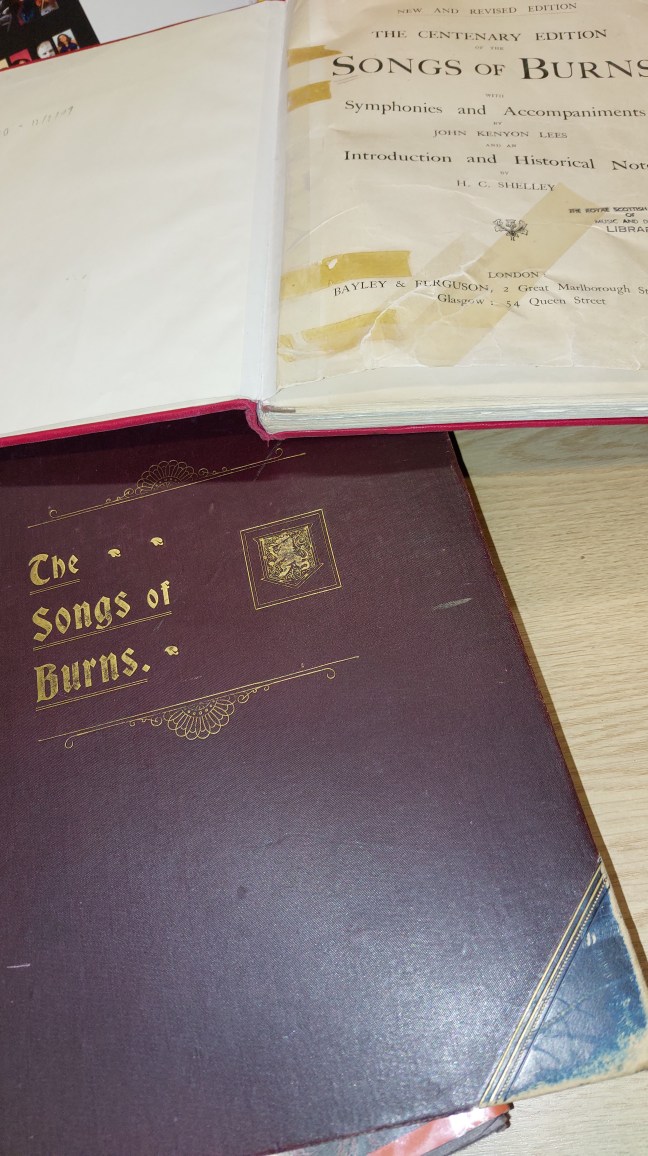
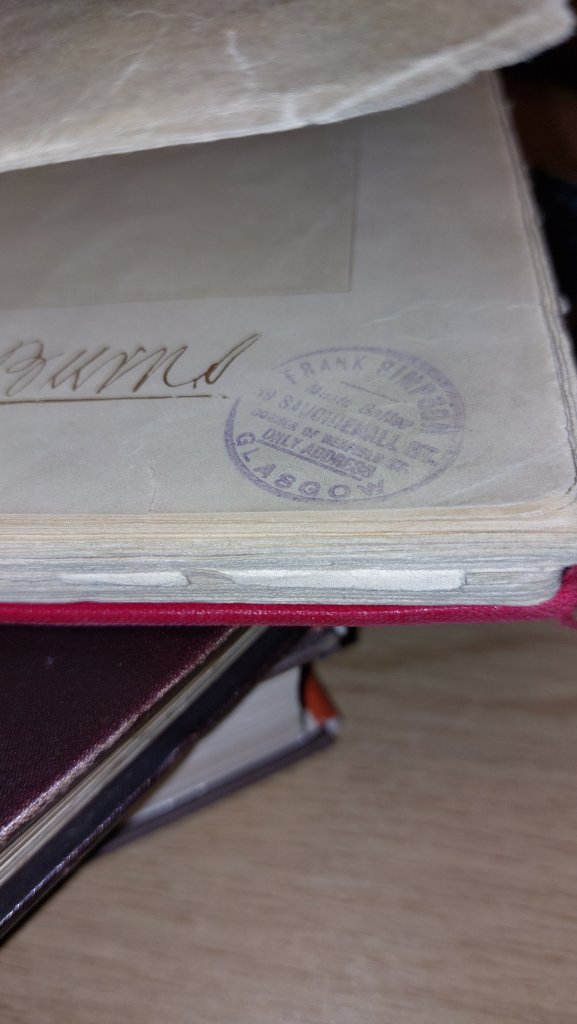
You can imagine the enthusiasm with which publishers rushed to produce centenary editions of Robert Burns’s songs in 1896. We have a Bayley & Ferguson ‘new and revised’ centenary edition in the Royal Conservatoire of Scotland library: well-used over the years, bearing the scars of untold tussles, its paper almost skin-soft through repeated borrowing. This one was published in Glasgow and London. I wasn’t at all surprised to see vendor Frank Simpson’s stamp on it – the Sauchiehall Street shop was there for many years, where the now defunct BHS store later stood. I can’t imagine how many of our old scores came from there!
Today, I needed to compare it with a more lavish bound presentation copy, which we acquired as a donation. The imprint likewise had Bayley and Ferguson’s name, but in larger print above it, it had Hedderwick, of Citizen Buildings in St Vincent Street. Both firms gave Glasgow addresses, and no mention of London. I suspect it was the earlier of the two, since I found 1896 newspaper adverts for this one. Hedderwick was a long established firm. And Bayley and Ferguson did publish music on behalf of other firms, groups or individuals.
It’ll have to go into the special collection – it’s so heavy that I can’t imagine anyone wanting to borrow it.
Plain or fancy, I imagine this title was a bestseller for several decades. I’ll finish cataloguing it tomorrow.
Now – have we got the Mozart Allan centenary Burns edition … ? Of course we have!
Today, I’m working from home wearing my library hat, but I have august company on the desk beside me. My fingers itch to give these new personal acquisitions a closer inspection, but they have to wait until tonight. Meanwhile, I can just look, and gloat.
The British Students’ Song BookThe Sottish Students’ Song Book
LATER, MUCH LATER. How helpful! There’s a page at the back actually listing the history of editions of the Scottish Students’ Song Book. That saves me having to unpick the history from newspaper adverts.
Also interesting to note that Janey Drysdale contributed a couple of songs to the British Students’ Song Book, that were arranged by her late brother. Marjory Kennedy Fraser contributed a couple of songs too, the lyrics of which were by Dr Charles Kennedy, whilst she had arranged the musical settings. Neither woman contributed to the earlier Scottish book.
Students were, of course, mostly male. Marjory had been one of the first women to attend music lectures at Edinburgh University, but she didn’t graduate until she was awarded an honorary doctorate much later.
Now, there’s one burning question. Who was the third woman that contributed to the British Students’ Song Book? Yes, I need to know! I have a book to write.






 Karen McAulay, Musicologist