Social History: Not Just Music!

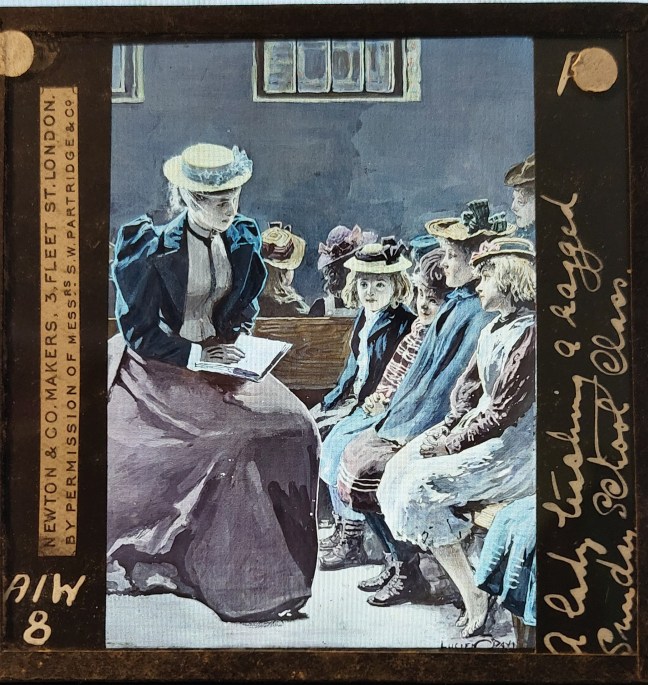
A Vctorian lady teaching children in a ragged Sunday School.
The Magic Lantern - title logo

Some months ago, I was looking for a picture of a Victorian Sunday School, to illustrate my writing about music for Sunday School use. I found an enchanting magic lantern slide, and – eBay being such a tempting resource – I immediately snapped it up. In truth, I just fell in love with the image: the children aren’t standing singing, but it conveys an impression of a kind and gentle Sunday School teacher, and attentive pupils. (Perhaps it also puts me in mind of attending Sunday School back in the 1960s?)

Anyway, I wrote a couple of paragraphs about it for The Magic Lantern (no.46, March 2026), and the copy duly popped through my letter box yesterday. Since the newsletter may prove hard to source in future, I’m taking the liberty of reproducing my piece here. I can hardly call it an article – it’s too short!
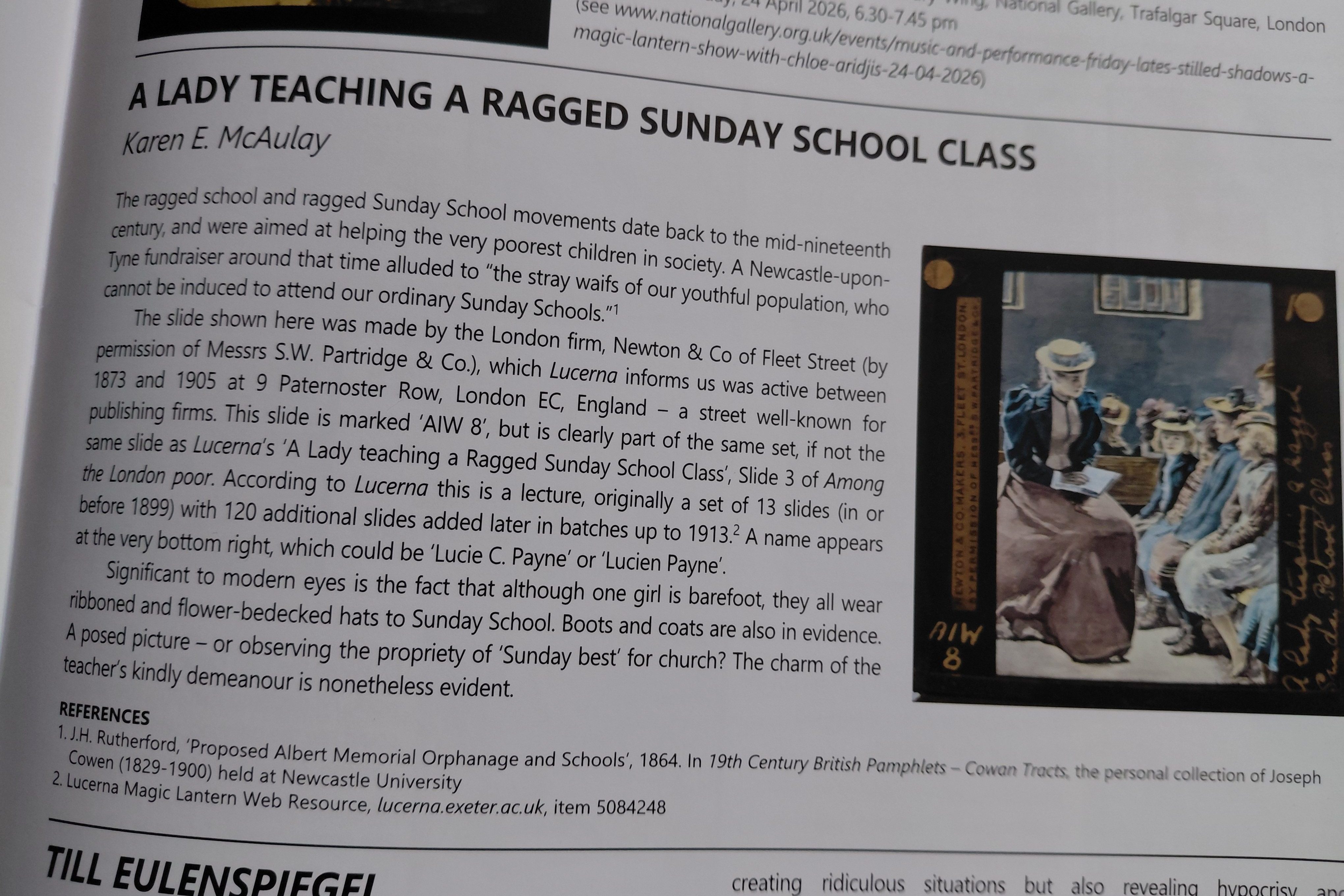
Entire annotated image in The Magic Lantern no.46, March 2026, page 13.
‘A Lady Teaching a Ragged Sunday School Class’, The Magic Lantern no.46, March 2026, page 13. DOI: 10.13140/RG.2.2.36840.43521

The Mervyn Heard Award

I’m honoured to have been awarded the Mervyn Heard Award by the Magic Lantern Society (UK) in recognition of my research into Scottish publishers Bayley and Ferguson’s Services of Song for magic lantern shows in the late-nineteenth and early-twentieth centuries. Their booklet, Wee Davie, containing a script for a reader, and suitably religious songs, was possibly the first thing they published – or certainly one of the first.

The Mervyn Heard Award is awarded for any written work, archival research or smaller-scale digitisation project.

I’ve talked about these service books in research lectures as honorary Ketelbey Research Fellow at the University of St Andrews in 2023, and at the Royal Conservatoire of Scotland’s Exchange Talks series. The discovery of these wee books certainly inspired me to delve deeper into the social history around amateur music-making, other entertainments and educational or religious events, so I owe a debt to the original author Revd. Norman Macleod and his moralistic story, Wee Davie, for starting me off on this particular research strand.

In due course, I’ll be writing more about this topic, most particularly for the Magic Lantern Society itself.