Dr Karen McAulay explores the history of Scottish music collecting, publishing and national identity from the 18th to 20th centuries. Research Fellow at Royal Conservatoire of Scotland, author of two Routledge monographs.
So, 202 years ago today, William Motherwell received Smith’s letter with accompanying draft preface. He would attend to the Scotish Minstrel Preface, he assured Smith. But …
… it would take him a week to get over his Hogmanay celebrations.
However much had he celebrated? Too hungover to do the task, but capable of writing back immediately?
If you’ve made any kind of study of Scottish songs and fiddle tunes, you’ll know that collector Andrew Wighton (1804-1866) bequeathed his fantastic music collection to the City of Dundee. As the Friends of Wighton website says, ‘Andrew J Wighton (1804-1866) was a merchant in Dundee. He built a music collection which is now of international renown and importance. After his death, his Trustees donated the music to the then Free Library in Dundee’. The Friends of Wighton is a charity which exists to promote the collection and the performance and study of Scottish music. I’m proud to be the honorary librarian.
On 31 December 1855, Wighton’s Aberdonian friend James Davie wrote to him observing that Wighton must, by now, have,
… the finest collection of old [Scottish] music in the three kingdoms.
You only have to look at the online catalogue today to see that Davie was perfectly accurate in his observation!
There are a few places where my in-laws’ history and my own research findings overlap. Glasgow is one of them, and Greenock is another. I know the stories of three mid-nineteenth century Greenock boys, all with family connections to shipping on the River Clyde: I encountered two of them whilst researching Scottish music publishers, but the other one is indirectly linked to me by marriage.
Allan Macbeth (1856-1910): Athenaeum School of Music Principal
Allan Macbeth was born in Greenock in 1856 to an eminent artist. After the family had moved to Edinburgh, he had two spells studying music in Germany, but he did return to Scotland. He married the daughter of a Greenock builder, ships carpenter, timber-merchant and saw-miller. Between 1880-7, he conducted Glasgow Choral Union.
Between 1890 -1902, he was Principal of Glasgow’s Athenaeum School of Music, building it up to a size barely imagined by the early directors. In 1902, he left to open his own Glasgow College of Music in India Street, taking umbrage after the Athenaeum directors decided they didn’t want a Principal who also taught classes. His own college appears to have died with him when he died in 1910.
Technically capable, in terms of musicianship, he wrote a quantity of lightweight music, eg his Forget me Not intermezzo and Love in Idleness serenata, both of which were subsequently re-arranged for different instrumentations, shortly after his death. Barely any of his music was published in Scotland – It was almost all published in England by a mixture of big and very small names.
Macbeth was one of the arrangers of James Wood and Learmont Drysdale’s Song Gems (Scots) Dunedin Collection, published in 1908 both in London and Boston, Massachusetts. Indeed, my own copy came from Boston, though there had also been an Edinburgh distributor. His Scottish song arrangements were typically late Romantic in style. The collection was aimed at a musically and culturally educated middling class, knowledgeable about Scottish poetry of earlier times. For example, his setting of Walter Scott’s ‘The Maid of Neidpath’ was set to an earlier tune by Natale Corri – hardly of Scottish origin! – with lush harmonies. I wrote about the collection in my A Social History of Amateur Music Making and Scottish National Identity(Routledge, 2025).
Macbeth’s son, Allan Ramsay Macbeth, briefly attended Glasgow School of Art (GSA) as an architectural apprentice before leaving to become an actor, and one of his cousins, Ann Macbeth, became head of embroidery there.
James [Hamish] MacCunn (1868-1916)
Twelve years after Macbeth’s birth, a second musical boy was born in 1868, this time to a wealthy ship-owning family in Greenock. The family firm later went bankrupt, but not before James MacCunn had benefited from a composition scholarship to the newly established Royal College of Music in London at a very young age. Like Macbeth, he left Scotland to further his musical education. He styled himself Hamish to suit his ostentatiously Scottish persona, and spent the rest of his life in England, determined to live in the style to which he had become accustomed. His compositions were on a decidedly larger and more ambitious scale than Macbeth’s, but he perhaps didn’t live up to his early adult promise, and his insistence on flaunting his Celtic origins may ultimately have gone against him. He too gets a mention towards the end of my Social History of Amateur Music Making.
McAulay (McAuley, MacAulay) Hogmanay, 1873
Also in the 1860s, my grandfather-in-law was born in Greenock to a much lowlier family, in 1866. (If you’re trying to calculate how my grandfather-in-law was born 159 years ago, shall we just say that age-gaps account for a lot.) This baby was the second Hugh born in the family, after the first one died of teething. Life wasn’t easy for the illiterate working-class poor; this family had already moved from Ballymoney on the north coast of Ireland, in pursuit of work on the Clyde. His father Alexander worked in the shipyards as a hammerman until his untimely demise one Hogmanay. Last seen on 31 December 1873, Alexander drowned in Albert Harbour and was found a month later. Did he jump, or was he pushed? We’ll never know!
My husband’s grandfather Hugh was later to move his young family to Tyneside in pursuit of work as a ship’s carpenter. Family mythology has various spellings of our name – but since our immigrant Irish McAulays were illiterate, there is no correct spelling. It was spelled however the registrar, or newspaper editor, chose to spell it. There was an embroidered family tale about my Great-Grandfather-in-Law, erasing the embarrassing Hogmanay drowning – and another story about Grandpa-in-Law’s move to Tyneside after a dispute with his foreman (which has every chance of being equally inaccurate).
I can’t help comparing how different were the lives of the two promising young musicians, and the Clydeside then Tyneside shipyard worker who was to thrive on tonic sol-fa, and whose adult family were to make up at least half of their Presbyterian church choir!
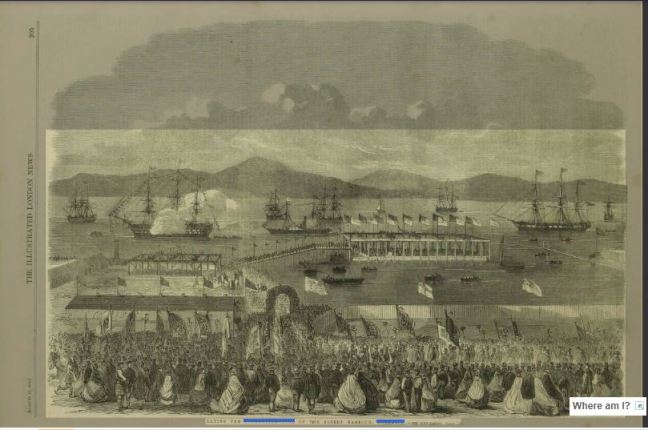
Image: Photo of the laying of the foundation stone, Albert Harbour Greenock, from the Illustrated London News 23 August 1862, p. 9 (British Newspaper Archive)
Through sheer bad luck, all the men in my house had flu between Christmas and New Year. Call it Casa Influenza, if you will. I’ve been downing zinc, echinacea, and multivitamins with cod-liver oil – providing room service whilst wearing a mask, and cursing my FitBit for suddenly deciding to pass daily comment on my own levels of activity. It’s not counting the stairs, which I consider a very bad show considering how many times I’ve been up and down them. Then, after the first day of my Florence Nightingale gig, it observed I’d been overdoing it and should take a rest. So, I tried to rest the next day (as much as I could), whereupon it observed that I really needed to increase my cardio load. The third day, I walked to the postbox to increase my step-count, but this still wasn’t enough for FitBit. Stupid device!
Bah, humbug!
Only One Resolution!
Left to myself downstairs for several days, I couldn’t help myself doing a little bit of research in between fetching and carrying coffee, soup and meals on demand. However, having done absolutely nothing about seeing the new year in last night, I decided that if I was going to make one resolution this year, then it would be to do something more relaxing than searching databases on a public holiday. Moreover, I had woken up early – again – and couldn’t get back to sleep. I reached for my headphones and settled down to an audiobook.
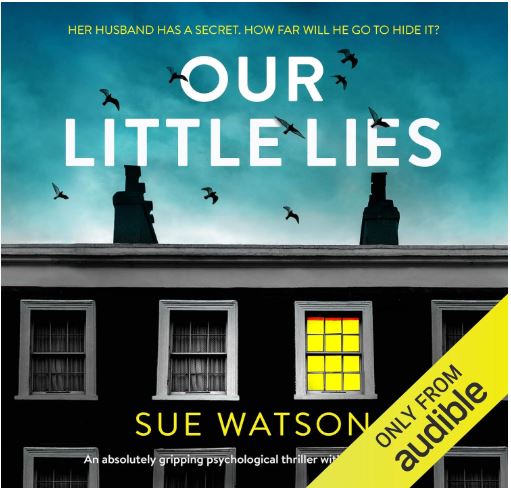
(10 hours and 8 minutes, narrated by Katie Villa.)
An absolutely gripping psychological thriller with a brilliant twist.
I settled down under my duvet, ready to be psychologically thrilled. Although it began pleasantly enough, I must confess that I was too cosy, and I fear I may have been a bit drowsy through a couple of the chapters near the beginning. This didn’t promise to be as exciting as I’d hoped. It seemed like rather a slow, pedestrian start. On the other hand, maybe I’d have got on better if I’d been sitting up in a chair, or doing something else at the same time, rather than nearly falling back to sleep! When I woke up properly again, I didn’t feel as though I’d missed much.
Having said that, I took my phone round the house with me today, and listened to the entire story enjoyably enough, interrupted only when one of my invalids needed sustenance to be supplied! It did get better as it went on. The heroine was believable, and the anti-hero’s determination to gaslight her, accusing her of madness and psychological instability, grew more and more chilling as the tale unfolded. Her husband was a serial adulterer, a manipulative bully, psychologically and sometimes physically abusive.
As you listen (or read), you really do feel the heroine is caught in a trap, where her husband would do anything to make her feel guilty, whether literally finding fault where there was none, or for genuinely pathetic infringements (not folding the throws tidily enough, not tidying up crumbs off the sofa, or allowing the twins to watch TV) – or for serious tragedies for which she was in no sense to blame.
Marianne was certainly obsessive. But her husband Simon, who was a brilliant and ambitious surgeon, convinced her GP to prescribe heavy tranquillisers, and you were left wondering (as Marianne did) whether she was going mad, losing her memory, losing her ability to cope or becoming paranoid – or was the medication causing side-effects?
Admittedly, at one point, I wanted to yell, ‘For pity’s sake, you need to leave him, taking your kids with you!’, but of course, she had no-one to go to; even her so-called new friend turned out to be disloyal in the extreme.
The final chapters were very clever. Marianne arranged a party in which she would reveal her husband (and his lover) in their true colours. There was a murder a couple of days later, and because she couldn’t recall exactly what had happened, she was arrested and held for a number of hours before being released. However, the denouement was not as straightforward as it would have appeared, and – as in the best whodunnits, the culprit eventually turned out to be someone else entirely.
It’s not a detective novel, or even a crime story as such – emotional and domestic abuse underpin the novel, but the murder comes near the end of the book and – as I said – there’s a twist in the last ten minutes.
I closed my Audible book feeling that I had actually chosen just the right book for a lazy New Year’s Day. I’d recommend it.





 Karen McAulay, Musicologist