
New Article: ‘Song Gems (Scots): the Dunedin Collection: a commercial failure?’

Pile of purple gems. Pixabay.

Four years ago, I gave a conference paper with this title. Time passed before I found it a home as a published article, but I’m pleased to say that it is now published in Brio, Vol.63 no.1, pp.13-30.
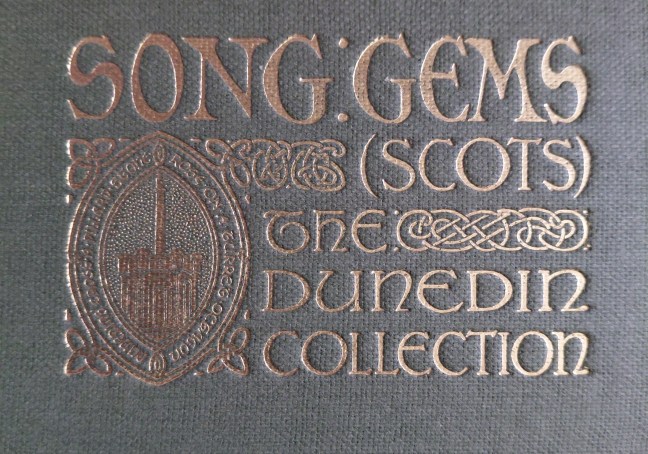
Song Gems (Scots) embossed song book cover, gold on olive green

Brio is the professional journal of IAML(UK & Irl), the British and Irish branch of the International Association of Music Libraries. It’s a fitting home for an article about a Scottish song collection of a rather distinctive nature.

I’ve added the article details to my RCS Pure page, and I’ll also list it here on my Publications page and on ResearchGate. If you’d like to read it but can’t access it, do drop me a line via my ‘Join the Conversation’ page on this blog.


Abstract

โ€˜The introduction to the musical world of yet another collection of Scots songs may possibly in certain quarters seem to demand something in the nature of an apologyโ€™, said editor James Wood in his 1908 preface.  Woodโ€™s collection is intriguing. The clumsily-worded title on the cover incorporates an embossed lozenge/roundel of Edinburghโ€™s Dunedin cross. Although Wood compiled the collection, he collaborated with a musical editor, Learmont Drysdale, and another eleven Scottish musicians are acknowledged.  His own identity is a bit of a mystery. The bookโ€™s scarcity is also noteworthy; it was possibly a short print-run.  Well-intentioned, it perhaps lacked general appeal, and paratextual clues bear out the assertion that this highbrow, specialist publication may not have sold very well.

Heading Image by Marilyn Cada from Pixabay
‘Repugnant to Modern Feelings of Propriety’? The Most Beautiful Scottish Song

I’ve started listening to another Audible book, but it’ll take a while for me to finish it. To take a break from listening, I sidled over to the piano and played a one-eyed rendition of my favourite song.

Lady Anne Bothwell’s Lament (Baloo, my Boy)

My Song Gems (Scots), edited by James Wood and Learmont Drysdale (London: Vincent Music Co., 1908), is a nice big score that sits comfortably on the piano stand. This song is arranged by Finlay Dun, a Victorian arranger. As I squinted at the words, they didn’t look like what I remembered hearing sung from Cedric Thorpe Davie and George McVicar’s The Oxford Scottish Song Book (1969). What was going on? I suspected Davie and McVicar had taken their words from George Farquhar Graham and James Wood’s mid-Victorian Songs of Scotland. ‘You’ll see’, I told my bemused son. ‘The words will have been too smutty for Victorian ears, so Graham and Wood changed them.’

Davie used their words – which were perfectly acceptable for a collection intended both for classroom and adult use – but his musical setting is updated.

A Deserted Mother and Child

Graham and Wood’s collection revealed in the footnotes that it was an old ballad collected by Bishop Percy. However, Graham said that …

The Old Ballad, though poetically meritorious, is so coarse in most of its stanzas as to be repugnant to modern feelings of propriety. We have, therefore, adopted only the first stanza of it, the additional stanzas here given having been written by a friend of the Publisher.

Songs of Scotland (Edinburgh: Wood & Co., 1850), Vol.2, pp.30-31

Percy’s original version is in the National Library of Scotland’s Digital Gallery (Reliques of Ancient Poetry, 1767). Today, the lyrics are inoffensive!

And here’s the Cedric Thorpe Davie setting using Graham and Wood’s sanitized words:-

Kathleen McKellar Ferguson sings the Oxford Scottish Song Book version, divinely, here on YouTube

The Song Gems (Scots) version is in modern English and the text has been partially rewritten again –  it falls halfway between the original and the sanitized words! And the musical arrangement? Straight from Graham and Wood’s collection.

Percy, verse 3: Smile not as thy father did, to cozen maids, nay God forbid / Bot yett I feire, thou wilt gae neire Thy fatheris hart, and face to beire.

Wood and Drysdale, verse 2: Smile not as thy father did, to cozen maids, may God forbid / For in thine eye his look I see, The tempting look that ruin’d me …

Olde English or modern, take your pick!

As for Graham and Wood, or Thorpe and McVicar? Not a ruinous smile to be be seen! The lady may have been deserted, but no hint that she had first been seduced!