Dr Karen McAulay explores the history of Scottish music collecting, publishing and national identity from the 18th to 20th centuries. Research Fellow at Royal Conservatoire of Scotland, author of two Routledge monographs.
I’m not a Luddite, and I fully appreciate that AI can do truly remarkable things – but I don’t entirely trust AI. It gets things wrong. It disrespects the concept of intellectual property. And it has the capacity to perpetuate fallacies – attributed and unattributed – on a scale which gives me misgivings for the work of future scholars.
To my horror, I found a tiny example of this today. I had trusted a Google AI summary. Yes, I know – it was reprehensible, and I should have known better. It was when I was writing my posting about ‘Durisdeer’.
Correct
Kenneth McKellar did indeed sing it – you saw the YouTube video that I shared.
Incorrect
Now then, a recording of a modern Scottish song by Kenneth McKellar was certainly used over the opening credits of a film in 1963. However, that modern Scottish song was not ‘Durisdeer’, which as we know, was a Victorian creation by Lady John Scott. Google’s AI summary put two and two together and made five. I was somewhat alarmed to discover that by repeating this fallacy, my blog post was now highlighted as an authoritative statement about it.
I have now corrected my earlier posting about ‘Durisdeer’, ensuring that I have not perpetuated the hallucination connecting the man-and-the song, with the man-and-a-different-song-and-a film. As attractive and appealing as the hallucination was, it was just plain wrong.
It’s important always to bear in mind the wide range of music that can be described as Scottish. It’s certainly not just folksy-sounding songs from farm workers of long ago! Styles have changed, and tastes varied over the centuries. And as I demonstrate here, different types and classes of people made contributions of a more or less lasting kind.
One Single Song
It’s so easy to go chasing after red herrings! This time it was a single song, and I only looked it up because I didn’t recognise the title. I think I’ll stop with what I’ve found out – quite enough for my purposes.
Lady John Scott (1810–1900)
Going through the Leng Gold Medal shortleets (Scots for ‘shortlists’) – I several times encountered a song that I hadn’t any recollection of seeing before: Lady John Scott’s ‘Durisdeer’.
Lady John Scott – born Alicia Ann Spottiswoode – was born in Berwickshire, now referred to as the Scottish Borders. She was a composer and poet, and enthusiastic about Scottish heritage – indeed she was the first female Fellow of the Society of Antiquaries of Scotland.
Ought I to have known more about her? Arguably not. She’s famous for one particular song, ‘Annie Laurie’, out of those that have actually been published. In fact, the Scottish Poetry Library website says that she ‘rewrote’ the words to ‘Annie Laurie’.
‘Durisdeer’
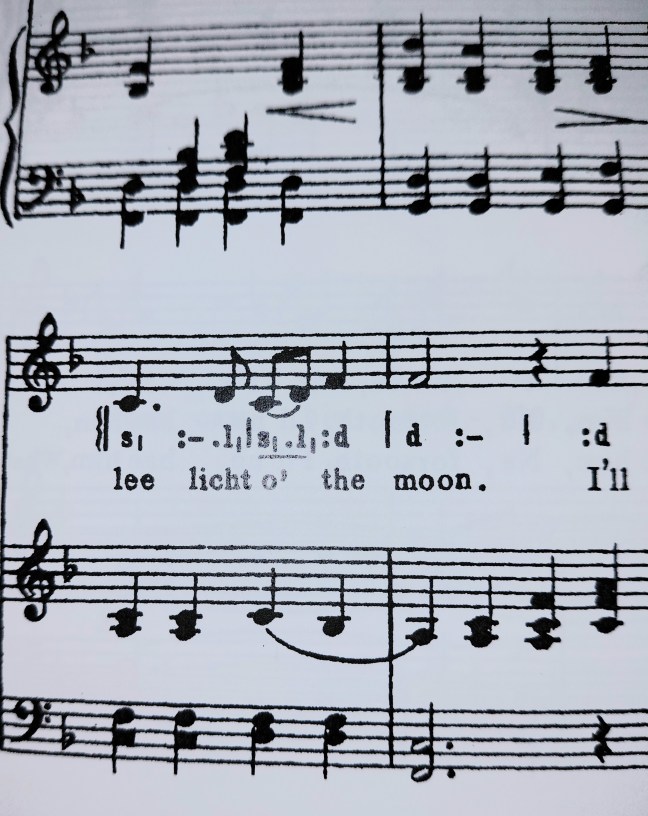
We’ll meet nae mair at sunset, when the weary day is done …
Opening lines of ‘Durisdeer’, by Lady John Scott
I was, in fact, wrong about not having encountered ‘Durisdeer’ before, though, because it’s in a couple of song-books in the Whittaker Library at the Royal Conservatoire of Scotland. Since I indexed most of the Scottish song books in the library – an activity which certainly paid off, because it means that ‘my’ Scottish song index is constantly, and universally available – it follows that I have almost certainly indexed those two instances of ‘Durisdeer’. However, I would have had no reason at the time to have noticed this particular song, which appears to have been published once in London by Lonsdale, ca.1850 (the Whittaker Library hasn’t got that one), and then by Glasgow and London firm Paterson ca.1910 in Lady John Scott’s Thirty Songs, and again by Paterson in the New Scottish Orpheus Vol.3 in 1937. The Thirty Songs must also have been reissued ca.1930-31, for I found a review of it in Music and Letters, April 1931. (More of that anon!)
Significantly, the person at the head of Paterson’s was John Michael Diack, who was a teacher at the Glasgow Athenaeum School of Music and later became Superintendent of Music for Glasgow, as well as being Paterson’s editor. (He gets several mentions in my Social History of Amateur Music-Making and Scottish National Identity, now available in paperback). Diack’s inclusion of this song in two Scottish song compilations (the one by Lady John Scott herself, and the New Scottish Orpheus) would also have helped bring it both to music teachers’ and to singers’ attention.
Kenneth McKellar popularised it in the late 1950s. Probably as a result of this, it began to appear in music festivals! I found it in the Leng Gold Medal shortleets from 1968 onwards – it could have been sung before that, but detailed records only survive from 1967 onwards. It was also sung in the nearby Arbroath Musical Festival in 1959, and in Perthshire festivals in the 1950-60s. I’m sure it must have been sung in a number of music festivals, but I’ve done enough searching!
Kenneth McKellar sings ‘Durisdeer’
‘Durisdeer’ is a pretty piece. It’s named after the place by that name, has Scottish lyrics, and is by a Scottish woman composer, but it’s not what you’d call a ‘traditional’ folk song. Whilst it undeniably is Scottish, it doesn’t sound very Scottish, apart from the use of Scottish dialect and a gapped melodic outline at the midway and final cadences of this two-verse song.
Mind you, I have mused and written often enough about what actually counts as Scottish, concluding that a bit like beauty, Scottishness is in the eye (ear) of the beholder.
Anyway, back (briefly) to the review of Lady John Scott’s Thirty Songs. This reassures me that, for all ‘Durisdeer’ is tuneful enough, I don’t need to feel too bad about not having known it:-
Lady John Scott: Songs (including Annie Laurie). She wrote the tune and fabricated the words of one immortal thing. This volume shows that as long as she stuck to Scots sentiments things went well. There is nothing here to equal ‘Annie Laurie,’ but still some pleasant things remain. [Paterson.]
Music and Letters, Vol. 12, No. 2 (Apr., 1931), p.214, Review by ‘Sc.G.’
‘Sc.G.’ was Scott Goddard (1895-1965), a music critic and Walford Davies’ assistant at Temple Church. He had studied at the Royal College of Music. I don’t know about the other 28 songs in the book. If, like ‘Durisdeer’, they’re ‘pleasant things’ rather than an ‘immortal thing’, then at least Goddard and I agree!
(The Scottish Orpheus Vol.3 is still available, now distributed by Novello.)
My Leng Medal Memories research is funded by an Athenaeum Award from the Royal Conservatoire of Scotland.
Whilst I had intended to conduct perhaps 50 interviews in connection with my Leng Medal Memories research, I haven’t amassed quite that many – but the interviews have generally been nearer to 30 minutes than the 15 minutes that I innocently projected, so I’ve probably got easily as many recorded minutes as I initially aimed for!
As I mentioned last week, I’ve been editing my interview transcriptions, and correcting any auto-correct infelicities. (Teams and TurboScribe both struggle a little with Scottish place-names and song titles.) One of my interviewees sang, ‘O Gin I were Whar’ Gadie Rins’ in the late 1960s. I knew the name of the song, but I couldn’t put a tune to it, so I Googled it. (As you do!) Spellings vary – as you’ll see.
Well, I found Kenneth McKellar singing it with a small classical chamber ensemble. (Lovely bassoon part, I must say.) The YouTube version was a 1995 Lismore remastered recording. I haven’t tried to establish the original date, though I believe it was recorded for the BBC in the late 1950s or early 1960s. But this setting was so delicate and precise that it was hard to imagine a youngster of eleven or twelve singing it quite like this. Quite apart from the fact that the Leng Medal competition has always been unaccompanied!
My next dip into YouTube found tutor Irene Ross talking about it and then singing it, with a ukelele, for Feis Rois followers. This is livelier and more authentic, but perhaps just a wee bit more ‘folky’ than might have been performed at a music competition by children of my own generation. But I could be wrong!
However, if the folk sound is what you’re looking for, then that interpretation is itself quite sedate compared to an invigorating 1999 recording by the Old Blind Dogs! Actually, I love this – one of my great frustrations in life is that I’ve been so embedded in the more classical side of music-making that I can only enjoy listening to this and would have huge difficulty trying to sing or play in anything like this idiom. I’d love to – but I can’t!
Oh well, I have to get back to these transcriptions, so I’ll stop here for now. Energised, you might say!
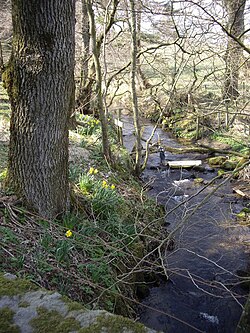
Image: Stanley Howe / Upstream Gadie Burn, from Wikimedia.
My Leng Medal Memories research is funded by an Athenaeum Award from the Royal Conservatoire of Scotland.