Dr Karen McAulay explores the history of Scottish music collecting, publishing and national identity from the 18th to 20th centuries. Research Fellow at Royal Conservatoire of Scotland, author of two Routledge monographs.
After my last Audible adventure – well, its dreamlike quality felt more like sleepwalking than an adventure – I needed something a bit more gritty for my next audio book. There can be nothing more ‘real’, or in the moment, than the story of the remarkable Ernest Shackleton’s abortive trip to the South Pole aboard The Endurance in 1915.
Alfred Lansing, Endurance. Abridged audio book (Blackstone Audio, Inc., 2000)
I don’t often read books in the ‘Adventures, Explorers & Survival’ or ‘Expeditions & Discoveries’ categories. However, I found this book gripping, and even terrifying, as challenge after seemingly impossible challenge had to be surmounted. To rescue the entire crew from two icy and inaccessible islands was more than remarkable.
For myself, I’d like to know what happened to them all after they got home! Do I need to look for another book …?
I won’t be there, but my choral piece, Not Like Noah, is one of the songs being tried out at this workshop.
I’m proud that, although I’m primarily a musicologist and librarian, my composition is getting a chance to be performed. Yes, it’s another piece about climate change. I hope the singers enjoy it!
[Later] And I have heard a recording. Gratifyingly successful, I must say. When there’s a weblink, I’ll share it here. Sounds as though the sopranos enjoyed doing their ‘howling gale’ glissandi, too!
‘You can read, use your laptop and phone’, says the post-op leaflet. What it SHOULD say, in my opinion, is ‘You can read, use your laptop and phone for short spells, but don’t overdo it.’
I did a musicological blog post last night, web-links and all. By the end of it, my good eye was protesting, and I had a headache for much of today. And I’m shattered!
So … back to the original plan! I will finish my next Audible book, then review it. Bear with me, dear reader!
I’ve started listening to another Audible book, but it’ll take a while for me to finish it. To take a break from listening, I sidled over to the piano and played a one-eyed rendition of my favourite song.
Lady Anne Bothwell’s Lament (Baloo, my Boy)
My Song Gems (Scots), edited by James Wood and Learmont Drysdale (London: Vincent Music Co., 1908), is a nice big score that sits comfortably on the piano stand. This song is arranged by Finlay Dun, a Victorian arranger. As I squinted at the words, they didn’t look like what I remembered hearing sung from Cedric Thorpe Davie and George McVicar’s The Oxford Scottish Song Book (1969). What was going on? I suspected Davie and McVicar had taken their words from George Farquhar Graham and James Wood’s mid-Victorian Songs of Scotland. ‘You’ll see’, I told my bemused son. ‘The words will have been too smutty for Victorian ears, so Graham and Wood changed them.’
Davie used their words – which were perfectly acceptable for a collection intended both for classroom and adult use – but his musical setting is updated.
A Deserted Mother and Child
Graham and Wood’s collection revealed in the footnotes that it was an old ballad collected by Bishop Percy. However, Graham said that …
The Old Ballad, though poetically meritorious, is so coarse in most of its stanzas as to be repugnant to modern feelings of propriety. We have, therefore, adopted only the first stanza of it, the additional stanzas here given having been written by a friend of the Publisher.
Songs of Scotland (Edinburgh: Wood & Co., 1850), Vol.2, pp.30-31
Percy’s original version is in the National Library of Scotland’s Digital Gallery (Reliques of Ancient Poetry, 1767). Today, the lyrics are inoffensive!
And here’s the Cedric Thorpe Davie setting using Graham and Wood’s sanitized words:-
Kathleen McKellar Ferguson sings the Oxford Scottish Song Book version, divinely, here on YouTube
The Song Gems (Scots) version is in modern English and the text has been partially rewritten again – it falls halfway between the original and the sanitized words! And the musical arrangement? Straight from Graham and Wood’s collection.
Percy, verse 3: Smile not as thy father did, to cozen maids, nay God forbid / Bot yett I feire, thou wilt gae neire Thy fatheris hart, and face to beire.
Wood and Drysdale, verse 2: Smile not as thy father did, to cozen maids, may God forbid / For in thine eye his look I see, The tempting look that ruin’d me …
Olde English or modern, take your pick!
As for Graham and Wood, or Thorpe and McVicar? Not a ruinous smile to be be seen! The lady may have been deserted, but no hint that she had first been seduced!
I’m still new-fangled with this Audible book app. It told me I had a monthly credit to spend, so I had a look at the recommendations. Yoshimoto’s The Premonition sounded intriguing, from the blurb – and the cover art was attractive; proof that book design matters!
Had I walked into a bookshop and seen it, would I have bought it? I don’t know. I’d have been surrounded by appealing new titles, and I can’t say whether I’d have chosen this above all others. It’s quite short, compared to the other books I’ve listened to, and – frustratingly – it is not broken up into chapters. I find it easier to put a book down if I’ve come to a structural break.
It’s a strange, dreamlike book, set in or around Tokyo. It’s richly descriptive of its physical surroundings, but I got a bit tired of reading about Yayoi’s brother’s straight back, the set of his shoulders and the way he walked!
Yayoi, the heroine is paradoxically both clairvoyant after a fashion (the word ‘clairvoyant’ isn’t used, but what is a clairvoyant if not someone who has premonitions?) and amnesiac, having lost all childhood memories after a traumatic incident. She knows that there’s something she doesn’t know. She has two loving parents; a wonderful brother a couple of years younger than her, whom she adores; and a completely eccentric young aunt who lives alone in a ramshackle house, from which she somehow emerges sane and tidy enough to work as a school music teacher every day … except when it rains.
We never find out quite why the house has been allowed to become so dirty and run-down (was there no-one to help her learn how to run a home?); why the aunt never seems to cook proper meals; or why she seems so dreamy and other-wordly. It takes a while to work out why the heroine feels so drawn to her.
There are loose ends. What was the significance of the heroine intuiting that someone had killed a baby in the leaky bath of the temporary accomodation that her own family rented during a house renovation? This seems to be completely unrelated to anything else in the story. And why did the aunt not like going out in the rain? Most particularly, once the heroine had worked out her real relationships to her brother and aunt, you’re left wondering why she hadn’t been told before.
At the end of the novel, Yayoi has pieced together the story, with the help of her aunt/sister. But what will become of the changed relationship with her brother? And how will the aunt/sister resume a romantic relationship with another young man, who had until recently been a classroom pupil? From a British vantage-point, all I could think about was child protection policies, ethical breaches and the involvement of social services, the teaching council and potentially the police. My knowledge of Japanese culture is so minimal that I don’t know if such a situation would be viewed differently there.
Discovering the truth may not make things any easier
So, if I had to summarise the book in one line, it would be this:- ‘Discovering the truth may not make things any easier.’
I’m not sure what I’ll read next, but perhaps I’ll opt for something a little more conventional!
‘Audible’ books are great for someone who is trying to rest their eyes. But the problem starts when the book you want to read isn’t on Audible! Only being able to read a few pages at a time made reading this book a bit more of an endurance test than it needed to be. It wasn’t difficult reading in terms of comprehension – just a bit of an effort for my left eye without the assistance of the right one, which will take a few more weeks to catch up!
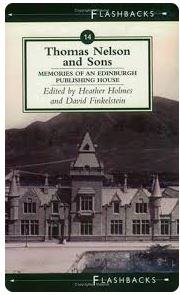
Thomas Nelson & Sons: Memories of an Edinburgh Publishing House, ed. Heather Holmes and David Finkelstein (East Linton: Tuckwell Press, 2001) ; Flashbacks series no.14 (Book cover shown above)
In the final pages of the book I’ve recently submitted to my publisher, I have referred to Thomas Nelson and Sons, the Edinburgh publisher. In connection with the research behind that book, I had acquired a copy of the paperback edited by Heather Holmes and David Finkelstein some months ago, but I didn’t read it at the time – because it was clearly not going to inform me about editorial decisions of the sort I was writing about. Nonetheless, I did want to read it at some stage, and I made a start last weekend.
Image from Wikimedia Commons
I learned a lot more about what it was like working in the print works, as recalled by four different individuals who were time-served printers – but I didn’t learn a huge amount more about publishing decisions in general, and there was nothing at all about publishing music. Nonetheless, it was useful; I’ve got a lot more background, and a few more facts and figures. Moreover, it was helpful to read about the demise of Thomas Nelson and Sons in the 1960s, the same decade that saw the decline of Scotland’s music publishing industry.
The ‘Flashbacks’ series is (or was) published by Tuckwell Press in association with SAPPHIRE (the Scottish Archive of Print and Publishing History Records) and The European Ethnological Research Centre. The latter sponsored the series, c/o the Royal Museums of Scotland. I think the National Museums of Scotland publishing page may be out of date, since it says there are six Flashbacks publications to date, yet the book I’ve just read is no.14, and was published in 2001. So far as I can make out, the series ended around 2004, and I think the SAPPHIRE oral history project ended about five years after that. (There are articles by Finkelstein, Sarah Bromage and Alistair McCleery dating from 2002 and 2009.)
As it happens, this was exactly the kind of book that I needed right now. Whilst I’m temporarily out of action, it’s useful to read around a subject without the pressure of needing to take notes. I can do the detailed scholarly work later!
Yesterday, I intended to start another audio-book. But somehow, nothing pleased me. I tried a book by a renowned TV presenter, but after a few minutes, one of the characters was standing gushing blood – and I just didn’t fancy it. No problem, I thought to myself, and started a twenty-first century pastoral narrative. Somehow, that didn’t catch my interest either. Finally, I read a few actual, paper pages of a book about the Edinburgh publisher Thomas Nelson – before my healthy eye got tired. Reading with one eye works fine for a wee while, but there’s no point in straining it.
I had yet another cuppa, and wrote a quick note to a friend, and that was all I managed. An attempt to go out for coffee failed at the first hurdle – my inability to see what I was doing was too annoying for my companion, who simply wanted me to pass a slice of cake. I couldn’t coordinate my hand with the different versions of what each eye was seeing.
I haven’t been in a reading frame of mind since then. Maybe tomorrow …
For folk with a Macular Hole Our treatment has only one goal: By careful incision, To better our vision, Then rest up and do as we’re tol’
Our middle son, Scott McAulay, has just shared details of a forthcoming Routledge book, The Pedagogies of Re-Use, in which he has one solo- and one jointly-authored chapter. I’m insanely proud! It’s ‘coming soon’ – Amazon says it’s due out on 6 June 2024 – so I look forward to the sight of the book actually in his hand before too long.
Tracking Irish Emigrants from Cork to USA and London
My third audio book just came up as a new publication when I logged onto Audible. Its title appealed to me. Additionally, since my own [in-the-pipeline] monograph touches upon emigration in the nineteenth and early twentieth centuries, then if Clair Wills’ book touched upon that, I was definitely interested.
The book describes the author’s extensive efforts to find out more about illegitimate births in her own Irish family; the adults involved, and the secrecy surrounding what had happened. The scandal of the Irish mother-and-baby homes during the twentieth century is naturally a significant focus, but the author also examines the part of the Irish Catholic Church; the local authorities; adoption; single mothers; questions of respectability and inheritance; of shame; of emigration (to America, and to England); of stigma and suicide; along with changing attitudes towards the end of the twentieth century. Since I’m neither Irish nor Roman Catholic, I was sure it would be informative – and it was.
It’s a moving, and multi-faceted narrative. Just when I was beginning to ask myself, ‘So, if the mother-and-baby homes were a twentieth century scandal, what happened before that?’, Wills explains how things gradually changed from the second half of the nineteenth century into the early twentieth, along with the political changes. The unbearable tragedies for the mothers and babies were too many to enumerate, but we’re reminded that the outcome for a young Irishman fleeing to life as an itinerant labourer in England was hardly what any young adult man would have hoped for, either.
Did any of this have any bearing on my own research? Not really, except to provide me with some statistics about emigration from Ireland that were far higher than I had imagined – and I already knew they were high. Moreover, my own musicological research really only requires me to say, ‘There was a lot of emigration from the Highlands and Ireland, usually for work.’ After all, I write about national songbooks, and their appeal to emigrants. If I was going to give more detail, I could, I suppose, add, ‘and sometimes, especially in Ireland, to make a fresh start where an illegitimate pregnancy made it expedient for either party.’ But to be honest, songs about missing your homeland – or even your sweetheart back in the old country – aren’t likely to go into specifics about babies born in inconvenient circumstances.
However, reading Audible books during a period of forced inactivity, doesn’t mean they have to be connected with research. It’s an unaccustomed luxury to listen to books for hours on end, and I’d recommend this one. I have six more titles lined up, but I don’t think I’ll start them today. I like to let the memory of one sink in, before beginning another.
As I mentioned yesterday, I’m being kind to my eyes this month. I challenge myself to review every audio-book I listen to in February. But – they’ll be the briefest of reviews!
David Wilkerson – The Cross and the Switchblade
This book was famous in the ‘Sixties, when I was far too young to read and understand it – and it later became a film. I had heard of it, probably in my undergraduate days, but I’d never read it. Wilkerson was an American pastor who felt a calling to minister to gang members, drug addicts and others on the edge of society. He set up a whole chain of rehabilitation centres under the name of Teen Challenge. There was much to marvel at, as I listened to his narrative. He was fearless, and 101% committed to his cause. What he achieved was remarkable – and to add to that, the funds were achieved by devout, purposeful prayer. I have Christian faith myself, but I don’t think I’ve ever encountered faith in action on the scale that Wilkerson, his team and his new converts practised.
I don’t know how this book would come across to readers without faith. It in no sense preaches to the reader, but is just a straight, sincere narrative. I found it both moving and inspiring.