A Quiet Contribution to Women’s History: Miss Elizabeth Lambert

Seashells of various sizes

At Tuesday’s Women who Dared book launch, mention was made of the Wikipedia ‘Women in Red’ project, to which I once attempted to contribute.  It’s a valuable project; there’s no denying far too few women are represented in Wikipedia.

I  got nowhere with my own attempt, as I was the only person who had researched and written about ‘my’ Elizabeth Lambert (married name Williams), so I couldn’t provide the requisite references by respectable authors. She wasn’t ‘daring’, but she definitely made a worthwhile contribution to St Andrews University Library, in cataloguing their legal deposit music so borrowers knew what was available to borrow.  (Her other private interests were interesting, too. She was an acknowledged expert in conchology.) I’m pleased to see she at least has a Wikidata entry now! Anyway, thwarted in my Wikipedia ambitions, I posted a biography on the present blog.

You might also find my article about St Andrews’ Copyright Collection of interest. Again, Miss Lambert gets several honorable mentions. And I found another posting that I’d forgotten all about, this time in 2021 for a University of Stirling research project. I might as well share details of these pieces, to get her a bit more exposure!

Addenda to ‘Our Heroine is Dead: Margaret Wallace Thomson …’

Choral music - A Weary Day, by Margaret (Maggie) Wallace Thomson

I wrote an article for a Scottish organists’ newsletter, a couple of years ago. To ensure the article would continue to be accessible even if the newsletter was not, I also posted it on this blog.

I was thrilled to receive a query about Margaret (aka Maggie) Thomson over the weekend, so I updated the article gently with a couple of scans and a little bit more detail.

Maggie was clearly a modest soul – or, maybe, a typical Victorian woman, eschewing the limelight – even when she was made a presentation, her brother made the acceptance speech. At any rate, I’m not at all surprised that so little survives of her work. It sounds as though she was an amazing, and much loved accompanist, but the two pieces in The National Choir really aren’t remarkable in any way. Parlane was a local, Paisley book publisher with a considerable output, but having a contribution published in The National Choir would not have as much kudos as a composition published by Boosey or even by one of Scotland’s bigger music publishers. (There’s quite a bit more about Parlane and The National Choir in my book, if you’re interested.)

Another piece, referenced in a newspaper review, probably wasn’t even published.

And there’s another piece, held by the British Library, that has some connection with her – although, if she arranged it, then I’m not quite sure what Wallace Waterston’s input was, even though it is catalogued under his name. Maybe he wrote the tune? I haven’t tried to find out.

ADDENDA to my earlier article:-

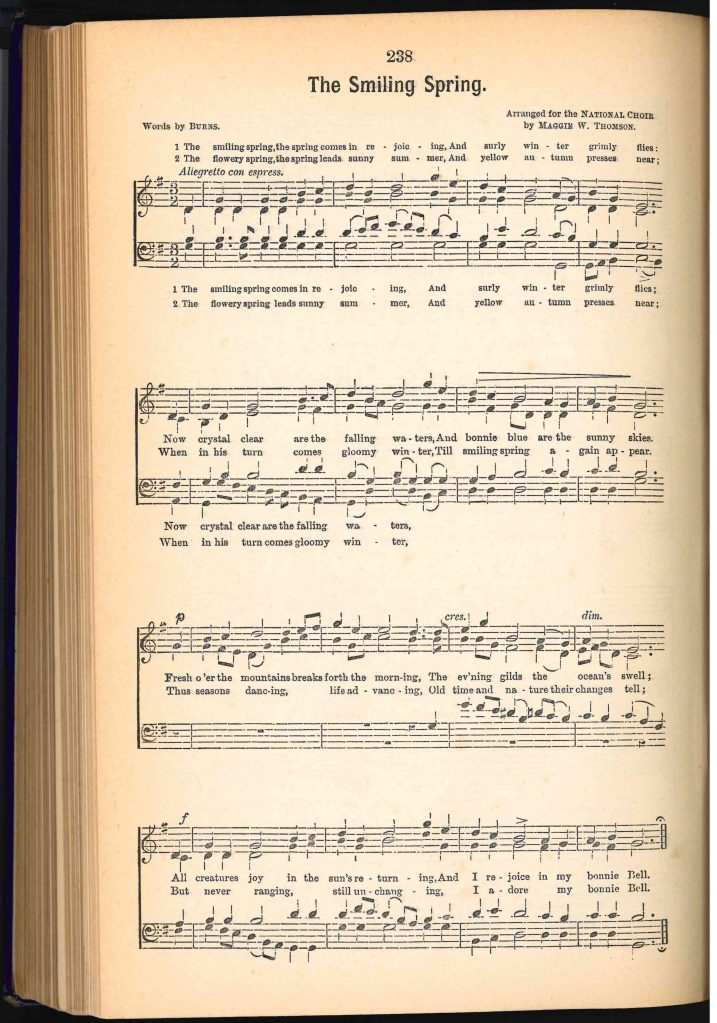
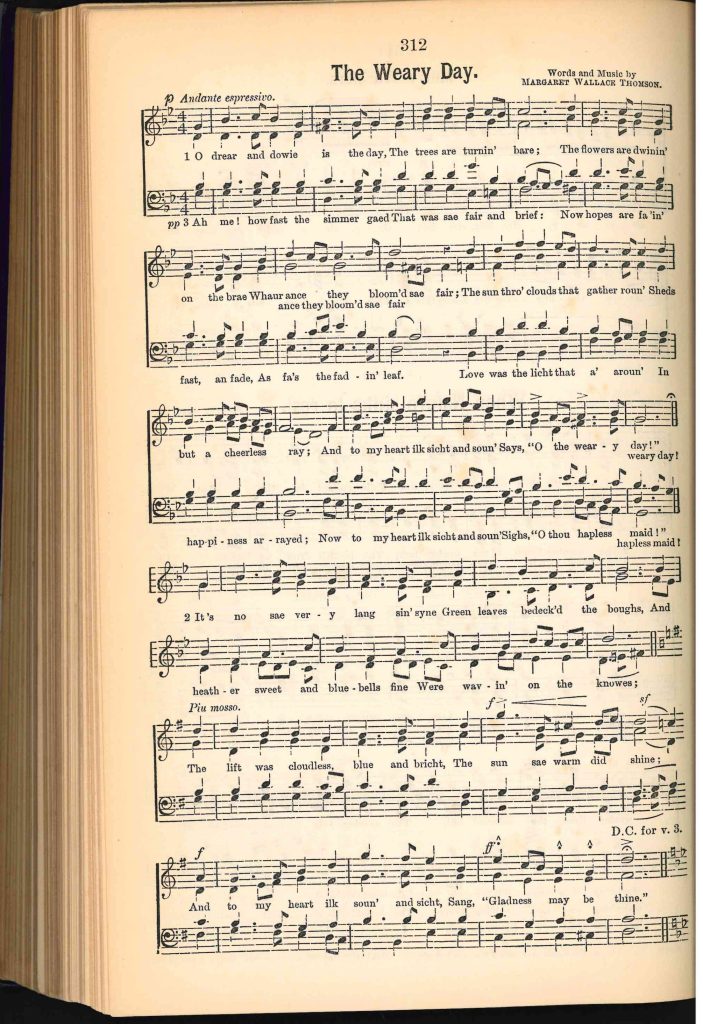
I can share images of the National Choir songs:-

  • ‘The smiling spring’, words by Burns, arr. by MWT for The National Choir [Vol.1 p.238] (Parlane, 1891)
  • ‘The Weary day’, original words and music, by MWT for The National Choir Vol.1 p.312 (Parlane, 1891)

Untraceable:-

  • ‘The voice of the deep’ (1883), bass song, written and composed by MWT [Addendum: referenced in a newspaper report of a concert that took place in St George’s Church, Paisley. A positive review!  However, the score might not have been published.]

I can also share the reference to the copy of ‘Break, break, break’ in the British Library:-

  • ‘Break, break, break!’, by Wallace Waterston, piano accompt by MWT (1894, published Paterson’s) – [addendum: copy in British Library – catalogue entry here.]

Moving with the Times: from Silent Movies to (oh, Gosh!) British Pathe Shorts

A tangle of movie film roll

You can tell I’ve spent too long in the late nineteenth century – in the research sense, that is.  Dizzy with excitement at the thought of seeing a silent movie – yes, it might actually come to pass, albeit not for a few months – I was almost deliriously pleased to discover that one of my research interests made British Pathe ‘shorts’ during the Second World War.  My aim is to contrast two singing careers, started only a decade apart – and here’s the first contrast. One began their career during the First World War and the silent movie era. The other made British Pathe shorts during the Second.

We think we’re so advanced, with our internet and our AI, electric cars and digital sound … but anyone born in the late nineteenth or early twentieth century might have been amazed by their own advances in technology.  A fin-de-siecle child treated to a magic lantern show, might have sung along to hymn or Scottish song texts projected on a magic lantern screen, the singing led by whichever grown-up had been co-opted in to help. When silent film came along, any music would be provided by a cinema pianist or a small ‘orchestra’ – possibly no more than a piano trio. What you heard would partly depend on who was playing and the bundle of music they’d brought with them.

But when the children became adults, they would would find themselves listening to the wireless or going out to ‘talking’ movies.  Watching, in adulthood, a short film performance by a contemporary star vocalist would have been unimaginable a decade earlier.

However, I must still cool my heels as I wait to see if (and when) the silent movie that I need to see, can be converted into a modern format.  Meanwhile, I’m trapped in the nineteenth century with the printed novel that gave rise to the movie.  As I read, I wonder how they managed to condense the story into a couple of hours, and then convey the whole plot by wordless gestures. 

I can’t wait to see.

Accessing Silent Films

Lucerna: a Magic Lantern Database

LUCERNA is an online resource on the magic lantern, an early slide projector invented in the 17th century.

‘For more than 350 years the magic lantern has represented and fed into every aspect of human life and every part of the world. It is still used today, both in its original form and through direct descendants like the modern data projector.

LUCERNA includes details of slide sets, slide images, readings and other texts related to slide sets, lantern hardware, people and organisations involved in lantern history, and much more.’

(Introduction to the Lucerna database)

Cover Image from Pixabay

Hearing Her at Last (She Died in 1936)

Why do collectors collect things? Especially old things.  The link with the past? The feeling that in some remote way, there’s a virtual thread linking you and an earlier era, or a particular individual?

As I’ve mentioned, I’m writing a long article about some late Victorian/Edwardian Scottish women musicians.  It’s virtually finished.  But there’s one more thing to do.

I have a single 78 rpm shellac recording of one of these women, whose reputation was not inconsiderable in her day.  She played in London.  She and her ‘orchestra ‘ made a handful of recordings.  But I have no means of playing this precious artefact.  I’ve tried to beg or borrow an old gramophone (or newer technology) to no avail, so eventually I bought a record player on Amazon.

All this because I wanted to know what instruments were in her band, a century ago! My article is incomplete without this detail. 

Petronella
There’s an anecdote about a whisky-filled teacup rattling on a piano edge whilst she played …!

Main image:- Beltona gramophone,  post 1923, from Wikipedia.

Highland Archive Centre – Conan Bridge School, 1880s

Another Covid-ridden short from me today. See if you can see what excited me about these images of Conan Bridge School inventory …

Highland Archive Centre Facebook Posting 31 Aug 2024

Check out “Books and Borrowing Database Launch” on Eventbrite!”!

How could I resist this event?! After all my efforts a few years ago, researching the borrowing of legal deposit music at the University of St Andrews in the early 19th century, I simply HAVE to attend this. It’s somewhat ‘meta’ for a scholar librarian to take a research interest in the borrowing habits of readers who ‘checked out’ centuries ago, isn’t it?

I’ve rearranged my research hours accordingly, so I  can finish the week on a research rather than a librarianly note:-

Books and Borrowing Database Launch Date: Fri, Apr 26 • 16:00 BST Location: University Avenue, Glasgow, G12 8QQ https://www.eventbrite.ca/e/books-and-borrowing-database-launch-tickets-879501281007?aff=ebdsshother&utm_share_source=listing_android

Material Evidence of Use: Music that was Loved

I accepted a generous donation of old books to the Library a couple of weeks ago. This presented me, personally, with a bit of a problem because our offices, furniture and contents are being moved around, and I had proudly emptied most of my shelves in readiness.  There will be fewer shelves in the other office.  And now I had two shelves full of old Scottish music  – right up my street – which needed cataloguing.

  • Most vital priority – get them done before I retire from the Library.
  • Almost as vital – to get them done before the move on Thursday next week!

Of course, the lovely thing is that they’re books I’ve encountered in various research contexts … the PhD; the Bass Culture project (https://HMS.Scot); the book chapter on subscriptions; and my own forthcoming monograph.

I catalogued like crazy on Thursday and Friday. I’ve catalogued Sammelbande (personal bound volumes) of songs, piano music and fiddle tunes. I’ve shown colleagues books signed by George Thomson.  I’ve indexed Gow’s strathspeys and reels. And yesterday I blogged about James Davie and his Caledonian Repository.

But I’ve also just enjoyed handling the music, because sometimes one finds some endearingly human evidence of the scores being used, even to the point of needing mending.  It’s quite touching to ponder how much a piece had been used, before it actually needed stitching – here, along a line where the edge of the printer’s block had originally left a dent in the paper:-

Stitched on one side, pasted on the other!

I’ve smiled at Georgian ladies’ stitched repairs to much-loved pieces, noticed with amusement a handful of early Mozart Allan books (yes, including some strathspeys and reels) in a fin-de-siecle Sammelband which had seen better days; spotted piano fingerings pencilled in; and best of all, found a tartan ribbon in a volume dedicated to the Duke of Sussex – his personal copy, which was first sold out of the family’s possession in 1844.  His library was dispersed after he died in straitened financial circumstances:-

Nine Scots Songs and three Duetts, newly arranged with a harp or piano forte accompaniment / by P. Anthony Corri

Whittaker Library catalogue entry

This book has the Duke’s family crest on a label pasted inside, and the outer cover is embossed with  ‘A F’ (Augustus Frederick), reflecting the monogram on the title page.

The Duke of Sussex’s mongram
Augustus Frederick, Duke of Sussex (1773-1843)

The tartan endpapers and tartan ribbon between pp.30-31 are a perfect illustration of what I have written about in a chapter on tartanry in my forthcoming monograph.  Everyone – whether nobility or commoner – liked a bit of tartan on or inside their Scottish song books, and here, someone even found a bit of tartan ribbon to use as a bookmark.

I have just a few of those books left to catalogue now.  There’s an intriguing one without a cover or title page, waiting for 9 am on Monday  …!  Hopefully, I’ll end up with an empty bookcase again.

A Grumpy and Irritable Aberdonian

Grey granite bricks

To be fair, David Baptie spoke highly of the Aberdonian James Davie, an early to mid 19th Century Scottish song enthusiast. He was a friend of the Dundonian song collector James Wighton.

However, correspondence between the two men reveals him writing sour objections to other contemporaries’ activities and opinions. I quoted some of his grumblings in my first book, Our Ancient National. Airs. I formed the impression that he was decidedly irritable in his old age! 

Here he is, in characteristic tone at the start of his Caledonian Repository:-

Arrangers? Pshaw!

Notwithstanding this, I was excited to accession several books of this Caledonian Repository to the library, since they’re quite rare. The books are tatty and fragile, but a tangible link with the past – they’re about 200 years old.

James Davie’s Caledonian Repository (You can find it in the National Library of Scotland https://digital.nls.uk/special-collections-of-printed-music/archive/102743092)

The Repository is in two series. We have three books from the first  and two from the second. Grateful that the tune contents pages were there, I sorted out which pages belonged where, then catalogued them. Oh, my fingers flew. But the last one that I managed to catalogue before 5 pm yesterday, simply didn’t want to play fair. The catalogue entry was done. But, without going into details, it wasn’t displaying properly.

I went home, had tea, opened the laptop and recatalogued that piece using the info I’d already entered.

No luck.

I removed the identifying sequential number and tried again.

Still no luck.

Maybe ‘something’ magical would happen to it overnight? It was too much to hope! Mr Davie, irascible as ever, did NOT want that book to appear properly in our catalogue.

Finally, my line-manager suggested trying to give it a different barcode. I have absolutely no idea why the system didn’t like the one I’d assigned it, but I did as suggested, and hey presto, we have Davie’s Caledonian Repository, Series 2, Book 2, properly catalogued and accessible.

So that left me with Series 2, Book 1 to do this morning. That book has all its pages, but the page numbering is, shall we say, a little quixotic.  Mr Davie has had the last laugh there.

Nonetheless, we do now have all five items in the Whittaker Library catalogue.  I like to think Davie would be a little bit pleased!

What does a Librarian want with a PhD, anyway?

Few people in Glasgow knew that I had an unfinished first PhD guiltily lurking in my past, when I announced I wanted to do a PhD. It would actually be my second attempt. I’m told that someone (an academic?) asked that memorable and somewhat hurtful question, ‘What does a librarian want with a PhD, anyway?’

Chained to the shelves – Wimborne Minster Chained Library (Wikipedia)

I realised with a jolt, yesterday morning, that I would be retiring from librarianship exactly fifteen years to the day, since I submitted my thesis to the University of Glasgow. I never managed to cease being a librarian in order to become a full-time academic, because I had family responsibilities in Glasgow, and the chances of a full career-change without relocation were limited, to say the least. However, if I entered librarianship with the unfulfilled expectation of soon having a PhD from Exeter, and the aspiration to become a scholar-librarian …. well, I did achieve the latter aspiration. After getting the Glasgow PhD, I became partially seconded to research three years later, and I’ll continue as a part-time researcher when I’m unshackled from the library shelves.

I don’t know who it was that queried whether a librarian actually needed a PhD, more than twenty years ago. It’s probably a good thing I don’t know! However, if I could show that individual how I’ve just spent my afternoon, then maybe they’d begin to understand.

The other day, an academic colleague said they were putting a student in touch with me, to advise them about resources for a project. This afternoon, I was working from home as a librarian, so I decided to spend the time finding suitable resources for my enquirer. I had in mind a lever-arch file from my own research activities, that I knew was in my study-alcove.

Subject Specialist

[Scottish] ResearchFish

The more I thought about the query, the more things I thought of suggesting. I looked at my own monograph, for a start, along with a couple of essay collections that I’ve contributed to. I compiled a list, mostly but not entirely from the library catalogue. (I tweaked a few catalogue entries whilst I was at it. What does an academic want with a library qualification?, one might ask!) I The family balefully eyed the dining-room table that they were hoping to eat off, as I moved aside the ancient and modern books that were gaily strewn across its surface. However, I’m fairly content that I’ve done my preparation to help with the query. I’ve also enjoyed an afternoon in the company of old friends – the compilers, authors and editors of all those books!

A Value-Added Librarian

Listen, I wouldn’t have known any of those resources if I hadn’t done that PhD. I wouldn’t have known what the arguments were. I wouldn’t have known how nineteenth and early twentieth century song-collectors viewed their collections, nor the metaphors they used to describe them, nor which collections might be of particular interest. I wouldn’t subsequently have collaborated on The Historical Music of Scotland database. And if I hadn’t gone on researching, I wouldn’t have known about some of the more recent materials, either.

I kennt his faither! (A Scot knows what that means)

There might have been times when others wondered who I thought I was, but I am absolutely certain that it has come in useful!

Women’s History Month 2024 – Musicians

Victorian or Edwardian woman descending stone staircase

I’ve written quite a bit about women in musical history, so I’m adding something to the top of this post every couple of days during Women’s History Month – mostly flashbacks to women musicians I’ve researched, but some other discoveries too. (I’ve been shifting things around to a more chronological order, but I’ve always added the new bit first!) You’ll find more musicians than composers in this posting, just because of my own recent research.

Sometimes I look at the history of women musicians from the point of view of good library provision for our readers, whilst at other times my own research interests are foremost.  It just depends on the day of the week, because I currently occupy two roles in the Royal Conservatoire of Scotland. For 3.5 days a week, I’m a librarian. For 1.5, a postdoctoral researcher.

15. The Ketelbey Fellowship

It’s a whole year since I learned that I had been awarded the first Ketelbey postdoctoral research fellowship at the University of St Andrews.  Scholar Doris Ketelbey was a significant figure in the history of the department.  I felt highly honoured to have been the first Ketelbey Fellow from September to December 2023.

14. Representation of Women Composers in the Library

I couldn’t resist adding the open access article I published about my EDI activity in our own Whittaker Library:-

‘Representation of Women Composers in the Whittaker Library’Journal of Perspectives in Applied Academic Practice. Vol. 11 No. 1 (2023): Special Issue on Breaking the Gender Bias in Academia and Academic Practice, 21-26. (Paper given at the International Women’s Day Conference hosted by the University of the Highlands and Islands, 2022.) DOI: https://doi.org/10.56433/jpaap.v11i1.533

Logo of the JPAAP https://jpaap.ac.uk/JPAAP

13. New Books for the Library

Susan Tomes – Women and the piano

It’s a privilege to shape a library collection, so I’m pleased to have just ordered and catalogued several relevant books this month.

  • Susan Tomes, Women and the Piano: a History in 50 Lives (Yale University Press, 2024) Read more about it on the publisher’s website, here. In actual fact, it’s the fourth title by this author that we now have in stock. So if readers like this, they might like the earlier three, too!
  • Margaret C. Watson, Women in Academia : Achieving our Potential. (Market Harborough : Troubadour, 2024). Not a book about women in history, but very much for women in the present day!
  • Gillian Dooley, She played and sang: Jane Austen and Music (Manchester University Press, 2024). Back to history again.
  • Women and Music in Ireland / ed. Jennifer O’Connor-Madsen; Laura Watson & Ita Beausang (Boydell Press, 2022)

Moreover, there’s a new Routledge book coming out this summer – I have ordered it for the Whittaker Library. Of course, I may have retired from the Library by the time it arrives. This just means I won’t need to catalogue it! I’ll still be a part-time researcher, so I’ll be able to read it:-

12. Jessy McCabe’s Petition

It’s some years now, since a single-minded schoolgirl decided action was necessary. In 2015,  Jessy McCabe noticed that Edexel had no women composers in the A-Level Music syllabus, and successfully petitioned to rectify this, via Change.org.  I found out about her impressive initiative when I was beginning to start serious work on building up our library collection to include more music – contemporary and  historical – by women and people of colour. 

Jessy is now a Special Needs teacher.  I’m sure she’ll go far.

11. Forgotten Women Composers

Part of academia entails sharing research outcomes beyond the ‘ivory walls’.  It’s called public engagement, and that’s the opportunity I seized when my old friend The People’s Friend magazine commissioned me to write a feature back in 2020.

  • The sound of forgotten music: Karen McAulay uncovers some of the great female composers who have been lost from history’, in The People’s Friend, Special Edition, 11 Sep 2020, 2 p. (Dundee : D C Thomson).  I blogged about it at the time (here).

10. Late Victorian Women Musicians

Torn pages of old music, some handwritten and some printed

Since my more recent research has focused on the late Victorian era and the first part of the twentieth century, you’ll not be surprised to find that I found some interesting Scottish women musicians of that era! They are forgotten today – but I’ve done my bit to raise their profiles!

9. In Praise of Music Cataloguers! Introducing Miss Elizabeth Lambert

Before I started the Claimed From Stationers’ Hall music copyright network, I had spent some months researching the wonderful late 18th and early 19th century music copyright collection at the University of St Andrews. A key resource was the handwritten catalogue in two notebooks, largely compiled by Miss Elizabeth Lambert (later to become Mrs Williams, when she married and moved to London.)

I just love the fact that this earnest young woman (I’m going out on a limb here, but I’m pretty sure she must have been earnest!) created a useful resource which would help everyone get maximum use out of the music repertoire that other libraries were less than impressed by. So we had Elizabeth cataloguing the collection, and numerous men and women, friends of the professors, making use of it. I blogged about her, and eventually wrote an article for the Edinburgh Bibliographical Society, mentioning her again.

8. Was there a Harp at St Leonard’s School?

Image by Sue Rickhuss from Pixabay

Some time ago, I blogged about an instruction manual for harp, which the Bertrams borrowed from St Andrews University Library:-

The library’s copyright collection of music was a boon for middling class women like headmistress Mrs Bertram, her teacher daughters and their pupils.  It does lead one to wonder if they had a harp at the school.  I checked their borrowing records for more evidence. They certainly borrowed several volumes which included harp music.

7. Students but not at University? Educating Young Women

It’s time to turn to piano teacher Mr T. Latour. I’d like to refer you to my June 2018 blog post about women in St Andrews using pedagogical musical material in the early 19th century. Possibly the self-same young ladies attending, or having attended Mrs Bertram’s school?! The illustration features a young woman – probably just approaching or about marriagable age – at an upright piano. The abundant floral arrangement atop the piano (quite apart from sending shivers down the housekeeper’s spine every time the young pianist played too enthusiastically) suggests a well-to-do household. Following Latour’s instructions, the pianist has elegantly flat hands …..

Title page of T. Latour's instruction manual, Ladies' Thorough Bass.
T. Latour – Ladies’ Thorough Bass
Instructions 'on the position at the piano-forte'
Latour advises on the seating position, and how to hold ones hands elegantly

6. Not my work – but very timely for WHM 2024]

I’m not posting anything relating to my work today, but I saw mention of a great new article by Dominic Bridge the other day, so I thought I’d share details here. It’s a fascinating read. The Journal for Eighteenth-Century Studies is part of the Wiley Online Library:-

5. Jointly authored with Brianna Robertson-Kirkland: ‘My love to war is going’: Women and Song in the Napoleonic Era

We published this article in the Trafalgar Chronicle, New Series 3 (2018), 202-212. My own observations were based on music I had found in the Legal Deposit Music at the University of St Andrews, whilst Brianna had already founded EAERN (Eighteenth-Century Arts Education Research Network) jointly with Dr Elizabeth Ford, funded by the Royal Society of Edinburgh.

4. Forgotten Female Composers

Back in 2018 when I was awarded the AHRC networking grant for the Claimed from Stationers Hall network, I drew up a list of women composers from the Georgian era. There were more than one might have expected – perhaps they only composed a handful of pieces, in many cases, but nonetheless – they composed. You can find the list on a separate page on this blog, here. And you can read more about it in the blogpost I wrote in July 2018,

3. Mrs Bertram

This lady ran a girls’ school at St Leonard’s in St Andrews. This was NOT the famous and long-established private school that has long stood there, but an earlier enterprise. And Mrs Bertram and her daughters subsequently moved to Edinburgh, to the disappointment of parents of daughters in St Andrews!

The photo portrays a Mrs Bertram of Edinburgh. Chronologically,  she could well be ‘our’ Mrs Bertram, and a scholarly bent is suggested by the pile of books at her hand.

2. The Accomplished Ladies of Torloisk

I almost forgot about the musical Maclean-Clephane ladies of Torloisk, which is a stately home on the island of Mull. But how could I forget about them, considering I published a lengthy article about them some years ago?! Luckily, a book of letters by Sir Walter Scott crossed my library desk, and even though it didn’t contain those particular letters, this did remind me of his musical friends in Torloisk!

1. Esteemed Academic introduces Composer Harriet Wainewright

Today, I’d like to introduce a woman composer who predates most of the individuals I’ve encountered. Professor James Porter applies his considerable intellect to produce this in-depth article:-

  • ‘An English Composer and Her Opera: Harriet Wainewright’s Comàla (1792)’, Journal of Musicological Research Feb, 2021. Published online: 16 Feb 2021.