Dr Karen McAulay explores the history of Scottish music collecting, publishing and national identity from the 18th to 20th centuries. Research Fellow at Royal Conservatoire of Scotland, author of two Routledge monographs.
Another call for papers, spotted on social media this morning …
Conference announcement: Finding the Women in
Library & Information History
CILIP LIHG Conference 2019
Saturday 22nd June
The John Rylands Library, Manchester pic.twitter.com/8EvNqVoFab
I’m excited to be part of a panel talking about paratext at the forthcoming ISECS Congress, 14th – 19th July 2019, hosted by the University of Edinburgh. Registration is now open, though the detailed programme isn’t yet finalised. (There’s an early bird rate until 30 April.)
Hosted at the University of Glasgow, Thursday 11th – Friday 12th April, this is a conference I find very tempting – the 1820s were my favourite era during my doctoral studies, and they’re pretty interesting in current Legal-Deposit-Music-From-Stationers-Hall terms, too. Will I manage to attend some or all of this one, though? I have 10.5 research hours per week: we’ll see!
Here is the conference page, with EventBrite booking and programme:-
I’m delighted to introduce today’s blogpost by Andrea Cawelti, who is the Ward Music Cataloger at Houghton Library, Harvard University. Andrea attended a course at the American Rare Book School a couple of years ago, and is keen for everyone to know what a wonderful opportunity it would be for anyone who could attend this year’s course. I shared a link to Andrea’s reflections on the course, which she authored for the Houghton Library blog last year – you’ll find the link in the posting below. Now you can read more about it – if you manage to get there, do please consider sharing your own experiences here!
Philadelphia skyline (Pixabay image)
Fellow readers of Claimed from Stationers’ Hall may be aware that the American incarnation of Rare Book School has offered a course on the Stationers’ Hall since Peter Blayney, one of the stalwart fathers of research on the Stationers, taught the course in the 1990s. But I see that applications have been opened today for this summer course, now taught by Professor Ian Gadd, so I’d like to share a bit about my excellent experience in taking this course in 2016, as prompt applications are usually the most successful.
This term, as in 2016, the course will be held in Philadelphia, June 2-7, at the Kislak Center for Special Collections, Rare Books and Manuscripts at the University of Pennsylvania, with reasonably-priced and comfortable dorm space available within easy walking distance through the picturesque Penn campus. As this course represented my first experience at the Kislak Center, I was delightfully surprised by our genuine welcome, and helpful assistance by the staff, both of the library and those in attendance from the Rare Book School, even though this wasn’t their turf. The Center holds significant hand-press material for examination and project fodder, and Penn Libraries holds a complete set of microfilms of the Stationers’ Company registers and archives, which we consulted extensively for our work.
As with all RBS courses, ample opportunities are presented for individual discussion, questions, and networking, including regular morning and afternoon breaks, lunches, and receptions. Evenings often include programmed activities from lectures to film presentations, and during my course, there was an excellent presentation by Lynne Farrington, senior curator at the Kislak, on American subscription publishers and their German-American readers. Dr. Farrington provided a fascinating overview of the American subscription publishing industry, and how it was utilized for foreign-language titles to be sold through the subscription network. The lecture was accompanied by a hand-on exploration of subscription samples from several of the Kislak’s collections.
Enough of that, you may say, what about the course itself?!?!?! Well, first of all, I should mention that I arrived with a specific agenda, which was to familiarize myself with the Registers, what was in them of a music format, and to learn how to use the microfilms most effectively (Harvard, too, holds a complete set of these microfilms).
Like many of you I’m sure, I’ve had cases where I’d hoped to find a specific date in the 18th century when something had been published, or to establish some kind of sequence for several publications, and had been frustrated by my inability to harness these resources. Now of course, newer products are available, including the Literary Print Culture online access, which Professor Gadd has now incorporated into the course. Still, the navigation of this product isn’t straightforward, and one really needs to know what one is doing before attempting to use, or it is easy to get completely lost.
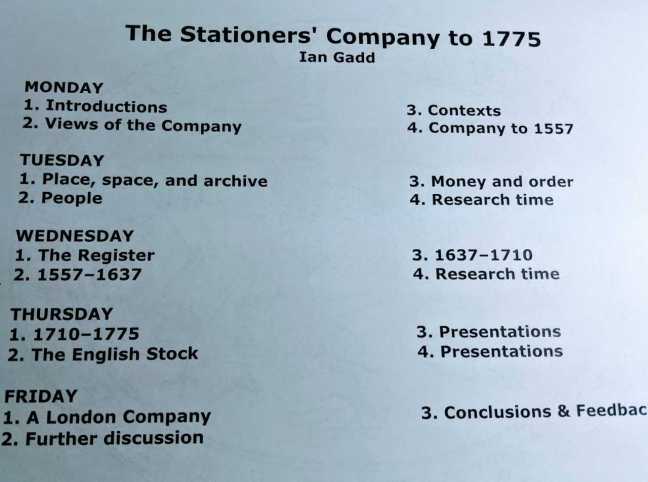
Course schedule
As you can see, the schedule was laid out to allow us a proper introduction to the history of the company and its archives: Professor Gadd offered spirited presentations on each aspect, as well as providing references to online and printed documentation which would be of use later in our explorations. Each of us was then tasked to research and present on some topic of particular interest to us (see “research time” and “presentation time” in the daily schedule). I chose a particular segment of time and explored all of the Registers chronologically to gain an idea of what music was being brought to the Stationers for registration between 1799 and 1804. Several of my discoveries ended up in our Houghton Blog, which presents a bit more information for those who are interested.
I had honestly come into this course completely unaware of how extensive the Stationers’ archives were apart from the Registers! Learning more about the “people” documentation was particularly eye-opening, and quite helpful in my cataloging. The online index to the London Book Trades for instance, based on the Stationers’ archives is great for finding more information on printers when researching, creating authority records, or for investigating connections between people. As always, Professor Gadd provided helpful hints: don’t use the “search” box, just go directly to the “index – names”. There were so many trails of bread crumbs offered to us, that who could remember them all (certainly not I!) Knowing this, the professor provided us with an extensive workbook to take home, complete with bibliography and most useful for me after the fact, an overview of the most important copyright legislation affecting just what was registered with the Company.
Workbook table of contents
While this course only goes up to 1775, and consequently doesn’t cover some of the most influential music-related legislation, suggested readings within provide an appendix as it were, and after going through the history before 1775, reading forward into the 1790s was not difficult. Additional revealing segments covered what species of books were included in the English Stock and why this was important, and an introduction to Edward Arber’s term catalogues – keyword-searchable, and covering (among others and appendices) periods into the 18th century. A mind-boggling amount of work, which doesn’t include that much music but is well worth a look.
Two and a half years later, am I glad I took the course? You bet I am; it has proved to be perhaps one of the most useful courses I’ve taken at RBS. Possibly more so for me, because I was essentially ignorant of so many details of the Stationers’ history, but I would heartily recommend this to anyone preparing to work with, or already working with 17th to 18th century music. The context will provide you with an invaluable overview of how printing functioned in Britain, and how and why and what was registered. I hope that I’ve given something of the flavor of the course, and if anyone has questions about how RBS works, please do ask the RBS:-
If you’re considering attending, you can find out more about the RBS on their website. The homepage explains, “Rare Book School provides continuing-education opportunities for students from all disciplines and skill levels to study the history of written, printed, and digital materials with leading scholars and professionals in the field.”
Be quick! The early bird catches the worm, as they say.
Good luck and good researching!
Andrea Cawelti Ward Music Cataloger Houghton Library Harvard University
Must be the start of the year – there’s a sudden outpouring of calls for papers, conference registrations and other exciting challenges. Here’s one for this morning – Musica Scotica is a network I’ve long been associated with.
We are delighted to announce that the Icepops 2019 call for contributions is now open. The conference is taking place on 26th June 2019 at the University of Edinburgh and you have from now until the 4th February to come up with an idea for your presentation.
We are looking for speakers on all aspects of copyright education from a variety of different perspectives. Last year we attracted expert speakers from educational & cultural institutions, publishing houses and government departments as well as an impressive number of international delegates. Our first keynote this year is composer, publisher and scholar Simon Anderson, who will be opening the conference with a musical theme. We particularly welcome sessions that might compliment this. However, we also retain the playful learning theme from last year and our afternoon keynote, the award-winning Charlie Farley from the University of Edinburgh will be leading an interactive workshop.
We would like to encourage presenters to address one of the themes of this year’s conference:
– Universal Copyright Literacy: bridging the gaps between lawyers, IP teachers, specialists and copyright muggles
– Engaging and creative approaches to copyright education including using games, music and performance
– Copyright education as part of digital and information literacy initiatives
– Copyright education in the cultural heritage sector
– Teaching copyright as part of scholarly and open practices
However, we wouldn’t want you to feel constrained if you have a great idea relating to copyright literacy that doesn’t fit 100% into any of the above. Please just let us know and we’ll see if it fits in the programme.
I am a Performing Arts Librarian 3.5 days a week, and a Postdoctoral Researcher 1.5 days a week. In this self-imposed annual review, I’m not listing routine activities conducted in either capacity; it goes without saying that I’ve answered queries, catalogued, delivered library research training to a number of different class groups, attended meetings, and pursued research-related activities and fieldwork.
From September 2017 to September 2018, I was the AHRC-funded Principal Investigator for a new research network, the Claimed From Stationers’ Hall music research project. Since then, I have continued to conduct research and network with the various scholars and libraries involved with this project, and in the new year shall be pursuing further grant-funding in order to extend the reach of the project.
As someone who continually asks themselves, “Am I doing enough?”, I feel that even I can be reasonably content with this year’s outputs!
JANUARY
Chaired sessions at Traditional Pedagogies, international conference at Royal Conservatoire of Scotland
Book chapter, ‘Wynds, Vennels and Dual Carriageways: the changing Nature of Scottish Music’, in Understanding Scotland musically: folk, tradition and policy. Abingdon, Oxon: Routledge, p. 230-239.
MARCH
Claimed From Stationers’ Hall Workshop, Royal Conservatoire of Scotland, (26 Mar)
Scottish Library & Information Council (SLIC) From PGCert to PG Certainty: Enabling the Distance Learner (invited talk, sectoral organisation) (March 2018)
APRIL
IAML(UK & Irl) Annual Study Weekend, invited talk, Pathways, outputs and impacts: the ‘Claimed from Stationers Hall’ music project takes wings
IAML(UK & Irl) Annual Study Weekend From PGCert to PG Certainty: Enabling the Distance Learner (quick-fire session) (April 2018)
EAERN (Eighteenth-century Arts Education Research Network), ‘Claimed From Stationers’ Hall: But What Happened Next?’ (University of Glasgow, 6 June)
Romantic Song Network steering group seminar at British Library
JULY
IAML/AIBM Annual Congress, Leipzig, ‘A Network of Early British Legal Deposit Music: Explored through Modern Networking
SEPT
RMA Conference, Bristol, ‘Overlapping Patterns: the Extant Late Georgian Copyright Music Explored by Modern Research Networking’
NOV
Field-trip to King’s Inns and Trinity College Dublin Libraries, and British Library
EFDSS Conference, London, ‘National Airs in Georgian British Libraries’
ARLGS (Academic and Research Libraries Group Scotland) Teachmeet at Glasgow University Library – speaker
Article, Trafalgar Chronicle, New Series 3 (2018), 202-212, jointly authored with Brianna Robertson-Kirkland, ‘My love to war is going’: Women and Song in the Napoleonic Era’.
DEC
Article, Information Professional, Nov-Dec 2018, ‘Coffee and Collaboration’ [teaching electronic resource strategies]
Additionally, I have authored 79 blogposts and 5 Newsletters in connection with the Claimed From Stationers’ Hall research project.
The other day, I decided to make a map of the UK’s Georgian legal deposit library locations. Yes, I know – it’s a strange way to interpret a serious research project, but I wanted an illustration that would have impact for an audience, not all of whom may know as much about legal deposit as I now do! So, first I thought about making a patchwork map, but after experimenting with lines on a map, I concluded that it would be such a weird piece of patchwork that maybe I needed to come up with a Plan B.
A collage map seemed more feasible, and I thought I’d mark out where the legal deposit libraries were by linking them together and then appliqueing the shape that resulted. And there they were – a triangle in England (London-Oxford-Cambridge) and a triangle in Scotland (Glasgow-Aberdeen-Edinburgh, with St Andrews sitting on the line between Aberdeen and Edinburgh). Finally, there were the new arrivals of two legal deposit libraries in Dublin from 1801 onwards (Trinity College and Kings’ Inns) – I couldn’t force them into a triangle, but I gave them one anyway. So there it was – the three triangles formed another triangle, and I had my graphic illustration.
But why the big gap in the middle with no legal deposit libraries? Ah, that’s probably because there weren’t any university libraries old enough to be considered when legal deposit was established at the beginning of the 18th century! As a graduate of Durham myself, I thought it was a shame that we missed out on this privilege, but the fact is that although Durham Hall became Durham College back in 1286, it was actually founded by the University of Oxford, eventually becoming Trinity College, Oxford in 1555. The University of Durham and University College weren’t founded until 1832, and the Royal Charter was granted to the University by King William IV in 1837. (All dates from the University website.) By the time Durham had its university, widespread legal deposit was about to be curtailed, and the Library Deposit Act had already been enacted a year before its Royal Charter was granted. “Too late”, as a Scottish friend put it succinctly! (Similarly, the Victoria University of Manchester was formed as a medical school in 1824, but did not become a university until even later, in 1851.)
So, the harsh facts are that there weren’t any old-established universities between the southern golden triangle and the Scottish one, at the time the legislation was enacted! And that’s why the legal deposit libraries were scattered around the UK and Ireland as they were.





 We are delighted to announce that the Icepops 2019
  I am a Performing Arts Librarian 3.5 days a week, and a Postdoctoral Researcher 1.5 days a week. In this self-imposed annual review, I’m not listing routine activities conducted in either capacity; it goes without saying that I’ve answered queries, catalogued, delivered library research training to a number of different class groups, attended meetings, and pursued research-related activities and fieldwork.
 Institutional Repository: Pure. My profile:-

