Dr Karen McAulay explores the history of Scottish music collecting, publishing and national identity from the 18th to 20th centuries. Research Fellow at Royal Conservatoire of Scotland, author of two Routledge monographs.
A quick post to mark a successful and very enjoyable evening. I gave my research exchange talk tonight at RCS. It was about a book of Scottish songs almost certainly published for the Festival of Britain in 1951. I talked about history, book history, music history, Scottish tourism and that all important catch-phrase for the Festival of Britain – ‘A Tonic for the Nation’. And then there was my book launch afterwards.
RCS wasn’t on Renfrew Street in 1951. We were the Royal Scottish Academy of Music at that point, in the old Athenaeum building (Nelson Mandela Place), but we had established a drama department in 1950 – the Glasgow College of Dramatic Art. (More about our history – click here.)
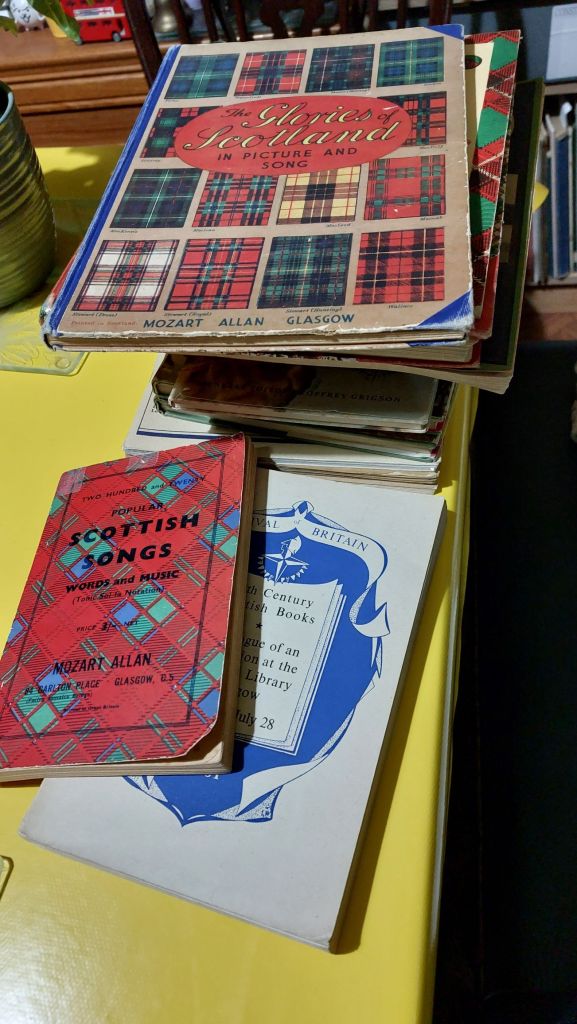
It’s fair to say that the book I talked about tonight – The Glories of Scotland, published by local publisher Mozart Allan – would not have been required repertoire for the talented students passing through our doors in 1951. It wasn’t aimed at high-performing classical artistes. (I doubt the library even had a copy in 1951, but there’s no way of finding out now. Anyway, we have recently acquired it!)
Nonetheless, the songbook does have a place in Glasgow’s history, in its own unique way.
Books relaxing after a night out!
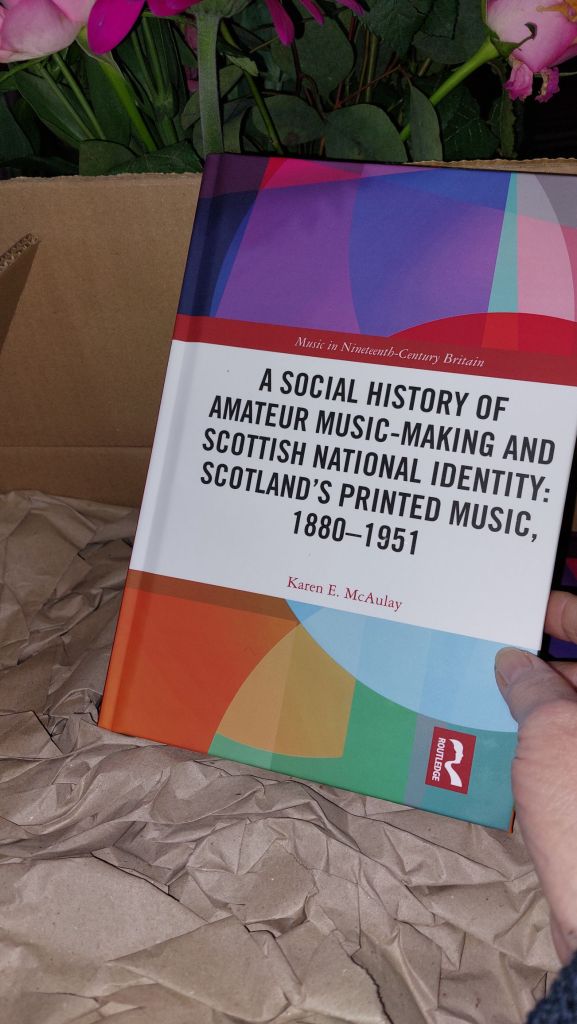
After the exchange talk, we launched my book about amateur music making, Scottish national identity and Scottish music publishing. Professor Stephen Broad introduced it, and said some very kind words about it. There were friends and colleagues there whom I hadn’t seen for a while, so it was very sociable as well as celebratory.
Book launch: my ‘few words’ in response
My thanks go to everyone who contributed to make the evening so successful – Research Exchange colleagues, Library former colleagues, and the box office events team. I’m ‘dead chuffed’, as they say.
I’m only semi-retiring; I’m leaving the main part of my job, but turning the research secondment into a new part-time contract. The technicalities are one thing: fill in the appropriate forms for receiving your pension. Decide what to do about outstanding holiday entitlement. Set things in motion for a new contract. Wait. Start counting the weeks, and then the days. Wait some more.
As I said in an earlier post, you can try to inject a few fun things into lunch-breaks, to brighten up the days. (I’m grateful to work in a place where there are loads of performances going on.) Meanwhile, you’re still at work in the old job. You know, and everyone else knows, that in a couple of months you won’t be there. In my unrealistic mind, I’d hoped to go out in a blaze of glory, but I don’t feel glorious or triumphant at all. How are you supposed to FEEL?, I asked a considerably older friend. They looked at me in a way that said they’d never asked themselves that!
Clearing Clutter (and Treasures)
I sit cataloguing donations and glumly eyeing piles that everyone would like to be cleared out of the way before I clear off! A late night email (which I found the next day) seemed to hint at that. But if I haven’t cleared the piles of donations by now, working steadily, then am I reasonably going to get the whole lot out of the way in two months? Am I not working hard enough? It’s a bit depressing, actually. On the other hand, when I arrived in 1988, there was a half a rolling stack full of donated materials. I used to wonder if I’d still be needed once I’d catalogued them all. Of course, they were all dealt with decades ago. None of our donations are remotely that old; there aren’t nearly as many; and no, I wasn’t discarded when the original donations were all done and dusted! Maybe it’s unrealistic to expect a final, purging blitz on what’s there now. Leave something for my successors.
Occasionally I get over-excited about treasures that crop up amongst the more routine stuff. (Over 200 years old? How could I NOT be excited?! One of the joys of having two parallel careers is having research knowledge that illuminates historical library materials. Sharing that knowledge sufficiently so that everyone else is aware of the treasures – that’s another thing entirely. Who wants to be trapped by an old librarian keen to share stories about ancient scores and famous poets?)
The Paranoia about Becoming Irrelevant – ‘Yesterday’s News?’
I’ve been keeping a ‘handover document’ for almost a year now, and every so often I think of something to add to it. Often things occur to me after I’ve had to deal with something, and realise that maybe it needs noting down! ‘It won’t be your concern in a few weeks’, my older spouse tells me. It’s hard adjusting to the certainty that things will be done differently once I’m gone. Things that I think should be done one way, will assuredly be done differently, and that’s to be expected. Even the things that I value aren’t necessarily of the same value to other folk – that’s the hard bit! (Mind you, some of the things I value have historical AND monetary value. My valued things aren’t valued without good reason.)
On the plus side, of course, is my list of research things to investigate, calls for papers and articles and chapters. I haven’t run out of steam, intellectually – far from it. My second book about to commence the copy-editing process. A research paper to write for a conference in July. New adventures on the horizon – oh, I really can’t wait for some new adventures! (I’m not a dull cataloguer – I’ve just ended up backed into a wee cataloguing corner. Neither does everyone find cataloguing tedious, but I have really done too much of it!)
You get lots of advice about how to write a CV, how to start your career with a flourish, how to make your mark. How to get on in the world. How to progress. But it seems there’s little advice about how to gracefully bow out!
This isn’t something unique to me – retirals happen all the time. What do other people do? Do you set up appointments to say goodbye to people? (Hard, when I’ll still be around, albeit in a different department.) Do you try to set up one last workshop/seminar/whatever before you go? [Post Script: you don’t!]
Or just try to be inconspicuous until the Last Day arrives?!
My research has been on hold whilst I recover from eye surgery. Firstly, a UK ‘fit note’ says you’re unfit to work (and research is work); and secondly, my good eye soon tells me if I’ve placed too many demands on it. It’s weird to look at a computer screen when one eye is compensating for the other one (that doesn’t fully focus and has an obstruction in the form of a black gas bubble).
So, no research reading, though I have bought a couple of books for later. But that doesn’t stop me thinking. I can’t help doing that.
The other evening, I started a very short list of potential research directions. I can’t proceed with any of them until (a) I am back at work, (b) I can get to various libraries and archives, and (c) I get the go-ahead to drive.
Each potential direction requires me to venture along the path to see what’s round the corner. Not just, whether there’s enough to research, but whether there might be an interested audience for it. For example, there are two Scottish women musicians I’d like to know more about – a Victorian and an Edwardian. One never was a big name, except in her locality. The other did enjoy fame, but she is virtually forgotten today.
Or, two Scottish music publishers with religious inclinations. Does anyone care today, apart from me? I’m interested in what exactly they published; and whether they ever interacted in any way. But is anyone else interested? (I had these hesitations about my mediaeval music research, decades ago. It was possibly one of the reasons it foundered.)
In any of these topics, I have to place the subjects into their social and cultural context, if I am to demonstrate relevance or significance in the grander scheme of things. My motivation is to examine what these individuals and firms’ music and activities tell us about the era in which they lived and worked.
But then there’s the question of impact. I don’t have to so much as open my laptop, let alone a book, to start worrying that I haven’t yet come up with a mind-blowing angle that will knock the world’s socks off! Moreover, there is no conceivable way I can make any of my research relate to climate change; saving the earth’s resources; social good or benefit to health.
And so I sit, blurrily gazing into the middle distance, reflecting! I have the go-ahead to return to work on Monday. Blurrily!
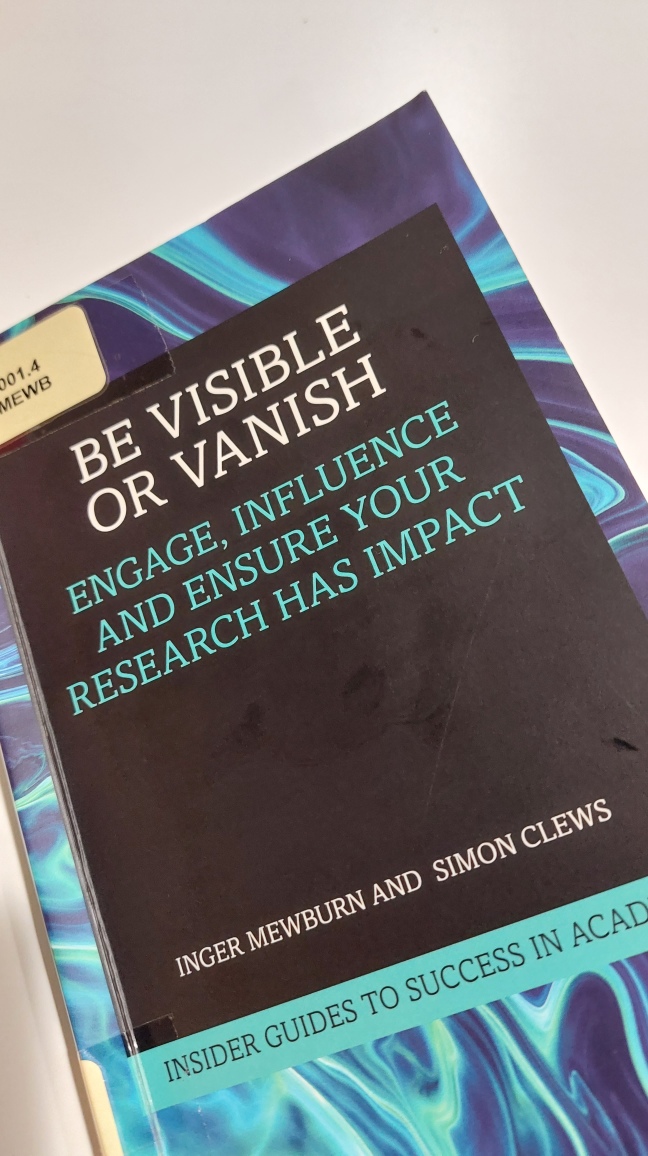
I’m currently reading a new book in the Routledge Insider Guides to Success in Academia series:
Be Visible or Vanish: Engage, Influence and Ensure your Research has Impact (Routledge, 2023)
The authors are Inger Mewburn and Simon Clews; since I’ve followed Inger’s work for a number of years, I knew it would be good, and I got it for RCS Library recently.
It’s an approachable guide, and the kind of book you can tuck into a bag or pocket to read at free moments during the day. This morning as I drank my pre-work latte, I was reading the chapter on making academic small-talk, and being ready with an answer to the inevitable question:-
So, what is your research about?
(A reasonable question in any situation!)
It particularly resonated for me this morning, because I take up my honorary Ketelbey Fellowship at St Andrews tomorrow. Not only that, but a family member had been asking me the same question last night! What are you studying there? Why there? How are you going to benefit from the experience? It wasn’t intended as preparation for the sort of questions I should be anticipating, but I nonetheless took it as a prompt to think carefully about how I shall be introducing myself when I meet new colleagues!
I’ve also heard this described as an ‘elevator pitch’ – though in my case, I would need the elevator to travel more than one floor! As I’ve said before, the title of my recently-submitted book doesn’t exactly trip off the tongue. However, it outlines what my research has been about in recent years so I have to be able to trot it out.
A social history (yes, that describes it well)
of amateur music-making (make no mistake, that’s what we’re talking about – it’s not generally about serious, cutting-edge classical music)
and Scottish national identity (this is such a big deal, that it’s inextricably interwoven throughout the whole book)
[And then there’s the subtitle!] : Scotland’s printed music, 1880-1951 (I’ve been looking at the output of Scottish publishers during this era, which proved much more interesting than even I had ever imagined. When I got to 1951, I got to fever-pitch excitement. You’ll have to wait for the book to find out why!)
But, back to the questions of last night. I’ll be revising the book when it returns from the reviewer(s). I’ll also be investigating a particular aspect of my research that still merits even deeper investigation. I’ll be exploring a bigger, richer library collection than I usually have access to, and I look forward to engaging with a lot of different research scholars, hopefully gaining fresh ideas and maybe ideas for new directions or collaborations.
Most of all, I’ll be settling into my academic role – yes, I know, I’m a seconded researcher back in my home institution, but it’s new for me to be a Fellow for a few months – and I’ll be thinking about my future ‘second career’ as a researcher once I retire from music librarianship next summer.
When my line-manager suggested I could give colleagues an update on my current projects and plans, I must confess I freaked out a little bit. Everyone else was talking about things happening in our library. I worried that ‘What Karen gets up to when she’s not being a librarian’ might come across as a boast-fest. It wasn’t about library news and developments, or services, or anything like that. I don’t research librarianship – I research music. My ‘research family’ are interested, but there’s no reason why anyone else should be! I tried to be absolutely factual, and to demonstrate how I chose my research subject because I wanted to study something relevant to students on one of the degree courses at the Conservatoire. I wanted it to be useful.
I was once told people’s attention begins to wander after 20 minutes – so I allowed myself about five minutes – three quarters of a Pecha Kucha presentation. Hopefully, that wouldn’t be too long?
First I had to explain my interest in research. I shared that, back in 2004, I decided to fund myself to study for a PhD, in my spare time. (I had never finished the one I had once studied for in Exeter before I even trained to be a librarian. Believe me, it wouldn’t have been useful in the workplace. Cantus firmus treatment in fifteenth century English polyphony? Definitely only for mediaeval enthusiasts! I had started writing that first thesis, but think I lost interest partly for that very reason.) To keep myself interested, the new PhD topic had to be relevant to RCS, and my circumstances (a full-time working mum with three primary-school aged sons) meant the university had to be local. That’s how I ended up researching Scottish music at Glasgow Uni. I hoped the knowledge gained would be useful.
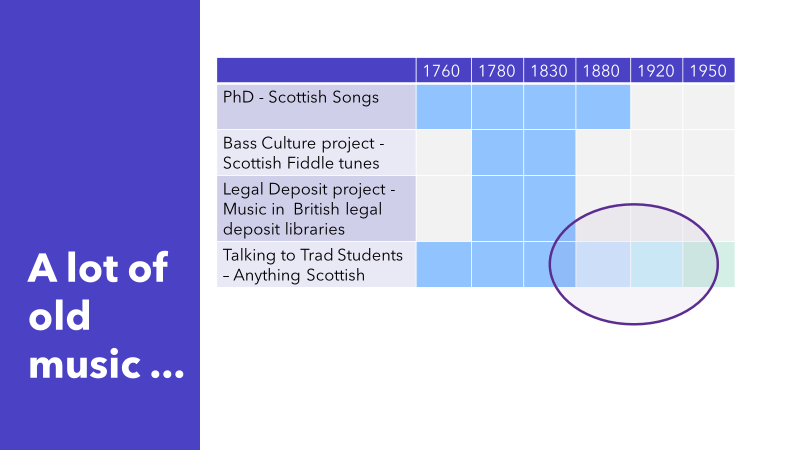
Next, I described how the Scottish song-collectors that I researched for my PhD, lived a long time ago, and even my subsequent research projects stopped when Queen Victoria was young. This meant that whenever I was asked to talk to our trad music students, I found that I had less to say about the 20th century Scottish song-books in our collection. However, I didn’t want to leave the impression that nothing much happened between 1920 and the second half of the 20th century. (The teaching staff cover the recent history, so that didn’t concern me much!)
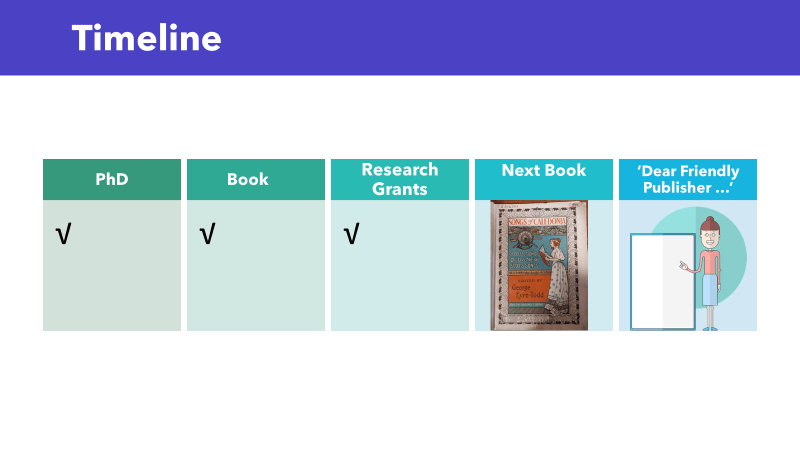
I explained that, having done the PhD and a couple of research projects, I decided I wanted to write another book, to fill in the gap I’d identified. I approached my publisher again.
A Social History of Amateur Music-Making and Scottish National Identity: Scotland’s Printed Music, 1880-1951
Naturally enough, I suggested a title at that point. But in the end, my publisher chose a better title for me – this one – when I signed the contract. It says exactly what it ought to say, but it’s a bit long! However, the book is about amateur music-making, because that’s what Scottish music publishers published – and it is about national identity, because they published so many Scottish songbooks! A long, accurate title can only be a good thing. Without a word of a lie, if anyone asks why the library has so many Scottish song-books, the answer is that it’s because they reflect different interpretations of national identity over a couple of hundred years. And my book will hopefully back this up!
My narrative began in 1880, because that’s where my first book stopped. I decided the book would finish in 1951. As well as some significant events that year, it marked when television came to Scotland. That was one topic too many; and my music publishers were dying out anyway!
I described what the book is about. It begins by focusing on two Glasgow publishers (I may have mentioned the occasional woman publisher or RCS woman piano teacher … )
Then I wrote about dance music – I may also have mentioned racism in Victorian music – and I wrote about books of songs for children. I wrote about Scottish songbooks costing a lot – and very little.
I wrote about educational music published by the Scottish music publishers, and I wrote about the publishers’ efforts to get Scottish music to expats who had emigrated.
Although I never intended to write about recording music or broadcasting it on the radio, the publishing and recording and broadcasting all seemed to be connected in different ways, so … I covered that too.
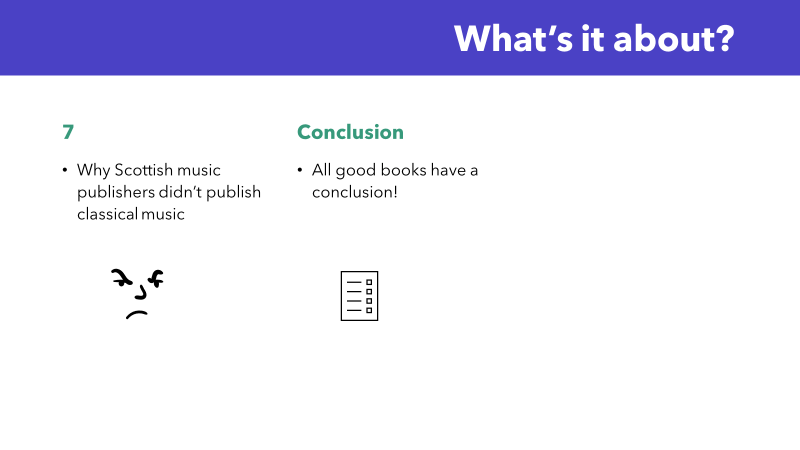
And then when I’d done all that, I decided to write about why Scottish music publishers didn’t publish classical music.
My book has been sent to the publisher; there will be reviewing and editing and indexing before it’s ready to actually be published. I’m waiting to hear if the reviewer liked it, right now. Nail-biting times!
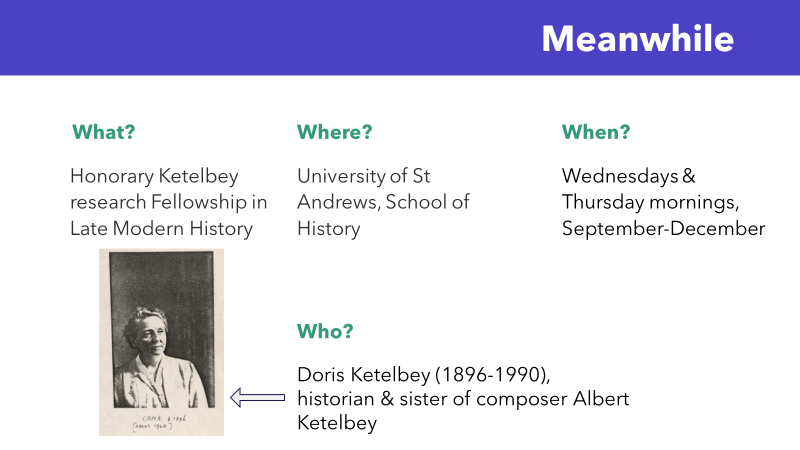
Hoping that my audience weren’t getting tired of the sound of my voice, I also mentioned that I’m about to take up a temporary honorary research fellowship at the University of St Andrews, in the School of History, from September to December. It’s the first Ketelbey Fellowship, named after the first woman history lecturer in St Andrews. Doris’s brother was an English composer – we have some of his music. I’ll be in St Andrews on Wednesdays and Thursdays, but still working back in RCS Whittaker Library the rest of the week. I anticipate editing the book, doing some more research, getting to know other scholars in the department, and I’ve been invited to give a couple of lectures – one in History and one in the Music department.
Next summer, I’ll be retiring from the library, but I hope I’ll still be a part-time researcher at RCS. If anyone else needs a part-time researcher, do get in touch – I couldn’t stand a retirement filled with daytime TV! I freely admit – I’m the librarian that is utterly sick of cataloguing, but loves doing research. An embarrassing oddity? Can’t be helped. Ideally, I’d like my book to have been published by the time I retire from librarianship, but who knows? Meanwhile, the fellowship gives me the opportunity to build up the research side of my profile.
I didn’t want to be boastful – I hope it didn’t come across that way! But at the same time, I didn’t want to sell myself short, and I didn’t want to be apologetic for being who I am. I hope I succeeded!
Vol. 11 No. 1 (2023): Special Issue on Breaking the Gender Bias in Academia and Academic Practice
Special Issue of JPAAP exploring and addressing issues, dimensions and initiatives related to ensuring a greater gender parity and representation within academic institutions, academic and academic-related work, and related professional practices. Guest edited by Alexandra Walker and Keith Smyth. (Published:2023-02-22)
Returning visitors to these pages may find the content thinner than it used to be. Now that I’m working on my next book, I want my best content to be honed to perfection and triple-checked before I commit it to print. Rather than leave extended writings – which I posted as ‘work in progress’ – sitting on the internet, I’ve pruned what is here. In general, I continue to research the topics I posted here (Scottish music publishers James Kerr, Mozart Allan and many others, and interrogations of cultural issues), and any new details or dates which I didn’t know at the time of blogging, could potentially change what I originally wrote. And also, of course, I want readers of the book to be surprised and delighted by new insights that no-one knew before!
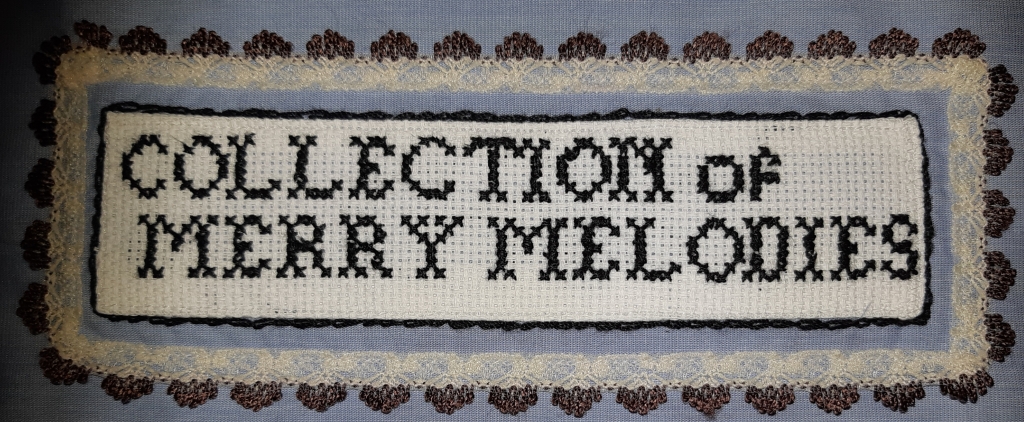
Collection of Merry Melodies
I shall continue to blog, of course. How could I not? I have so many ideas buzzing round my head that it’s hard keeping them all to myself!
I’m speaking at the second Pondering Paratext seminar next Wednesday afternoon between 2.30 and 4 pm. There will also be a talk by Dr Hazel Wilkinson.
My talk is entitled ‘Scottish Songs and Dances ‘Preserved in their Native Simplicity’ and ‘Humbly Dedicated’: Paratext in Improbable Places’. Amongst other delights, I’ll be sharing some of my recent findings about subscription lists to Scottish fiddle tunebooks.
(Musicologists of this kind of music – do take a closer look at the tune pictured above. The book it comes from is riddled with errors in the basslines – I know this for a fact. So, the first bar and the third bar here are actually very similar, and I’m tempted to play the first bar with the bassline that the third bar uses. I promise not to talk such heresy in my talk, of course, when I shall focus on the paratext rather than the notes themselves!)
I was one of the speakers doing a short talk for Glasgow University’s Hunterian museum on Tuesday 16 March evening – my talk was about Alexander Campbell, editor of Albyn’s Anthology (1816-18).
Apologies if it’s a bit quiet round here at the moment. I was all set to take a deep breath and [inhales] … start writing the first chapter for my next book, when I received the peer-reviewed chapter that I wrote for someone else’s book a couple of months ago.
Call them improvements, corrections or revisions, what you will, this means rather a lot of work before I can get back to my original plan.
And then there are the talks I’m giving in the next fortnight! It’s a busy time. Please bear with me. I’ll be back …













 Karen McAulay, Musicologist