The Value of Using a Sensible, Meaningful Title

AI-generated owl in tweeds, with library shelves in background

Some years ago, I wrote an article about bibliography and paratext – for a librarianship journal, The Library Review. Taking a marketing term, I discussed ways of trying to make bibliographic citation more ‘sexy’, ie, appealing to students.

Oh, how I regretted that article title. Too late, I feared no-one would take it seriously.  All the advice says that an article title should say what it means, directly. 

After all, if we’re going to be very ‘meta’ about it, what attracted you to this blog post? I said it was about article titles, and here I am, writing about them. It does what it says on the can, to use a colloquial expression. If you were looking for advice about entitling your article, you might conceivably have thought you’d arrived at the right place.

So, why hadn’t I just entitled that earlier article,

‘Getting undergraduates interested in library-based teaching: bibliographic citation and historical paratext’

But I didn’t. Library Review Vol. 64 Iss 1/2 pp. 154 – 161 is there for all to see, with that cringeworthy article title:-

‘Sexy’ bibliography (and revealing paratext)

I learned my lesson. Titles have to be plain and meaningful, so that everyone knows exactly what they’re about. No messing.  Otherwise,  the danger is that people looking for conventionally sexy and revealing material might stumble across my pedagogical peregrinations and feel cheated. Whilst pedagogues might not even find my article.  (Which would be a shame.)

Today, however, my line manager was digging about in Pure, our institutional repository. And – well, I’m a bit stunned to find that my poor little article got far and away the most views. Over 8,700 views, to be precise!

If you’re interested in pedagogy, and specifically, in librarians teaching, then I commend it to you. It’s not a bad article. You can access it here.

However, if you’re expecting a sultry-looking librarian in an off-the shoulder chiffon number, then I’m afraid you are going to be bitterly, bitterly disappointed! I reveal only my experimentation in making bibliographic citation and historical paratext interesting to music undergraduates!

AI generated image by Kalpesh Ajugia from Pixabay

“You can take the boy out of the country but you can’t take the country out of the boy”

Little boy in field of sunflowers

According to the Oxford Dictionary of Proverbs, this common saying originated in North America. Nowadays, you can find it borrowed and adapted to suit any situation. So, “You can take the girl out of Glasgow, but you can’t take Glasgow out of the girl” – or whatever.

Today, I’ve come up with a new version:-

You can take the scholar-librarian out of the library, but you can’t take the librarian out of the scholar.

I received an email asking me about a particular publication. Did I have any idea where it might be found? Oh, yes, I had ideas. (Indeed, as a former librarian, I tend to take it as a slur on my searching abilities if I can’t find something online!) Sadly, none of my digital ideas have borne fruit this time – and goodness knows, I have turned the internet inside out. I used all the tricks of the trade – Boolean searching, phrase searching, library union catalogues, libraries NOT in union catalogues, second-hand music sites, NEW music sites (just to be on the safe side), specialised bibliographies – I just hope that maybe my non-digital suggestions might be more successful.

Messy spider's web

But if you find your web-searches are a wee bit weird tonight, it’s because the internet is now inside out! Sorry about that.

Images by StockSnap and Daniel Roberts from Pixabay

Third Space Professionalism in the Library: the Exhilaration and Exasperation of Hybridity

CONTEXTUAL EXPLANATION
This article was written for a peer-reviewed journal. Owing to personal circumstances and commitments, I was unable to make requested amendments in time for the deadline, and I withdrew my submission. Nonetheless, I’d like to share it, since I don’t foresee myself writing much more on librarianship in future. I present it here in the same shape in which it was originally written, give or take a few tweaks to sentences (and reversion to the first person in a few places).

Abstract

It is fair to note that ‘third space’ has a variety of meanings within librarianship circles, with the liminality of the literal physical library space attracting perhaps more contemporary commentary than the idea of a ‘borderland’ where silos break down and different professions meet.

Nonetheless, although recent writing about third space professionals has focused on individuals with administrative roles in academia, it prompts me to argue that academic librarianship similarly occupies a third space role, and the arguments for valuing and increasing the visibility of third space professionals are equally applicable.

I briefly describe the typical career path of those attaining librarianship qualifications.

There follows a reflective case-study on my own third-space professionalism, having attained librarianship and teaching qualifications, and a mid-career PhD. (I’m posting this article a short while after retiral from the library, as I embark on the next stage of my career.)

Best practice in the context of a third-space career in librarianship is outlined, suggesting that it is arguably just as applicable for achieving success and fulfilment in a third-space role anywhere in higher education.

___________________________________________________________________________

Introduction

Whilst authorities such as Emily McIntosh, Diane Nutt and Celia Whitchurch have researched and published various aspects of third-space roles in higher education, the focus appears largely to have been upon more obviously administrative roles such as student success professionals, or what reviewer Agnete Vabø describes as the ‘new administration class’. (Whitchurch and Society for Research into Higher Education, 2012; Vabø, 2013, p.646; McIntosh and Nutt, 2022, p.1)

In discussions within the library community, ‘third space’ or ‘third place’ has been construed more in terms of a physical space where different communities meet, whether students from a variety of backgrounds; or students alongside librarians; or a ‘third space’ rather like a bookshop or coffee-shop – a space that is neither home nor work, where patrons meet with various expectations, and where librarians occupy roles ranging from curatorial, through pedagogical, to something akin to a guide to the resources within. These and other constructions of the concept were extensively explored by American Associate Professor of Library and Information Science, James K. Elmborg, just over a decade ago.(Elmborg, 2011)

Image by StockSnap from Pixabay

In terms of the status of library staff occupying roles somewhere between administrative, professional and academic, discourse amongst American librarians has tended more to focus on what a recent report has referred to as ‘Academic librarian faculty status’, but this is not exactly applicable in the British context, where librarians are seldom described either as ‘faculty’ or ‘tenure-track’. (Wertheimer, 2023) This makes the concept of a professional ‘third space’ particularly appealing The present opinion piece argues that academic librarians have, in a sense, occupied a third-space position for years. I describe the nature of academic librarianship, outlining some of the pleasures and pitfalls of such a career, and addressing some of the misconceptions that students and academic staff sometimes hold about librarians.

Drawing upon personal experience, I posit that individuals occupying more than one role also find themselves in a yet another uniquely ‘third space’ of their own, and I highlight some of the challenges that this raises.

Lastly, I suggest some best-practice pointers towards making such careers as rewarding as they have the potential to be.  I believe this demonstrates the overlap between all the different kinds of career in these hybrid professional roles.

Becoming an Academic Librarian

Whilst educational administration and student success-related work has in recent decades become a largely graduate profession, there has been a professional framework for librarianship for much longer. It may therefore not be immediately obvious that there are significant similarities between library work in higher education, and other third-space professional roles.

In British librarianship today, graduates from other disciplines often take a postgraduate Master’s in Library and Information Science, in much the same way that a graduate aspiring to teaching might now take a Master’s in Education. (Only a few decades ago, a postgraduate diploma was considered sufficient in both librarianship and teaching.)  Indeed, mirroring our transatlantic cousins, an academic librarian might already have a Master’s in their own discipline before pursuing a Master’s in librarianship. Thereafter, there are various routes to becoming a Chartered Librarian, and optionally, in due course, a Fellow of CILIP. (Chartered Institute of Library and Information Professionals website, no date) 

Those occupying library assistant roles are equally likely to have a first degree, but may not necessarily have completed vocational training, unless their ultimate goal is a more advanced professional role. Conversely, some qualified librarians go on to acquire teaching qualifications as well, particularly when involved in library or research skills instruction. Teaching is a particularly relevant competency for librarians, in terms of assisting patrons.

Whilst librarianship in the UK is still a profession in which professional qualification and/or registration is desirable rather than compulsory, there is nonetheless an emphasis on gaining proficiency in a variety of key skills, with CPD encouraged both by librarianship organisations, and employers. Chartered Librarians or Fellows can choose to submit for revalidation after a while, but this is not essential.  (However, both the Charter and the Fellowship do require continued membership of the awarding body, otherwise one may no longer use the postnominals.) 

Subject librarians in academic libraries depend on subject knowledge as much as their professional skills. In-depth understanding of a discipline makes one better able to acquire the right library stock, whilst subject analysis enables one to create a more helpful catalogue to aid future discovery by readers. There’s little point in creating beautiful catalogue entries, if you don’t understand what a student is actually asking for. Having studied a subject to degree or postgraduate level, one can better understand queries and requests from both students and lecturers, but this also opens up opportunities for collaboration with teaching staff, when both parties appreciate the skills that the other brings to the task in hand.

Librarians are very much hybrids in that third space between professional and academic staff. For a start, we not only help students find resources for their assignments, but also advise on how to discern what is an appropriate or acceptable resource to use. That’s a bit more than being a pen-pusher, and indeed, is as key to a student’s ultimate success as the work done by our professional colleagues in student success roles.

Correcting Misconceptions

There are, however, misconceptions about what it takes to be an effective library worker. At times, patrons seem to regard our professionalism as little more than being an efficient office worker. Indeed, serving at an issue or enquiry desk is to some readers clear evidence that one’s main purpose is to stamp and shelve books.  This is untrue for most library workers!  To be dismissed as ‘just a librarian’ does tend to betray this viewpoint. 

‘You’re actually quite bright, aren’t you?’ an undergraduate observed, after a resource had been located for them. (They didn’t know that I’d walked away from doctoral studies to train as a librarian some years earlier. Ruefully, I reflected that an incomplete PhD – a “Ph” without the “D” – was no use at all.)  But, ‘What does a librarian want with a PhD?’, an academic once asked.

When a Librarian embraces Research

Much midnight oil was burned, before eventually – a quarter century later – I had a PhD on a different topic, self- funded and studied for in my ‘spare time’ alongside full-time work and raising a family. The knowledge I’d gained doing the doctorate was directly related to one of the subjects we teach at my place of work.

I followed the PhD by secondment as a Research Assistant to a major AHRC grant, publishing a monograph, taking a PGCert in Teaching in Higher Arts Education, getting an AHRC networking grant in my own right, and more recently being awarded an honorary research fellowship at another institution. Oh, and writing quite a bit more. Moreover, as a hybrid, third-space professional, it turned out I was very well-suited to helping with academic writing and referencing!

Occupying More than one Role: another Take on Hybridity

Whilst librarians certainly provide academic support, hybridity by its very nature can take different forms. Being a librarian with an element of teaching (we call it ‘user education’) is one thing. Being a librarian with an element of research – for twelve years, I was seconded to be a researcher 1.5 days a week – is another. Or try being a postdoctoral fellow at another institution whilst keeping the home-fires burning as a librarian at the same time. It’s not so much occupying one role in a ‘third space’, as occupying multiple roles and finding oneself a hybrid professional as a consequence.

Academics get research leave. I resorted to taking odd half-days of annual leave.

Carving out a Role in the Third Space

Approaching the end of my librarianship career, I inevitably reflected upon successes and failures. With a ‘year-end’ review, one does a similar exercise, but there is more expectation that certain things will be done differently, or better in future, in an effort to become one’s best, most efficient self.  However, I’ve chosen to focus on research, with a new part-time research role since retiring from the library – I’m leaving the third space for other people to make their own.

Nonetheless, these observations may be helpful to younger colleagues carving their careers as ‘hybrids’, somewhere between academia and the professional office – in whatever professional capacity. Taken in the following order, the mnemonic ‘CARVE’ seems appropriate:-

Collaboration and networking are by far the best way to experience fulfilment in a hybrid role. McIntosh and Nutt underline that, ‘One way to find a place is through participating in knowledge networks.’  (McIntosh and Nutt, 2022, p.5)  Librarians are fortunate to have a variety of librarianship organisations and interest groups with which to engage, and networking became even more important when I acquired other research-based roles:-

  • As an AHRC Research Assistant, I brought research skills, extensive experience in cataloguing music, and my existing engagement with appropriate library networks. Our small team was developing a database of digitised resources, entailing much comparison of sources and amassing critical metadata. (University of Glasgow et al, 2015)
  • With my AHRC Networking grant, I established a network of third-space professionals and scholars, as we explored printed music surviving from the eighteenth and early nineteenth centuries. Librarians and scholars met on a level footing. (‘Brio, Special issue: “Claimed from Stationers” Hall’: papers from an AHRC-funded network project’, 2019)
  • Before, during and since the pandemic, I devised a project of my own, acquiring more music by women composers and composers of colour, to improve equality, diversity and inclusion for our own library. Here, I was undeniably acting as a librarian, but I found myself networking with composers, museum professionals, librarians in other institutions, and educationalists at conferences, as I outlined what I was trying to achieve. (McAulay, 2023)  Indeed, the research I conducted proved useful in a variety of contexts. I’ve shared my findings with interested students, and proudly attended a Master’s student’s final recital, in which one of the newly-acquired works was performed. In future, there is also going to be a prize for diversity in recital programming – the initial idea was mine, even if I wasn’t in the space where the decisions were made.

Achieving a qualification, publishing something, or completing a project (within the department, or inter- departmentally) merits praise. In any role, there is plenty of mundane slogging, but it’s bearable if third-space achievements are noted and greeted with approval.

Recognition is important, and distinct from visibility (see below). Without recognition, success can be lonely. McIntosh and Nutt cite work by J. Hall arguing that ‘one of the challenges for those working “in-between “ is the lack of recognition and validation for this work.’  McIntosh and Nutt, 2022, p.2 citing (Hall, 2022)  Line managers can signal to other members of the department that achievements are a valuable part of the departmental success story. Without reinforcing this message, there’s the risk of causing resentment that one is pushing too hard against the glass ceiling, an upstart with ambitions above one’s station.  

Visibility is similarly crucial. It is entirely appropriate that a noteworthy achievement  should be disseminated – not just internally, but perhaps also sectorally. This boosts confidence and a sense of both autonomy and authority. Blogging and social media are invaluable, and journals are there for disseminating ideas.

Energy is required, to achieve the exhilaration of a successful third-space career. It can be exhausting, particularly in the effort both to maintain visibility and be an effective self-advocate. If, in a library, there is often a perception amongst patrons, whether staff or students, that librarians simply issue materials, send out overdue notices and catalogue things, then it must be very similar in the registry, faculty support office or IT department. Combatting misconceptions with a smile can be very wearing, but is there a choice?  However, backing from line-managers goes a long way to making the task easier and more fulfilling. Indeed, it’s crucial.

Conclusion

Librarians talking about libraries as a ‘third space’ tend more often to mean the physical space in which they operate, but there is also value in discussing the third-space nature of the librarian’s role.

It is important that the concept of the ‘third space’ or ‘hybrid’ professional should be more widely understood by those whose roles are more conventional.  Whether a professional in student success work; the library; or some other academic support role; or indeed, the individual wearing a multiplicity of professional ‘hats’, many workers in higher education support roles are striving to make a difference in a more modern, blended way. With appropriate departmental support, this can only make us more rounded as individuals, confidently offering a wider range of strengths and skills than hithertofore.

_______________________________________________________

Bibliography

‘Brio, Special issue: “Claimed from Stationers” Hall’: papers from an AHRC-funded network project’ (2019) Brio, 56(2).

Chartered Institute of Library and Information Professionals (no date) CILIP accredited qualifications – CILIP: the library and information association, CILIP: the Library and Information Association. Available at: https://www.cilip.org.uk/page/Qualifications (Accessed: 10 January 2024).

Elmborg, J.K. (2011) ‘Libraries as the Spaces Between Us: Recognizing and Valuing the Third Space’, Reference & User Services Quarterly, 50(4), pp. 338–350.

Hall, J. (2022) ‘Understanding and debating the third space: achieving strategy’, in The impact of the Integrated Practitioner in Higher Education: Studies in Third Space Professionalism, ed. E. McIntosh and D. Nutt. Routledge, pp. 26–32.

McAulay, Karen (2023) ‘Representation of Women Composers in the Whittaker Library’, Journal of Perspectives in Applied Academic Practice, 11(1), pp. 21–26. Available at: https://doi.org/10.56433/jpaap.v11i1.533.

McIntosh, E. and Nutt, D. (2022) ‘The Impact of the Integrated Practitioner: Perspectives on Integrated Practice to Enhance Student Success’, Student Success Journal, 13(2). Available at: https://studentsuccessjournal.org/ (Accessed: 18 December 2023).

University of Glasgow, University of Cambridge, Royal Conservatoire of Scotland (2015) HMS.Scot: Historical Music of Scotland. Available at: http://hms.scot/ (Accessed: 3 September 2024).

Vabø, A. (2013) ‘Review of In the space between administration and academia. Reconstructing Identities in Higher Education. The Rise of Third Space Professionals’, Higher Education, 66(5), pp. 645–647.

Wertheimer, A. (2023) ‘Review of Academic librarian faculty status: CLIPP # 47 (2022)’, The International Journal of Information, Diversity, & Inclusion, 7(1/2), pp. 1–3.

Whitchurch, C. and Society for Research into Higher Education. (2012) Reconstructing identities in higher education: the rise of ‘third space’ professionals. 1st ed. New York, NY: Routledge. Available at: http://ebookcentral.proquest.com/lib/aston/detail.action?docID=1075438 (Accessed: 18 December 2023).

Cover Image by Joe from Pixabay

A Brief (the Briefest!) Hiatus between Librarianship and Research

Freworks

After a memorable retiral from the Library last Friday, today (Monday) is a day’s annual leave, and tomorrow is my birthday. It goes without saying, nothing work-related will be happening until Wednesday! That’s when I am officially a Post Doctoral Research Fellow.

Meanwhile – please just imagine me indulging in fine dining and more cake than usual!

Image by Steve Raubenstine from Pixabay

Last Jazz CD to Catalogue – Penultimate Librarian Day

There was a box on the office windowsill – it was full to the brim of jazz CDs only a few weeks ago. On the one hand it was ‘not a priority’ – on the other hand, nothing would happen to the rest of the jazz CD project until this box was shifted. I retire from librarianship tomorrow, and I am cataloguing the last CD out of that box.

Result!

Lavay Smith & Her Red Hot Skillet Lickers

I now know so very, very many jazz artistes’ names. (I’ve catalogued over 2000 jazz CDs in recent years.) However, I can truthfully say I hadn’t heard of Lavay Smith & Her Red Hot Skillet Lickers until yesterday, when I picked up the CD. Wikipedia informs me she’s ‘an American singer specializing in swing and blues’, and she’s a year older than my youngest sibling. At least I’m cataloguing a contemporary female artiste, which feels a bit more relevant than some of the older guys who have been digitally remastered multiple times on multiple labels!

And the Handover Document(s)

I’ve been compiling this masterpiece for twelve months. It looks pretty comprehensive, but I’m sure there will be things I consider so run-of-the-mill that I haven’t mentioned them. I’ve done my best. There’s also a document about cataloguing music items, and a final document with examples of things catalogued.  Sheet music, CDs, Sammelbander – oh, it’s all there. I can’t download my entire career’s knowledge and experience, but these documents might help.

I hope my successors find these at least slightly useful!

To be truthful, I don’t know what I’ll do at work tomorrow morning. I’ve never retired before. My son suggests it’s probably a bit like the last week at school before the holidays. I’m only semi-retiring, but maybe he’s right. (I should take a Scrabble board with me, then??)

I spent this morning indexing my book, as a scholar. Now to finish off cataloguing Lavay Smith’s CD, as a librarian!

Diversity in the Concert Programme

Below, you’ll find a blog post that I have just written for the Whittaker Library blog. In my library career, I haven’t changed the world, but I have bought and catalogued quite a lot of music.  (Why be modest? Mountains of it!) In the past five years, I’ve focused particularly on equality and diversity – I put a huge amount of effort into it, and I hope it has made a difference to our users.  Perhaps one day, there will be an event to raise awareness of all this music.  I tried, but I have done all I can.  I wish it had been more, and I wish it could have ended more triumphantly.

In an era that’s all about impact and engagement, it can be an up-hill struggle for a librarian to make a significant difference, and even harder to blow one’s own trumpet metaphorically when surrounded by genuine stars in the making, deservedly blowing their own actual trumpets!

Whilst repertoire lists might not seem the most exciting topic in the world, if they’re important to recitalists and other people planning concert programmes, then they’re important to us. We would like to remind everyone that the Whittaker Library does have a lot of music by women and/or BIPOC composers. We’ve committed a fair chunk […]

Diversity in the Concert Programme

Diversifying Your Repertoire: Music by BIPOC Composers

At the Whittaker Library, we use the Portal (a bit like Moodle, it’s a kind of intranet for material shared within the institution) for useful information to help our students and colleagues.

A while ago, I compiled lists of music by women composers, subdivided into categories, such as music for children, music for tuba, music for mixed chamber ensemble – but until now, I hadn’t done much in the way of subdividing the lists of music by BIPOC composers. So, I have been working on it.  Despite having acquired quite a lot of music, I have discovered that the commonest instruments have by far and away the most music. Poor tuba player, if you want to diversify your programme with music by people of other ethnicities.

Some university libraries have put in a lot of effort helping students find this kind of thing – especially in Canada and the USA – and there are some useful databases to help – but I have still been struggling to find materials for some of the more minority instruments. Not a great deal for piccolo, tuba, accordion – or bagpipes! (Well,  there might not be as much pipe music over there – we started the piping tradition here in Scotland. However,  there are plenty of non-Scottish pipe bands. Some international pipers must also compose!)

If you play tuba, trombone, piccolo, oboe, saxophone – you get the picture – and your repertoire includes a fabulous piece of music by a BIPOC composer, PLEASE do recommend your library to get that piece in stock so that other musicians can also find it! It won’t be up to me to continue ordering music at RCS after the end of June – and that’s a strange feeling – but I can, right now, highlight the fact that libraries need to pay attention to the repertoire they buy.

If you’re a librarian – by all means, keep the standard repertoire up to date. Buy what your patrons need and ask for. But if you have a chance to do stock development, please keep the BIPOC composers in mind. They are, after all, the global majority! And I’m ashamed to say, we don’t know enough about them, though I can, hand on heart, say that I’ve been making a determined effort to find out.

I had hoped to do one last workshop about all the exciting new repertoire in the library, before I retired. Sadly, this isn’t going to happen. Never mind – maybe one day, someone will find this blog post and feel inspired to explore it all for themselves.

Image by congerdesign from Pixabay

Slow Productivity: my Latest Read

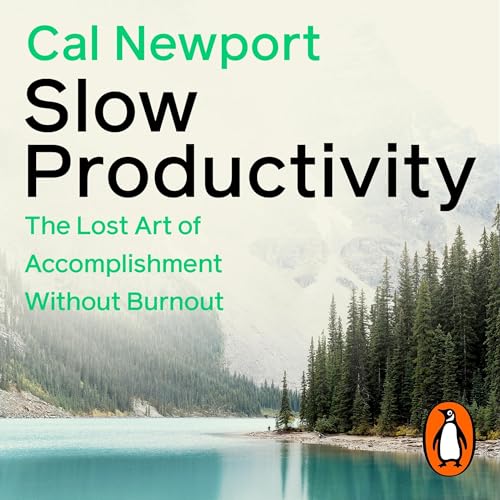
Cover of Cal Newport book, Slow Productivity

Slow Productivity: The Lost Art of Accomplishment Without Burnout
by Cal Newport and Penguin Audio (March 2024)

picture of headphones on a patchwork background.

I’ve been listening to Cal Newport’s book, Slow Productivity: the Lost Art of Accomplishment without Burnout, on Audible. I’ve taken my time over it – appropriately – and I’m approaching the end of it. Because I haven’t finished completely, what I’m writing here today can’t really be described as a review, so much as a first impression.

But why, you might ask, would anyone less than two months away from retirement age, decide to read a book about productivity at all? It’s a good question! I think I was both intrigued by the title, and fascinated by the different paces at which different people work. There are times when I achieve a lot – but not usually at a frenetic pace.   I don’t throw myself into tasks at fever-pitch, unless a deadline is creeping up on me. On the other hand, I do tend to have so many things on the go, that going slow feels impossible. (And I’m worryingly obsessed about accomplishment and achievements! That’s how I was raised.)

The main thrust of the book is that we ‘knowledge-workers’ should be more deliberate, allow ourselves time to do things well, factor in holidays, breaks and slower-moving spells, and not take on too much. That we’re not like factory workers on an assembly line, and aren’t generally required to produce so many units of whatever-it-might-be, per hour, day or week. Newport’s historical examples are inspiring, underlining his message, but some suggestions have no application to any role I’ve ever occupied. Pay someone to do some part of my work? If I was self-employed, possibly. However, the only time I’ve ever done that, was getting my first book indexed professionally. Librarians don’t outsource their work. (Neither do 0.3 of the week researchers!) Similarly, if you own a business or are freelance, you can deliberately decide to make a little less profit in exchange for a longer, more intentional route towards a high-quality product/performance act/whatever. People employed in any kind of academia can choose to seek a promoted position or not (depending on circumstances, of course), but it’s not about profitability directly affecting one’s own pocket.

Obsess over Quality

However, the suggestion to look at your role and focus on the ‘core activities’ that will have the most impact, is certainly sensible. As I’ve mentioned before, cataloguing barely-used jazz CDs is a soul-destroying task, mainly because it has such little impact. I hardly needed an Audible book to endorse that sentiment, but there it was.

Impactful Librarianship

As I did the ironing one night last week, listening to my book, I think that’s what prompted me to make sure my final weeks of librarianship would have a bit more impact than that! I’ve thrown myself back into tracking down music by BIPOC composers, and it certainly passes the time more quickly than other tasks I could mention!

My aim is simply to make it possible for students to find more diverse repertoire, should they feel so inclined.  My efforts won’t result in a massive listing – there are less than a thousand such items tagged in our catalogue, and our budget isn’t huge. It’s not just about getting the materials in – but I won’t be the one devising ways to get it known about and borrowed, after 28 June 2024.

Yesterday, a highlight was discovering one particular new acquisition was already on loan to a second borrower. Result!  That  in library terms, is impact.

And Impactful Research

As for slow productivity? I need to finish reading Newport’s book and then consider how to apply the best suggestions to a semi-retired existence. At the time I’m posting this, it’s a Wednesday, and I have my research hat on. I have a book review to do, and then I’ll look at my list of projects … because I’m not retiring from research! Far from it.

7 Weeks until I’m Unshackled From the Shelves

Coincidentally, a Twitter contact shared the perfect picture – a chained book at a church in Broughton, Bucks. When I think of myself being ‘unshackled from the shelves’, this is precisely the mental picture that comes into my mind! Irreverently, I’m ashamed to admit that the mental picture has a soundtrack: it’s accompanied by a line from a hymn, ‘And can it be?’ In my own defence, hymns have been a large part of my life, and I shall in all probability write a few more myself in retirement, so it’s hardly surprising that this line pops into my head!

My chains fell off, my heart was free …

Making Memories

Friday’s concert programme at RCS

The past week saw me attending two lunchtime concerts – the Strings Department on Monday, and a chamber music concert (two substantial pieces by Dohnanyi and Brahms) on Friday. I wasn’t familiar with the Dohnanyi, but it was a lovely discovery.

Another day, I had tea and a cake at Waterstones – yes, I did buy a book. No surprise there.

Improving Vision

It wasn’t all fun and merriment this week: I had a check-up at the eye department on Thursday. ‘Slow progress’ is certainly still progress, so I’m trying to feel positive about this qualified good news. But ‘fantastic, wonderful progress’ would have been more uplifting … I’m just glad the other eye more than compensates.

Vision for the Future: BIPOC composers

And on Friday, I got back to my efforts in taking steps to increase our coverage of music by historically under-represented composers.  More about that in a later posting.

Chained book photo courtesy of Steve, @portaspeciosa, with thanks

But How DO You Bring a Career to a Close?

Pocket watch with chain

I’m only semi-retiring; I’m leaving the main part of my job, but turning the research secondment into a new part-time contract. The technicalities are one thing: fill in the appropriate forms for receiving your pension. Decide what to do about outstanding holiday entitlement. Set things in motion for a new contract. Wait. Start counting the weeks, and then the days. Wait some more.

As I said in an earlier post, you can try to inject a few fun things into lunch-breaks, to brighten up the days. (I’m grateful to work in a place where there are loads of performances going on.) Meanwhile, you’re still at work in the old job. You know, and everyone else knows, that in a couple of months you won’t be there. In my unrealistic mind, I’d hoped to go out in a blaze of glory, but I don’t feel glorious or triumphant at all. How are you supposed to FEEL?, I asked a considerably older friend. They looked at me in a way that said they’d never asked themselves that!

Clearing Clutter (and Treasures)

I sit cataloguing donations and glumly eyeing piles that everyone would like to be cleared out of the way before I clear off! A late night email (which I found the next day) seemed to hint at that. But if I haven’t cleared the piles of donations by now, working steadily, then am I reasonably going to get the whole lot out of the way in two months? Am I not working hard enough? It’s a bit depressing, actually. On the other hand, when I arrived in 1988, there was a half a rolling stack full of donated materials. I used to wonder if I’d still be needed once I’d catalogued them all. Of course, they were all dealt with decades ago. None of our donations are remotely that old; there aren’t nearly as many; and no, I wasn’t discarded when the original donations were all done and dusted! Maybe it’s unrealistic to expect a final, purging blitz on what’s there now. Leave something for my successors.

Occasionally I get over-excited about treasures that crop up amongst the more routine stuff.  (Over 200 years old?  How could I NOT be excited?!  One of the joys of having two parallel careers is having research knowledge that illuminates historical library materials.  Sharing that knowledge sufficiently so that everyone else is aware of the treasures – that’s another thing entirely.  Who wants to be trapped by an old librarian keen to share stories about ancient scores and famous poets?)

The Paranoia about Becoming Irrelevant – ‘Yesterday’s News?’

I’ve been keeping a ‘handover document’ for almost a year now, and every so often I think of something to add to it. Often things occur to me after I’ve had to deal with something, and realise that maybe it needs noting down! ‘It won’t be your concern in a few weeks’, my older spouse tells me. It’s hard adjusting to the certainty that things will be done differently once I’m gone. Things that I think should be done one way, will assuredly be done differently, and that’s to be expected. Even the things that I value aren’t necessarily of the same value to other folk – that’s the hard bit! (Mind you, some of the things I value have historical AND monetary value.  My valued things aren’t valued without good reason.)

Silhouette of woman at computer desk in library
Image by Chen from Pixabay

On the plus side, of course, is my list of research things to investigate, calls for papers and articles and chapters. I haven’t run out of steam, intellectually – far from it. My second book about to commence the copy-editing process. A research paper to write for a conference in July. New adventures on the horizon – oh, I really can’t wait for some new adventures! (I’m not a dull cataloguer – I’ve just ended up backed into a wee cataloguing corner.  Neither does everyone find cataloguing tedious, but I have really done too much of it!)

You get lots of advice about how to write a CV, how to start your career with a flourish, how to make your mark. How to get on in the world. How to progress. But it seems there’s little advice about how to gracefully bow out!

This isn’t something unique to me – retirals happen all the time. What do other people do? Do you set up appointments to say goodbye to people? (Hard, when I’ll still be around, albeit in a different department.) Do you try to set up one last workshop/seminar/whatever before you go? [Post Script: you don’t!]

Or just try to be inconspicuous until the Last Day arrives?!

Old pocket watch Image by Bernd from Pixabay