Now
 We tend to take catalogues for granted. We expect them to tell us everything about a book, score or recording – author, title, publisher and publication date, pagination, unique identifying numbers (ISBN, ISMN or publishers’ code), and the contents of an album or collection of pieces. We look for the author or composer, the editor(s) – and expect to be able to know which is which. In modern, online catalogues, this metadata is all carefully entered into special machine-readable fields as a “MARC record”. That’s a MAchine-Readable Cataloguing record.
Not so Long Ago
When I began work as a librarian, I was taught how to catalogue onto pre-printed MARC data entry forms which the library assistants then entered into the library computer system. Computer tapes were run overnight to upload the data to a cooperative system hosted in the Midlands, and shared by a number of libraries. Things are more streamlined now!
A Couple of Centuries Ago
 But what about our Victorian forefathers or the Georgians before them? By the early 19th century, library catalogues of books were often prepared as printed volumes, but this wasn’t the case for the music I’ve been looking at. Take the University of St Andrews’ handwritten catalogue made by Miss Elizabeth Lambert in the 1820s. If there were (for example) three completely separate pieces making up a set of sonatas or songs, then it was not unusual for her to write a composite entry: “Three sonatas”, “Six Quadrilles on airs from Le Comte Ory” or whatever.
In 1831, a meeting of the Curators at the Advocates’ Library – the precursor to the National Library of Scotland – agreed that their copyright music had been handled with a worrying degree of laxity, and decided that things had to be tightened up by appointing a music committee. Rules were drawn up regarding the handling and curation of this material, from arrival through to borrowing (yes, borrowing! It wasn’t yet a national reference library, after all) – not to mention calculating replacement costs and barring readers who had lost books, until they paid up!
However, it took until 1856-7 – by which time John Donaldson had become the Fourth Reid Professor at the University of Edinburgh – for the committee to decide that formal cataloguing rules were needed. Donaldson was at least a musician. Several committee members seem to have been in the legal profession. They spent a week thinking about how to set about it, debating whether to enter items under the composers’ names, or the publishers. And then they asked the experts at the British Museum. They received, by return, the rules used for cataloguing music, and adopted them for their own use.
This week, I looked at the National Library of Scotland’s Victorian Catalogue. I was trying to identify items on those two mysterious lists of music from 1830. They presumably wouldn’t have been catalogued until after 1857, if I’m interpreting the facts right. It took a little while before I realised just how far things have come since then!
Filing Systems
 In the Victorian catalogue, music is entered alphabetically by composer, and then alphabetically by title within each composer’s output. However, the alphabetical titles were often alphabetical by genre rather than by exact title, so Selected Marches might be followed by Fourth March then Fifth March and then would come Favorite Quadrilles on airs from Rossini’s Le Comte Ory. (“Quadrilles” are alphabetically after “Marches”, and never mind about the words before them in the title!) Today, we create “uniform titles”, which standardise titles for filing purposes. By comparison, the Victorians had uniform titles in their heads but nothing like that on the catalogue slip!
Statements of Responsibility (aka, Entry Points)
This is modern library-speak for the names of people involved with creating the book or composition, whether they wrote, edited, or arranged it, or supplied some specialised service such as the fingering or bowing in a piano or violin piece, or indeed, writing an introduction or compiling an index at the end. Things are sometimes a bit more complicated than that.
For example, if Halevy wrote a piece, then clearly he was the main author. If he wrote a duet arrangement of themes in someone else’s overture, then in today’s parlance, he’d be the arranger. If he wrote variations on a theme, then you could argue that he was an author in his own right – the variations wouldn’t exist without him writing them. Thanks to online cataloguing, you’d find the piece regardless of what his contribution was, and in the case of sets of variations, the original composer of a theme would probably get a mention too. (The rules are clear, but if you check Copac, you find that sometimes the same piece has been catalogued by different libraries with either composer as the main entry, because it’s admittedly a slightly grey area – it doesn’t matter hugely, so long as the piece can be found!)

Anglo American Cataloguing Rules 2nd Edition (AACR2)

AACR2
IMAGES FROM AACR2 (Anglo American Cataloguing Rules 2nd Edition)
Now, in the days before online cataloguing, say, fifty years ago, an arranger or editor would have had an “added entry” with his name above the name of the original composer, so two catalogue cards would have been typed, and one filed under each individual’s name.
However, in the Victorian catalogue, you’d find Halevy’s compositions, sorted from A-Z, as I’ve just described, and then a second series of pieces sorted from A-Z, that he’d edited or arranged in some way. And the second sequence weren’t always complete entries. Sometimes, the card was just a cross-reference: it didn’t tell you which volume the piece was in, but the original composer’s name was underlined. So you’d then go and look under their name, to find out which volume contained the piece you were seeking.
As for publication and physical details – most records in the Victorian catalogue seem merely to inform us that the work was published in London, and was folio size. Not really very informative!
Those two lists from 1830 contained some 147 pieces, a few of which I had been unable precisely to identify. I made a valiant start trying to see how many of the identifiable ones could actually be traced in the Victorian catalogue. I didn’t get to the end of the lists! However, it did look as though the majority were there in some form. Had I been prepared to spend quite a few more hours on the task, looking for cross-references and arrangements in other places, maybe I’d have found more of them. I was at least able to establish that these lists seemed to be of pieces that the Advocates wanted to keep, rather than pieces they intended to sell. The lists didn’t look like Mr Greenhill’s lists from Stationers’ Hall; the Stationers’ Hall lists came quarterly, in books, and more closely written, whilst the Advocates’ lists were on loose sheets of paper, more spaced out, and dated as consecutive months: February and March 1830.
Of the pieces that I managed to trace in my two-hour session, most appeared to be bound into music volumes numbered from 1 to 68. I traced a handful in later-numbered volumes, but it was a bit difficult to be certain, when the handwritten lists themselves had given me little to go on!
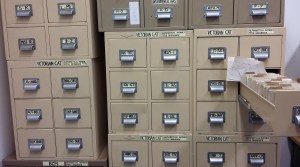 It always pays to enquire whether there are other old card catalogues that may not be on general public access. The National Library of Scotland’s Victorian catalogue, and Glasgow’s main public reference library, The Mitchell’s Kidson collection, are just two examples. Because they’re paper slips in long trays, you have to be a bit careful with them, and access may have to be arranged under supervision of a member of staff. But these are valuable resources, and may be the only way of accessing a historical collection of music. Who would have thought it, in these days of online catalogues – or OPACs*, as we fondly refer to them.
*Online Public Access Catalogues, to those in the trade!






 As I’ve mentioned recently, this is another network with which I’ve been involved. Last week, the new website of the Romantic National Song Network was launched – and yesterday, my contributed guest blogpost about a Scottish song – Afton Water – went live. It draws heavily on my doctoral research into Scottish song-collecting, but I like to think that my present interest in the wider context (collecting, publishing, curating) has also influenced my approach. I was certainly very glad of the National Library of Scotland’s
  Today, sifting through a library donation of largely 20th century scores, I was astonished
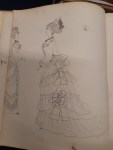 to lift two obviously older volumes out of one of the boxes. We’re now the proud owners of the third set of Collection of National Airs known to be held in Scotland. Since I haven’t looked at this title for a decade or so, I leafed through both volumes briefly, to remind myself what they were like. (The volumes had belonged to a Mrs Chambers, and either she or a young relative had practised their drawing skills on the flyleaves, but we’ll overlook those for now!)
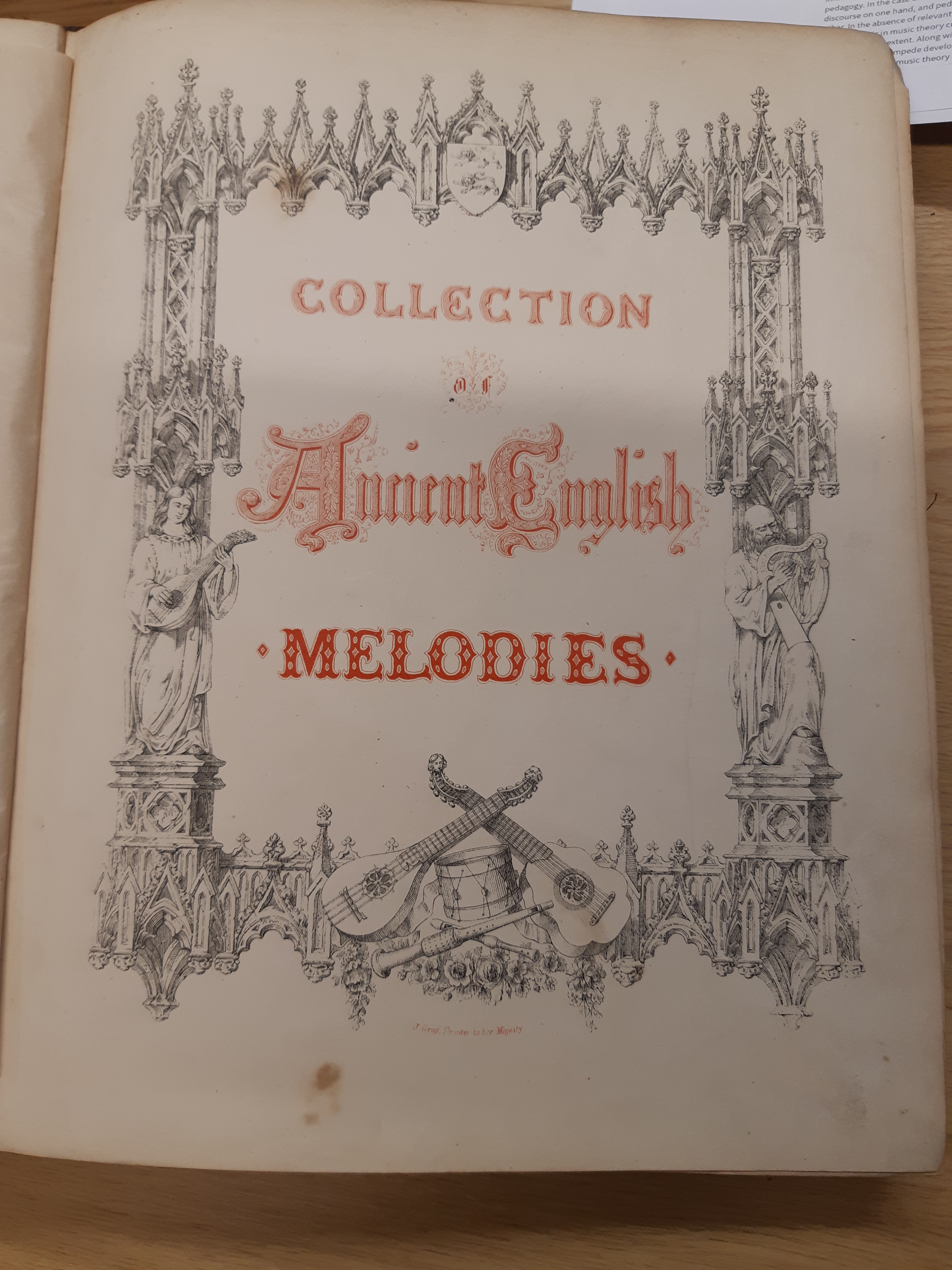 Chappell’s work is in two volumes: the first contains the subscriber’s list and a preface, with the rest of the volume devoted to the tunes themselves. The second volume contains commentary, winding up with a conclusion and then an appendix.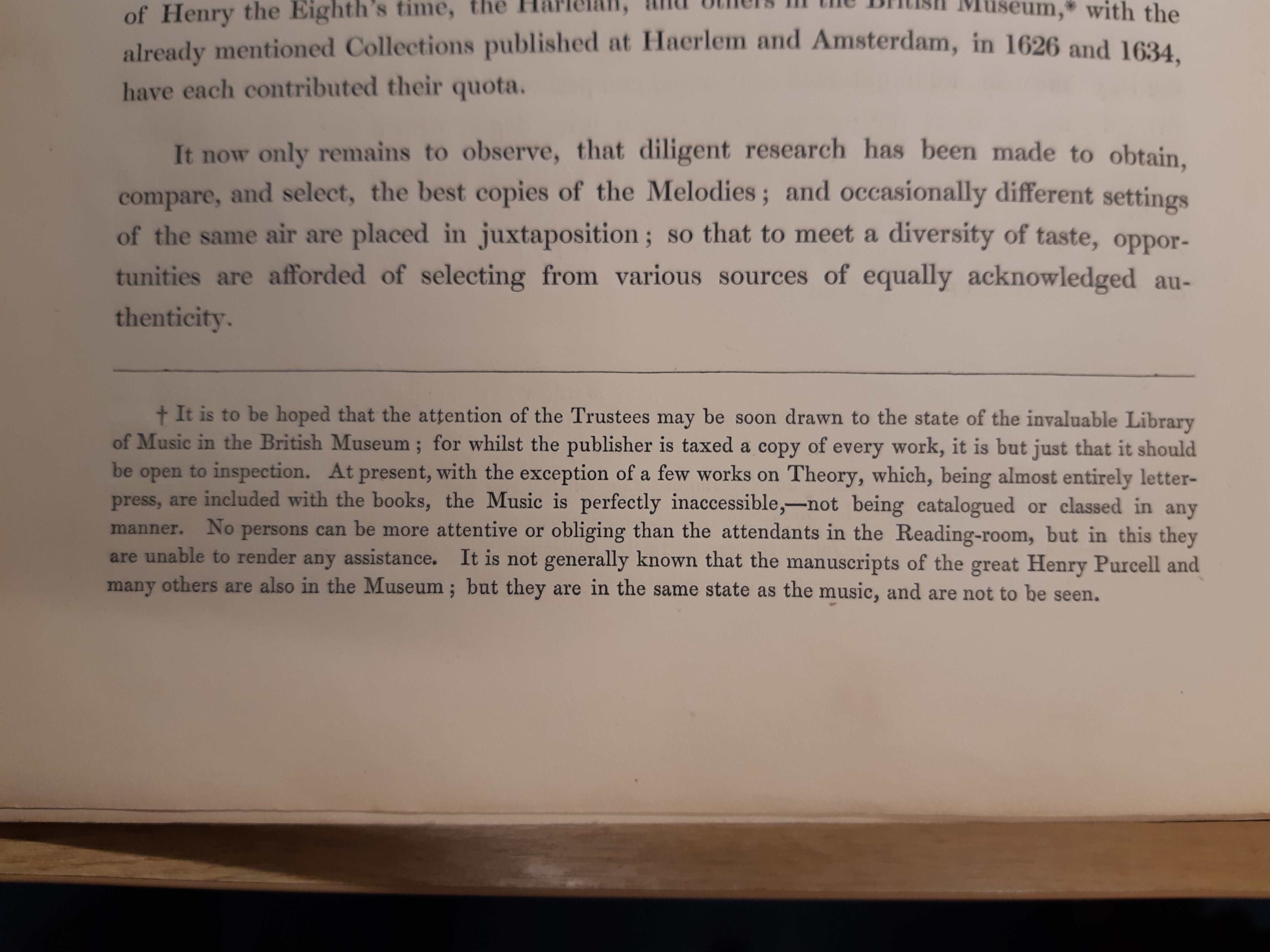
 In the past month, I’ve been to Edinburgh, Cambridge and Oxford in connection with the Claimed From Stationers’ Hall research network. I’ve chatted with Almut Boehme in the National Library of Scotland, Elizabeth Lawrence and Jenny Nex at the University of Edinburgh, Margaret Jones and Jill Whitelock in Cambridge, and Martin Holmes and Giles Bergel in Oxford. We’ve talked about how different libraries stored and curated their legal deposit collections, attitudes towards music and cataloguing, and the influence of the British Museum’s mid-nineteenth century cataloguing rules. Several libraries began by categorising their music as instrumental or vocal – so to anyone wondering why our library does it that way – well, we’re following the Library of Congress, and they seem to have followed the British Museum too!
 and the lists of music – lists that came from Stationers’ Hall at regular intervals, and lists that were made of material as it was accessioned. Serendipity is a wonderful thing – Margaret looked out scores corresponding to material in the lists, and came up with a bound collection of various national songbooks – always a popular genre – not to mention an English opera that might have made no ripples in nearly two centuries, but certainly raised a few smiles in that meeting room in February 2018!
 Meanwhile, Martin’s selection of scores included a composition by a young English woman whom I’d never heard of before – Sarah Allison Heward – and a network member in Germany has since unearthed a whole wealth of information about her and her musical family. Watch this space – there’s a blogpost coming up!
 Waiting with bated breath to see if I’ll make it to the antipodes, this week I continued my explorations closer to home, visiting the National Library of Scotland yesterday to investigate music committee meetings at the Advocates Library in 1831-2, and later in 1856. The Advocates Library (later to be absorbed into the National Library of Scotland) was one of the Scottish copyright libraries, so received the quarterly consignments of legal deposit materials, and indeed continued to receive them after the legislation had stripped most universities of legal deposit entitlements in 1836.
 to be sure of his identity, though there certainly
 Karen McAulay, Musicologist