Book: A Social History of Amateur Music-Making and Scottish National Identity

Wavy lines of music and an artistic interpretation of a fiddle

Folks, I’ve just noticed Routledge has a 20% summer sale on at the moment.  So, if you or your library could use a copy, this might be a good time to get it!  (All books and e-books are 20% off until 1 August 2025.)

The accent is on social history and Scotland – and music-making, obviously. I’m keen to hear what readers think of it. (If you are a reviews editor, do get in touch with Routledge. There’s a link on the website.)

  • Amateur music making
  • Scottish music publishing
  • Scottish and Irish songs
  • Fiddle tunes and dance music
  • Preserving the heritage and passing it on
  • Nostalgic Scots abroad
  • Newfangled technology

Routledge link

Karen E McAulay,  A Social History of Amateur Music-Making: Scotland’s Printed Music 1880-1951 (Routledge, 2005) 

ISBN 9781032389202
220 Pages
Published October 30, 2024 by Routledge

How to Catch a Song Book in the Wild

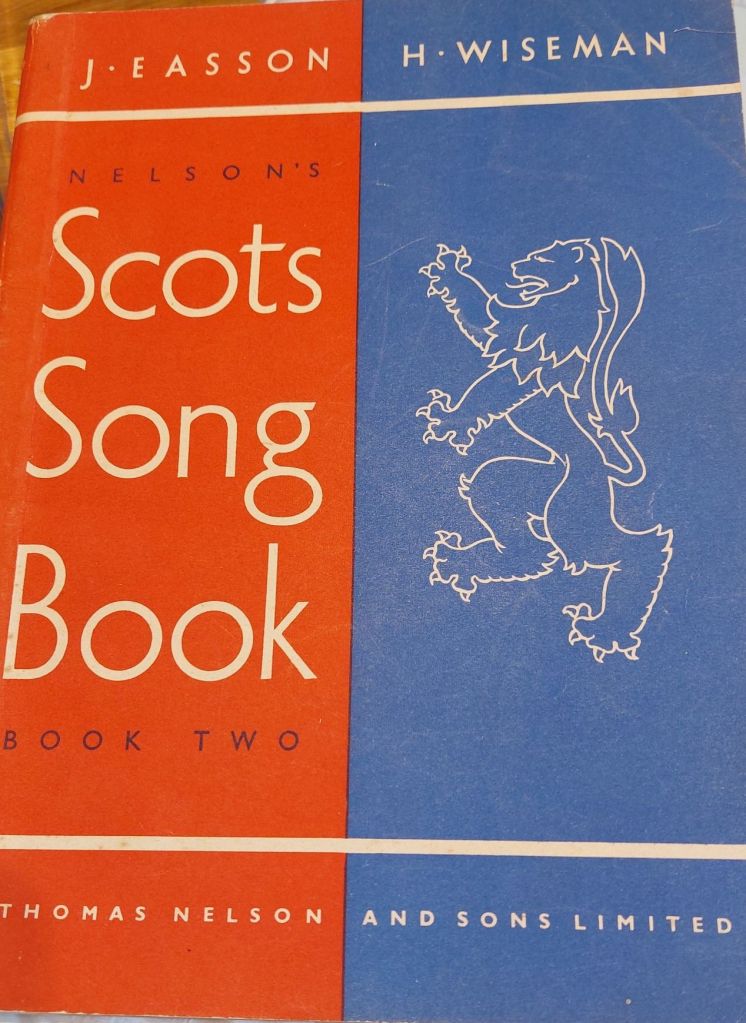
As regular readers will know, my IASH Fellowship concerns the history of the Nelson’s Scots Song Books.

I’ve seen all four of the teacher’s books in libraries; and possess one teacher’s edition of my own, plus one pupil’s edition – not the same volume number.  And I’m going to some lengths to track down the other three of each edition.  I want to be able to show them when I talk about them, so I simply must keep looking.

Today, I headed to town, feeling as though I ought to be riding a pony and tootling a hunter’s horn, to the sound of La Chasse or the William Tell Overture.  (The heavens opened between subway and second-hand bookshop, somewhat spoiling my fantasy. Urghh!)

But hunting with a pack of hounds would have been no good at all, for you have to creep up on these rare beasts very, very softly. Pretend to be looking at something else, as you slowly extend your arm towards the shelf. And then, whilst it’s relaxed with its defences down, grasp it quickly and hold on tight.

Captured!

I examined it disbelievingly.  Yes! I now have the teacher’s edition to go with my pupil’s edition of Vol.2. (Actually, I also found some other useful material that wasn’t published by Thomas Nelson.)

And then I turned round.  On a table, if you please, there sat another Nelson music book that I’ve been reading about. Not a song book, but interesting just because it was published around the same time, by the same Nelson editors.  It was as though it was waiting for me to find it.

Did I celebrate with a coffee? Now, what do you think!

Fame! Flora Woodman and Robert Wilson under the Spotlight

I’m giving a paper at a forthcoming conference at the University of Surrey: Actors, Singers and Celebrity Cultures across the Centuries.

It takes place from tomorrow, Thursday 12 to Saturday 14 June 2025, and is organised under the aegis of the University’s Theatrical Voice Research Centre.

My talk’s entitled, ‘Comparing the Career Trajectories of Two Scottish Singers: Flora Woodman and Robert Wilson‘. 

The Gowns! The Kilts!

I could write plenty about their concert attire alone (think lace, diamonds and fluted frocks, or smart kilts and jackets) – but obviously, I can only just brush past that particular clothes rail, considering the more significant observations that I’m also making.

Boosey’s Ballads

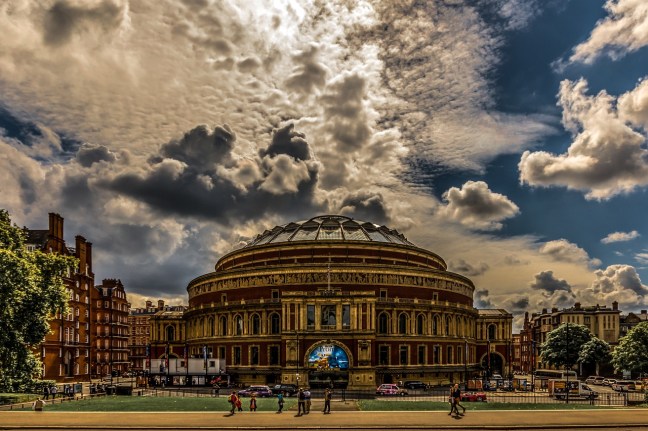
Today, I’d like to share some audio that won’t be making it into my talk. Let’s call it ‘extra content’.  I’ve recorded some of the Boosey-published ballads that Flora performed at their Royal Albert Hall concerts.  Since I’m not a trained singer, I’ve done my best to convey an impression solely on the piano.  (I’m not going to start singing here!)  I also highlight some of the themes in these songs – captured hearts, broken hearts, the joys of spring and of youth.  It’s surprising what you find, if you really look.

Here goes:-

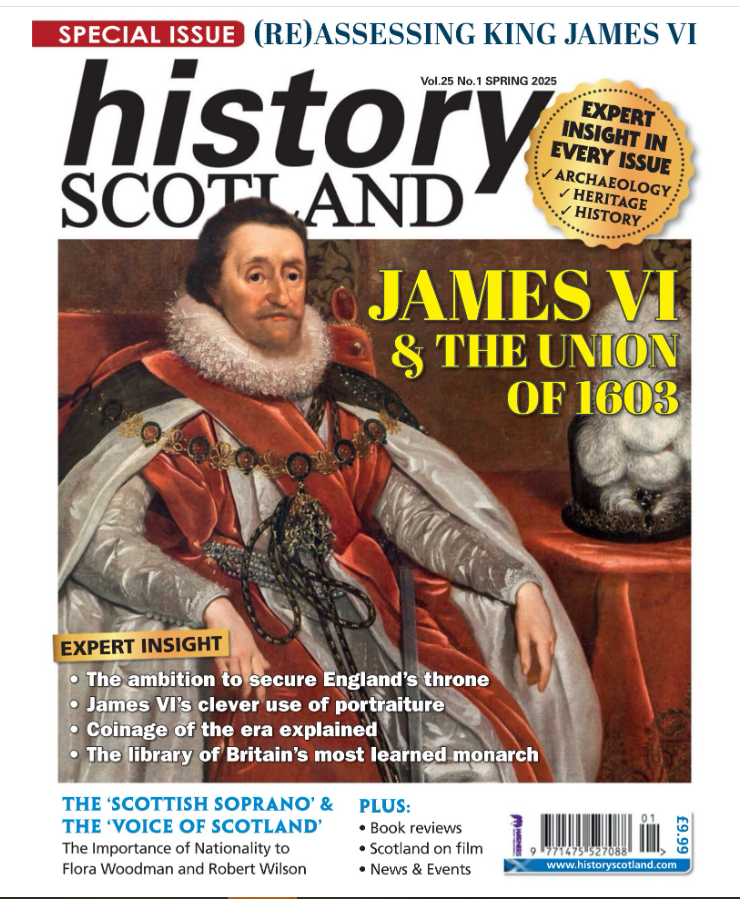
Now published in History Scotland, Spring 2025: The ‘Scottish Soprano’ and the ‘Voice of Scotland’

The Scottish Clans Association of London badge, on background of Mackinnon tartan

Sadly, this is the last issue of History Scotland, but I’m very pleased to have an article published there. I have really enjoyed writing this, and I think my idea of comparing two very different Scottish singers has actually come together rather well.  I wanted to write about Robert Wilson, but I didn’t want to go over the same ground that has already been covered.  I also wanted to write about Flora Woodman – but would anyone remember her? Then came the inspiration: what if I wrote about them both, two almost contemporary but very different celebrities, and then I could compare them.  This hadn’t been done before! And it worked  – the piece almost wrote itself.

Karen E McAulay, ‘The ‘Scottish Soprano’ and the ‘Voice of Scotland’: the Importance of Nationality to Flora Woodman and Robert Wilson’, History Scotland Vol.25 no.1 (Spring 2025), 74-81

If your public library has e-magazines, you’ll be able to read it online. Glasgow Life certainly has it!

Flora Woodman – photo and compliments, 25th October 1924

A Gift Idea? A Social History of Amateur Music-Making

Stumped for a present for your Scottish music enthusiast? My new book is affordable as an e-book! (Just sayin’ …)

A Social History of Amateur Music-Making and Scottish National Identity: Scotland’s Printed Music 1880-1951

Why did Scottish music publishers produce so many songbooks and dance tunes? Who took Scottish music overseas to the diaspora? How did classical composers interact with local publishers?

I’ve discussed all this and more. Full details on the publisher’s page, link above.

Monday 11th November: Exchange Talk & Book Launch

Venue: Royal Conservatoire of Scotland,  Glasgow

Please watch this space!

On Monday 11th November at 6 pm, I’m giving a talk in the well-established and popular RCS Exchange Talk series, where scholars talk about their latest research. I’ll be talking about a song book compiled for the Festival of Britain:-

The Glories of Scotland in Picture and Song: compiling a book with the 1951 Festival of Britain in mind

It’s in the Fyfe lecture theatre. There will be ONLINE BOOKING for this lecture. This will be the link:- https://www.rcs.ac.uk/whats-on/exchange-talk/book/507006/

At 7 pm we’ll have the launch of my new book, in the library. No online booking for the book launch, but if you’re hoping to attend, please do let me know, so we have an idea of numbers.

You can attend both, or either event.

McAulay,  Karen E., A Social History of Amateur Music-Making and Scottish National Identity: Scotland’s Printed Music, 1880-1951 (Routledge, October 2024) 🎶

A book is born

The Sweetest Words (to an Author)

I just received an email containing the sweetest words!

“We will proceed with the final production and notify you when the book is delivered from our end.”

Does this mean – the End is Nigh?! (As far as my second monograph goes, at any rate!)

I knew there was this vast mass of cheap, popular music books, many containing what used to be called ‘national songs’, dating back to the late 19th century and the first half of the 20th. I decided a book needed to be written, and wrote it. I can’t wait for it to make its entry into the world!

Most Memorable Scottish Songs Today (Library Perspective!)

Preparing for my Good Morning Scotland interview the other day, as I mentioned, I drew up something halfway between a mind-map and a spreadsheet to clarify in my mind how old the songs were, and who they were associated with. I had also – ever the librarian – looked up which of the Whittaker Library songbooks actually contained the songs in question. I wasn’t looking for every copy we had, just a rough overview. I thought you might be interested to see what our library patrons have access to. 

It is significant that there are only two genuinely old songs – the last two, by Sir Walter Scott and Robert Burns. Otherwise, they’re popular songs that are Scottish, but folksongs? Not exactly traditional or old, but certainly much beloved today. So, will there still be popular songs in fifty years’ time? Yes, of course – but maybe they haven’t even been written yet! 

Here is the list – in order of popularity – that Visit Scotland compiled from their recent survey:-

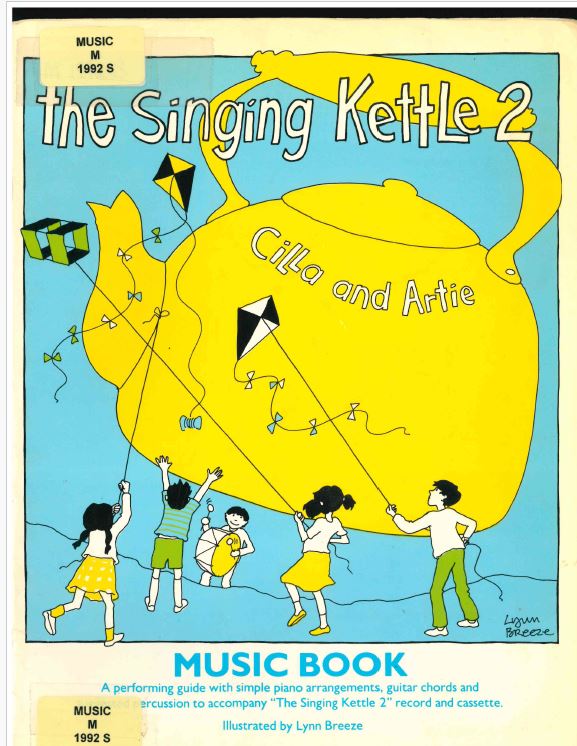
The Singing Kettle, book 2
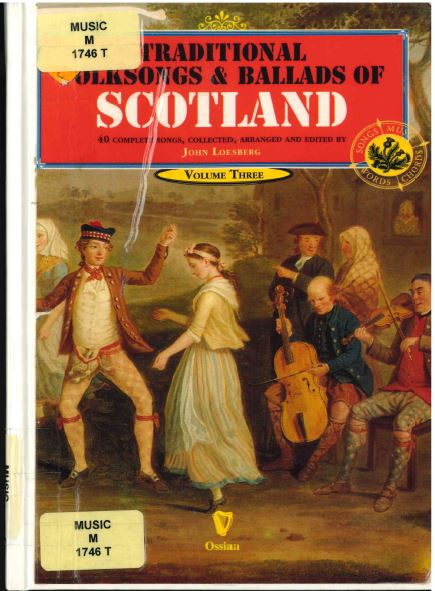
  1. You cannae shove yer grannie aff a bus – it’s in Cilla Fisher and Artie Tresize’s second Singing Kettle music book (1989). Also in Ewan McVicar’s One Singer, one Song (1990) and his Scottish Songs for Younger Children (a words-only book, 2002); and in Traditional Folksongs and Ballads of Scotland Vol.3 (1994).
  2. Donald, where’s your Troosers? Sung by Calum Kennedy and published by our friends Mozart Allan in 1959, and by Andy Stewart, published by Kerr’s in 1960. We listened to Andy’s rendition at home last night – and it still makes us laugh.
  3. Coulter’s Candy – (hint: it’s pronounced ‘Cooters’) in Singing Kettle [book 1]; Katherine Campbell and Ewan McVicar’s Traditional Scottish Songs and Music (St Andrews: Leckie & Leckie, 2001); and Ewan McVicar’s Scottish Songs for Younger Children.
  4. Wee Willie Winkie – I know it, and we have it in the library, but not in the version I know!
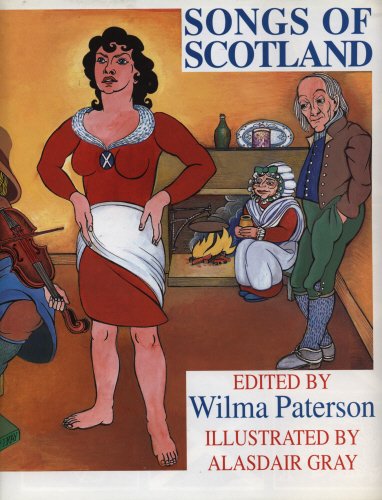
  5. Skinny Malinky – in Wilma Paterson and Alasdair Gray’s Songs of Scotland (1996)
  6. Three Craws – in the second Singing Kettle book; and Jimmie McGregor’s Singing our Own (1970)
  7. The Jeely Piece Song – the library has Adam McNaughtan’s CD, The Words that I used to know (Greentrax, 2000). It’s also known as The Skyscraper Wean and can be found in Morag Henriksen and Barrie Carson Turner’s Sing Around Scotland (1985).
  8. Bonnie wee Jeannie McColl – first sung by Will Fyffe in 1929, and more recently by the Alexander Brothers, it appears in 100 Great Scottish Songs (Dublin: Soodlum,1986)
  9. An oldie: Walter Scott’s, Scots wha’ ha’e – it’s in many, many collections! I found it in Traditional Folksongs and Ballads of Scotland Vol.3; and Wilma Paterson’s Songs of Scotland.
  10. Another oldie; Robert Burns’s My heart’s in the Highlands. People probably know the version sung by Karine Polwart in 2001, and Fara in 2014. There are much earlier versions in printed books, of course, but I suspect not what today’s enthusiasts are looking for!

This is a YouTube link to Karine Polwart’s, ‘My heart’s in the Highlands.

Wilma Paterson’s Songs of Scotland, illustrated by Alasdair Gray
Traditional Folksongs & Ballads of Scotland Vol.3

Folksongs: did they Grow, or were they Made?

I was being a dutiful music librarian yesterday, when I looked up the Tonic Sol-Fa proponents John Curwen and his son J. Spencer Curwen, to see what of their output was in the Conservatoire library. My first shock was discovering that we had catalogued a couple of Mrs J. Spencer Curwen’s piano teaching books under her spouse’s name. (The horror!) Having righted this wrong – with apologies to her memory* – I thought I’d glance at J. Spencer Curwen’s Folk Songs of Many Lands, published by the family firm in 1911. We had access to an electronic version in the library, but I borrowed the hard-copy to bring home and examine more closely in my own time.

What am I always saying about the prefaces of these books being the most fascinating aspect of this genre? I was enthralled immediately!

Folk Songs of Many Lands, collected by J. Spencer Curwen; words by Florence Hoare [et al]; accompaniments by Percy E. Fletcher (London: Curwen, 1911)

Let me share the bulk of this preface with you, to show you what I mean. (It’s okay – J. Spencer Curwen is well out of copyright!) One of my own bêtes noires is the idea that a folk song could have just arisen out of thin air or been collaboratively crafted by multiple people – I’ve always felt this denies the very fact that someone, somewhere, had the idea and developed into a song, no matter how many iterations it subsequently goes through, so I quite liked how this compiler starts his preface:-

‘A Conscious or Unconscious Artist’

‘There has been a good deal of discussion lately as to the nature of a folk-song.  Is it a song of “communal origin” built up by a succession of singers, originating nowhere, bearing no name, impersonal and evolved? Or is it any popular song that has staying power, that has been in the mouths of the people for say a hundred years, a song that is simple and artless, but which, whether a name is attached to it or not, was undoubtedly first the work of a conscious or unconscious musical artist?’

Curwen says he has,

‘[…] never found a statement of the “evolved” origin of the folk-song such as is upheld […] by some collectors in England.  The only place [he has] discovered this idea is in a work of fiction, the popular little German story “Immensee”, by Storm.  One of the characters in this book, after singing a folk-song and being asked who wrote it, says of folk-songs generally:-

[Here it is quoted in German, before the quote is translated.]

“They are not made; they grow, they fall from the air, they fly over the country like gossamer-threads, hither and thither, and are at once sung in a thousand places. We find in these songs our inmost deed and suffering; it is as if we had all helped to make them.”

Curwen does not hold with this idea, and says it finds a parallel with the remark of the little enslaved girl in Uncle Tom’s Cabin:-

‘Topsy, as we all know, grew, she was not made.’

(In the story, Miss Ophelia tries to explain the idea of the Christian God to Topsy, asking the little girl if she knew her creator, and Topsy’s answer was, ‘I ‘spect I growed.  Don’t think nobody never made me.’ So now we know that Curwen has either read Harriet Beecher Stowe’s already nearly sixty year-old bestseller, or he’s just using an expression that has entered common parlance. I myself have often read that something ‘like Topsy, just growed’, but I didn’t realise where the phrase came from! Must get round to reading that book, a new edition already sitting on my bookshelf.)

So Curwen continues,

‘And this is like Storm’s folk-song.  I do not know if this pretty idea will help the case for those who talk of “communal origin.”  But of one thing I am sure.  The charming melodies in this book […] are the works of men and women who, whether they knew the fact or not, were artists.  These tunes were composed for the people, not by the people.  The idea that from an amorphous condition these melodies were gradually moulded into shape by being handed from one untutored singer to another is to me unthinkable.’

So far, so good. But I disagree with Curwen’s next comment!

‘Deteriorates’?!

‘Popular use deteriorates melodies, it does not shape them.’

Says who, Mr Curwen? Says who? We want the tunes to be popular and used – we can’t actually stop little changes creeping in! Nowadays we tend to accept that there may be variants to a tune. I personally don’t get upset about it, though there will always be some who try to establish which is the ‘best version’.

At this point, Curwen turns to introduce the scope of the songs in his book and their national characteristics, concluding by pointing out that it contains no British or Irish songs, as they already appear ‘in so many collections’.  He is so right there! Dozens and dozens of collections.

The songs are arranged for two voices. There were two editions, one wholly in staff notation with piano accompaniment, and the other purely a vocal score with staff and sol-fa vocal lines.  (Our library copy came from Bayley & Ferguson’s shop in Queen Street, Glasgow – where else? Just round the corner from the old Athenaeum building, as it happens – it didn’t travel far.) Many of the English texts are by Florence Hoare, though she is not the sole lyricist.  A couple do also have their original language verses at the bottom of the page.  There are very few annotations, of the most minimal kind – for example, explaining what a may-pole is. It’s a respectable looking book with decent accompaniments, providing the singing teacher was a competent pianist!

Fifty-one years later, some of the songs were set to guitar in an edition by John Gavall, Folksong and Guitar, still published by Curwen.  It says something not only for the longevity of the collection, but also for the continued belief amongst pedagogues that folk-songs really are good material for children to learn!

*NOTE. Mrs Curwen’s published piano teaching output was extensive, including pedagogical psychology as well as a highly popular piano method. Another woman who certainly made a name for herself!

Cover image by Ghislain from Pixabay

Thistle image by 51581 from Pixabay

Celebrating Milestones

I’m sure I’m not alone in wanting to buy myself something to mark a significant milestone – admit it, you do it too! Getting my second book submitted on time was certainly an important occasion for me. So, too, was commencing my Fellowship at St Andrews.

My gaze strayed to my eBay ‘Watch List’! I had ‘liked’ a lot of items. Some of them might, arguably, have been even more useful a month or two earlier, but I went through that list carefully. It was all printed matter, whether music or ephemera. I made a couple of offers (one has been accepted already!), then checked I couldn’t easily access the most desirable of the other publications some other way. That still left a handful of items I could definitely justify getting!

They will all be useful in the research I am now embarking upon – an extension of one particular aspect that enthralled me in my book project.

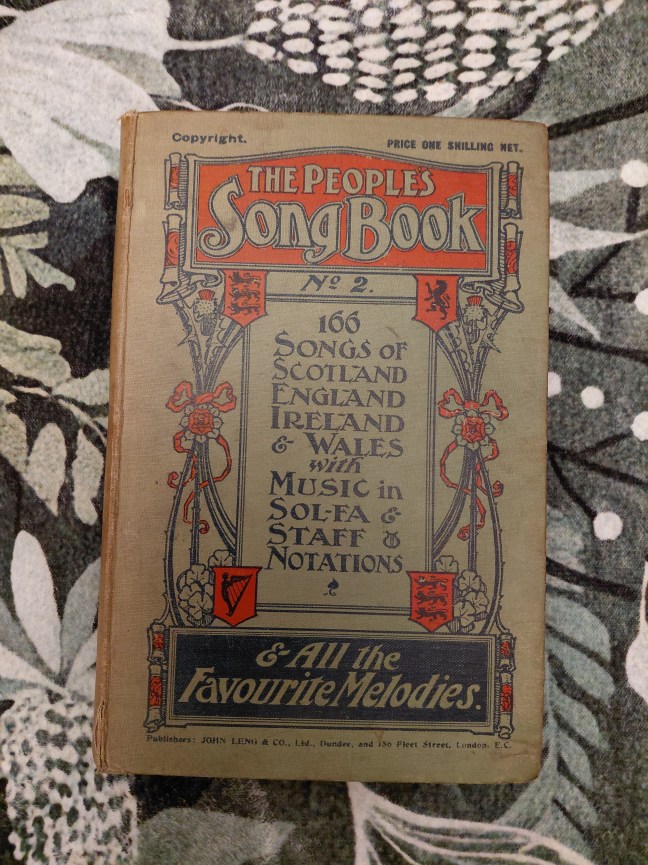
But one particular songbook – which I resolutely did not buy during the book-writing – sneakily snuck into my shopping basket! I had been telling it all along that it couldn’t be included, since it wasn’t published by a Scottish publisher. But although my specialism is Scottish music, there’s nothing to stop me buying something published by a contemporary English firm. And it is very pretty, as well as not being expensive! I’ll show you when it arrives.

Indeed, there are several English-published titles by ‘my’ Scottish educationalists that I now need to examine alongside the things they published in Scotland! But there’s a difference between treating myself and going overboard, so I deferred looking for those until another time. There will be library copies of quite a few of them.

Now, how do I explain the postie paying us more frequent visits for the next week or so?!

Image by Petra Reuter from Pixabay