What do you know? I’m delighted to discover that my article is February Article of the Month in vol.56 of the RMA Research Chronicle!


Dr Karen McAulay explores the history of Scottish music collecting, publishing and national identity from the 18th to 20th centuries. Research Fellow at Royal Conservatoire of Scotland, author of two Routledge monographs.

What do you know? I’m delighted to discover that my article is February Article of the Month in vol.56 of the RMA Research Chronicle!

Remembering my fruitful walk on 3 January 2023, I looked outside today – yes, the third of January again – saw the sun shining (athough the temperature was literally freezing out there), and decided to go on another research-and-exercise outing. What could possibly go wrong?
I’ve been exploring the story of a Victorian Glasgow music professor, so I headed for St George’s Cross by subway, to see a former church where he had once been organist. He had started his tenure in an earlier building, which was burned down in a fire, but a new one was built in a mere two years, so he must have resumed duties at that point. I already knew that, as with organist Maggie Thomson’s Paisley church, this Glasgow church had likewise now been converted into rather classy flats.
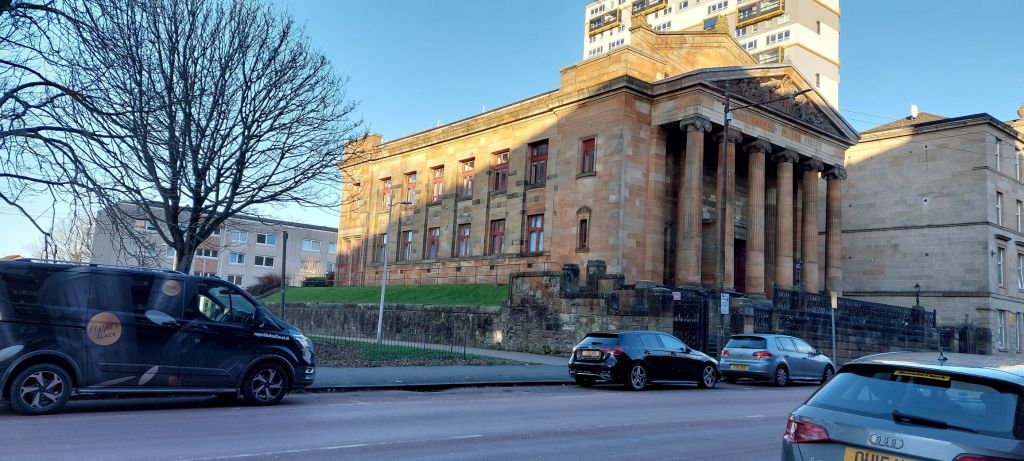
Unperturbed, I headed next to the Mitchell Library, and up to the fourth floor where the old music card catalogue lives; it has never been digitized. This eminent individual certainly composed enough, but mostly in a light-music vein, and not published by any of Glasgow’s bigger music publishers. However, I was still surprised to discover that he is completely unrepresented in the card catalogue.
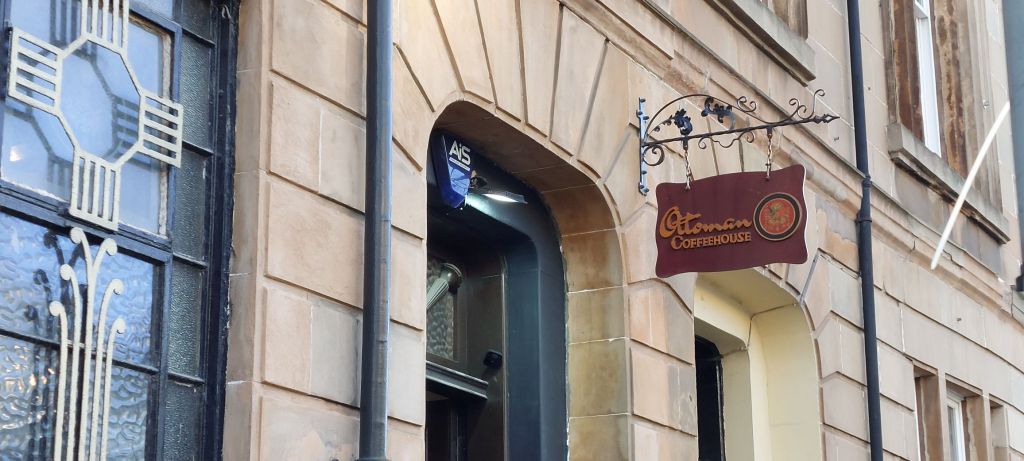
To drown my sorrows, I headed next to a celebrated Turkish coffee shop in Berkeley Street. (The premises had once been a club for Glasgow musicians, and our hero had been included in a song-book that they sponsored; clearly I needed to have a coffee there in his honour.) Foiled again! There was a queue out to the pavement, just to get inside the cafe. Back I went to the Mitchell Library cafe, to get my coffee more quickly!
It was still bright and sunny outside, so my next port-of-call was India Street (on the opposite side of the M8, near Charing Cross station). This had been both of professional significance and latterly home to our hero, and although I knew modern developments had taken place, I still hoped that I might be able to walk the length of the street. Thwarted! Scottish Power sits squatly and solidly across the line of the road, and pedestrian access is blocked by ongoing building works before you even get to it.
I could have headed into the city centre to gaze at the Athenaeum, but I’ve passed it hundreds of times, and there are plenty of pictures on the web – it wouldn’t have felt like much of a discovery. Sighing – for the mere glimpse of a road sign at the wrong end of India Street had not exactly thrilled me – I headed for the bus home.
But fate had one more twist for me: whilst I was looking on the travel app to find out when the next bus was due …
… the next bus sailed past my stop.
I decided that maybe walking briskly to the Subway would be quicker than waiting for another bus. At least the Subway dates from the era when our hero was in his prime and doing well.
‘How did you get on?’, I was asked, when I got back home. I was forced to admit that, apart from St-George’s-in-the-Fields, I had really seen virtually nothing.
On the plus side, my FitBit is as happy as Larry. Finally, it said, she has realised that Christmas is over, and it’s time for the healthy living to resume!
Followers of this blog will already know my penchant for anniversaries. This festive season, I’ve decided to indulge myself – and you, dear reader – with the kind of trivia that doesn’t make it into my research writing.
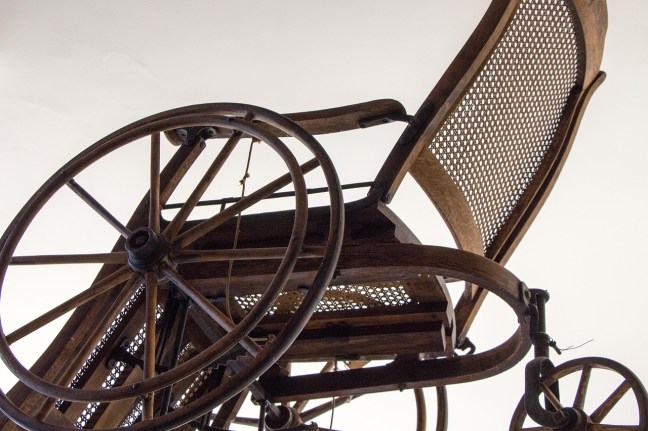
90 years ago today, Thomas Nelson editor Richard Wilson was languishing in hospital. (On Boxing Day – how miserable!) His daughter had been handling his correspondence whilst he was ill, so he could keep in contact with his boss. But by Boxing Day, he’d been able to check the page proofs of the Music Guide (a teaching manual) from his hospital bed.
Now, I know he was a dedicated soul – but I also know that the series editor (not his boss) of the teaching series, ‘Music Practice’, was agitating to get these books published as soon as possible. Sooner, if at all feasible!
Let’s hope Wilson’s efforts didn’t delay his recovery …

It would be remiss of me not to point out that Routledge’s Black Friday sale makes the e-book version of my book very affordable! (Maybe someone might even buy you it for Christmas?).
Those preferring to read a hard copy might point out to their library that there’s no time like the present…
Its forerunner, Our Ancient National Airs, is also in the sale.
There! Your Christmas reading is sorted.

I don’t often sign up to webinars, but something so closely aligned to my own current research was irresistible.
The History Scotland webinar series is promoted by the History Department at the University of Dundee. The guest speaker today was Dr Michelle Moffat of Manchester Metropolitan University.
And what did I learn? Leisure pursuits didn’t stop in wartime, especially going to the cinema. This is worth knowing. (However, I must be careful not to assume things were exactly the same everywhere. It makes me wonder about central London, for example, where people might have felt more threatened. )
There was also interesting detail about rationing and food shortages, and discussion about how much people in Scotland felt the war was ‘their’ war. (I suspect anyone who had relatives fighting overseas would very much have felt indirectly part of it.)
And a reminder about the Mass Observation Archive. I had forgotten about this, but it’s a crucial resource – I’m going to check it out with some questions that I hope it might help with!
Writing a second book has felt quite different from the first time round. The first one developed out of my PhD, so I had my supervisor supporting me as I wrote the original thesis.
But this one? All my own, unsupervised work, arising originally from the thought that someone really ought to write a book about the music published by Scottish publishers in the late Victorian era and the early twentieth century. No-one had written one, so I researched and wrote it myself. I was grateful for my peer-reviewers’ feedback on the first draft, and I know that the final product benefited from the subsequent edits that I made during my Ketelbey Fellowship at St Andrews.
This time, I did my own indexing, too. That was a new experience for me.
Now, to start planning a book launch! Watch this space – I have an idea. Provisional date Monday 11th November, but the details have yet to be finalised!

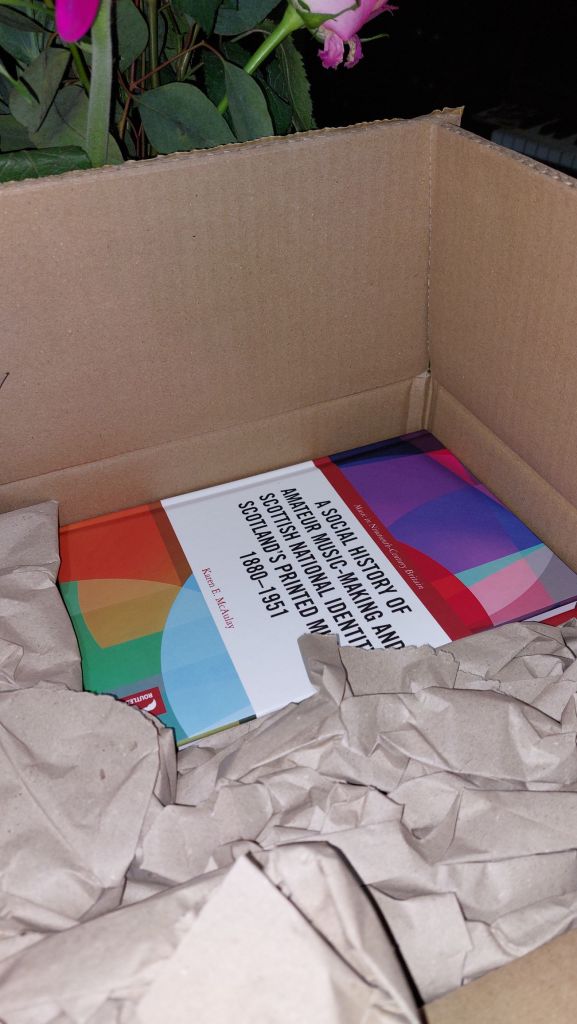
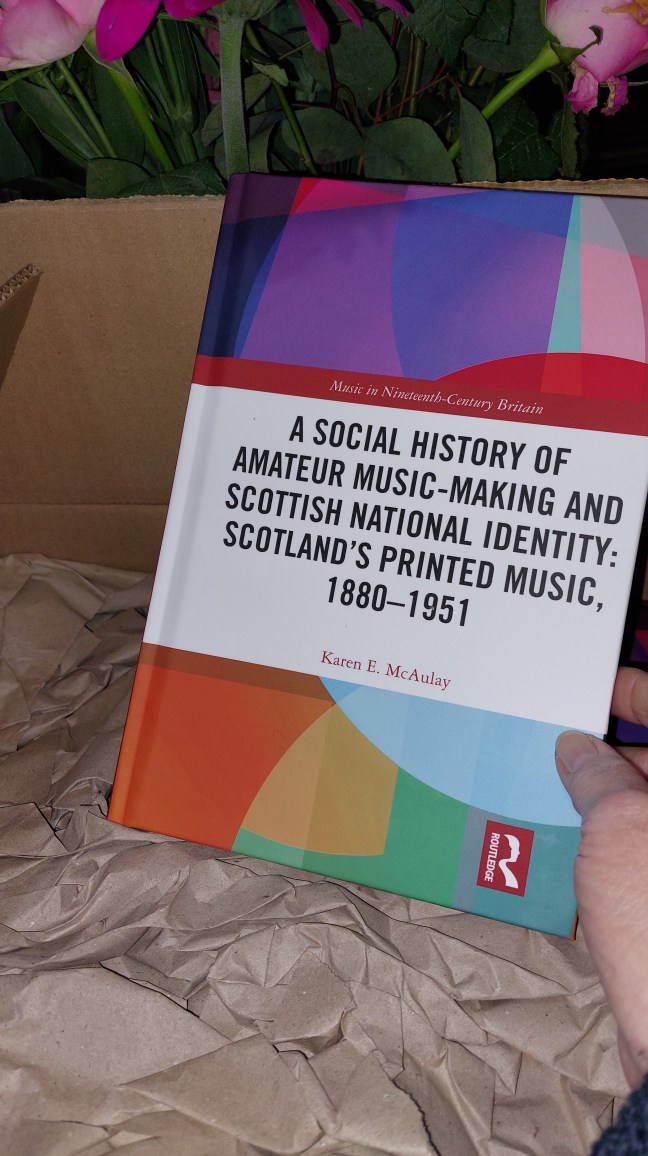
Friends, my forthcoming book, A Social History of Amateur Music-Making and Scottish National Identity: Scotland’s Printed Music, 1880-1951, can now be ordered!

It’s a proud day – I’m so excited. (Amazon even recommended it to me the other day, which I found quite amusing!)
(from the book – and the Routledge website)
(again, from the Routledge website)
Late Victorian Scotland had a flourishing music publishing trade, evidenced by the survival of a plethora of vocal scores and dance tune books; and whether informing us what people actually sang and played at home, danced to, or enjoyed in choirs, or reminding us of the impact of emigration from Britain for both emigrants and their families left behind, examining this neglected repertoire provides an insight into Scottish musical culture and is a valuable addition to the broader social history of Scotland.
The decline of the music trade by the mid-twentieth century is attributable to various factors, some external, but others due to the conservative and perhaps somewhat parochial nature of the publishers’ output. What survives bears witness to the importance of domestic and amateur music-making in ordinary lives between 1880 and 1950. Much of the music is now little more than a historical artefact. Nonetheless, Karen E. McAulay shows that the nature of the music, the song and fiddle tune books’ contents, the paratext around the collections, its packaging, marketing and dissemination all document the social history of an era whose everyday music has often been dismissed as not significant or, indeed, properly ‘old’ enough to merit consideration.
The book will be valuable for academics as well as folk musicians and those interested in the social and musical history of Scotland and the British Isles.

Unless you’re Scottish, you may not have come across Clifford (Cliff) Hanley. He was a Glasgow journalist, writer and sometimes lyricist, born in 1922 and dying in 1999. Dancing in the Streets was first published by Hutchinson in 1958. My own eBay copy is a 1983 reprint by Edinburgh’s now defunct Mainstream Publishing. Amusingly, it came secondhand all the way from a library in Ilford, Essex!
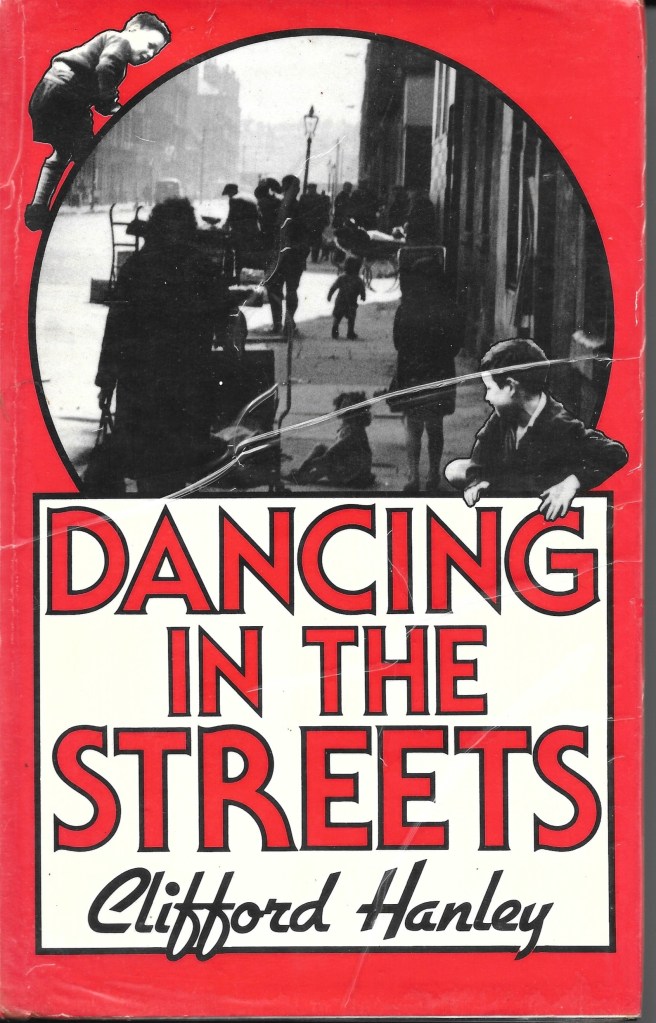
On the second day of my indisposition with Covid, I picked it up, decided that even Glasgow autobiography and social history was beyond me, and turned to Audible. Don’t judge me! But yesterday and today, feeling closer to my normal self, I picked it up again, and read the whole thing cover to cover. This is a man who knew Glasgow inside out, as a local journalist. (You’d like to read his obituary, maybe? Here it is in The Guardian, 14 August 1999.)
Hanley wrote well, and entertainingly. There’s lots of local colour – not to mention wee reminders that times have changed since then. (Go to a party on the night your wife’s in hospital having your firstborn? I think not! I imagine husbands weren’t allowed in the delivery room in those days, but this is still barely a mitigating factor!)
I bought Dancing in the Streets in the hope of tracking down some elusive information – which I didn’t find, as it happened. (It was, admittedly, a long shot!) However, I did recognise names that I’d already encountered, and I was to discover different gems that filled me with some excitement, because odd little passages foreshadow things that I, as an incomer to Glasgow, had later discovered through diligent research, and these convinced me that what I have written in my forthcoming monograph is certainly born out by someone who was actually there in inter-war and postwar Glasgow. I’m quite glad I hadn’t read it until now. It’s useful background, but it’s not on the subject of Scottish music publishing or amateur music-making, so I don’t feel I was negligent in not considering it earlier. However, in bearing out truths that I had to learn the hard way, there were several ‘Yes! See? That’s what I found!‘ moments, amongst the laughs that I couldn’t stifle between coughing!
For example –
Hanley took a holiday job on a cattle-ship from the Clyde to Montreal, as a very young teenager. On page 95 of his book, he meets some Glaswegian expat women there:-
‘How is Argyle Street, son?’ one of them asked kindly. ‘Fine – still the same, big crowds on a Saturday night an’ buskers playin’ the flute.’ ‘Oh, my God!’ She started weeping, but took a hold of herself. ‘It’s that nice tae hear a good Scotch voice. Could you no’ take me hame on your boat, son?’ ‘I wish I could’, I said in desperate pity. ‘Ah know, ah know, son, ah wish you could tae. Don’t you ever leave your hame, son, it’s the best place in the world. Ah wish tae God ah had never left dear auld Glesga.’
You can see how sentimental old (or more recently manufactured) Scottish songs would go down well with such fond emigrants!
I have certainly not suggested that the folk revival started, like flicking on a light switch, in a certain year, but I have highlighted new trends, and the influence of Edinburgh University’s new School of Scottish Studies. It’s fair to say that Hanley was not in this new movement. On the contrary, he seems to be poking gentle fun at it, on pages 208-10 of his book. At the abovementioned party, he describes an actor who ‘wanted everyone to sing folk songs, or Hebridean mouth music’, and a girl who was a potter, who wanted to ‘dance some kind of reel in her bare feet’. Later, she was ‘doing something stooping down and stamping, which apparently was meant to represent walking [sic] the tweed’.
Clifford and the potter were both, I’m afraid, wrong. The word is ‘waulking the tweed’ and Hebridean women used to thump urine-soaked cloth on a table, to soften it. Yes, I know – it sounds gross, put that way! (Feel the same about your genuine old Scottish tweed now?) Anyway, here Clifford has encountered one individual who is more aware of the new trends, and another who has a vague delusion that she understands it! Neither are seen as kindred spirits. Hanley wrote for a living, including the aforementioned song-lyrics, and had occasionally dabbled in performing on stage and radio. Probably a little younger, these partygoers were not part of his usual scene at all.
And on page 242, Hanley writes about the decline of variety theatre, about teenagers’ musical tastes, and a new preference to listening to music at home on gramophones rather than go out to a variety show.
So, unexpectedly, reading this book came as welcome vindication for some of the points I’ve made – a feeling which is always nice, of course. It’s hardly surprising that a book like this actually functions as useful background reading for a study in popular musical culture. But it also came as a welcome reminder that sometimes there’s benefit in stepping back and reading more widely. A book doesn’t have to be a scholarly tome – no index or bibliography here – to contain worthwhile background information. Information, in fact, that I wouldn’t even have recognised as valuable before I embarked on my research, but which came as validation of the most welcome kind.
My own book’s been copy-edited, the proofs have been corrected, and it’s well on its way to being published. I believe orders can be placed at the end of October. But for now, you might just find me heading to the local library to see if I can pick up anything else by Clifford Hanley. You can get Dancing in the Streets very cheaply secondhand, if you’d like to read it for yourself.
 Karen McAulay, Musicologist