‘Dr Karen McAulay of the Books’ – by Dr Karen Marshalsay

Karen Marshalsay's album, The Road to Kennacraig

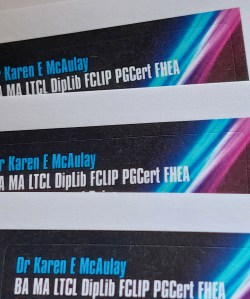
When my first book was published in 2013, my dear friend clarsach-player and composer Dr Karen Marshalsay played at the book-launch, performing a tune that she had written especially for me. ‘Dr Karen McAulay of the Books’ has been included in Karen’s album, The Road to Kennacraig – you can hear the tune here.

Karen’s playing ‘my’ tune at a gig in Crail on 18th February 2023 – clarsairs have a much more interesting and varied existence than librarians! – but I’ll have to content myself with listening to my CD or the digital rendition. I feel very privileged to have a tune named after me.

My Own Domain!

Quick update – you can now find this blog at KarenMcAulayMusicologist.blog. No adverts, and an easier hyperlink to remember. After all this excitement, I’ll go and put the kettle on. (We musicologists know how to enjoy ourselves!)

Now you See it, Now you Don’t: the British College of Music

I was just tidying up some loose ends in the chapter I’ve been writing. There was a music professor called John Greig who looked after things at Edinburgh University in between Reid Professors. Friedrich Rieck got the job – Greig didn’t. Within a decade the press was reporting his taking up an organist post in London. Then acting as an external examiner for the London College of Music, and finally principal of his own college – the British College of Music – in 1908. He died within a couple of years of opening it, having funded it largely out of his own pocket, but with a handful of shareholders holding a tiny fraction of the shares.

A contemporary magazine said it was just a money-spinning exercise. Okay, but it did advertise from time to time, notwithstanding Greig’s demise, so it clearly continued at least a little while. I also found reference in an Australian source, suggesting it was went on being a money-spinner for a while.

Here’s the thing: on the face of it, it appears still to be offering music exams to this day. I found reference to a modern professor in the UK, who offers masterclasses to students wishing to take ‘British College of Music exams’; there’s even a masterclass coming up in Ochanomizu, Japan this month (February 2023). However, I suspect that the professor actually means ‘exams offered by British music colleges’ rather than an institution by that name. Capital letters and word order make such a difference!

I don’t really mind. It has absolutely nothing to do with my research, and I stopped before I fell any further down the Alice-in-Wonderland-type rabbit hole. Anyway, I don’t need to mention the institution in a book about Scottish music publishers!

Review: George Kennaway, John Gunn: Musician Scholar in Enlightenment Britain

Image of book cover: John Gunn: Musician Scholar in Enlightenment Britain

My review of George Kennaway’s impressive monograph has just appeared in Brio vol.59 no.2 (Autumn/Winter 2022), pp.62-63.

Boydell & Brewer link to the book itself.

Brio is the IAML(UK & Ireland) journal – the professional publication of British and Irish music librarians.

A Good Description (Bibliographers will understand!)

Two school music books entitled "Pictures in Song"
Tonic Sol-Fa notation
Tonic Sol-Fa

My latest eBay purchase will teach me to look more closely at the photos. (Of which there were a lot, I might add.) But the words DESCRIBING the pair of books nowhere said that one was a staff edition, and the other Tonic Sol-Fa!

The cover title was correctly transcribed, although the seller hadn’t indicated that the one without the words “School edition – Staff” was, in fact, the School edition in Tonic Sol-Fa. Had I looked right through the photos, I would have got to the picture of the Sol-Fa title page and an example of the Sol-Fa itself. My mistake!

However, in this case it’s not too much of a problem – I’m more concerned with the contents of the books and their paratext, than actually playing or singing the music. And if I want to practise my sol-fa reading skills, well, I now have another book to practise with!

A Forgotten Victorian Lady Organist

I took a 2-volume book of part-songs home over Christmas, in connection with my Scottish music publishers research.

Our heroine’s church in Paisley

Just two women had contributed to the collection. Researching one of them occupied much of last week’s annual leave! But I ended up with a respectable article for a local newsletter. Not peer-reviewed, not likely to hit the headlines, but it got all my findings sorted into a narrative which I can draw upon again later. And I enjoyed my week!

Moreover, I’ve just managed to get her a mention in Chapter 4 of my book. Her brother would think this most audacious! When she got a presentation, he stood up and accepted it for her … because …..

Fearing being considered a strong-minded female!

Retrospective 2022

I still don’t know if this kind of post is helpful.  To anyone who hasn’t many/any visible outputs, reading someone else’s list of what they achieved is probably the very last thing they need to brighten their day – and I apologise.  You’ve probably achieved other, equally or even more important things, which didn’t take the form of words on a page!

From my vantage point, as a researcher who sentenced herself to a career in librarianship, not necessarily as a first choice but what seemed at the time to be a reasonable one, I look at other academics’ lists of achievements and struggle not to compare myself – although realistically I cannot achieve as much research in 1.5 designated days a week as the average full-time academic. My research line-manager is more than content, so maybe I should remind myself of that more often.

So, what have I achieved?

As a librarian, I have spoken at two conferences, a panel discussion and as staff training for another library, about EDI (Equality, Diversity and Inclusion) in our own library.  I have a paper being published in an academic journal next year, on the topic of women composers in libraries; but my proudest achievement was actually in sharing a song by a Victorian woman teacher in the junior department of the Athenaeum, that I had discovered in a research capacity, and which a singing student eagerly learned and presented as one of their competition entries in a recent singing competition at RCS.  Discovering something, having someone else declare it lovely, and hearing them perform it beautifully, is a very special privilege.

Still hatching

As a researcher, I have another paper forthcoming in an essay collection, though I can hardly list details here before it has even gone through the editorial process.  And another magazine article which has been accepted for 2024.  Can’t include that either.  Nor can I yet include the monograph I’m halfway through writing.  I’ve done a ton of work in that respect, but it doesn’t count in a retrospective list of successes!

I’ve also applied for a grant which I didn’t get, and a fellowship for which the deadline is just today, so no news on that front for a little while.

That leaves this little list, the last item of which appeared through my letterbox at the turn of last year, so I’ve cheekily included it here again.

Forthcoming

  • ‘Representation of Women Composers in the Whittaker Library’, Journal of Perspectives in Applied Academic Practice. Arises from a paper given at the International Women’s Day Conference hosted by the University of the Highlands and Islands, 2022.  Peer-reviewed and pending publication.

Arrived

  • ‘Alexander Campbell’s Song Collecting Tour: ‘The Classic Ground of our Celtic Homer’, in Thirsty Work and Other Heritages of Folk Song (Ballad Partners, 2022), 180-192
  • ‘An Extensive Musical Library’: Mrs Clarinda Webster, LRAM, Brio vol.59 no.1, 29-42
  • ‘Burns and Song: Four New Publications’, Eighteenth Century Scotland, no. 36 (June 2022),12-15.
  • ‘Strathspeys, Reels and Instrumental Airs: a National Product’, in Music by Subscription: Composers and their Networks in the British Music Publishing Trade, 1676–1820, ed. Simon D. I Fleming & Martin Perkins. (Routledge, 2022), 177-197

Meanwhile, as an organist, I’ve completed my first year in Neilston Parish Church, which has been a very healing experience.  I love it there!  This Christmas has seen three of my own unpublished carols being performed, one in Neilston and two in Barrhead; and earlier in the autumn I contributed a local-history kind of article to the Glasgow Diapason, the newsletter published by the Glasgow Society of Organists.  Another publication! Might as well add it to the list:-

  • ‘Trains, Trossachs, Choirs and the Council: Neilston Parish Church’s First Organist’, in The Glasgow Diapason Newsletter

Confession time. Sewing is my relaxation of choice, often influenced by something I’m researching. This year’s project, a Festival of Britain canvas-printed linen piece, relates to the aforementioned chapter that I’ve contributed to someone’s book.

I know I would get more research writing done if I didn’t sew in my leisure time, but I need that for my mental health. Swings and roundabouts…

Wearing my Pedagogical Librarian Hat …

I’m gratified to have an article accepted for a special issue of Journal of Perspectives in Applied Academic Practice. It arises from a paper I gave at the International Women’s Day Conference hosted by the University of the Highlands and Islands earlier this year. You won’t find the article online yet, but bookmark this space for when the special issue does appear. My guess is it’ll be in 2023.

(This is what happens when a librarian – who is also a musicologist – decides to spend a day with pedagogues for a change!)

Whose Book is it Anyway? A View from Elsewhere on Publishing, Copyright and Creativity

Sitting feeling somewhat sorry for myself with the aches-and-pains that follow a Covid booster vaccination (yes, I’m grateful really, but … owch!) – I sat bolt upright when I spotted this open access book title on social media. It looks irresistible, quite apart from the delight of finding it is free! I shall add it to our bibliography page, and find time to delve into it at the earliest opportunity. How did I not stumble across it earlier?

Whose Book Is it Anyway? A View from Elsewhere on Publishing, Copyright and Creativity, ed. Janis Jefferies and Sarah Kember. (Open Book Publishers, 2019)

All the ISBNs, and other bibliographical data are on the page I’ve linked to above.

Interdisciplinary Research, Anyone?

When I graduated with my PhD in 2009, there was a flurry of interest in me as a ‘mature’ postgraduate, and my ‘portfolio career’. There’s only one problem – it isn’t a portfolio career! I work in one place, full-time, on a full-time salary. I’m not self-employed, nor do I do a little bit of this and that for different employers. It’s correct that I spend 0.7 of my time as an academic librarian, and 0.3 of my time as a researcher. If I had any aspirations at the start of my librarianship career, it was to be a scholar librarian of some kind, and as you see, that IS where I’ve ended up. I don’t claim that it exactly reflects who I am now – in my head, I’m more scholar than librarian.

So, if I don’t consider myself a good example of a portfolio career, then here’s another conundrum: do I do interdisciplinary research? If at some times I’m writing about librarianship, and at other times I’m writing about nineteenth to twentieth-century music publishing, does that make my research interdisciplinary? I guess it probably does, even if the librarianship and the music publishing seldom meet! I’m often contemplating the social context of whatever I’m researching. And just occasionally – like my recent article about Clarinda Webster – I manage to mention librarianship, music publishing AND social history in one fell swoop.

At other times, my research finds its way into the librarianship quite naturally. This week, the RCS Library is having a series of events throwing a Spotlight on Diversity. I’ve written a short blogpost about Scottish Women Composers as one of my contributions. The names I’ve suggested are just a start – and I haven’t attempted to include every Scottish woman who wrote a tune, because I’m assuming our students are basically looking for recital repertoire. My research has led me to several more women who made their own unique contribution, but they’ll get a mention in the book I’m currently writing. Their pieces aren’t necessarily recital repertoire, or even easily sourced today.

See my Scottish Women Composers in the Spotlight library blogpost.