Dr Karen McAulay explores the history of Scottish music collecting, publishing and national identity from the 18th to 20th centuries. Research Fellow at Royal Conservatoire of Scotland, author of two Routledge monographs.
If you’ve made any kind of study of Scottish songs and fiddle tunes, you’ll know that collector Andrew Wighton (1804-1866) bequeathed his fantastic music collection to the City of Dundee. As the Friends of Wighton website says, ‘Andrew J Wighton (1804-1866) was a merchant in Dundee. He built a music collection which is now of international renown and importance. After his death, his Trustees donated the music to the then Free Library in Dundee’. The Friends of Wighton is a charity which exists to promote the collection and the performance and study of Scottish music. I’m proud to be the honorary librarian.
On 31 December 1855, Wighton’s Aberdonian friend James Davie wrote to him observing that Wighton must, by now, have,
… the finest collection of old [Scottish] music in the three kingdoms.
You only have to look at the online catalogue today to see that Davie was perfectly accurate in his observation!
170 years ago today, antiquarian ballad and song collector William Chappell sent an unintentionally incendiary letter to Andrew Wighton!
It is difficult to find really good tunes of this early date, because there is so little genuine Scotch music in print – although plenty of Anglo-Scottish.
Sparks flew in Dundee. How dare Mr Chappell suggest that much of Scotland’s song repertoire wasn’t really Scottish, but some kind of English-worked mishmash? Sparks also flew in Aberdeen, when Chappell’s song-collection was published, on account of his extensive annotations.
This is actually part of a larger story, which I explored in the final chapter of my first book, Our Ancient National Airs: Scottish Song Collecting from the Enlightenment to the Romantic Era. Chapter 8 is headed,
William Chappell, English antiquarian and song collector; author of Popular Music of the Olden Times;
Andrew Wighton, Scottish shopkeeper and song-collector in Dundee (his amazing collection was bequeathed to the city, and The Wighton Collection is now in the Central Library);
James Davie, crusty old Aberdonian musician and song-collector, fiercely patriotic and with a strong dislike of Chappell and all that he stood for;
David Laing, Edinburgh librarian, authority on Scottish literature and songs, and altogether good chap, generous in sharing his knowledge.
If you’re interested in learning more, my book is available in quite a few libraries or in paperback, e-book or Kindle format. Chappell’s collection is also readily available.
To be fair, David Baptie spoke highly of the Aberdonian James Davie, an early to mid 19th Century Scottish song enthusiast. He was a friend of the Dundonian song collector James Wighton.
However, correspondence between the two men reveals him writing sour objections to other contemporaries’ activities and opinions. I quoted some of his grumblings in my first book, Our Ancient National. Airs. I formed the impression that he was decidedly irritable in his old age!
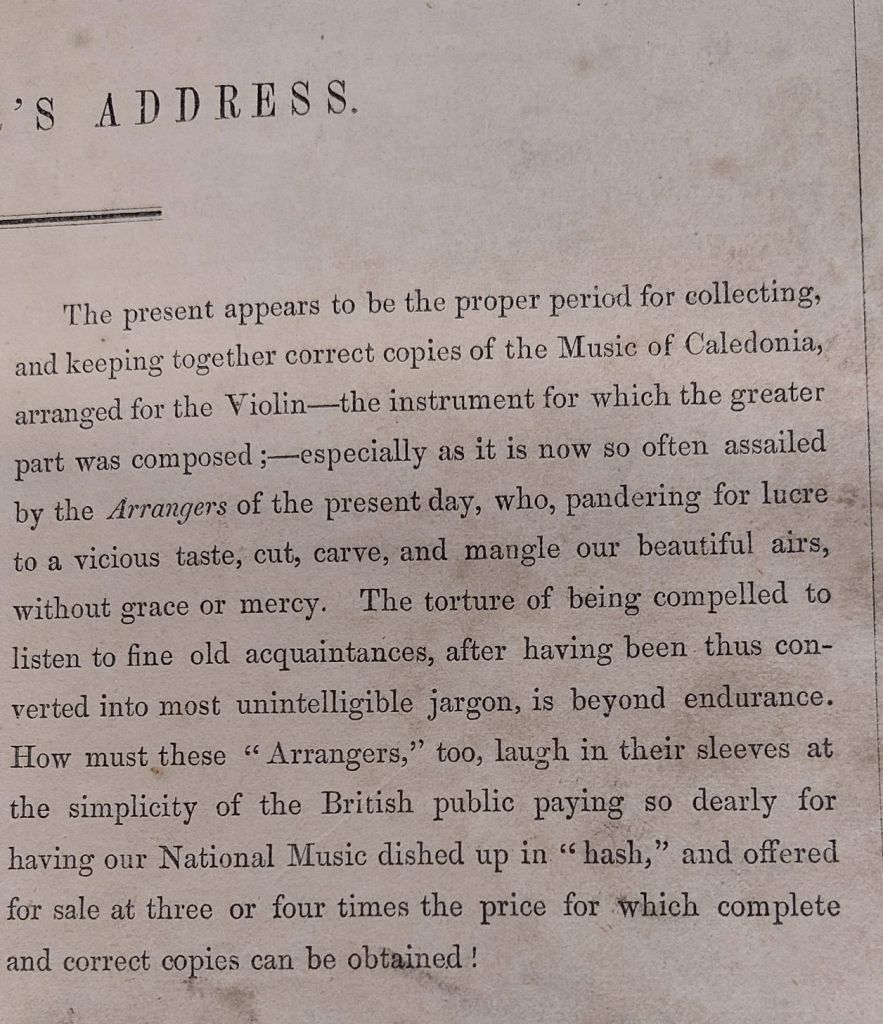
Here he is, in characteristic tone at the start of his CaledonianRepository:-
Arrangers? Pshaw!
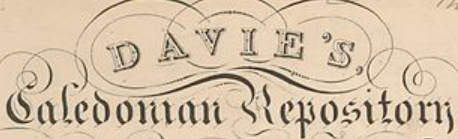
Notwithstanding this, I was excited to accession several books of this Caledonian Repository to the library, since they’re quite rare. The books are tatty and fragile, but a tangible link with the past – they’re about 200 years old.
The Repository is in two series. We have three books from the first and two from the second. Grateful that the tune contents pages were there, I sorted out which pages belonged where, then catalogued them. Oh, my fingers flew. But the last one that I managed to catalogue before 5 pm yesterday, simply didn’t want to play fair. The catalogue entry was done. But, without going into details, it wasn’t displaying properly.
I went home, had tea, opened the laptop and recatalogued that piece using the info I’d already entered.
No luck.
I removed the identifying sequential number and tried again.
Still no luck.
Maybe ‘something’ magical would happen to it overnight? It was too much to hope! Mr Davie, irascible as ever, did NOT want that book to appear properly in our catalogue.
Finally, my line-manager suggested trying to give it a different barcode. I have absolutely no idea why the system didn’t like the one I’d assigned it, but I did as suggested, and hey presto, we have Davie’s Caledonian Repository, Series 2, Book 2, properly catalogued and accessible.
So that left me with Series 2, Book 1 to do this morning. That book has all its pages, but the page numbering is, shall we say, a little quixotic. Mr Davie has had the last laugh there.
Nonetheless, we do now have all five items in the Whittaker Library catalogue. I like to think Davie would be a little bit pleased!



 Karen McAulay, Musicologist