Service of Song? (If you Know, you Know!)

If you’ve glanced at my book, you may have encountered the part where I explain  about Bayley and Ferguson and the services of song. Services of song are a virtually forgotten genre nowadays, but be assured that they were once a very common form of entertainment/instruction.

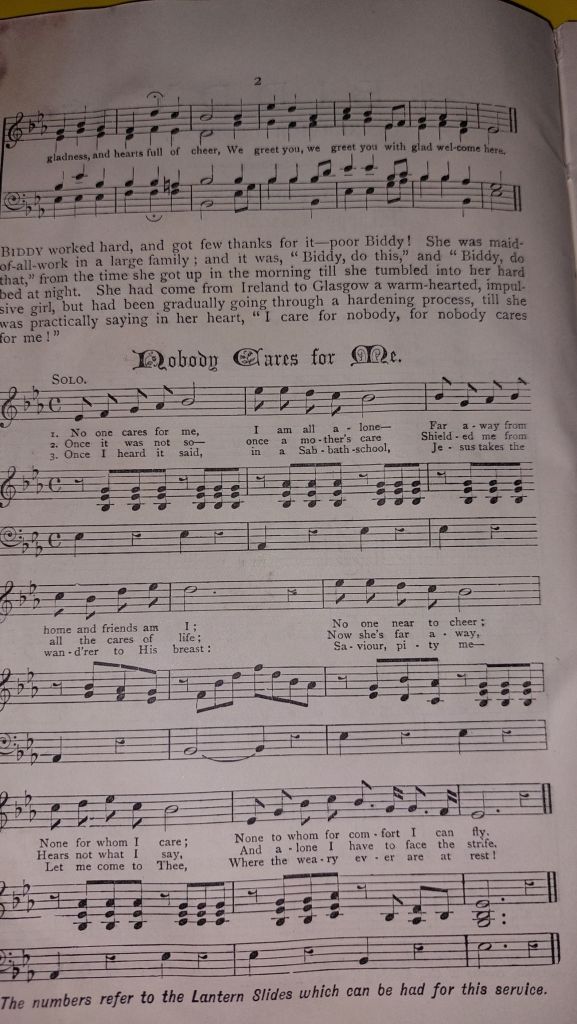
Biddy: opening piece

It’s not an abstract concept – these were a genre of magic lantern show, aimed at adult and/or juvenile audiences.  To put on a magic lantern show, you needed a few key ingredients:-

  • A venue
  • A magic lantern
  • Something to project onto
  • Set of slides
  • Something containing a narrative (for the narrator), and plenty of songs for the audience.  The music could be in Tonic Sol-Fa or staff notation (notes on lines and spaces).
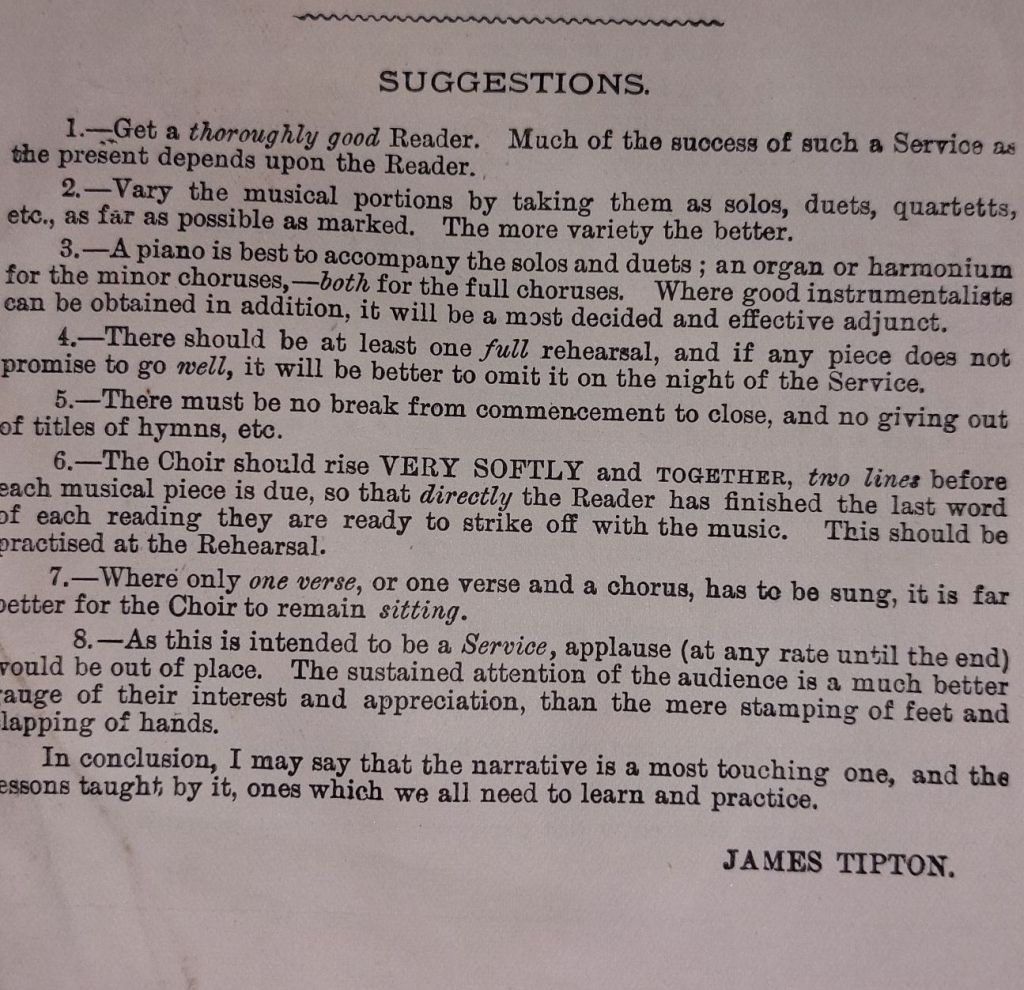
‘Get a thoroughly good Reader’

The narrative could be a biblical story or an adaptation from a moralistic story.  Or perhaps something about a poet or a place.

‘Biddy worked hard …’

Whatever, the narrative and the songs were in a wee booklet, and that was your Service of Song.  You bought multiple copies  – they were cheap!  The event itself was advertised as a service of song.

So, as you can see, a Service of Song was an early slideshow providing a variable mix of education, entertainment and religion. They were popular with Sunday Schools as a special treat, and they were often used by the temperance movement. Bayley and Ferguson published loads of them. (Organisers would have to buy or hire the slides – possibly from somewhere else.)

If you would like to know more … read the book!

Karen E McAulay,

A Social History of Amateur Music-Making and Scottish National Identity: Scotland’s Printed Music 1880-1951 🎶

Routledge, 2025.

Moving with the Times: from Magic Lanterns to Silent Movies

My new schedule entails thinking about an Edinburgh publisher whilst I’m in Edinburgh, and writing about various other aspects of my research on my Glasgow days.

I have an article I’m actively gearing up to write; another requiring tweaking; a couple more requested; and lastly, a new avenue for which I’ve identified a journal, but not yet completed the research. Quite a bit of writing!

But first, in the first article, we have the soprano and her repertoire.  And her ‘go-to’ encore.  And if you thought I got excited about magic lanterns – new technology for late Victorians – well, you can imagine my excitement at the thought that I may need to watch a silent film soon.

Why? A musicologist watching something in silence?  What does silence have to do with music (apart from John Cage’s 4’33”, of  course)?

You see, I think this film may have influenced her choice of encore. So, firstly, I’m awaiting an eBay copy of the novel on which the movie was based.  And then, I’m waiting to find out if I can watch the movie without leaving Scotland.

She wasn’t a film actress herself, so my whole quest is a bit tangential – I’m not thinking about nipping down to London unless it’s absolutely unavoidable. But I could  …

Meanwhile, I reflect that watching silent moving pictures must have been enormously exciting if you had grown up with the occasional magic lantern show.  And when, in due course, talkies came in … it’s hard to imagine how amazing that must have been.  Small wonder that printed music took a bit of a nosedive in the late 1920s – the options for entertainment outside the house were expanding all the time.

I’m eagerly awaiting news of my chances to watch this intriguing spectacle!

The Mervyn Heard Award

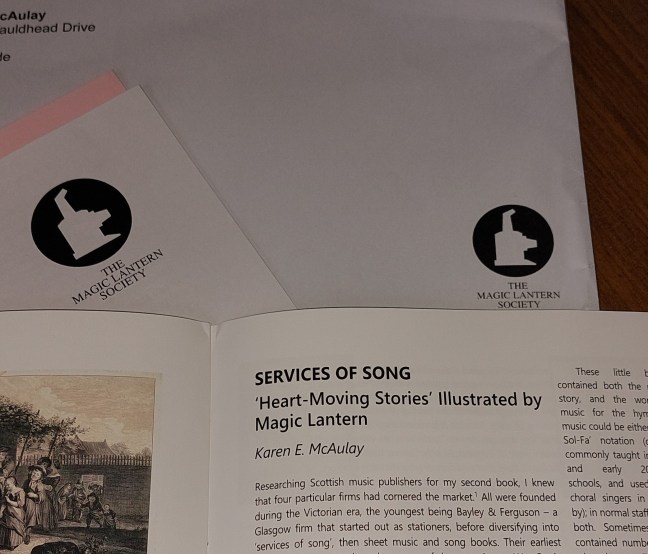
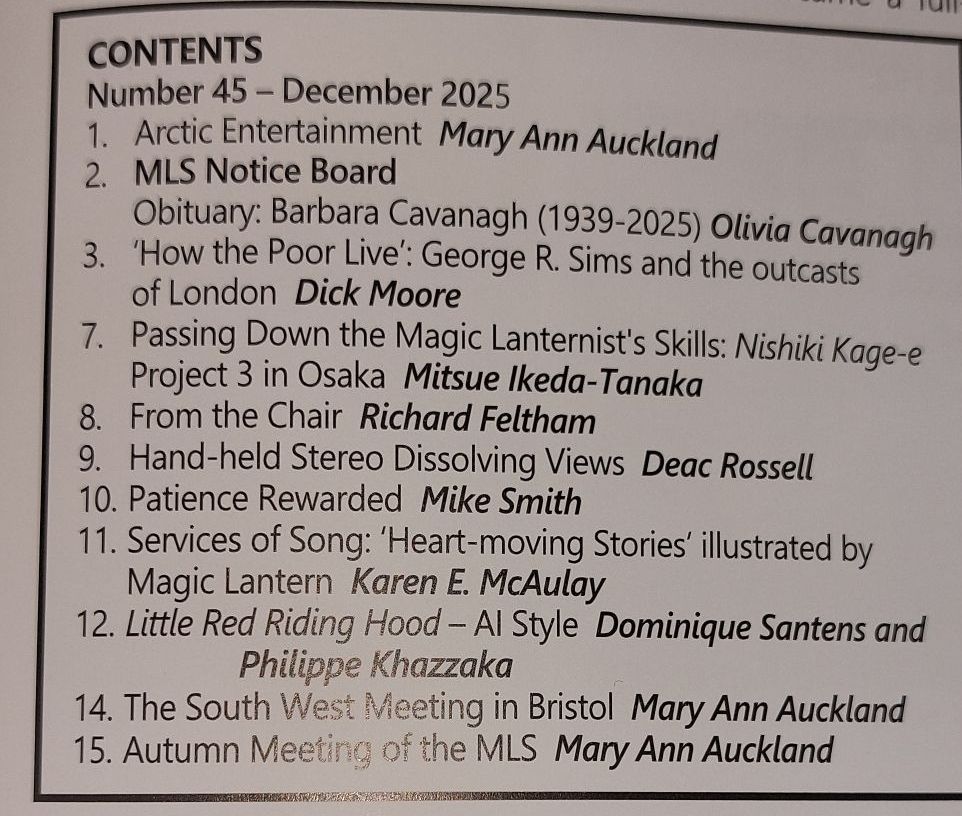
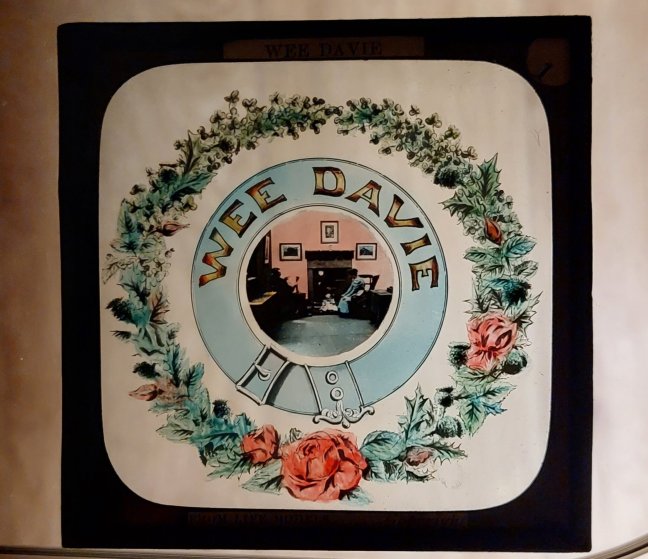
I’m honoured to have been awarded the Mervyn Heard Award by the Magic Lantern Society (UK) in recognition of my research into Scottish publishers Bayley and Ferguson’s Services of Song for magic lantern shows in the late-nineteenth and early-twentieth centuries. Their booklet, Wee Davie, containing a script for a reader, and suitably religious songs, was possibly the first thing they published – or certainly one of the first.

The Mervyn Heard Award is awarded for any written work, archival research or smaller-scale digitisation project.

I’ve talked about these service books in research lectures as honorary Ketelbey Research Fellow at the University of St Andrews in 2023, and at the Royal Conservatoire of Scotland’s Exchange Talks series. The discovery of these wee books certainly inspired me to delve deeper into the social history around amateur music-making, other entertainments and educational or religious events, so I owe a debt to the original author Revd. Norman Macleod and his moralistic story, Wee Davie, for starting me off on this particular research strand.

In due course, I’ll be writing more about this topic, most particularly for the Magic Lantern Society itself.

YouTube video of my recent RCS Exchange Talk

I’ve linked to this on my Publications page as a permanent record, but if you’re interested, you can see my talk on YouTube now:-

Engagement activity: RCS Exchange Talk, Monday 29 January 2024: ‘From Magic Lantern to Microphone: the Scottish Music Publishers and Pedagogues inspiring Hearts and Minds through Song’ – YouTube recording