My IASH Fellowship Ends …

IASH - Institute for Advanced Studies in the Humanities

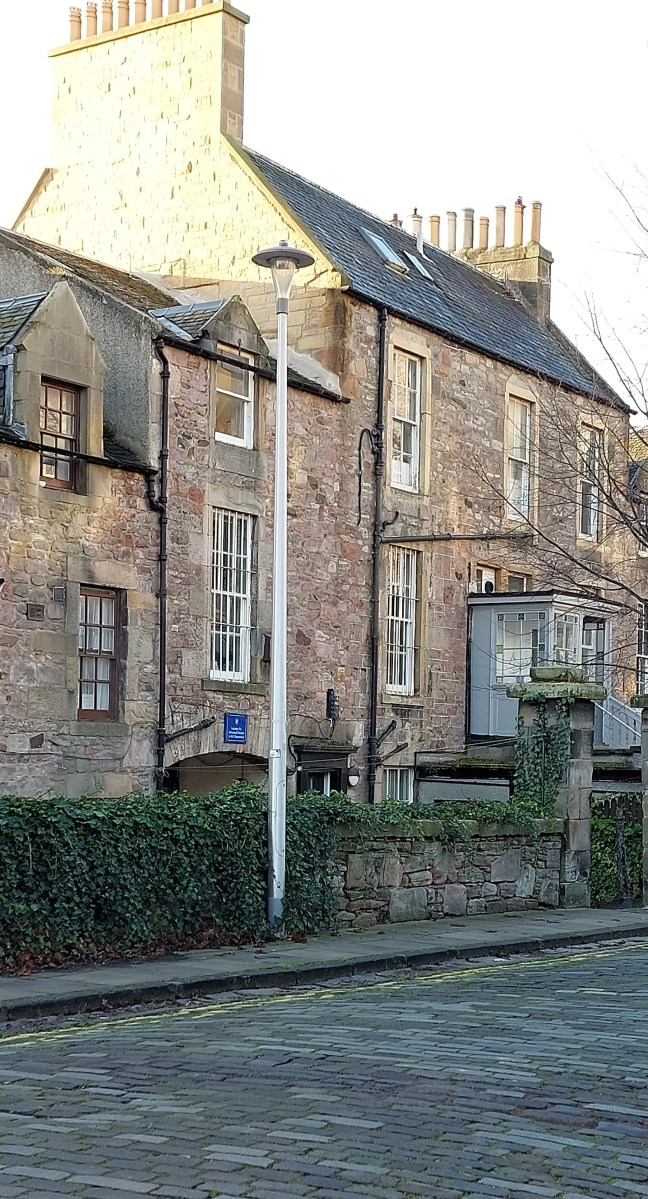
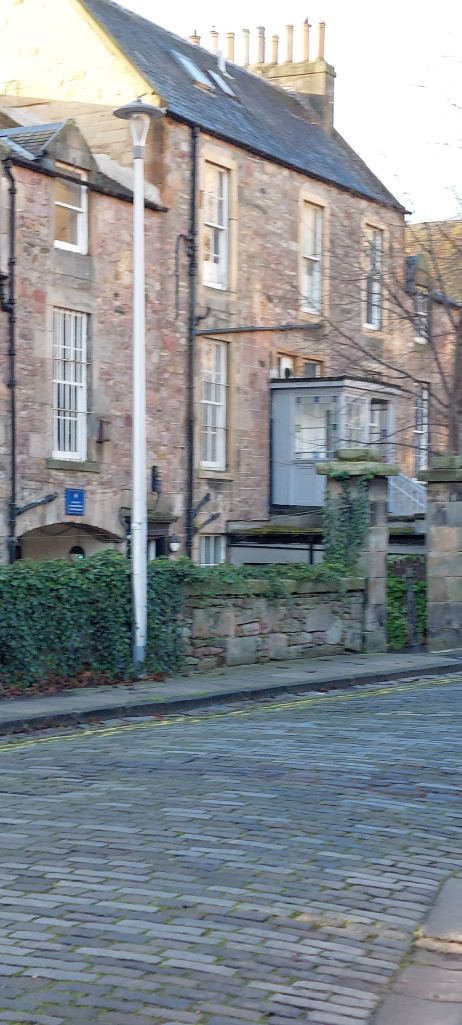
‘All good things must come to an end’, as the saying goes. And an IASH Postdoctoral Research Fellowship is a thoroughly good thing.  I handed back my keys with sadness today, but I have had a great year. (The Fellowship was technically six months, but I was graciously permitted to hang around, retaining the use of my office for the rest of the year, which was wonderful, and enabled me to continue data-gathering in the Library’s Heritage Collections.)

If you are looking for a next step after your PhD, or if like me, you’re making a change of direction – or need a spell concentrating on a particular research question in the Humanities – do consider applying.

I devoted my time to examining the archives of the Edinburgh publishers, Thomas Nelson.  I initially entitled my project, ‘From National Songs to Nursery Rhymes, and Discussion Books to Dance Bands: investigating Thomas Nelson’s Musical Middle Ground’, but the nursery rhymes turned out to be poems, and weren’t what I had in mind! The rest? Yes, I researched them.

I found quite a bit of correspondence between Thomas Nelson’s editors, authors and compilers, which was gratifying. I was able to trace material in journals that I would not have had access to, had I not been in Edinburgh; there’s the excellent University Library collection of actual and digital resources, and the National Library of Scotland just down the road.

I have deferred commencing any significant written work until I had explored all the potentially relevant materials in the files. I believe I’ve now reached that point.  As a result of conducting this research, I have ideas for extending my research in new directions, and I’m contemplating writing another book, so I need not only to explore potential audiences, but also to start working on a book proposal

However, I have also applied for and recently won an Athenaeum Award from the Royal Conservatoire of Scotland to enable me to conduct an oral history project. This work, to be conducted in 2026, will hopefully enable me to write a final chapter for my proposed monograph. (I’ll be blogging about this before too long, but there are things I need to do first, before I spill the beans!)

I have benefited from being part of a research community, hearing other scholars’ papers and discussing our research; and attending researcher development sessions. I  was able to focus on my new direction as a researcher – important, after so many years as an ‘alt-ac’ researcher working in professional services. In this regard, I have also been in a position to submit some other unrelated work for publication, and I spoke at a conference at the University of Sussex in June, all of which gives me a sense that my research is gathering momentum.

Today, my last day, I took a cake to the University Library’s Heritage Collections; went to IASH’s Christmas lunch; and mulled over aspects of my ethical approval submission for my next project. (Oh, and drank quite a bit of coffee!)

Thank you so very much for a great year, IASH!

IASH (Institute for Advanced Studies in the Humanities)

A Happy and Healthy New Year – Here’s Hoping!

Through sheer bad luck, all the men in my house had flu between Christmas and New Year. Call it Casa Influenza, if you will. I’ve been downing zinc, echinacea, and multivitamins with cod-liver oil – providing room service whilst wearing a mask, and cursing my FitBit for suddenly deciding to pass daily comment on my own levels of activity. It’s not counting the stairs, which I consider a very bad show considering how many times I’ve been up and down them. Then, after the first day of my Florence Nightingale gig, it observed I’d been overdoing it and should take a rest. So, I tried to rest the next day (as much as I could), whereupon it observed that I really needed to increase my cardio load. The third day, I walked to the postbox to increase my step-count, but this still wasn’t enough for FitBit. Stupid device!

Bah, humbug!

Only One Resolution!

Left to myself downstairs for several days, I couldn’t help myself doing a little bit of research in between fetching and carrying coffee, soup and meals on demand. However, having done absolutely nothing about seeing the new year in last night, I decided that if I was going to make one resolution this year, then it would be to do something more relaxing than searching databases on a public holiday. Moreover, I had woken up early – again – and couldn’t get back to sleep. I reached for my headphones and settled down to an audiobook.

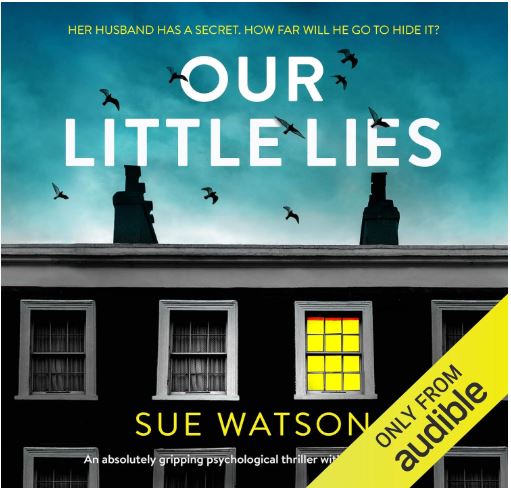
My book review of Sue Watson’s, Our Little Lies (2018)

(10 hours and 8 minutes, narrated by Katie Villa.)

An absolutely gripping psychological thriller with a brilliant twist.

I settled down under my duvet, ready to be psychologically thrilled. Although it began pleasantly enough, I must confess that I was too cosy, and I fear I may have been a bit drowsy through a couple of the chapters near the beginning. This didn’t promise to be as exciting as I’d hoped. It seemed like rather a slow, pedestrian start. On the other hand, maybe I’d have got on better if I’d been sitting up in a chair, or doing something else at the same time, rather than nearly falling back to sleep! When I woke up properly again, I didn’t feel as though I’d missed much.

Having said that, I took my phone round the house with me today, and listened to the entire story enjoyably enough, interrupted only when one of my invalids needed sustenance to be supplied! It did get better as it went on. The heroine was believable, and the anti-hero’s determination to gaslight her, accusing her of madness and psychological instability, grew more and more chilling as the tale unfolded. Her husband was a serial adulterer, a manipulative bully, psychologically and sometimes physically abusive.

As you listen (or read), you really do feel the heroine is caught in a trap, where her husband would do anything to make her feel guilty, whether literally finding fault where there was none, or for genuinely pathetic infringements (not folding the throws tidily enough, not tidying up crumbs off the sofa, or allowing the twins to watch TV) – or for serious tragedies for which she was in no sense to blame.

Marianne was certainly obsessive. But her husband Simon, who was a brilliant and ambitious surgeon, convinced her GP to prescribe heavy tranquillisers, and you were left wondering (as Marianne did) whether she was going mad, losing her memory, losing her ability to cope or becoming paranoid – or was the medication causing side-effects?

Admittedly, at one point, I wanted to yell, ‘For pity’s sake, you need to leave him, taking your kids with you!’, but of course, she had no-one to go to; even her so-called new friend turned out to be disloyal in the extreme.

The final chapters were very clever. Marianne arranged a party in which she would reveal her husband (and his lover) in their true colours. There was a murder a couple of days later, and because she couldn’t recall exactly what had happened, she was arrested and held for a number of hours before being released. However, the denouement was not as straightforward as it would have appeared, and – as in the best whodunnits, the culprit eventually turned out to be someone else entirely.

It’s not a detective novel, or even a crime story as such – emotional and domestic abuse underpin the novel, but the murder comes near the end of the book and – as I said – there’s a twist in the last ten minutes.

I closed my Audible book feeling that I had actually chosen just the right book for a lazy New Year’s Day. I’d recommend it.

Vision for the Future

Friends, a word of explanation. An eye problem had to be sorted out.  (Some pharmaceutical company somewhere had a sense of humour, calling their eyedrops a compound name beginning with ‘Cyclop’ ….)

So, whilst I convalesce, I have the use of one good eye.  I can type a few lines quite comfortably, but I realised yesterday that sitting at my laptop for any longer, only strains the good eye.  (I tried to set up a new spreadsheet – but I won’t try that again this month: I just got myself a headache which lasted much of today.)

Frustrating as it is, I can’t do anything research-related for a few weeks. I have new headphones and a new Audible subscription to help pass the time. 

I recommend Poor Things, by Alasdair Gray – a great discovery. There’s a film out now, too, but I don’t thinking I’ll be watching anything on the big screen in the immediate future.  (Ironically, the title –  which reminded me of an early 20th century London charitable organisation that I encountered in my research a year or so ago – has nothing whatsoever to do with that organisation, but I had worked that out before I bought the Audible book.)  I loved the fact that much of it is set in Glasgow, and also the way the reader’s expectations are confounded at the end.

I’m on a third book now.  After that, maybe I’ll see if I can find Walter Scott or James Hogg …

‘Reading’ a commercial audio book is wholly absorbing, but it makes me realise how hard it must be for a partially-sighted reader to skim a book. A recording is linear – there is no ‘Find’ function as in an e-text, and neither can you flick through,  hoping to find something you spotted first time round.  If chapter headings are meaningful, at least that gives the reader an indication of the book’s structure.

I wanted to post an explanation as to why there will be less activity on this blog in February, so there it is.  I’m taking care of my sight, as an investment for the future. Watch this space!

Image by …♡… from Pixabay

Report of Conference: Reading and Book Circulation, 1600-1800

(Libraries, Lives and Legacies Festival of Research), University of Stirling, 17-18 April 2023

I wrote a report for the conference that I attended in April this year, thanks to an LIHG Bursary. This report has just been published in the latest LIHG Newsletter for Summer 2023 , Series 3, no. 53 (ISSN 1744-3180), pp.7-10.

I thought I’d share excerpts of the report here, too.

The conference resonated strongly with the research topic of my 2017-18 AHRC Networking Grant, Claimed from Stationers’ Hall, when we were investigating surviving music in the British Legal Deposit libraries of the Georgian era.  Although my network was interested in books rather than music, I had immersed myself in the Georgian borrowing records of St Andrews University Library, and had taken a particular interest in the music borrowing habits of women of that era, so the opportunity to hear more about what people borrowed apart from music was irresistible. 

On the subject of borrowing records, the opening introduction to the ‘Books and Borrowing 1750-1830 project’ and demonstration of the digital resource by Katie Halsey, Matthew Sangster, Kit Baston, and Maxine Branagh-Miscampbell was fascinating, offering so much data for investigation.

The following panel on Reading Practices in Non-Institutional Spaces was just as interesting, with Tim Pye’s ‘Had, Lent; Returned: Borrowing from the Country House Library’, along with Abigail Williams speaking about non-elite book use in rural settings, and Melanie Bigold’s paper about women’s book legacies. Whilst my own interest has been in formal library borrowing, ‘my’ borrowers took music away for their leisure-time enjoyment, and these papers served as a reminder that musicians were probably just as likely to have borrowed music outwith the more regulated library environment. Similarly, the concept of the Sammelband is very familiar to me – that was how libraries kept their legal deposit music. Sam Bailey invented a useful new verb, ‘Sammelbanding’, during the course of their talk on ‘The Reading and Circulation of Erotic Books in Coffee House Libraries’ – a topic far removed from my own research.

Kelsey Jackson Williams’ hands-on session with books from the Leighton Library, in an exhibition curated by Jacqueline Kennard, was the perfect after-lunch session, offering the chance both to stretch one’s legs on the way there, and to inspect some rare selections from the Leighton.

Parallel sessions meant tough choices, but I opted to hear Angela Esterhammer talk about John Galt’s various publishing ventures – an intriguing history – followed by Cleo O’Callaghan Yeoman’s ‘Still my ardent sensibility led me back to novels’.  (I reflected that St Andrews’ first music cataloguer, Miss Elizabeth Lambert, had read a wide variety of books, and whilst her reading included travel accounts, religious books, and books on botany and conchology, she certainly wasn’t averse to reading a good novel, too.)  Next came Amy Solomon talking about Anne Lister’s considerable book collection at Shibden Hall, and how she had made an inherited collection her own, as well as keeping commonplace books, diaries, and reading journals. I regret having missed seeing the films about her diaries, and the two more recent ‘Gentleman Jack’ series on the television.

The first keynote paper was given by Deidre Lynch, on ‘The Social Lives of Scraps: Shearing, Sharing, Scavenging, Gleaning’.  I am sure I was not the only delegate pondering as to whether any of my own ‘scraps’ would survive to intrigue future readers, but more importantly, Deidre’s paper reminded us that proper ‘books’ are only a small proportion of the vast amount of printed material still surviving, often against the odds and far from their original context. 

On the second day, the opening plenary roundtable chaired by Jill Dye addressed borrowers’ records across Scotland, and I heard from several people with whom I was already acquainted, three of them through my own AHRC Networking project. 

We heard about the library of Innerpeffray, the National Library of Scotland, and Edinburgh, Glasgow and St Andrews’ University Libraries. I was interested to hear about the bigger picture, so that I could place my own special interests into the wider context.

For the third panel, I opted for the panel on Readers, Libraries and Loss.  Jessica Purdy gave a fascinating talk on ‘Libraries of Lost Books?’, speaking about chained church libraries, and the fact that their tight security and still pristine condition suggest that the books might as well have been ‘lost’ as far as most of the local residents were concerned.  Elise Watson, too, made us reflect upon just how many publications of Catholic devotional material had been published, even if they were so ephemeral that there are now ‘”Black Holes” of Ephemeral Catholic Print.’

For the fourth panel, I attended the panel on ‘Education’, hearing Maxine Branagh-Miscampbell talking about the Grindlay bequest and ‘Childhood Reading Practices at the Royal High School, Edinburgh’.  The Grindlay bequest was valued sufficiently that it was all added to stock, even though some material was never going to interest young or teenage boys.  Mary Fairclough gave an interesting talk on ‘Barbauld’s An Address to the Deity and Reading Aloud’.  I have recently encountered Victorian publishers appropriating evangelical hymns for magic lantern shows, but had not considered that poetry might also be ‘trimmed down’ and repurposed.

Duncan Frost’s paper did have a musical subject: ‘Bird Books: Advertising, Consumption and Readers of Songbird Training Manuals’.  Who would have thought that so many books were written about catching and training songbirds to sing in captivity?!  The most intriguing aspect of this genre of books was in fact that, despite many pages dedicated to all aspects of caring for and training your bird, there was significantly little information about the kind of tunes that you might want to teach it.

The second and closing keynote lecture was delivered by Andrew Pettegree, on ‘The Universal Short Title Catalogue: Big Data and its Perils’.  Professor Pettegree was at pains to underline not only what the USTC had achieved, but also its shortcomings, or rather, what it was not.  We were also reminded of some aspects that I have encountered in my own work: that books in libraries were not the only copies of these titles; they would have existed plentifully outside libraries, and so might other books which we can now only trace by, for example, publisher’s catalogues and advertisements. Moreover, library catalogues can conceal different editions, or show duplicate entries, depending on minor differences in cataloguing approaches.

Since my own networking grant, I have had to reflect upon the benefits of the work, and the impact the research has had.  One of the outcomes that I identified then, was that library history research created effectively a ‘third space’ where librarians and academic scholars – and those like myself, straddling both library and research worlds – could meet and beneficially share our insights and learning.  I realise that at this recent conference I had experienced exactly the same kind of meeting of minds again. Similarities of approach and a common interest in library and book history meant that I felt I had an underlying understanding enabling me to benefit from their fresh insights.

I am grateful to the Library and Information History Group for enabling me to attend this wonderful and thought-provoking conference.  Besides having such a rich array of papers to listen to, I certainly did benefit from the opportunities to talk to other delegates.  It was a treat to be able to take two days out of normal routine in such a beautiful setting, giving plenty of food for thought for the future.

Image: Image by G.C. from Pixabay

I won a Bursary!

Exciting news. Thanks to CILIP’s Library and Information History Group, I shall be attending a fascinating conference in Stirling soon!

Books and Borrowing 1750-1830.

The conference is 17-18 April in Stirling, and the programme for ‘Reading and Book Circulation, 1650-1850’ is on their Events page:- borrowing.stir.ac.uk/events/

My interest in this topic

It’s of special interest to me because of my work on music borrowing at the University of St Andrews in the days of the old Copyright Libraries: I examined the borrowing habits of two particular women, Miss Elizabeth Lambert and Mrs Bertram, and contemplated the changing readership over the three and a half decades under examination. This work led into my successful application as Principal Investigator of an AHRC postdoctoral research network, the Claimed From Stationers’ Hall network (2017-2018) investigating music surviving from legal deposit in the old copyright libraries.