‘Repugnant to Modern Feelings of Propriety’? The Most Beautiful Scottish Song

I’ve started listening to another Audible book, but it’ll take a while for me to finish it. To take a break from listening, I sidled over to the piano and played a one-eyed rendition of my favourite song.

Lady Anne Bothwell’s Lament (Baloo, my Boy)

My Song Gems (Scots), edited by James Wood and Learmont Drysdale (London: Vincent Music Co., 1908), is a nice big score that sits comfortably on the piano stand. This song is arranged by Finlay Dun, a Victorian arranger. As I squinted at the words, they didn’t look like what I remembered hearing sung from Cedric Thorpe Davie and George McVicar’s The Oxford Scottish Song Book (1969). What was going on? I suspected Davie and McVicar had taken their words from George Farquhar Graham and James Wood’s mid-Victorian Songs of Scotland. ‘You’ll see’, I told my bemused son. ‘The words will have been too smutty for Victorian ears, so Graham and Wood changed them.’

Davie used their words – which were perfectly acceptable for a collection intended both for classroom and adult use – but his musical setting is updated.

A Deserted Mother and Child

Graham and Wood’s collection revealed in the footnotes that it was an old ballad collected by Bishop Percy. However, Graham said that …

The Old Ballad, though poetically meritorious, is so coarse in most of its stanzas as to be repugnant to modern feelings of propriety. We have, therefore, adopted only the first stanza of it, the additional stanzas here given having been written by a friend of the Publisher.

Songs of Scotland (Edinburgh: Wood & Co., 1850), Vol.2, pp.30-31

Percy’s original version is in the National Library of Scotland’s Digital Gallery (Reliques of Ancient Poetry, 1767). Today, the lyrics are inoffensive!

And here’s the Cedric Thorpe Davie setting using Graham and Wood’s sanitized words:-

Kathleen McKellar Ferguson sings the Oxford Scottish Song Book version, divinely, here on YouTube

The Song Gems (Scots) version is in modern English and the text has been partially rewritten again –  it falls halfway between the original and the sanitized words! And the musical arrangement? Straight from Graham and Wood’s collection.

Percy, verse 3: Smile not as thy father did, to cozen maids, nay God forbid / Bot yett I feire, thou wilt gae neire Thy fatheris hart, and face to beire.

Wood and Drysdale, verse 2: Smile not as thy father did, to cozen maids, may God forbid / For in thine eye his look I see, The tempting look that ruin’d me …

Olde English or modern, take your pick!

As for Graham and Wood, or Thorpe and McVicar? Not a ruinous smile to be be seen! The lady may have been deserted, but no hint that she had first been seduced!
Do You Own This Songbook?

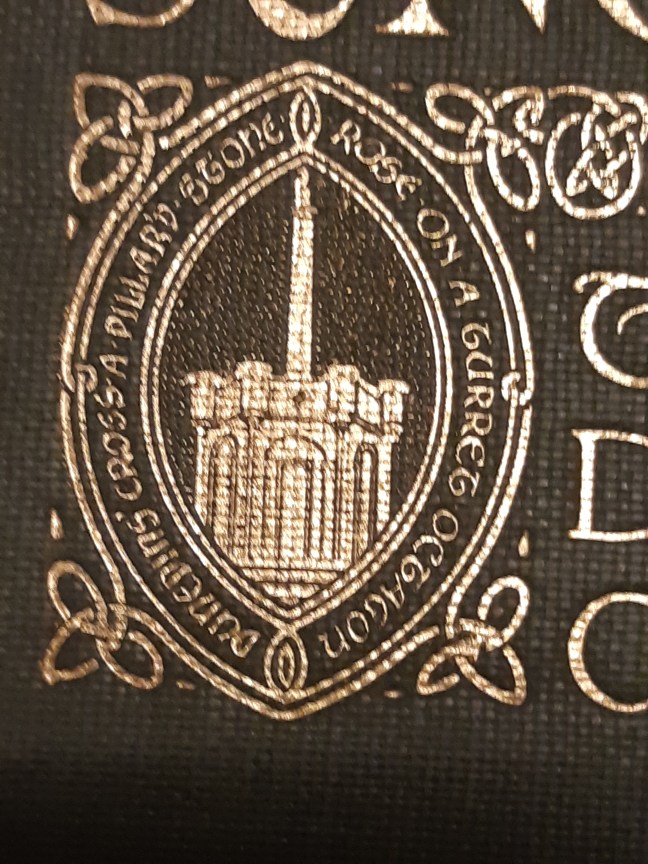
Song Gems (Scots) front cover
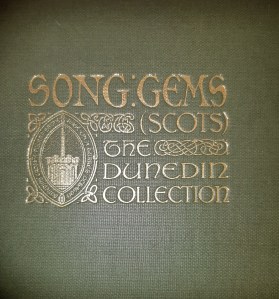
Song Gems (Scots) whole cover

If you’ve visited this blog before, you’ll know I’m writing a history book about Scottish music publishers. (58,000 words and rising!) But I’ve reached a point where I’m writing about a book COMPILED by Scots, PUBLISHED in England, but also DISTRIBUTED from Edinburgh and Boston, Massachusetts.

I know a lot about the anthology (as I should – I’m writing about it!), but I’m curious about its life in the Scottish diaspora – in other words, anywhere else in the world where Scots emigrated.

The Boston agent of the book was Thomas J. Donlan. His address was Room 831, Colonial Building, 100 Boylston Street, Boston. He moved to New York some time between 1910-1915.

Song gems (Scots) : the Dunedin collection

Authors: James WoodLearmont Drydsdale

Print Book, English, 

Publisher: Vincent Music Co, London, 1908

WorldCat bibliographical details

Now, I know from WorldCat and Jisc Library Hub Discover, that there aren’t many copies in libraries. My interest is more to see if there are many copies out ‘in the wild’ in people’s homes, and obviously it would be nice to discover that Mr Donlan imported and distributed lots of them. It was more of an ‘art music’ book than a book of simple folk melodies. The repertoire is non-standard. You’d probably have owned a piano, and been quite a good pianist – or had a good pianist to accompany your singing.

I’m not looking to buy copies – my own came from a dealer under 40 miles from Boston, and I don’t need another! I’m not a bookseller. I am literally just curious to find out if there are many survivors hiding in piano stools and under-stair cupboards. If you’ve got a copy, I’d love to hear from you!

Maybe you haven’t got this book, but you know more about Donlan the agent? If you are aware of archival data, please do let me know. My book is about Scottish publishing, but there’s room for a paragraph or two about the American distributor, if more information came to light. (I’ve already discovered that Colonial Building also housed the Colonial Theatre, and that there were a lot of music shops along the street – indeed, I know which organisation occupied room 831 after Donlan, and that’s another fascinating story, but really I can’t pursue that – it has nothing to do with Scottish music publishing!)

POSTSCRIPT, July 2024. This song-book is the subject of a chapter that I have contributed to an essay collection published by Lang, that is due out later this year.  It also gets mentioned in my own forthcoming monograph, again due out later this year. Do follow this blog if you want to keep updated!