Define ‘Scottish’ without a Scotch Snap (human asking human!)

OK. We’re thinking about ‘classical’ music. ๐ŸŽถ

Art music, if you like.

If you’re a serious classical composer, wanting to convey your Scottish identity – but also aspiring to avoid clichรฉs – how do you do it?

  • No ‘Scotch snaps’
  • No ‘modes’, flat sevenths, or gapped scales
  • No Scottish song or fiddle melodies
  • No titles derived from Robert Burns or Walter Scott’s literary output
  • Oh, okay, you can have a clarsach, fiddle, whistle or pipes if you absolutely insist!

Why am I asking you this riddle?

I read in an old newspaper that a certain composer had truly captured ‘Scottishness’ in his music. I didn’t know the piece they were referring to. Did he evoke Scotland in his soundscape? How?

We say that Sibelius’s music evokes Finland. To be truthful, many of us have probably just accepted that it’s a ‘Finnish sound’, making us think of steep valleys, tall pines, and vast echoing lakes. Fair enough. We’ve heard something, and learnt to associate it with a set of visual images.

So what would evoke Scotland? Can we look at some Romantic-era tone-poems and point to elements that sound Scottish, or could only be Scottish?

What are your thoughts about this ๐Ÿค”

SGSAH Summer School: The Gentle Art of Bibliography

An entirely new venture for me: I’ve offered to give a talk at the Scottish Graduate School for Arts and Humanities Summer School later this month – next week, to be precise! It’s a summer school for all Arts and Humanities doctoral researchers in Scotland. When the opportunity came up to participate, I initially wondered if I had any expertise that I could share, leaving aside my own niche research interests. But then it occurred to me that people seem to enjoy my talks and writing about the process of research, as much as my talks about the research itself, so the obvious thing was to talk about one of my favourite things – bibliography. A lot of people have signed up – I’m so pleased.

Today felt like a good day to get it written, powerpoint and all.

The Gentle Art of Bibliography: a Timely Reminder (Quick Talk)

I might share the talk later, after it has actually taken place. For now, here’s a taster for any Scottish postgraduate researcher deciding which talks to attend!

“Have you ever forgotten where you read something useful?  You know the scenario โ€“ whilst youโ€™re searching for something, whether on the web, in the library or in a database, you flick past something thatโ€™s perhaps only of tangential interest, only to realise later that it was more significant than you thought.  Or youโ€™re just killing time, so youโ€™re not in full scholar-mode, and you find something interesting that is so relevant that you just know youโ€™ll be able to find it again? But you canโ€™t. 

Isnโ€™t it an awful feeling?”

When I submitted my proposal for this talk, I had to describe the learning outcomes. Here’s what I’m aiming to do:-

Learning Outcomes:- By the end of this session, participants will have a greater understanding of the options available to them, in terms of building, maintaining and deploying a bibliography in scholarly writing. By the end of this session, participants will also understand the importance of starting to build one’s bibliography at the earliest opportunity.

Full Programme of the Summer School here

Flower Pots! How to Brighten a Music Librarian’s Day

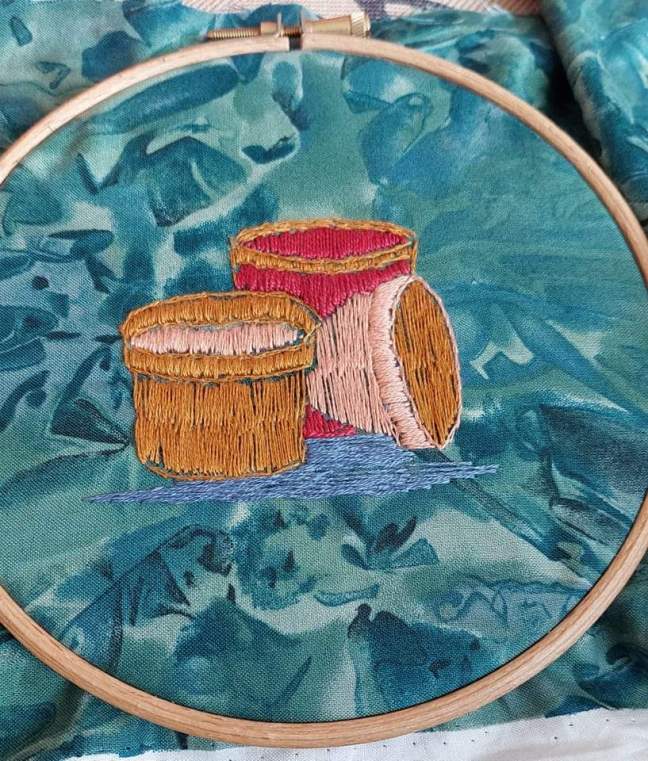
Embroidered picture of flower pots

I’ve mentioned before how, for the past four or five years, I’ve particularly focused on getting more music by women and composers of colour into the Whittaker Library. By the time I reach retirement age, there will be a good, up-to-date selection of such works for students to choose from. (I’ve also mentioned my rationale for this activity – if we introduce this music to today’s students, then whether they go out and perform it, or teach it, or combine these with other activities, there’s hope that they’ll pass on a wider, more receptive approach to repertoire-building to the students that follow on behind them.

Today, I was invited to attend a recital by one of our students. Two of the pieces were pieces by women composers, that their teacher had recommended us to acquire. It was a great recital – innovative, exciting and impressive. One particular piece involved a percussionist playing a counterpart on – wait for it – an assortment of carefully-chosen, differently pitched flower pots. You didn’t think flower pots were pitched? No, they aren’t deliberately tuned, but they can be chosen for the sound they make when you hit them! I bet you none of the audience had ever heard flower pots in a recital before, but it was great. Another piece had been written with piano accompaniment, but this time it was played on accordion. (From a personal point of view, this was of considerable interest. I got an accordion a few months before the pandemic, and a concertina a few weeks before. I get a lot of enjoyment out of my beginner’s attempts with two inexpensive instruments. But to sit and hear a truly excellent instrument in expert hands – and a “button box”, too; completely baffling to me! – well, that was something else. If you think accordions are just about ceilidhs and the good old days of Jimmy Shand, then believe me, you’ve missed so much.)

I and my colleagues even got a mention in the programme “credits”, for having obtained the music. It makes all the difference to feel that we were part of the programme-planning in our own small way. Sometimes, in a performing institution, it’s easy to feel that our hidden-away, behind-the-scenes work is really very insignificant and unnoticed. Obviously, we research and source the materials, catalogue and index them, then sit back and wait to see what happens. Our job is effectively done, one score or resource at a time, and the performers then go off and do the hard work, putting together a balanced programme and practising hard. We don’t always get to hear the results, though, which is why this morning’s recital was so lovely.

I have already expressed my opinion on – and weariness of – repetitive cataloguing. Processing CD after CD, all in the same genre and series, is mind-numbing. The mental exercise in cataloguing and indexing fresh, contemporary sheet music is definitely more enjoyable! Nothing can be ‘discovered’ in a library unless it has first been carefully catalogued, indexed and assigned the correct place on the shelves.

Seeing and hearing the results reminds me of the importance of music librarianship. A timely reminder!

35 years in one post

I omitted to note that this week is my 35 year anniversary of being in the same library post at RCS. Having said that, I have …

  • Had 3 children (minimum maternity leave each time) and seen them grow up.
  • Done a self-funded PhD in my spare time; also gained Fellowship of CILIP and Advance HE. Nearly forgot – I did a PGCert too. My commitment to CPD is, I suggest, exemplary!
  • Published a book;
  • Written a number of articles and papers etc;
  • Nearly finished the second book;
  • Am looking forward to a part-time visiting fellowship in my part-time research secondment.

I just haven’t managed a promotion ๐Ÿ˜•. Still, apart from that big fail (a single, male former colleague once said that anyone who didn’t move on and up was not a success), at least I have some other successes to my name!

Has anyone said that to you? How did you respond?

Chat GPT (Part 2) Fake News? It found me a Music Publisher that I haven’t heard of!

It’s intriguing – I couldn’t resist investigating it! Has Chat GPT led me up the garden path again? This time, my younger son is inclined to believe me rather than the AI. “Mum, you’ve researched the subject FAR MORE than Chat GPT has!” But the worrying thing is, that it looks so convincing. Anyone just hastily asking a question, and not having my level of knowledge, would completely believe what they were being told.

Music Sellers in the Paisley Post Office Directory for 1904-1905

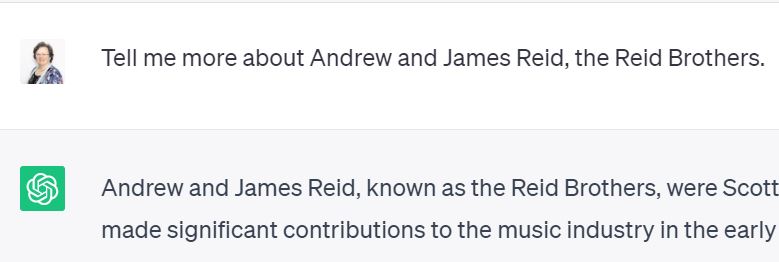
The question that I asked Chat GPT, after it named the Reid Brothers

All of the information I’m about to reproduce here, comes from Chat GPT. I am not going to modify it at all. But before you read it, let me share a few truths with you! I will then annotate Chat GPT in square brackets.

  • This music publisher is unlisted in the Scottish Book Trade Index – but would have been too modern for that database. If it existed at all.
  • The Jisc Library Hub Discover database doesn’t have any music published by this firm.
  • They aren’t mentioned in the local press when they were starting trading.
  • They aren’t listed in the Paisley Post Office Directory for 1904-1905.
  • Chat GPT didn’t give me an actual address in Paisley.
  • I did find an Andrew Reid with those dates in a genealogy site – in Aberdeenshire, not Paisley, and nothing to do with music.
  • And there was a James Milton Reid in Kentucky with the dates for Chat GPT’s James Reid!

Here goes, courtesy of Chat GPT. It had already alluded to them briefly, so I threw out a challenge:-

ME “Tell me more about Andrew and James Reid, the Reid Brothers.”

ChatGPT:-

“Andrew and James Reid, known as the Reid Brothers, were Scottish music publishers who made significant contributions to the music industry in the early twentieth century. Here are some details about them:

  1. Background and Early Career [unverified]: Andrew Reid (1870-1944) and James Reid (1872-1956) were born in Paisley, Scotland. They came from a musical family, with their father being a music teacher. Both brothers developed a deep passion for music from a young age.
  2. Formation of Reid Brothers [no music shop traced, though a friend did trace a grocery shop]: In 1902, Andrew and James Reid established their music publishing business, known as the Reid Brothers, in Paisley. They started with a modest shop selling sheet music and musical instruments. Over time, their business expanded and became well-respected in the industry.
  3. Wide Range of Publications [untraced]: The Reid Brothers published a diverse range of music, including Scottish songs, instrumental compositions, dance music, and educational materials. They had a particular focus on Scottish music, contributing to the preservation and promotion of traditional Scottish tunes.
  4. Collections and Songbooks [untraced]: One of the notable contributions of the Reid Brothers was the publication of various songbooks and collections. They released compilations of Scottish songs, often accompanied by sheet music and lyrics. These collections played an important role in preserving traditional Scottish music and making it accessible to a wider audience. [I have never come across compilations ‘accompanied by sheet music and lyrics’. Lyrics are IN the compilations or IN sheet music of single songs. Lyrics are not provided to ‘accompany’ a compilation or a single song, which makes them sound like a separate entity…]
  5. Collaborations with Composers and Songwriters [untraced – this all looks like wishful thinking!]: The Reid Brothers worked closely with Scottish composers and songwriters, publishing their works and providing them with a platform for their music. They actively sought out new talent and supported local musicians, contributing to the vibrant music scene in Scotland.
  6. Music Shop and Instrument Sales [untraced, see above]: In addition to their publishing activities, the Reid Brothers operated a music shop in Paisley. The shop offered a wide range of musical instruments, sheet music, and accessories, catering to the needs of local musicians and enthusiasts.
  7. Influence and Legacy [untraced and probably again wishful thinking!]: The Reid Brothers played a significant role in promoting Scottish music and supporting local musicians during their time. Their publications and contributions helped preserve traditional Scottish tunes and fostered a sense of pride in Scottish cultural heritage. Their music shop and publishing business remained active for several decades.

The Reid Brothers’ dedication to music publishing [really?] and their efforts to promote Scottish music contributed to the rich tapestry of Scottish musical heritage. They played a vital role in preserving and disseminating traditional Scottish tunes, leaving behind a lasting legacy in the music industry.”

Now, it looks convincing, doesn’t it. Can ANYONE verify it, though?!

It was pointed out to me that I have just given the text credence by posting it. Hopefully the observations in square brackets will help cast doubt on the original!!

Chat GPT (Part 1) – Experimentally

Robot image from Pixabay (Erik Stein)

Have you tried it? Were you impressed?

Using artificial intelligence to find things out is undeniably fun. You can sign up to Chat GPT’s free service to ‘play’ with it, and ask it all sorts of questions. But although you might think it’s just an advancement on Google, enabling you to type a question in a box and get what looks like an intelligent written reply, there are pitfalls as well as advantages. I’ve done a little experimentation this week, on topics that interest me.

Scottish Song Collecting?

When I first heard about it, at Christmas last year, I immediately asked it a question about something I knew a lot about, Scottish song-collecting. It named a nineteenth-century society that I’d never heard of. ‘But Mum!’, laughed my family, ‘you wrote the book about it. And you haven’t even heard of that society?’

Ashamed, I spent a few hours trying to find the confounded society. And you know what? It doesn’t exist. I’ve seen it said that Chat GPT is simply set up to provide what looks like a reasonable answer to any question that it’s asked. The ‘society’ that it named would have been a reasonable name for a society, if the terminology was being used in the nineteenth century. But it wasn’t!

What’s new?

I know, too, that the free version is based on the internet at a particular point in time, so if you’re trying to find out something very current, it won’t work. I tried again yesterday, asking about something I thought colleagues might be discussing. But of course, it doesn’t know what’s being discussed in 2023, so I got no reply.

So today, I had another go.

Explain why libraries are acquiring more music by women

I was very impressed this time. It even listed five key factors: ‘Promoting gender equality … Broadening Cultural Representation … Recognising underrepresented talent … Meeting user demand and interests … Educational and research purposes …’

If I’d written that answer, it would certainly have passed muster in a blog post. So, if Chat GPT looks at what people have said in response to that question, and creates an answer in line with those observations, then the job’s done and dusted. However, if it had been presented as an answer to an essay question, an essay-marker could have been fooled into thinking it had been carefully researched and considered. Or could they? There were no references, no named authorities or published sources. Not so good, then. (Apart from which, if I had set an essay that was going to be assessed, I’d like to think the author had done a bit of research of their own, and cited a few opinions by respected experts in the fields.)

I asked Chat GPT where they got the info from.

Where did you get this information?

Chat GPT is honest!


As an AI language model, my responses are generated based on a mixture of licensed data, data created by human trainers, and publicly available data. I have not been directly trained on specific libraries or their acquisition policies. My previous response was based on my understanding of the topic as a language model trained on a diverse range of text, including books, articles, websites, and other written sources.

When providing information, I strive to offer accurate and up-to-date content. However, it’s important to note that my responses may not always reflect the most current news or events. The field of library acquisitions is constantly evolving, and it’s always a good idea to consult the latest research, publications, or speak with professionals in the library field for the most accurate and specific information.

Chat.openAI.com

Well, that makes sense. But I thought it was worth pushing just a little further.

Can you cite any sources for this data?


I apologize for any confusion, but as an AI language model, I don’t have direct access to a database of sources or the ability to browse the internet. I don’t have citations to provide for the specific data mentioned in my previous response.

I can tell you that the information provided is based on general knowledge and understanding of the topic as of my last training in September 2021. The points mentioned are commonly discussed aspects related to diversity and representation in library collections.

If you’re looking for specific sources or more in-depth information on this topic, I would recommend consulting scholarly articles, books, or reports on library acquisitions, diversity in music collections, and gender representation in the arts. This will help you find more detailed and sourced information to support your research.

Chat.openAI.com

So, I would see it as a bit like Wikipedia – it’s great for giving an overview of a subject, but it doesn’t take away the need to do your own homework! It makes things up (the imaginary 19th century society), and it doesn’t cite sources. Moreover, if you use the free version, you won’t get the most up-to-date data or opinions.

And I’d also be concerned to know how a teacher would be able to tell that an open AI source had been used. Someone could copy and paste the answer, submit it, and never have actually done any deep thinking, or achieved any level of learning.

It’s something I’d like to know more about! There’s no point in advising, ‘don’t use Chat GPT’. It’s there, and it won’t go away. But we should certainly be advising students to use it responsibly. It might be tempting to use it, but not as a replacement for doing the work!

What about Writing Research Papers? Helpful or Unethical?

On a related topic, have you heard about the most prolific scientist in the world (allegedly), producing articles on average every 37 hours in the present year 2023? With the assistance of AI, I imagine, but it can’t be the Chat GPT that we ‘ordinary’ folk are playing with. After all, scientists have to be slap-bang up to date,for one thing. And also, I presume he is feeding data INTO his AI, otherwise how will he get new results and new discoveries? Intriguing. Let me say that I’m not entirely clear whether the suspension is at all connected with the use of AI – it seems more to be about who paid him (or didn’t, depending who you believe) for some of his work, and that he has been punished for something by his university. The fact that he is so prolific seems to be a side-issue here, even though that’s the aspect that caught my attention.

Here’s the citation for that particular story:-

One of the worldโ€™s most cited scientists, Rafael Luque, suspended without pay for 13 years.’

Ansede, Manuel, for EL PAรS English. 2 April 2023

Truly, these are interesting times. Future scholars will look at my generation and marvel at how comparatively innocent we were, and how slow to get results!

Two Worlds Meet

News of a potentially interesting archival item triggers an attack of insatiable curiosity. I must confess that the musicologist is somewhat more triggered than the custodian!

So, I have a few questions that need answered. Where and when was the original owner born? When did they leave Scotland? What did their Scottish ancestry/identity mean to them?

And most importantly, was ‘Scottish’ music a significant part of their repertoire?

As I mentioned in earlier posts, my librarianship is amply qualified, and embodies four decades of expertise, but musicology and research came first. The musicologist is buried beneath the outer librarian, and can’t help bubbling to the surface when an intriguing possibility presents itself!

If I can answer these initial questions satisfactorily, then I’ll want to explore further. I think you can guess what I need to do this morning!

AND LATER …

Well, the original owner called themselves Scottish. But they were born in England of a Scottish mother. Should I order their birth certificate? It’s not cheap, and could arrive too late to be useful. But … !

58 Weeks to Go โ€“ How is This Meant to Feel?

Goalposts

The government moved the goalposts โ€“ when I started work, I imagined Iโ€™d have retired by now.  Instead, Iโ€™ve worked an extra five years, with one more to go. I shall hit 66 in summer 2024.  I donโ€™t want to retire entirely, but I must confess Iโ€™m utterly bored with cataloguing music! (Except when it turns out to be a weird little thing in a donation, perhaps shining a light on music education in earlier times, or repertoire changes, or the organisation behind its publication – or making me wonder about the original owner and how they used it … but then, that’s my researcher mentality kicking in, isn’t it?!)

Status Quo: Stability and Stagnation

Everyone knows Iโ€™m somewhat tired of being a librarian.  Everyone knows that my heart has always been in research.  Librarianship seemed a good idea when I embarked upon it, and it enabled me to continue working in music, which has always been my driving force.  But the downside of stability โ€“ and Iโ€™d be the first to say that it has been welcome for me as a working mother โ€“ has been the feeling of stagnation.  No challenges, no career advancement, no extra responsibility.  Climbing the ladder?  There was no ladder to climb, not even a wee kickstep!  (I did the qualification, Chartership, Fellowship, Revalidation stuff. I even did a PhD and a PG Teaching Cert, but I never ascended a single rung of the ladder.)

In my research existence, I get a thrill out of writing an article or delivering a paper, of making a new discovery or sorting a whole load of facts into order so that they tell a story. I love putting words on a page, carefully rearranging them until they say exactly what I want them to say. I’m good at it. But as a librarian, I cannot say Iโ€™m thrilled to realise that Iโ€™ve now catalogued 1700 of a consignment of jazz CDs, mostly in the same half-dozen or so series of digital remasters.  (Iโ€™d like to think theyโ€™ll get used, but even Canute had to realise that he couldnโ€™t keep back the tide.  CDs are old technology.)

The Paranoia of Age

But what really puzzles me is this: when it comes to the closing years of our careers, is it other people who perceive us as old? Is age something that other people observe in us?  Do people regard us as old and outdated because they know weโ€™re close to retirement age? 

Cognitive Reframing (I learnt a psychology term!)

Cognitive reframing? It’s a term used by psychologists and counsellors to encourage someone to step outside their usual way of looking at a problem, and to ask themselves if there’s a different way of looking at it.

So – in the present context – what do other people actually think? Can we read their minds? Of course not. Additionally, do our own attitudes to our ageing affect the way other people perceive us?ย  Do I inadvertently give the impression that Iโ€™m less capable?ย  Do I merely fear that folk see me as old and outdated because I know Iโ€™m approaching retirement age? A fear in my own mind rather than a belief in theirs?

How many people of my age ask themselves questions like these, I wonder?

Shopping Trolley

Am I seen as heading downhill to retirement?  Increasingly irrelevant?  Worthy only to be sidelined, like the wonky shopping-trolley thatโ€™s only useful if thereโ€™s nothing else available?

Is my knowledge considered out-of-date, or is it paranoia on my part, afraid that I might be considered out of date, no longer the first port-of-call for a reliable answer?

When I queue up for a coffee, I imagine that people around me, in their teens and early twenties, must see me as โ€œoldโ€ like their own grandparents.  And I shudder, because I probably look hopelessly old-fashioned and fuddy-duddy.  But is this my perception, or theirs?  Maybe they donโ€™t see me at all.  Post-menopausal women are very conscious that in some peopleโ€™s eyes, theyโ€™re simply past their sell-by date.  I could spend a fortune colouring my hair, and try to dress more fashionably, but Iโ€™d still have the figure of a sedentary sexagenarian who doesnโ€™t take much exercise and enjoys the odd bar of chocolate!  (And have you noticed, every haircut leaves your hair seeming a little bit more grey than it was before?)

Similarly, I worry whether my hearing loss (and I’m only hard of hearing, not deaf) causes a problem to other people?  Does it make me unapproachable and difficult to deal with?  Iโ€™m fearful of that.  Is it annoying to tell me things, because I might mis-hear and have to ask for them to be repeated?  Or do I just not hear, meaning that I sometimes miss information through no fault but my own inadequate ears?  Friends, if you thought the menopause was frightening, then believe me impending old age is even more so. I don’t want to be considered a liability, merely a passenger. And I know that I’m not one. But I torment myself with thoughts that I won’t really be missed, that my contribution is less vital than it used to be.

Gazing into the Future

Crystal ball
Crystal Ball Gazing

I wonder if other people at this stage would agree with me that the pandemic has had the unfortunate effect of making us feel somewhat disconnected, like looking through a telescope from the wrong end and perceiving retirement not so much a long way off, as approaching all too quickly?  The months of working at home have been like a foretaste of retirement, obviously not in the 9-5 itself (because Iโ€™ve been working hard), but in the homely lunch-at-home, cuppa-in-front-of-the telly lunchbreaks, the dashing to put laundry in before the day starts, hang it out at coffee-time, or start a casserole in the last ten minutes of my lunchbreak.  All perfectly innocuous activities, and easily fitted into breaks.  But I look ahead just over a year, and realise that Iโ€™ll have to find a way of structuring my days so that I do have projects and challenges to get on with. 

Not for me the hours of daytime TV, endless detective stories and traffic cops programmes. No, thanks!  Being in receipt of a pension need not mean abandoning all ambition and aspiration. I want my (hopeful) semi-retirement to be the start of a brand-new beginning as a scholar, not the coda at the end of a not-exactly sparkling librarianship career.  If librarianship ever sparkles very much!

Iโ€™m fortunate that I do have my research โ€“ Iโ€™m finishing the first draft of my second book, and looking forward to a visiting fellowship in the Autumn.  As I wrote in my fellowship application, I want to pivot my career from this point, so that I can devote myself entirely to being a researcher, and stop being a librarian, as soon as I hit 66.  And I want to be an employed researcher.  I admire people who carve a career as unattached, independent scholars, but Iโ€™d prefer to be attached if at all possible!

Realistically, I will probably always be remembered as the librarian who wanted to be a scholar.  At least I have the consolation of knowing that โ€“ actually โ€“ I did manage to combine the two.

An Alcove of One’s Own: On Being Taken Seriously

Male public speaker at podium

A whole room? Virginia Woolf asked too much. I sit at my desk in an alcove – an early Edwardian bed-recess, to be accurate – and from my vantage point, I survey the rest of the room. The smell of roast dinner – my efforts – drifting through from the kitchen. The ironing awaiting my attention. The table waiting to be laid. (I’m neither going to explain nor apologise why it’s all mine.) The piles of books which are meant to help me finish Chapter 6 and commence Chapter 7, but which I won’t be going near until later tonight or perhaps tomorrow. After all, tomorrow is the start of a week’s annual leave – so what could be more natural than to write? It can be hard to settle down to intellectual work with so many demands on my time, particularly when I’m technically seconded to be a scholar for just ten and a half hours a week. And yet, if I don’t take myself seriously, then how can I expect anyone else to?

Great Expectations?

Do people still, in 2023, have lower expectations of women? I grew up in a middle class family, simultaneously encouraged to do my best, remain modest, and not get upset if I was unsuccessful. Does that sound contradictory? When my 11-plus results came through the letter-box, I was warned, ‘Don’t be disappointed if you haven’t passed’. I got a County Scholarship to the best girls’ school in my home city. When I look back at my schooldays, there is one aspect for which I’m very grateful. It was an all-girls school, and I expect there probably were fewer distractions without boys around, but that’s not my point. My abiding memory is that there was NEVER any doubt, not the slightest shadow of a doubt, that girls could achieve every bit as much as boys. Indeed, it came as a bit of a shock at university to discover that there were boys who expected to be better than the girls. How could this be? We were equal, I’d been brought up to believe that, and I wasn’t intending to be bested.

One thing led to another, until I embarked on a PhD. ‘You’d better do secretarial training next, dear. In case you can’t find a job.’ Well, we compromised there – I took typing classes, so that I’d never again have to pay what it had cost to get my Master’s dissertation typed. (This was long before people had their own computers – yes, I’m that old. I learned on a manual typewriter.)

I didn’t complete that doctorate, which is largely my own fault – I started librarianship training before completing the PhD. Yes, it was a stupid move! However, academia didn’t appeal to me at the time – I had absolutely NO female peer models, was offered NO teaching opportunities, never so much as considered giving a conference paper; and was told by everyone (everyone being male, since there were no other women academics in my department, and precious few in the conferences that I attended) that it was virtually impossible to get even a short-term postdoctoral fellowship. I accepted this unquestioningly. It was the 1980s. I now ask myself, how would I have known, without trying? And surely it couldn’t have been harder than it is today!

I’ve already told the story of my much later part-time doctoral studies on a different topic, whilst working full-time and raising three children. (If I could do that, I could have completed the first one …. but let’s not go there!) When I asked about doing a PhD at work, I understand one of the academics queried why I would even want one.

‘What does a Librarian want with a PhD, anyway?’

I wanted it because I knew I was capable of it! Apart from which, I had just finished paying for nursery fees, and it was a perfectly logical time to divert those funds to something else worthwhile. I finished my PhD in 2009. I’ve turned it into a monograph, written a number of papers and articles, managed to get grant-funding once in my own right, and am currently completing my second monograph. I might be a part-time scholar, but I don’t consider myself a second-rate one. I am geographically restricted, true, but my achievements in 1.5 days a week are pretty good, though I say it myself. And I’m going to be a visiting postdoctoral fellow in the autumn – I can’t tell you how delighted that makes me!

Modesty

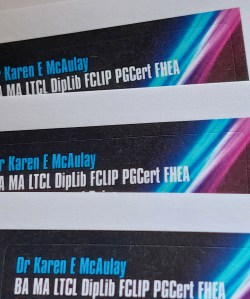
There are times when I feel I’m an embarrassment. ‘Are you writing fiction, or a Boring Book’, asks an elderly relative. Guilty as charged. And again, ‘You shouldn’t have your letters on your address labels, dear. No-one needs to know them – it’s just showing off.’ But what’s the point of being well qualified if no-one knows you are? ‘They said they didn’t want a string of useless qualifications like yours.’ Mmm, thanks!

In Scotland, there’s a phrase, ‘I kennt his faither’, which basically means, ‘I know his background – he’s nothing special and he shouldn’t have ideas above his station.’ I’m not Scottish myself, but I feel I’ve been on the receiving end of this attitude so often! She’s a librarian – why can’t she just be one?

Owning our Own Work

Last week, there was a conference in Glasgow. I didn’t speak at it – I was asked to, then uninvited six months later, for some unclear administrative reason. (I’m pretty sure it wasn’t anything personal!) I didn’t even get told about registration for the event. But to my surprise, I understand that the topic I was to have talked about, did get talked about. I’m grateful that the topic came up, and grateful if my peer-reviewed article was alluded to, but somewhat disappointed that it was relayed by a third party. Was the link shared? Will anyone be able to find it? Obviously, I was denied the chance to take questions, since I wasn’t even present.

Representation of Women Composers in the Whittaker Libraryโ€™,   Journal of Perspectives in Applied Academic Practice. Vol. 11 No. 1 (2023): Special Issue on Breaking the Gender Bias in Academia and Academic Practice, pp.21-26.  (Paper given at the International Womenโ€™s Day Conference hosted by the University of the Highlands and Islands, 2022.)  DOI: https://doi.org/10.56433/jpaap.v11i1.533

What do I mean, when I say that we women should ‘own’ our work? In an employed work context, ‘owning’ seems to mean taking responsibility for seeing something through to the end, but I suggest that actually it can, and indeed sometimes should mean more than that. I’m not thinking about ownership in the sense that a manager assigns you a project and empowers you to make all the necessary decisions to ensure its success, although that kind of ownership is certainly very agreeable. No, what I actually mean is that if you’ve done a significant piece of work, with results that are important enough to be worth sharing, then we should be much less reticent about saying, ‘Thank you, I am proud to have seen that through, and I wish to claim acknowledgment. Here’s where you can read my article. I’m happy to take questions. And if you’re interested, here’s where you can find more of my writing.’

No Apologies

So from that point of view, I’m resolutely determined that I will not apologise for having been ambitious. I will not apologise for realising that librarianship was not my sole raison d’etre, and that research had a louder, more urgent call for me. ‘You’re a bloody librarian, woman!’, I was once told. That, with respect, is incorrect. I’m a librarian and a scholar, inseparably. The librarian benefits mightily from the scholarship, the scholar has bibliographical skills second to none, and the combined finished product also provides pretty top-notch guidance about research skills.

I will not denigrate myself by fading into the background, nor by pretending I don’t have a string of qualifications after my name. Who do I think I am? I know who I am.

I have read about women scholars who always get humdrum administrative tasks dumped on them in their departments. (That hasn’t happened to me – I just sit and catalogue stuff on my librarian days, until I could scream with the tedium. It’s not a sexist thing, just an annoyance.) I’ve also read that when it comes to job applications, men are much more likely to apply for things where they might lack some of the required experience, whereas women will hesitate unless they can tick every box.

Women, we need to ‘own’ our achievements. There’s no sense in being reticent or humble. The other half of the human race aren’t going to give us a chance because we’re nice, gentle and conciliatory, or indeed because we let them go first.

I made a few adjustments to my Twitter profile today. Take a look at yours, and see if it does you justice!


My next post is about career women, ageing, and approaching retirement. Read on! https://karenmcaulaymusicologist.blog/2023/05/23/58-weeks-to-go-how-is-this-meant-to-feel/

Still on the topic of Coronations … this time, 1937

An English publication caught my attention. I had to acquire it.

The paratext was pretty standard for the time …

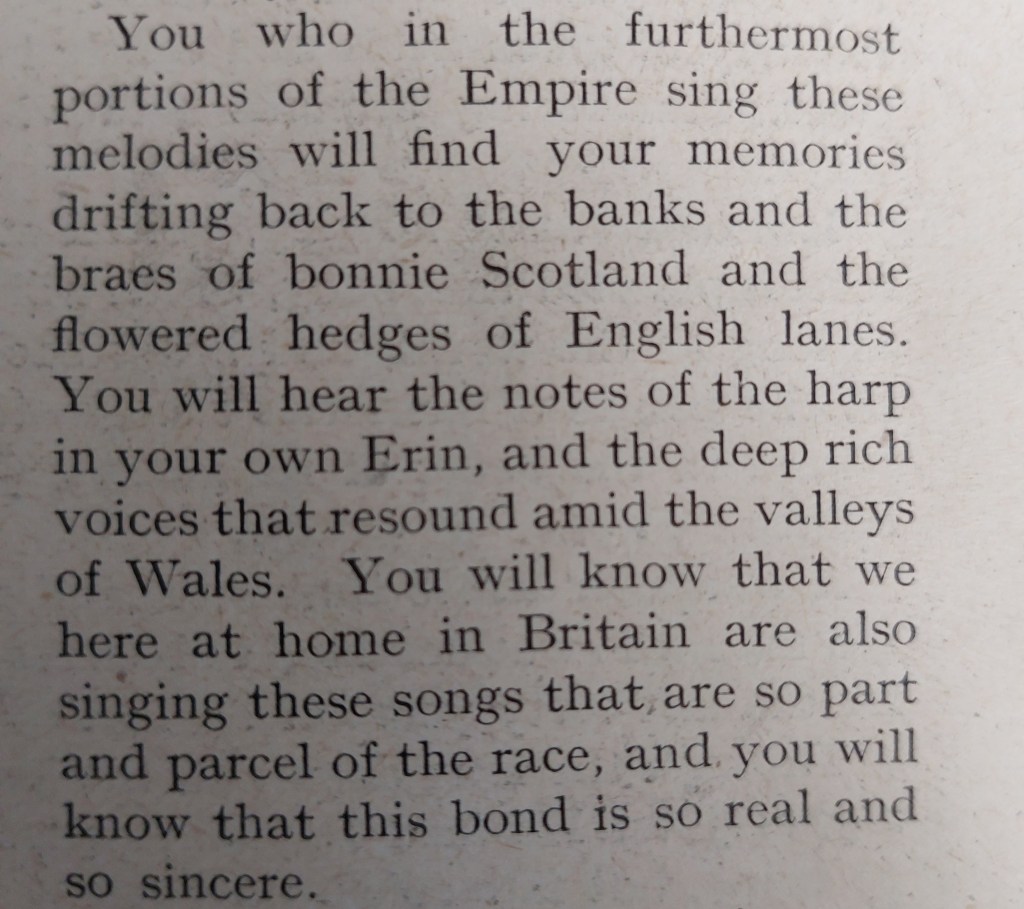
Introduction aimed at ex-pats

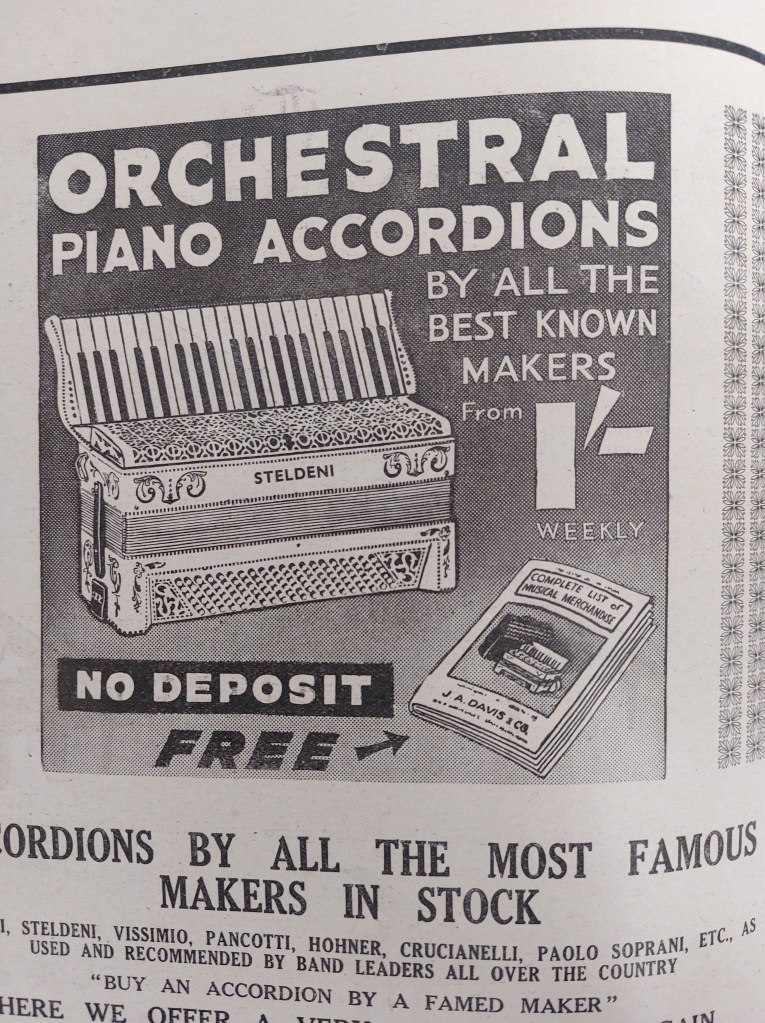
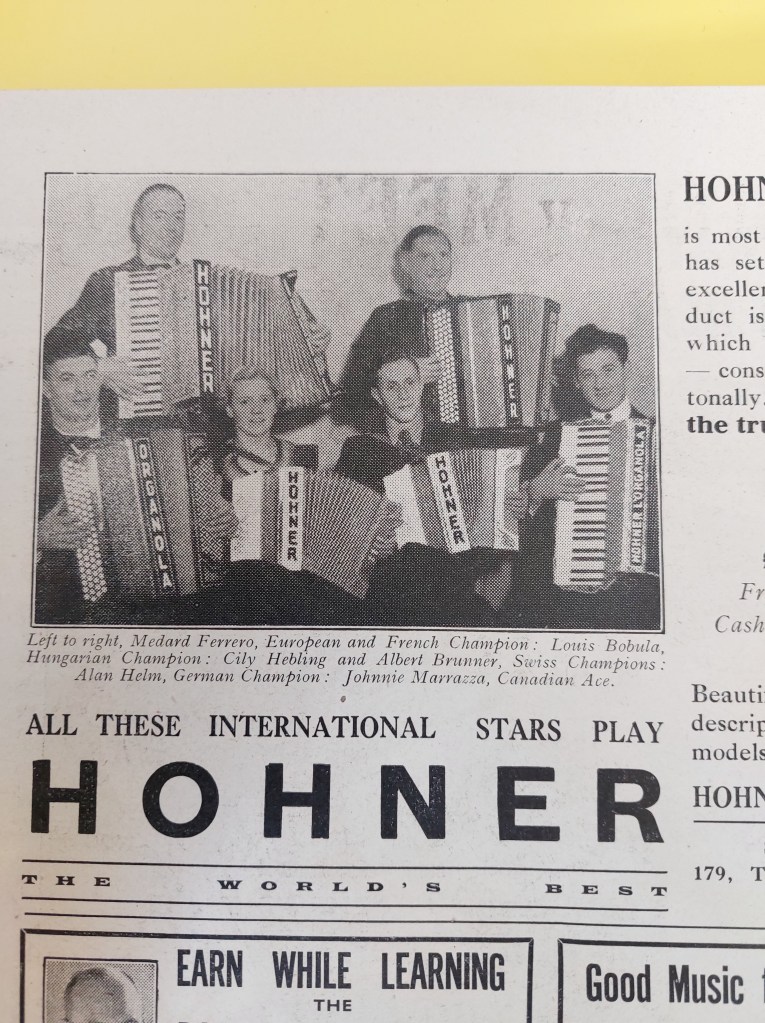
But the adverts were the best bit! Piano, or accordion – take your pick! The idea that you could ‘earn while learning’ amused me mightily. Would your audience appreciate having to pay you for your fumbling efforts?!

Musical instruments advertised in this London coronation song collection

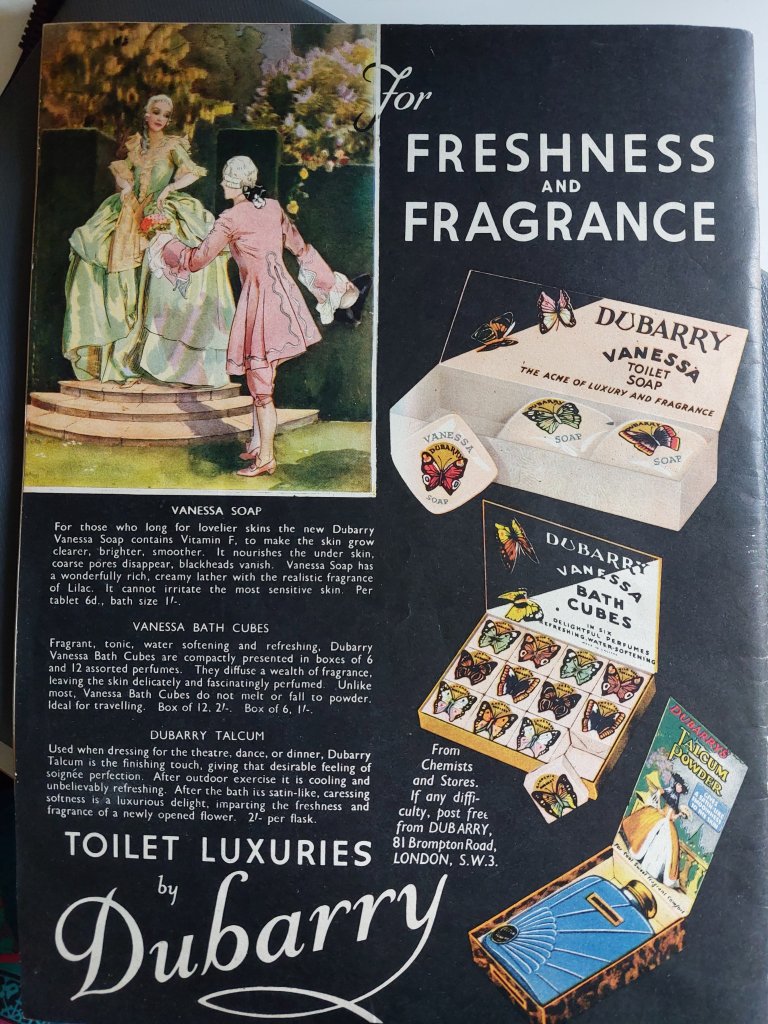
But at the end, a lovely colour advert for soap, bath cubes and talc. De luxe products, for sure:-