Dr Karen McAulay explores the history of Scottish music collecting, publishing and national identity from the 18th to 20th centuries. Research Fellow at Royal Conservatoire of Scotland, author of two Routledge monographs.
Below, you’ll find a blog post that I have just written for the Whittaker Library blog. In my library career, I haven’t changed the world, but I have bought and catalogued quite a lot of music. (Why be modest? Mountains of it!) In the past five years, I’ve focused particularly on equality and diversity – I put a huge amount of effort into it, and I hope it has made a difference to our users. Perhaps one day, there will be an event to raise awareness of all this music. I tried, but I have done all I can. I wish it had been more, and I wish it could have ended more triumphantly.
In an era that’s all about impact and engagement, it can be an up-hill struggle for a librarian to make a significant difference, and even harder to blow one’s own trumpet metaphorically when surrounded by genuine stars in the making, deservedly blowing their own actual trumpets!
Whilst repertoire lists might not seem the most exciting topic in the world, if they’re important to recitalists and other people planning concert programmes, then they’re important to us. We would like to remind everyone that the Whittaker Library does have a lot of music by women and/or BIPOC composers. We’ve committed a fair chunk […]
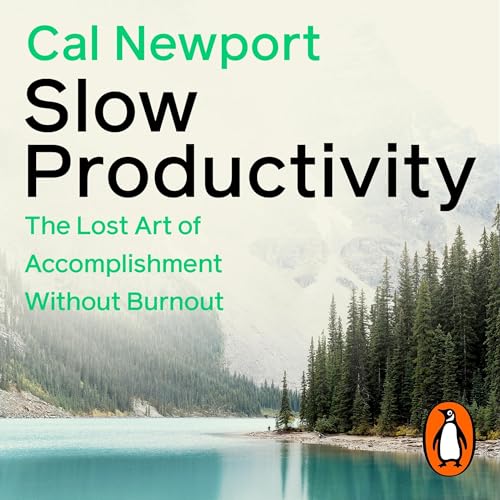
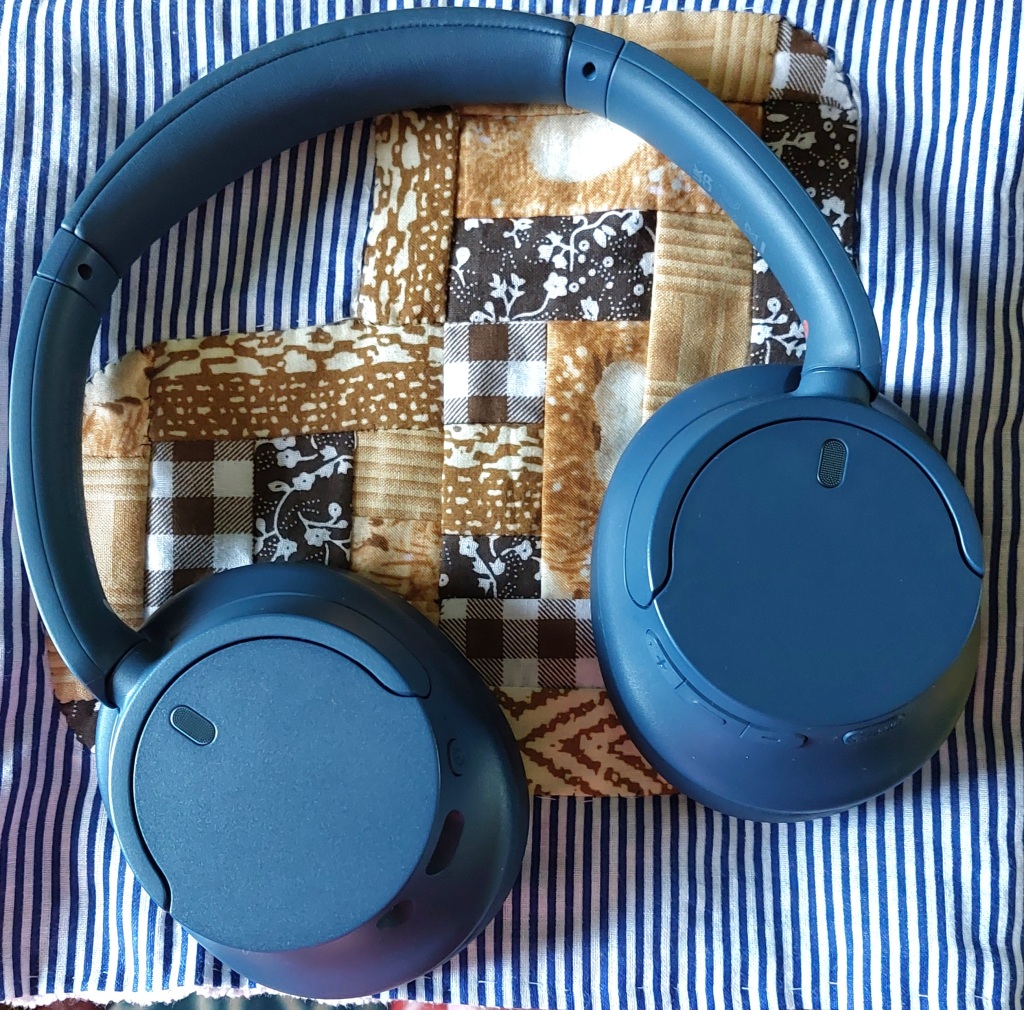
I’ve been listening to Cal Newport’s book, Slow Productivity: the Lost Art of Accomplishment without Burnout, on Audible. I’ve taken my time over it – appropriately – and I’m approaching the end of it. Because I haven’t finished completely, what I’m writing here today can’t really be described as a review, so much as a first impression.
But why, you might ask, would anyone less than two months away from retirement age, decide to read a book about productivity at all? It’s a good question! I think I was both intrigued by the title, and fascinated by the different paces at which different people work. There are times when I achieve a lot – but not usually at a frenetic pace. I don’t throw myself into tasks at fever-pitch, unless a deadline is creeping up on me. On the other hand, I do tend to have so many things on the go, that going slow feels impossible. (And I’m worryingly obsessed about accomplishment and achievements! That’s how I was raised.)
The main thrust of the book is that we ‘knowledge-workers’ should be more deliberate, allow ourselves time to do things well, factor in holidays, breaks and slower-moving spells, and not take on too much. That we’re not like factory workers on an assembly line, and aren’t generally required to produce so many units of whatever-it-might-be, per hour, day or week. Newport’s historical examples are inspiring, underlining his message, but some suggestions have no application to any role I’ve ever occupied. Pay someone to do some part of my work? If I was self-employed, possibly. However, the only time I’ve ever done that, was getting my first book indexed professionally. Librarians don’t outsource their work. (Neither do 0.3 of the week researchers!) Similarly, if you own a business or are freelance, you can deliberately decide to make a little less profit in exchange for a longer, more intentional route towards a high-quality product/performance act/whatever. People employed in any kind of academia can choose to seek a promoted position or not (depending on circumstances, of course), but it’s not about profitability directly affecting one’s own pocket.
Obsess over Quality
However, the suggestion to look at your role and focus on the ‘core activities’ that will have the most impact, is certainly sensible. As I’ve mentioned before, cataloguing barely-used jazz CDs is a soul-destroying task, mainly because it has such little impact. I hardly needed an Audible book to endorse that sentiment, but there it was.
Impactful Librarianship
As I did the ironing one night last week, listening to my book, I think that’s what prompted me to make sure my final weeks of librarianship would have a bit more impact than that! I’ve thrown myself back into tracking down music by BIPOC composers, and it certainly passes the time more quickly than other tasks I could mention!
My aim is simply to make it possible for students to find more diverse repertoire, should they feel so inclined. My efforts won’t result in a massive listing – there are less than a thousand such items tagged in our catalogue, and our budget isn’t huge. It’s not just about getting the materials in – but I won’t be the one devising ways to get it known about and borrowed, after 28 June 2024.
Yesterday, a highlight was discovering one particular new acquisition was already on loan to a second borrower. Result! That in library terms, is impact.
And Impactful Research
As for slow productivity? I need to finish reading Newport’s book and then consider how to apply the best suggestions to a semi-retired existence. At the time I’m posting this, it’s a Wednesday, and I have my research hat on. I have a book review to do, and then I’ll look at my list of projects … because I’m not retiring from research! Far from it.
Coincidentally, a Twitter contact shared the perfect picture – a chained book at a church in Broughton, Bucks. When I think of myself being ‘unshackled from the shelves’, this is precisely the mental picture that comes into my mind! Irreverently, I’m ashamed to admit that the mental picture has a soundtrack: it’s accompanied by a line from a hymn, ‘And can it be?’ In my own defence, hymns have been a large part of my life, and I shall in all probability write a few more myself in retirement, so it’s hardly surprising that this line pops into my head!
My chains fell off, my heart was free …
Making Memories
Friday’s concert programme at RCS
The past week saw me attending two lunchtime concerts – the Strings Department on Monday, and a chamber music concert (two substantial pieces by Dohnanyi and Brahms) on Friday. I wasn’t familiar with the Dohnanyi, but it was a lovely discovery.
Another day, I had tea and a cake at Waterstones – yes, I did buy a book. No surprise there.
Improving Vision
It wasn’t all fun and merriment this week: I had a check-up at the eye department on Thursday. ‘Slow progress’ is certainly still progress, so I’m trying to feel positive about this qualified good news. But ‘fantastic, wonderful progress’ would have been more uplifting … I’m just glad the other eye more than compensates.
Vision for the Future: BIPOC composers
And on Friday, I got back to my efforts in taking steps to increase our coverage of music by historically under-represented composers. More about that in a later posting.
Chained book photo courtesy of Steve, @portaspeciosa, with thanks
Do you remember the old family memory game, ‘I packed my bag, and in it I put ….’ Each successive person has to remember the list, and add something else.
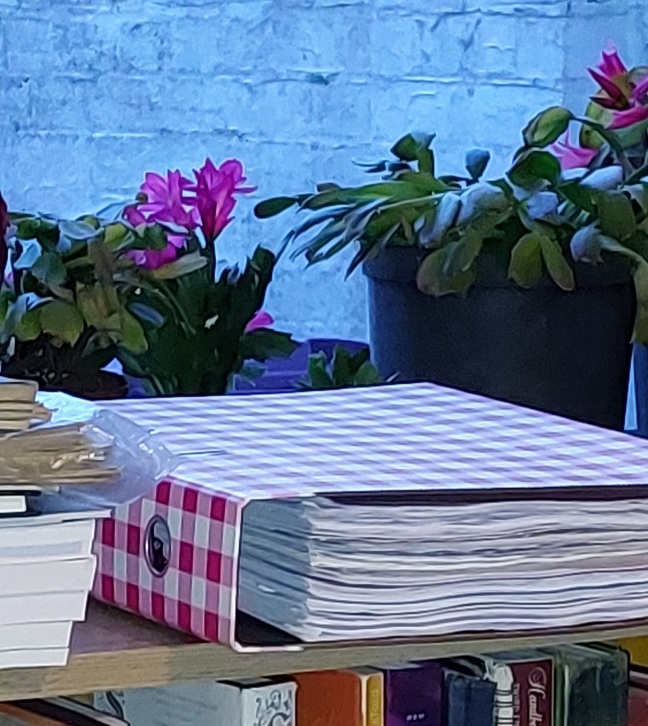
Today, I both literally and metaphorically packed my bag. At the end of the working day, I took home my thick lever-arch file containing Stationers’ Hall research notes. It used to live in the research lab until it ceased to be a working space for staff researchers. Then it had an honoured shelf behind my desk in the library. Then my desk moved to another office, I got a smaller desk in the new office, and lost all but one of my shelves. It’s time for my research notes to go home, one file at a time. Research is something that often lends itself to working from home, though I don’t know where I’ll put the extra files!
Mondays at One: Strings
Since this is a memory game – I also attended a lunchtime concert of the Strings Department, to give myself some more enjoyable memories of my final weeks as a librarian. I heard a fabulous piece by Schnittke for violin and accordion (Suite in the Old Style, op.80); Beethoven’s Piano Trio, op.70 no.2 and Suk’s Piano Trio, op.2. Unfortunately, I had to get back to work after my lunchbreak, so I missed Bartok, more Suk and – sadly – Mancini’s Pink Panther. Ah, well. I did gather some pleasant memories, and I hope I get to hear that Schnittke again in that setting one day. It really was lovely! The original violin and piano piece is very charming, but it was even nicer with accordion instead of piano.
Post Script.
Today’s treat was lunch and a book at Waterstone’s. Research files have all gone home. Bookshelves empty and desk surface clear. (Should I go now?!)
I’m only semi-retiring; I’m leaving the main part of my job, but turning the research secondment into a new part-time contract. The technicalities are one thing: fill in the appropriate forms for receiving your pension. Decide what to do about outstanding holiday entitlement. Set things in motion for a new contract. Wait. Start counting the weeks, and then the days. Wait some more.
As I said in an earlier post, you can try to inject a few fun things into lunch-breaks, to brighten up the days. (I’m grateful to work in a place where there are loads of performances going on.) Meanwhile, you’re still at work in the old job. You know, and everyone else knows, that in a couple of months you won’t be there. In my unrealistic mind, I’d hoped to go out in a blaze of glory, but I don’t feel glorious or triumphant at all. How are you supposed to FEEL?, I asked a considerably older friend. They looked at me in a way that said they’d never asked themselves that!
Clearing Clutter (and Treasures)
I sit cataloguing donations and glumly eyeing piles that everyone would like to be cleared out of the way before I clear off! A late night email (which I found the next day) seemed to hint at that. But if I haven’t cleared the piles of donations by now, working steadily, then am I reasonably going to get the whole lot out of the way in two months? Am I not working hard enough? It’s a bit depressing, actually. On the other hand, when I arrived in 1988, there was a half a rolling stack full of donated materials. I used to wonder if I’d still be needed once I’d catalogued them all. Of course, they were all dealt with decades ago. None of our donations are remotely that old; there aren’t nearly as many; and no, I wasn’t discarded when the original donations were all done and dusted! Maybe it’s unrealistic to expect a final, purging blitz on what’s there now. Leave something for my successors.
Occasionally I get over-excited about treasures that crop up amongst the more routine stuff. (Over 200 years old? How could I NOT be excited?! One of the joys of having two parallel careers is having research knowledge that illuminates historical library materials. Sharing that knowledge sufficiently so that everyone else is aware of the treasures – that’s another thing entirely. Who wants to be trapped by an old librarian keen to share stories about ancient scores and famous poets?)
The Paranoia about Becoming Irrelevant – ‘Yesterday’s News?’
I’ve been keeping a ‘handover document’ for almost a year now, and every so often I think of something to add to it. Often things occur to me after I’ve had to deal with something, and realise that maybe it needs noting down! ‘It won’t be your concern in a few weeks’, my older spouse tells me. It’s hard adjusting to the certainty that things will be done differently once I’m gone. Things that I think should be done one way, will assuredly be done differently, and that’s to be expected. Even the things that I value aren’t necessarily of the same value to other folk – that’s the hard bit! (Mind you, some of the things I value have historical AND monetary value. My valued things aren’t valued without good reason.)
On the plus side, of course, is my list of research things to investigate, calls for papers and articles and chapters. I haven’t run out of steam, intellectually – far from it. My second book about to commence the copy-editing process. A research paper to write for a conference in July. New adventures on the horizon – oh, I really can’t wait for some new adventures! (I’m not a dull cataloguer – I’ve just ended up backed into a wee cataloguing corner. Neither does everyone find cataloguing tedious, but I have really done too much of it!)
You get lots of advice about how to write a CV, how to start your career with a flourish, how to make your mark. How to get on in the world. How to progress. But it seems there’s little advice about how to gracefully bow out!
This isn’t something unique to me – retirals happen all the time. What do other people do? Do you set up appointments to say goodbye to people? (Hard, when I’ll still be around, albeit in a different department.) Do you try to set up one last workshop/seminar/whatever before you go? [Post Script: you don’t!]
Or just try to be inconspicuous until the Last Day arrives?!
At the end of last year, I wrote a Year-end Review, and told myself firmly that it was not for the purpose either of blowing my own trumpet, or making adverse comparisons of my own output with that of other people. I discovered that the best way was to reflect on successes, failures, and what I would do differently next time.
So, what happens? The first time I read someone’s justifiably proud summary of a few weeks’ outstanding triumphs, I creep into my little hole and bemoan the fact that I haven’t achieved half as much.
I am predominantly a Librarian (0.7 FTE)
That means I catalogue stuff, answer queries, and – at present – engage in discussions with a younger colleague so that the handover goes smoothly this summer. (It also means I’m NOT contracted to do scholarly stuff for 70% of my working hours. If I achieve less as an academic, this is the reason – it’s not disinclination or lack of application.)
My library line manager pointed me towards a CFP for an open-access journal, and in January, I researched, wrote, and submitted an article for it. I haven’t yet heard if it’s been accepted – it’s too soon.
I shall be co-delivering a workshop about the library’s holdings of music by underrepresented composers, in March. That’s something I need to plan out fully in February.
I’m also a Postdoctoral Researcher (0.3 FTE)
Bearing in mind that I have 10.5 hours a week as an academic, I am pleased with my own efforts in January. Even though I had to take annual leave, to get some more research hours:-
Second book revised and resubmitted – too soon to expect a response
Abstract submitted for September conference
Abstract submitted for July conference
BBC Scotland: Good Morning Scotland interview
Completed an AHRC Peer-Review
Delivered an Exchange Talk at RCS: ‘From Magic Lantern to Microphone: the Scottish Music Publishers and Pedagogues inspiring Hearts and Minds through Song’
HERE – TONIC SOL-FA IS MUCH PRETTIER IN COLOUR!!
And I’m an Organist
No need to summarise what I’ve done. I play, practise, schedule music and rehearse the choir.
NEILSTON PARISH CHURCH
I Compose
My Extinction Calypso, performed in Edinburgh last year, is set to be performed twice by a choir in a church down in Buckinghamshire in April this year. I’m ecstatic!
In January, I took steps to clarify my future research existence after I’ve retired from the library this summer. It has been massively stressful, actually, but I have taken steps, and look forward to further progress.
I have commitments in February which means I won’t be posting as often on this blog. However, there will be plenty of thinking time, listening time and perhaps some fiddling about on the piano and squeezeboxes later on in the month.
Seriously, why do we do year-end reviews? To show the world what we’re most proud of? Quite possibly. To convince ourselves – and the world – that really, we’ve been very busy and deserve a pat on the back? Perhaps so. I took to the internet to find out why businesses do reviews, and why a career-minded individual might do one of their own.
Consulting the Experts
Braze.com said that year-end reviews offer the chance to ‘create distinctive content’; to ‘build loyalty’ and to remind the world what your particular business does best. To that end, obviously you log milestones, achievements and events. You use multimedia formats, and draw upon customer data. This all makes sense, although I don’t know that I, as an individual, can do all these things. (No customers, for a start!)
I tried again, and found a Harvard Business Review posting about, ‘How to create your own “Year in Review“. There’s plenty of sound advice here, suggesting that I should pause and reflect upon successes and failures; lessons learned; proudest achievements; who has helped me most; how my strengths have helped me to succeed; and whether there’s anything I wish I’d done differently. This is much more introspective, and certainly valuable advice. Whether I’d want to blog about all these headings is a moot point, though.
For me, I have an extra conundrum. I shall be retiring from the Whittaker Library at the beginning of July. I hope to continue the research element of my work, though. So – in one sense I’m writing a career-end review, as far as librarianship is concerned, but it’s not a career-end review for me as a researcher.
The Harvard Business Review suggests using your diary to capture key events on which to reflect. I spent a few minutes doing just that, yesterday. Immediately, I realised that there’s one thing I’m proud of over everything else, and that is that although I spend 85% of my time as an academic librarian, my 15% as a postdoctoral researcher is actually highly productive.
What do I do best? I get things done.
‘She’s a Librarian’
I confess, I don’t like hearing this! It makes me feel as though my research activity is dismissed as dilettantism – that I don’t do badly, considering research isn’t my main role. On the other hand, a fly on the wall would point out that yes, I do spend the majority of my time as a librarian.
Jazz CDs – not a Highlight
So, what did my diary exercise reveal? I’ve catalogued a lot of jazz CDs. This causes me to feel quite a bit of resentment, because I know our readers don’t generally listen to CDs as a format, so all my efforts are to very little avail indeed. Maybe that’s one of the things that I wish I’d done differently. It’s not a high-priority task; however, I am conscious that I don’t want to leave the backlog to my successor. And that’s why I do this dreadfully tedious and repetitive activity!
Retrospective Post Script: that jazz CD cataloguing was indeed a waste of time. I did it because the promise had been made that those CDs (thousands of them) would be catalogued. I didn’t make the promise, but I did feel the obligation to fulfil the promise. My resentment was because it used so little brainpower and expertise, provided so very little fulfilment in the moment, and so little benefit in the long-term.
Equality and Diversity: Stock Development
What I’m more proud of is my efforts to get more music by women and composers of colour, into the library, and most particularly, to ensure that our staff and students know just how much of it there now is in our stock. With a colleague from the academic staff, I’m concocting a plan to raise the profile of this material.
I also suggested maybe there might be a prize for diverse programming …
And I just heard – there is going to be such a prize – it really is happening. A red letter day!
For me, a particularly proud moment was being invited to attend a Masters student’s final recital in June, at which one of these new pieces was played. It was a piece requested by a member of staff – I don’t think it was me that actually stumbled across it – but I certainly sourced it, catalogued and listed it. Whilst I’m heartily sick of cataloguing, I do take pleasure in stock development, and in ensuring there are ample means of discovering the music once we have it.
In September, I was gratified that one of our performance departments reached out to me to request more materials by under-represented composers – a sign that the message is getting through, and that staff appreciate that the library really is trying to help.
Since October, I’ve also been broadening the stock of music inspired by climate change and ecology, including songbooks for school-children, since we have a number of music education students. That pleases me, too.
What else? Dealing with donations to the library, some eagerly received and others needing sifting through. Weeding stock to ensure there’s room for new material, and ensuring that tatty material is removed or replaced depending on how much it’s likely to be used.
User Education
Some things are cyclical – most particularly providing initial library introductions, and later talking to different year-groups about good library research practice. In June, I gave a talk about bibliography to the Scottish Graduate School of Arts and Humanities, which attracted far more of an audience than I’d ever dreamt of!
Queries, and Research-Related Activity
I’ve also dealt with queries – such as one from a Polish librarian, or another from an elderly enquirer wanting to trace music remembered from childhood. And I talked about my research activities at a library training session, even though I was rather afraid of wasting colleagues’ time going on about something that might not feel very relevant. (This autumn, I also obtained and catalogued – in detail – a book of Scottish songs that I have written a book chapter about. It would be dreadful, wouldn’t it?, if someone read the chapter but couldn’t find the song-book in the library!)
Professional Activity
Professionally, I managed the comms for the IAML Congress in Cambridge this summer (with a little bit of help from mascots Cam, Bridge and Don and a couple of fellow IAML (UK & Ireland) librarians, and I think it went quite well. The stats for the blog and Twitter (“X”) rose gratifyingly during this period. I went to a couple of days in Cambridge, but I didn’t speak this time.
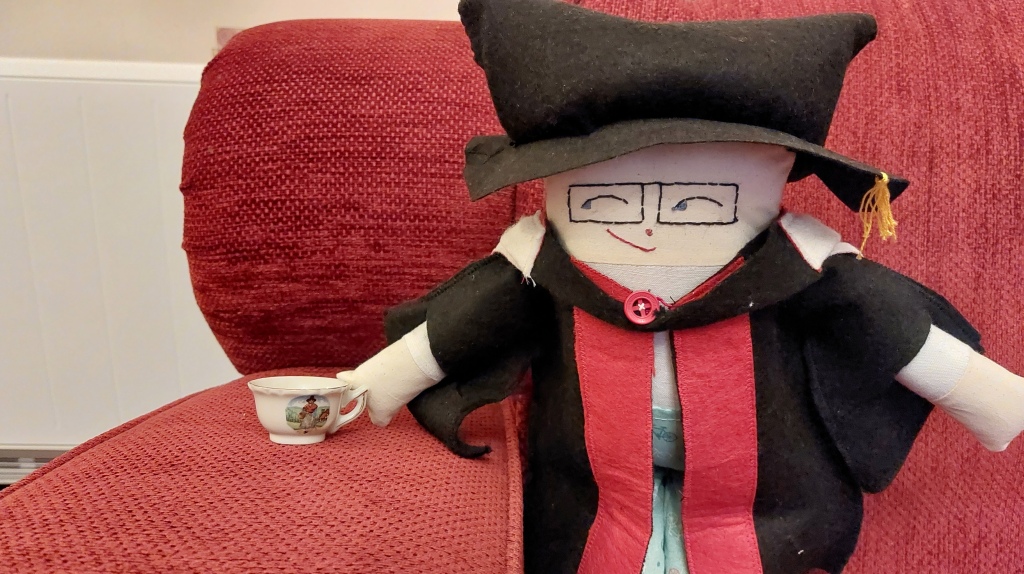
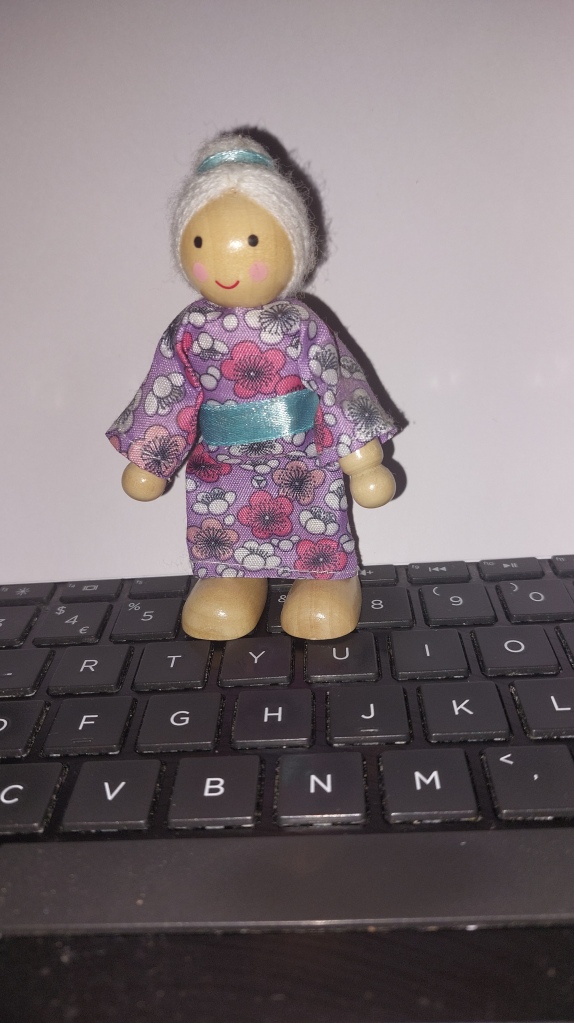
IAML Congress mascot Don
A Researcher with Determination
Early on in 2023, I was gratified to receive an LIHG (Library and Information History Group) Bursary to attend a conference at the University of Stirling between 17-19 April, which was about Reading and Book Circulation 1650-1850. This was to be the first of two major successes this year, for I was also elected the inaugural Ketelbey Fellow in the Institute of Scottish Historical Research at the University of St Andrews. I’ve written extensively about this experience in other blog-posts, so I won’t duplicate it here. However, I can’t resist reminding myself of highlights!
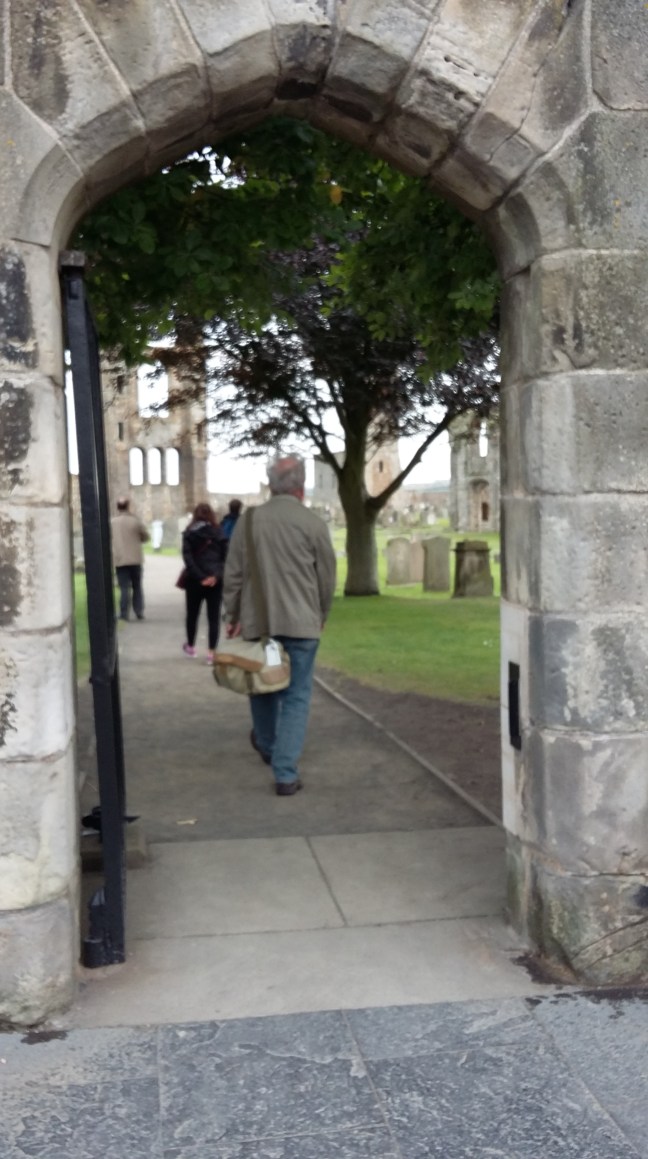
Researching key documents in Martyrs’ Kirk Reading Room
Attending both fortnightly research lectures, and ISHR pub lunches on alternating weeks
Many enjoyable hours concentrating on my book revisions – with a view of the sea!
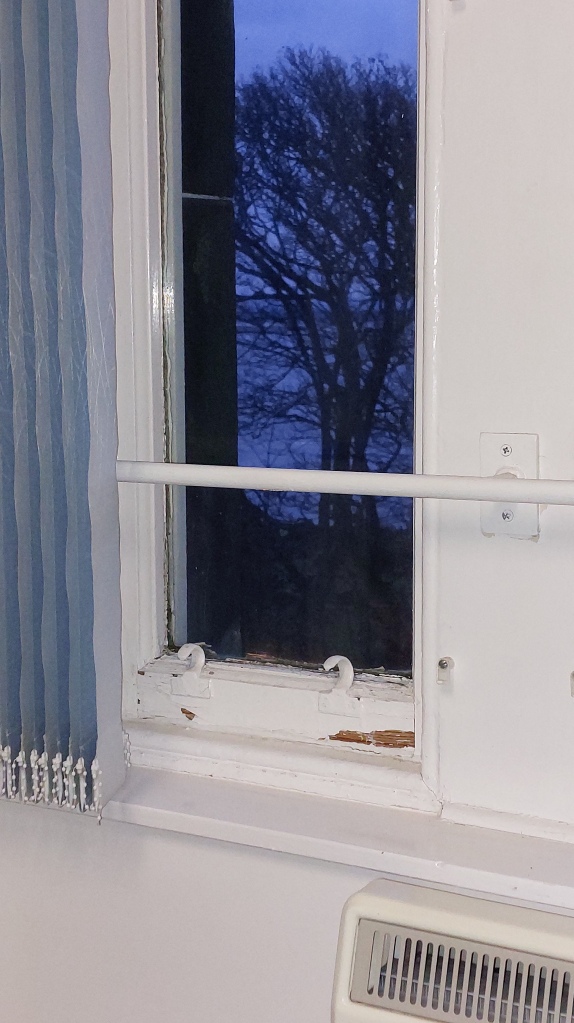
Twilight from my window, St Katharine’s Lodge, St Andrews
We’re not going on a (sniff!) Summer Holiday …
Being a researcher for 15% of the time is not easy – there simply isn’t the time to do all I want to do. Far from ‘dabbling’ in research, I take this side of my work very seriously indeed. I might have been a librarian most of the time, but I have devoted far more than the designated 10.5 hours a week to my research activity! I took annual leave in the summer to get my book draft completed, and took more annual leave to enable me to spend two, rather than 1.5 days researching in St Andrews. I’m doing it again next week; the book revisions must be completed and submitted very soon, and if the only way I can do it is by taking holiday, then that is what I must do.
In January, I wrote an article for the Glasgow Society of Organists, about a Paisley woman organist and accompanist whom I’d discovered during research over Christmas 2022. Even though it wasn’t for a scholarly journal, it was research done to my usual standard, and I’ve drawn upon that research in one of the chapters in my forthcoming monograph.
I’ve peer-reviewed an article, a book manuscript and a grant application. Considering all that I’ve had on my plate this year, I’m quite proud that I did manage to do these things. I don’t attend reading groups, and I’m not always able to attend research-related events that fall in ‘library time’ – I don’t want to give the impression I’m skiving off library work! But I do want to feel part of the research community, and that was precisely what was so magical about my Fellowship in St Andrews. For those two days a week, I was a researcher, pure and simple.
Roll on 2024! What am I going to do differently?
I’m looking forward to the summer. I feel I’ve been a librarian long enough. I’ll miss doing the user education, and rising to the challenges posed by unexpected or unusual queries. I shan’t be sorry to quit cataloguing, particularly jazz CDs!
I don’t actually have any ‘retirement’ plans as such. Apart from having more time to spend on my role as Honorary Librarian of the Friends of Wighton in Dundee. Whilst I live on the other side of Scotland, at least I shall have more opportunities to leap on a bus or train to get to Dundee Central Library to look after the repertoire that I love.
Little old lady? Not me!
Not Entirely Retiring!
I don’t feel remotely like a little old lady! I hope I’ll continue as a postdoctoral researcher in my present institution, but I’m also keeping my eyes open for any other part-time opportunities that I could pursue alongside that. ’Actively looking’, is the phrase, I think.
With a colleague in another institution, we’re cautiously planning a new research idea. And I also have strands of research that I commenced for my book, but hope to pursue in greater depth once this book is safely further along the publication process. Watch this space.
When my line-manager suggested I could give colleagues an update on my current projects and plans, I must confess I freaked out a little bit. Everyone else was talking about things happening in our library. I worried that ‘What Karen gets up to when she’s not being a librarian’ might come across as a boast-fest. It wasn’t about library news and developments, or services, or anything like that. I don’t research librarianship – I research music. My ‘research family’ are interested, but there’s no reason why anyone else should be! I tried to be absolutely factual, and to demonstrate how I chose my research subject because I wanted to study something relevant to students on one of the degree courses at the Conservatoire. I wanted it to be useful.
I was once told people’s attention begins to wander after 20 minutes – so I allowed myself about five minutes – three quarters of a Pecha Kucha presentation. Hopefully, that wouldn’t be too long?
First I had to explain my interest in research. I shared that, back in 2004, I decided to fund myself to study for a PhD, in my spare time. (I had never finished the one I had once studied for in Exeter before I even trained to be a librarian. Believe me, it wouldn’t have been useful in the workplace. Cantus firmus treatment in fifteenth century English polyphony? Definitely only for mediaeval enthusiasts! I had started writing that first thesis, but think I lost interest partly for that very reason.) To keep myself interested, the new PhD topic had to be relevant to RCS, and my circumstances (a full-time working mum with three primary-school aged sons) meant the university had to be local. That’s how I ended up researching Scottish music at Glasgow Uni. I hoped the knowledge gained would be useful.
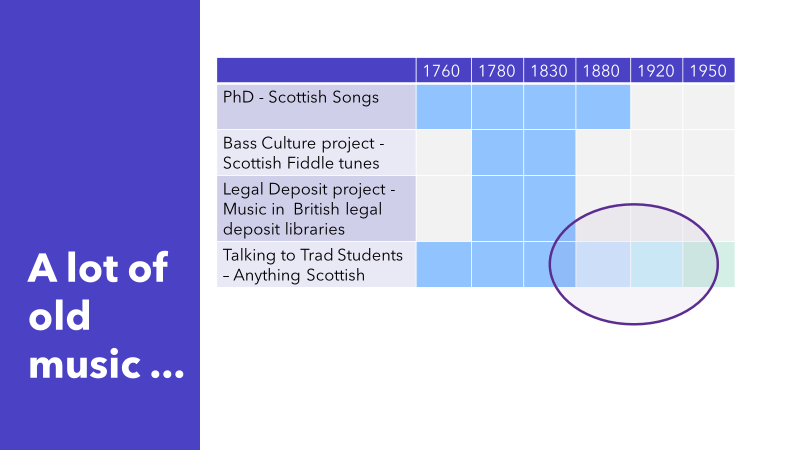
Next, I described how the Scottish song-collectors that I researched for my PhD, lived a long time ago, and even my subsequent research projects stopped when Queen Victoria was young. This meant that whenever I was asked to talk to our trad music students, I found that I had less to say about the 20th century Scottish song-books in our collection. However, I didn’t want to leave the impression that nothing much happened between 1920 and the second half of the 20th century. (The teaching staff cover the recent history, so that didn’t concern me much!)
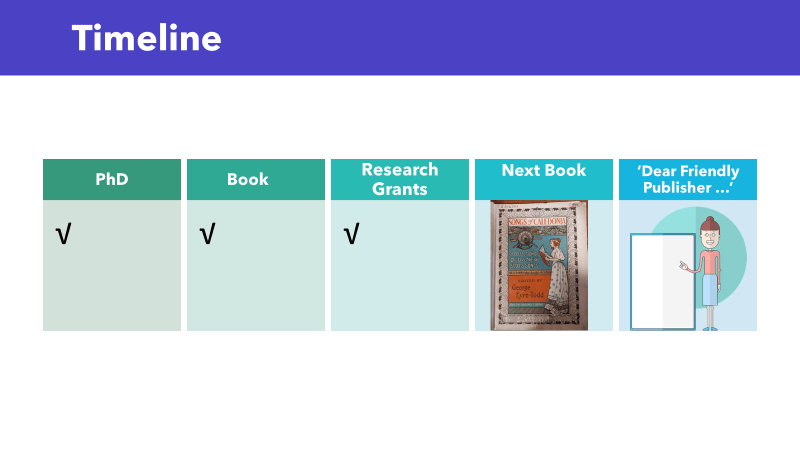
I explained that, having done the PhD and a couple of research projects, I decided I wanted to write another book, to fill in the gap I’d identified. I approached my publisher again.
A Social History of Amateur Music-Making and Scottish National Identity: Scotland’s Printed Music, 1880-1951
Naturally enough, I suggested a title at that point. But in the end, my publisher chose a better title for me – this one – when I signed the contract. It says exactly what it ought to say, but it’s a bit long! However, the book is about amateur music-making, because that’s what Scottish music publishers published – and it is about national identity, because they published so many Scottish songbooks! A long, accurate title can only be a good thing. Without a word of a lie, if anyone asks why the library has so many Scottish song-books, the answer is that it’s because they reflect different interpretations of national identity over a couple of hundred years. And my book will hopefully back this up!
My narrative began in 1880, because that’s where my first book stopped. I decided the book would finish in 1951. As well as some significant events that year, it marked when television came to Scotland. That was one topic too many; and my music publishers were dying out anyway!
I described what the book is about. It begins by focusing on two Glasgow publishers (I may have mentioned the occasional woman publisher or RCS woman piano teacher … )
Then I wrote about dance music – I may also have mentioned racism in Victorian music – and I wrote about books of songs for children. I wrote about Scottish songbooks costing a lot – and very little.
I wrote about educational music published by the Scottish music publishers, and I wrote about the publishers’ efforts to get Scottish music to expats who had emigrated.
Although I never intended to write about recording music or broadcasting it on the radio, the publishing and recording and broadcasting all seemed to be connected in different ways, so … I covered that too.
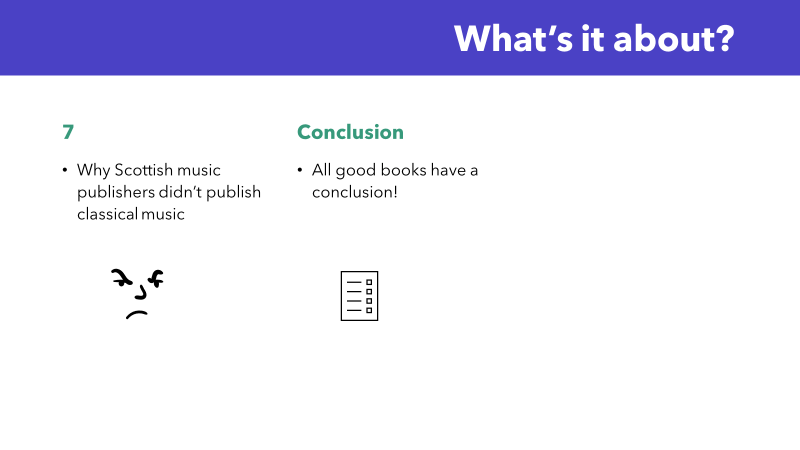
And then when I’d done all that, I decided to write about why Scottish music publishers didn’t publish classical music.
My book has been sent to the publisher; there will be reviewing and editing and indexing before it’s ready to actually be published. I’m waiting to hear if the reviewer liked it, right now. Nail-biting times!
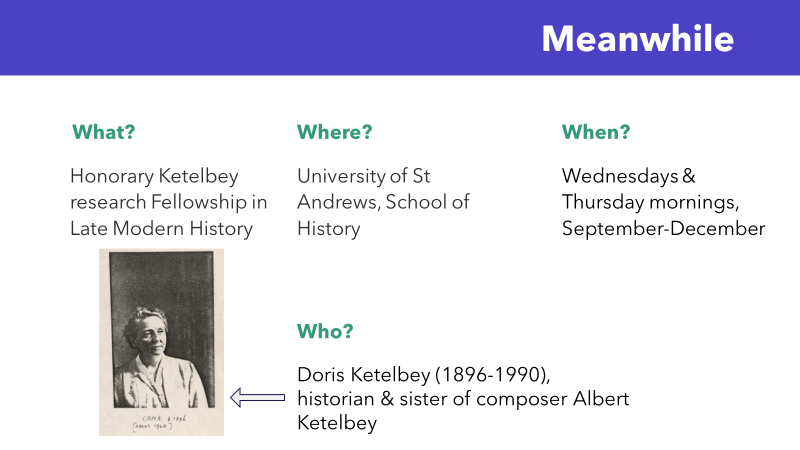
Hoping that my audience weren’t getting tired of the sound of my voice, I also mentioned that I’m about to take up a temporary honorary research fellowship at the University of St Andrews, in the School of History, from September to December. It’s the first Ketelbey Fellowship, named after the first woman history lecturer in St Andrews. Doris’s brother was an English composer – we have some of his music. I’ll be in St Andrews on Wednesdays and Thursdays, but still working back in RCS Whittaker Library the rest of the week. I anticipate editing the book, doing some more research, getting to know other scholars in the department, and I’ve been invited to give a couple of lectures – one in History and one in the Music department.
Next summer, I’ll be retiring from the library, but I hope I’ll still be a part-time researcher at RCS. If anyone else needs a part-time researcher, do get in touch – I couldn’t stand a retirement filled with daytime TV! I freely admit – I’m the librarian that is utterly sick of cataloguing, but loves doing research. An embarrassing oddity? Can’t be helped. Ideally, I’d like my book to have been published by the time I retire from librarianship, but who knows? Meanwhile, the fellowship gives me the opportunity to build up the research side of my profile.
I didn’t want to be boastful – I hope it didn’t come across that way! But at the same time, I didn’t want to sell myself short, and I didn’t want to be apologetic for being who I am. I hope I succeeded!
I omitted to note that this week is my 35 year anniversary of being in the same library post at RCS. Having said that, I have …
Had 3 children (minimum maternity leave each time) and seen them grow up.
Done a self-funded PhD in my spare time; also gained Fellowship of CILIP and Advance HE. Nearly forgot – I did a PGCert too. My commitment to CPD is, I suggest, exemplary!
Published a book;
Written a number of articles and papers etc;
Nearly finished the second book;
Am looking forward to a part-time visiting fellowship in my part-time research secondment.
I just haven’t managed a promotion 😕. Still, apart from that big fail (a single, male former colleague once said that anyone who didn’t move on and up was not a success), at least I have some other successes to my name!
The government moved the goalposts – when I started work, I imagined I’d have retired by now. Instead, I’ve worked an extra five years, with one more to go. I shall hit 66 in summer 2024. I don’t want to retire entirely, but I must confess I’m utterly bored with cataloguing music! (Except when it turns out to be a weird little thing in a donation, perhaps shining a light on music education in earlier times, or repertoire changes, or the organisation behind its publication – or making me wonder about the original owner and how they used it … but then, that’s my researcher mentality kicking in, isn’t it?!)
Status Quo: Stability and Stagnation
Everyone knows I’m somewhat tired of being a librarian. Everyone knows that my heart has always been in research. Librarianship seemed a good idea when I embarked upon it, and it enabled me to continue working in music, which has always been my driving force. But the downside of stability – and I’d be the first to say that it has been welcome for me as a working mother – has been the feeling of stagnation. No challenges, no career advancement, no extra responsibility. Climbing the ladder? There was no ladder to climb, not even a wee kickstep! (I did the qualification, Chartership, Fellowship, Revalidation stuff. I even did a PhD and a PG Teaching Cert, but I never ascended a single rung of the ladder.)
In my research existence, I get a thrill out of writing an article or delivering a paper, of making a new discovery or sorting a whole load of facts into order so that they tell a story. I love putting words on a page, carefully rearranging them until they say exactly what I want them to say. I’m good at it. But as a librarian, I cannot say I’m thrilled to realise that I’ve now catalogued 1700 of a consignment of jazz CDs, mostly in the same half-dozen or so series of digital remasters. (I’d like to think they’ll get used, but even Canute had to realise that he couldn’t keep back the tide. CDs are old technology.)
The Paranoia of Age
But what really puzzles me is this: when it comes to the closing years of our careers, is it other people who perceive us as old? Is age something that other people observe in us? Do people regard us as old and outdated because they know we’re close to retirement age?
Cognitive Reframing (I learnt a psychology term!)
Cognitive reframing? It’s a term used by psychologists and counsellors to encourage someone to step outside their usual way of looking at a problem, and to ask themselves if there’s a different way of looking at it.
So – in the present context – what do other people actually think? Can we read their minds? Of course not. Additionally, do our own attitudes to our ageing affect the way other people perceive us? Do I inadvertently give the impression that I’m less capable? Do I merely fear that folk see me as old and outdated because Iknow I’m approaching retirement age? A fear in my own mind rather than a belief in theirs?
How many people of my age ask themselves questions like these, I wonder?
Am I seen as heading downhill to retirement? Increasingly irrelevant? Worthy only to be sidelined, like the wonky shopping-trolley that’s only useful if there’s nothing else available?
Is my knowledge considered out-of-date, or is it paranoia on my part, afraid that I might be considered out of date, no longer the first port-of-call for a reliable answer?
When I queue up for a coffee, I imagine that people around me, in their teens and early twenties, must see me as “old” like their own grandparents. And I shudder, because I probably look hopelessly old-fashioned and fuddy-duddy. But is this my perception, or theirs? Maybe they don’t see me at all. Post-menopausal women are very conscious that in some people’s eyes, they’re simply past their sell-by date. I could spend a fortune colouring my hair, and try to dress more fashionably, but I’d still have the figure of a sedentary sexagenarian who doesn’t take much exercise and enjoys the odd bar of chocolate! (And have you noticed, every haircut leaves your hair seeming a little bit more grey than it was before?)
Similarly, I worry whether my hearing loss (and I’m only hard of hearing, not deaf) causes a problem to other people? Does it make me unapproachable and difficult to deal with? I’m fearful of that. Is it annoying to tell me things, because I might mis-hear and have to ask for them to be repeated? Or do I just not hear, meaning that I sometimes miss information through no fault but my own inadequate ears? Friends, if you thought the menopause was frightening, then believe me impending old age is even more so. I don’t want to be considered a liability, merely a passenger. And I know that I’m not one. But I torment myself with thoughts that I won’t really be missed, that my contribution is less vital than it used to be.
Gazing into the Future
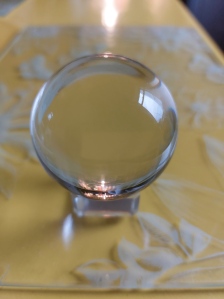
Crystal Ball Gazing
I wonder if other people at this stage would agree with me that the pandemic has had the unfortunate effect of making us feel somewhat disconnected, like looking through a telescope from the wrong end and perceiving retirement not so much a long way off, as approaching all too quickly? The months of working at home have been like a foretaste of retirement, obviously not in the 9-5 itself (because I’ve been working hard), but in the homely lunch-at-home, cuppa-in-front-of-the telly lunchbreaks, the dashing to put laundry in before the day starts, hang it out at coffee-time, or start a casserole in the last ten minutes of my lunchbreak. All perfectly innocuous activities, and easily fitted into breaks. But I look ahead just over a year, and realise that I’ll have to find a way of structuring my days so that I do have projects and challenges to get on with.
Not for me the hours of daytime TV, endless detective stories and traffic cops programmes. No, thanks! Being in receipt of a pension need not mean abandoning all ambition and aspiration. I want my (hopeful) semi-retirement to be the start of a brand-new beginning as a scholar, not the coda at the end of a not-exactly sparkling librarianship career. If librarianship ever sparkles very much!
I’m fortunate that I do have my research – I’m finishing the first draft of my second book, and looking forward to a visiting fellowship in the Autumn. As I wrote in my fellowship application, I want to pivot my career from this point, so that I can devote myself entirely to being a researcher, and stop being a librarian, as soon as I hit 66. And I want to be an employed researcher. I admire people who carve a career as unattached, independent scholars, but I’d prefer to be attached if at all possible!
Realistically, I will probably always be remembered as the librarian who wanted to be a scholar. At least I have the consolation of knowing that – actually – I did manage to combine the two.


















 Karen McAulay, Musicologist