Dr Karen McAulay explores the history of Scottish music collecting, publishing and national identity from the 18th to 20th centuries. Research Fellow at Royal Conservatoire of Scotland, author of two Routledge monographs.
But I hope that whilst I’m there, I’ll also be able to chat to friends about my new research project – Silver and Gold Leng Medal Memories. You may recall that I blogged about the project a couple of days ago.
My research is made possible with the support of an Athenaeum Award from the Royal Conservatoire of Scotland.
Already, several people have been in touch, and I’ll be responding next week. I can’t wait to hear everyone’s stories, and it’s clear there are hundreds of people out there who participated in this competition!
Would you like to help me? If so, I’d be very grateful if you could fill in a very short questionnaire, and I’ll get back in touch as soon as I can to arrange an interview with anyone who has a story to tell!
A strange coincidence occurred to me last week – I encountered conductor Landon Ronald in two quite different research contexts.
Firstly, I knew that soprano Flora Woodman appeared in at least a couple of concerts with Landon Ronald (1873-1938), Principal of the Guildhall School of Music. (Possibly more – but I was mainly focusing on her repertoire as I went through her logbook and scrapbooks.) However, I did note in her scrapbooks of press-cuttings, en passant, that she wished it to be clarified that she was not his protegee. Interesting – but there’s really nothing more to be said. If she wasn’t, she wasn’t.
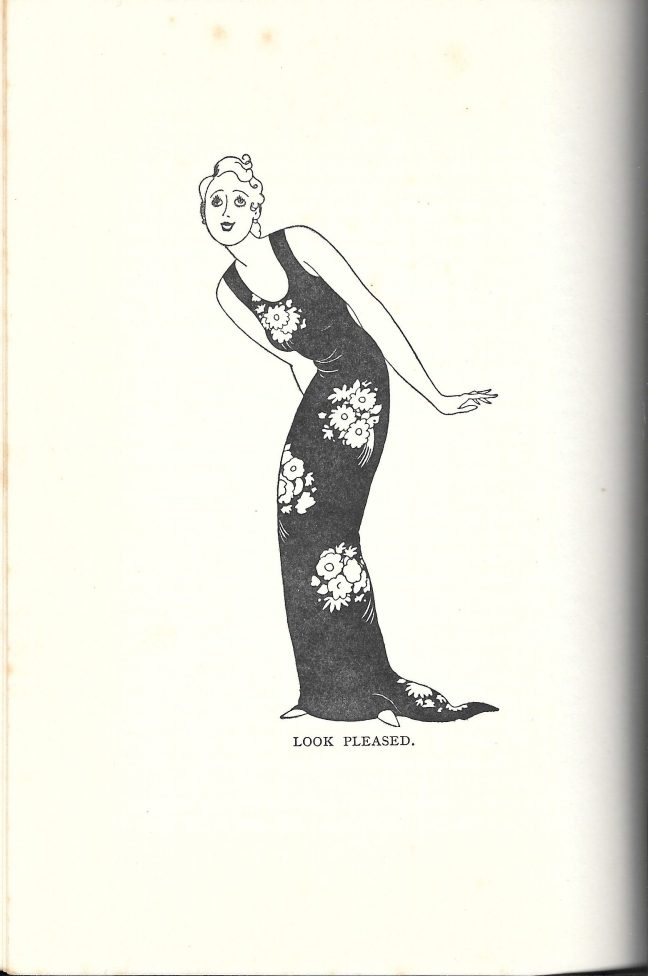
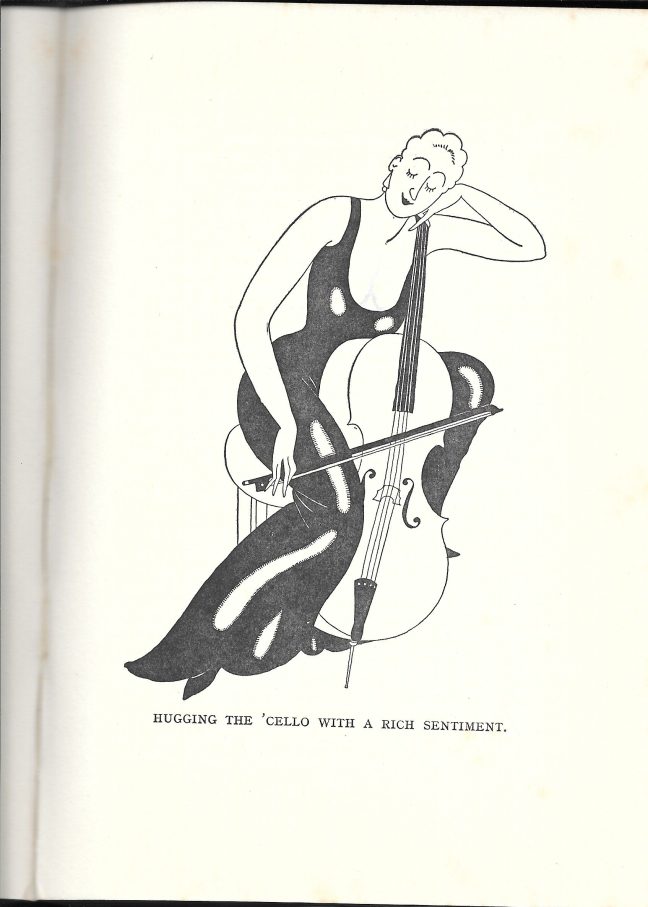
Nonetheless, I had also encountered Landon Ronald in a different context last week. In 1936, Thomas Nelson published a book, Let’s Get up a Concert by Rodney Bennett (1890-1948, father of composer Richard Rodney Bennett) and H. S. Gordon, with a preface by Sir Landon Ronald and Illustrations by Joyce Dennys. Landon Ronald again! Nothing to do with Woodman this time. Indeed, it may not have a great deal to do with Landon Ronald either. I’ve found no evidence that he didn’t author the preface, but I do have evidence that someone else paid a ‘big name’ to put their signature to a preface for another book, in full knowledge that the ‘big name’ could be mentioned in book promotions and would undoubtedly add appeal and authority to the book. If Thomas Nelson allowed one author to do this, who’s to say they didn’t with others too?
Now aged 63, Ronald was still Principal of Guildhall, but he says he no longer promotes concerts. He alludes to his experience of ‘hundreds of orchestral concerts in the Summer Season on Sunday evenings at that most democratic of all holiday resorts, Blackpool’ (yes, Flora performed in Blackpool too) – ‘and an unbroken series of four hundred Sunday afternoon orchestral concerts at the Royal Albert Hall.’ (Plenty more about him on the CHARM website, which is the AHRC Research Centre for the History and Analysis of Recorded Music.)
But back to Bennett’s book. Part Two consists of practical advice to performers: dealing with nervousness, platform technique –
However much you desire to pop off like a frightened rabbit, don’t.
‘Walk like a Dancer’
The eager would-be concert performer is advised to ‘learn from professionals’ (p.135) especially from foreign artists, whom Bennett says are more accomplished in this regard – and about ‘pleasing the eye’ (p.136). You must ‘walk like a dancer’, and ‘support [the man in charge*] with unfaltering loyalty’, whilst pianists should appear to be a ‘natural, kind-hearted, happy human being’.
In fact, dated as it seems in some respects, there’s a lot of useful advice in this book. I can only commend the individual who presented it to Penarth County Girls’ School* Library in 1946. It would have been helpful at the time, and a lot of it still is. The illustrations are decidedly tongue-in-cheek, but on the plus side, they don’t patronise the intended audience – advice is always easier taken if the advice giver uses a touch of humour! The artist, Joyce Dennys (1893-1991) was a cartoonist and illustrator. The book perfectly fits into Thomas Nelson’s lists, with their emphasis on providing self-improvement, self-educational material for the intelligent layperson. You might be a teacher needing more guidance on laying on concerts, a nervous and somewhat inexperienced performer, or an organiser of any number of different kinds of musical entertainment, and this title would have plenty of accessible, useful advice.
Of course, platform etiquette would have been second nature to a superstar like Flora Woodman, who would probably have needed little advice after her first few performances. (Neither, I imagine, would she have liked the suggestion that foreign artistes had more stage presence! My gut feeling is that she had it by the bucketful.) She was mixing with professionals of the highest calibre, in Britain’s best concert halls.
I’ve already posted details of some of her fabulous wardrobe, and it would become rather dull if I went on producing lists. But I noticed today how she liked to ring the changes with glamorous accessories. They wouldn’t be wise choices today, but hey, this was a century ago. So – I spotted white fox, ermine, beaver and swansdown, as well as velvet hats, black tulle, hydrangeas, lilacs, pink flowers, a wreath (garland?), and regular adornments of silver (silver what? she doesn’t say). Also, even within a couple of years, she updated her outfits, with ‘second editions’ of her black and white, and pink and pearl ensembles. (Once again, do use your imagination – I’ve given you plenty to work on!)
Meanwhile, excuse me whilst I browse through Rodney Bennett’s book a bit more …
*Yes, Bennett does talk about ‘the man in charge’. It was a different age – don’t shoot me!
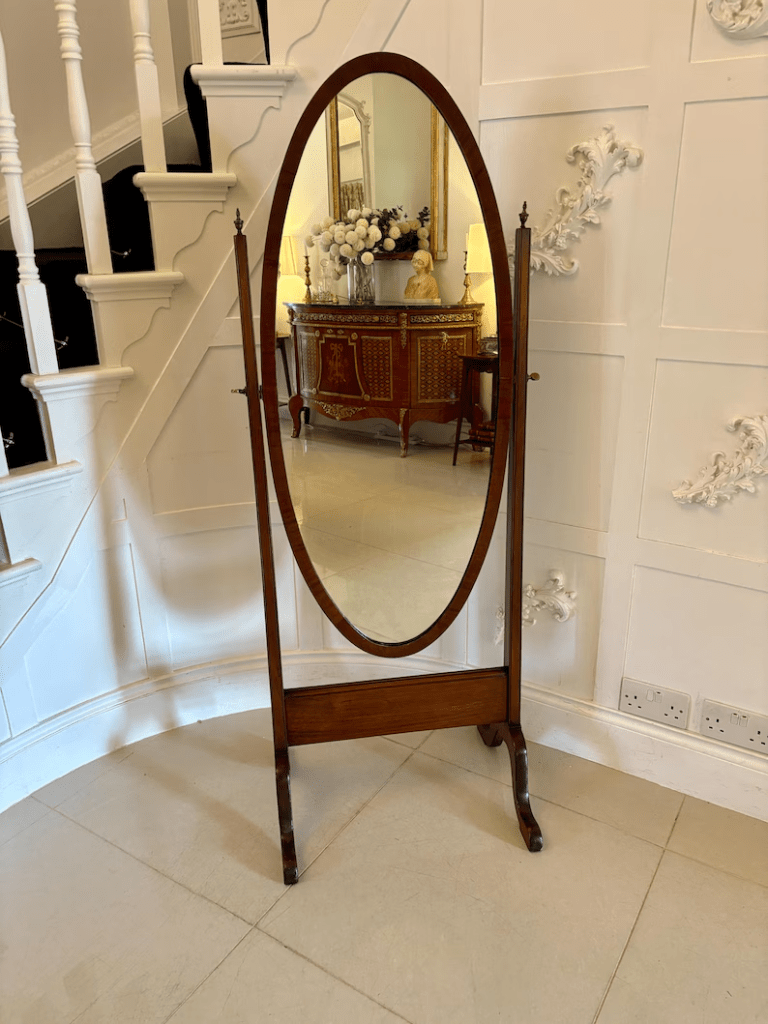
Here is some more of soprano Flora Woodman’s concert attire, this time for 1916. I imagine she had a walk-in wardrobe for this collection. (Look back at my previous posting, to see which of her earlier outfits she was still using!) I’m quite sure her admiring mother would be sitting on the bed, nodding in approval, and maybe helping Flora tuck in a wisp of hair, adjust a shawl or the tilt of a hat in front of a full-length mirror before they set out.
In my mind’s eye, this blog post has multiple paper dolls wearing 1916 outfits, or little squares showing the colours of the outfits and hinting at the accessories – a hat here, a fox or ermine stole there (for this was decades before anyone hesitated about wearing fur), or a little sprig of flowers to coordinate with her frock. Sadly, I can’t rise to illustrations like that, so again, please use your imagination!
[illegible] with Blouse, White Fur & hat
Black & White Black hat, Fur Coat Black Velvet
Brown hat, pink jersey? (Presumably with a skirt!) Singing to wounded soldiers in hospital
Green coat & skirt, brown hat, white fox, a blouse Green Coat & Skirt, Pink
Mauve frock and white hat & shoes
Navy blue check and white hat
Pink & pearl Pink with hydrangea
White & pink watersilk White with black Tulle White with ermine
Well, the ‘Scottish Entertainment’ took place yesterday – attended by sixty to seventy people, if you include our [small] choir. A great time was had by all. There was lots of community singing, along with a couple of choir items, and a smattering of solo items (two spoken, two sung solos, and the concertina.) And, of course, haggis, neeps and tatties in the middle of the entertainment. Our pastoral care committee organised the whole event – I just coordinated the entertainment bit!
It wasn’t a research event, and I can’t exactly call it public engagement – it wasn’t in any sense designed for, or linked with, my research. (Although, as I’ve mentioned, my little introductions were informed by my research!) So, I don’t think I can call this autoethnographical or practice-based research, but I can certainly reflect upon the whole experience.
Timing
I planned two equal ‘halves’ for either side of the meal. It wasn’t a full-scale meal, as such, but I underestimated how much time we’d spend eating. The first half of the entertainment was almost spot-on: we only had to leave one item until after the meal. However, the second ‘half’ had to be significantly cut back (mostly by omitting verses) – so I could really have made it a good bit shorter.
Feedback
The feedback was gratifying. Our repertoire went down well, as did the solos. I shall respect the soloists’ privacy, so I won’t elaborate further on that point.
My own debut as a soloist surprised me as much as everyone else, though. ‘I didn’t know you sang’, someone said. ‘Nor did I – I’ve never sung a solo in public before!’
I chose a song within my range, and the concertina piece was likewise as simple as I could find! Considering that I took up the concertina during lockdown, with the deliberate aim of having a ‘folk’ instrument for just such an occasion, it was gratifying to be able to play to an appreciative audience.
People were still talking about the event today, which was lovely to hear.
Repertoire
Remember that I did a BBC Scotland radio interview 13 months ago, discussing the top ten Scottish songs of nowadays, the results of a Visit Scotland survey? I didn’t even consult that list for our own afternoon entertainment. There was some, but not a lot of overlap – but I’m happy that the songs chosen by myself and the choir, went down well with our audience. We had a few Burns songs, a few from the early 20th century, some from the middle and a couple from towards the end of it.
And if we were to do another event, well, there’s still that Visit Scotland list to draw on! There is bound to be variation, depending on the sample of people surveyed – whether they are young or old, whether they had children or taught children in schools, and so on.
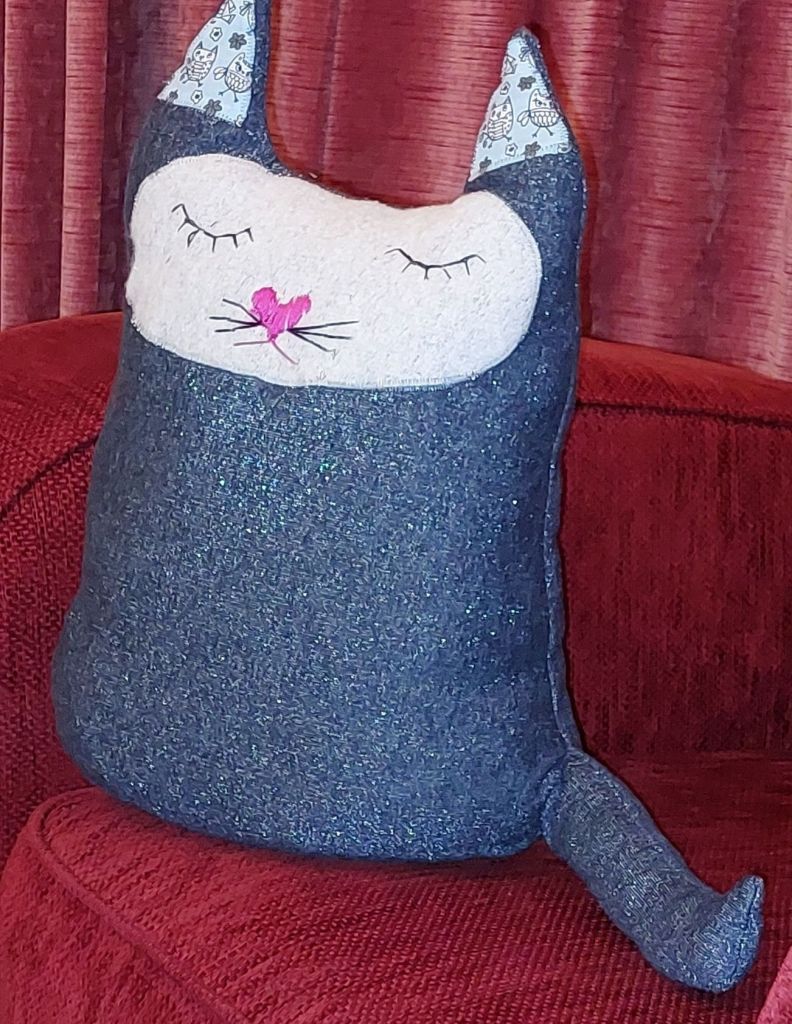
This forthcoming Scottish entertainment promises to be so much fun. I had to book more time off for a tradesman’s visit today, so I spent the morning writing song introductions quite different from my usual restrained scholarly style. All the nice little anecdotes suddenly found a home. But let’s see if you can guess the songs requiring my unorthodox props! (How well do you know the west of Scotland?)
Uncommonly Grey Cat
Grey cat, stuffed (fabric, not taxidermy)?
Jam sandwich?
Tartan shawl?
Yoyo?
I still need to unearth a music stand. (We had one! But where?) And heaven help me if I forget the concertina. I found a couple of tunes that suit it and my own capabilities.
The accordion is staying at home, though. After due consideration, I wouldn’t even have enough hands to carry it …
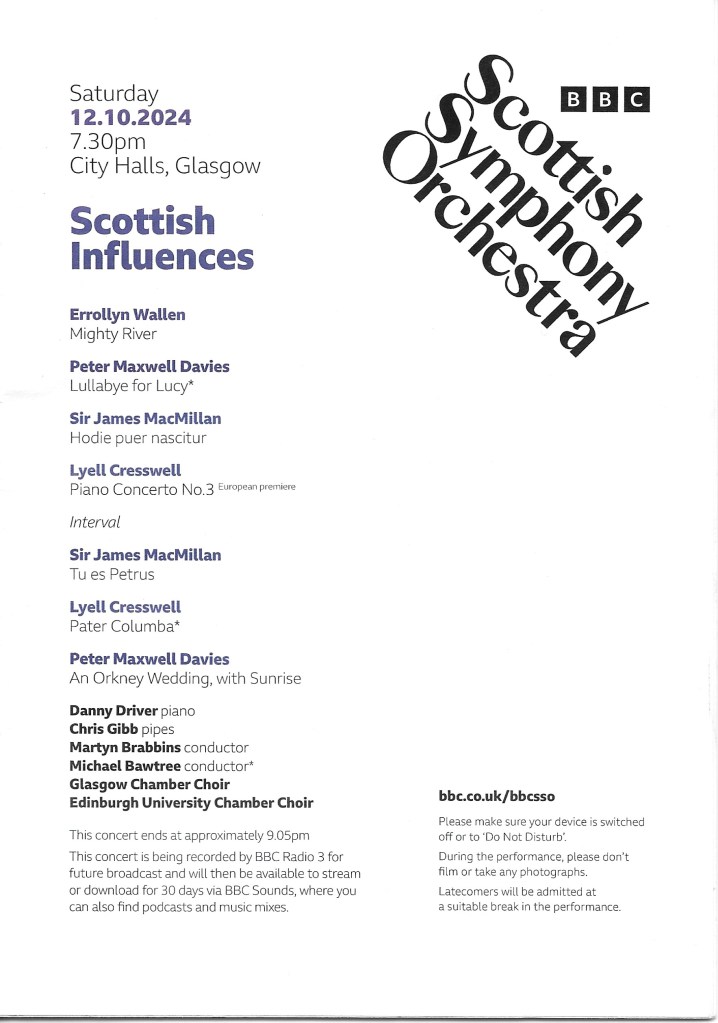
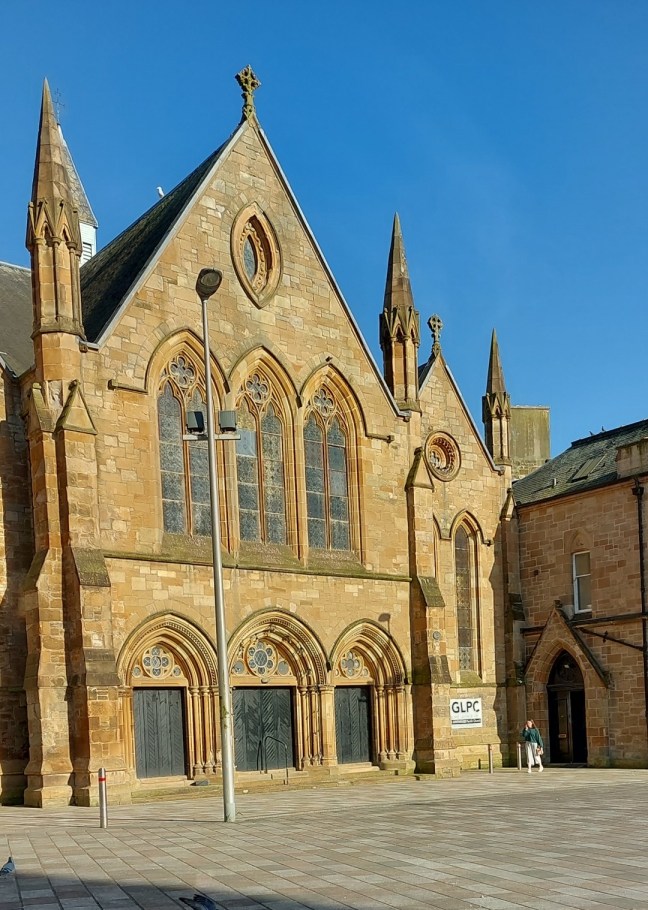
By way of a change, I took myself to the BBC Scottish Symphony Orchestra’s concert in Glasgow City Halls last night. Conducted by Martyn Brabbins and Michael Bawtree, the programme was entitled Scottish Influences, with music by Errollyn Wallen, Master of the King’s Music; Sir James MacMillan; and the late Peter Maxwell Davies and Lyell Cresswell. I anticipated seeing a few faces that I recognised – and I did – and I was particularly looking forward to hearing Wallen’s Mighty River and Maxwell Davies’ An Orkney Wedding, with Sunrise.
It was a truly great night. Wallen’s piece very much suggested a wide, flowing river, and incorporated two spirituals and a hymn, ‘Deep River’, ‘Go down, Moses’, and ‘Amazing Grace’. Davies’ piece – which I only encountered for the first time a few weeks ago on Radio 3, whilst driving – evoked uninhibited Scottish celilidh dancing, along with a waiter delivering a tray with whisky and glasses to the principal violinist and conductor at an appropriate point – and a fully kilted piper striding the length of the auditorium. (Yes, Chris Gibb is one of our RCS alumni. I was proud!) Michael Bawtree conducted gorgeous choral pieces performed by students from Glasgow and Edinburgh. New Zealander Lyell Cresswell’s PianoConcerto no.3, was premiered in Europe last night by pianist Danny Driver.
I couldn’t help smiling at the thought that yesterday afternoon, I was listening to Scottish country dance music recorded a century ago, whilst only a few hours later, I was sitting listening to Scottish-influenced music with the two living composers literally sitting within ten feet of me. Yesterday afternoon, I was remembering the story of the dance pianist who played with a tea-cup of whisky teetering on the edge of her grand piano, whilst last night the ‘whisky-drinking’ (was it real?!) took place right before my eyes. Indeed, my recent research of Scottish printed music has revealed a healthy export trade of Scottish song and dance music to Australia and New Zealand – whilst the late Lyell Cresswell reversed the process by bringing himself to Scotland, where he made his home in Edinburgh.
The good news is, last night’s concert will eventually be broadcast and will then be available to stream or download for 30 days via BBC Sounds. I’d certainly recommend listening.
When I was invited to come and listen to our accordionists’ final recitals, it struck me that this would be a great way to mark my 36th anniversary here. And it was!
We heard solo pieces, mixed ensembles, and one with dancers and a speaker. I only heard the first and second players, sadly – I heard my cataloguing calling me, after that – but I thoroughly enjoyed what I heard. Truly, those recitalists must have had six fingers on each hand, they played such fiendishly difficult pieces!
I was talking to a couple of teaching colleagues recently about the ‘diverse’ music I’ve been acquiring. They were both keen to tell me that it IS beginning to make a difference in concert programming. That makes me a bit happier! Indeed, I recognised one woman composer’s name today, that I wouldn’t have known of, five years ago.
So, there’s another memorable morning in my last weeks as a performing arts librarian. Not many more days!
Despite some depressing occurrences whilst I wasn’t working last week, there was plenty of music to brighten my mood.
I have mentioned before that working at the Conservatoire brings the advantage of lots of concerts to choose from. Lunchtime recitals suit me, from a personal point of view (it saves trying to rush home for a family evening meal and then back out again), but they aren’t ideal from an operational point of view! Anyway, I planned to attend lunchtime recitals on Monday and Friday.
However, I was too late for the Monday recital. The doors closed promptly at 1 pm. I wasn’t inside.
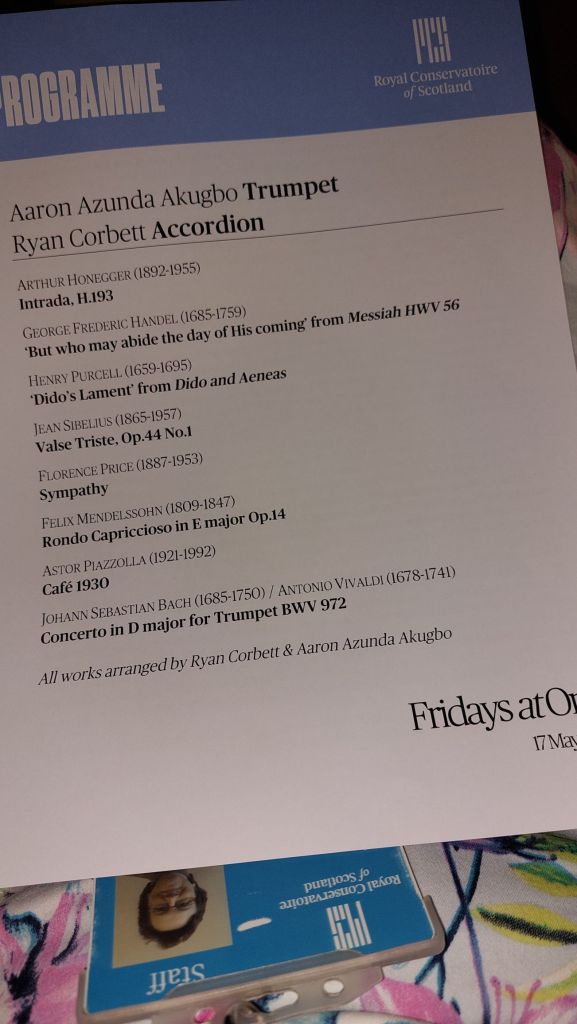
So that left three concerts. I made it to the Friday recital – trumpet and accordion, absolutely fantastic. Feeling a bit like Cinderella rushing to beat the clock, I made it back to my desk for 2 pm, so all was well. (There are aspects of my impending semi-retirement that have considerable appeal!)
Friday – Trumpet and Accordion
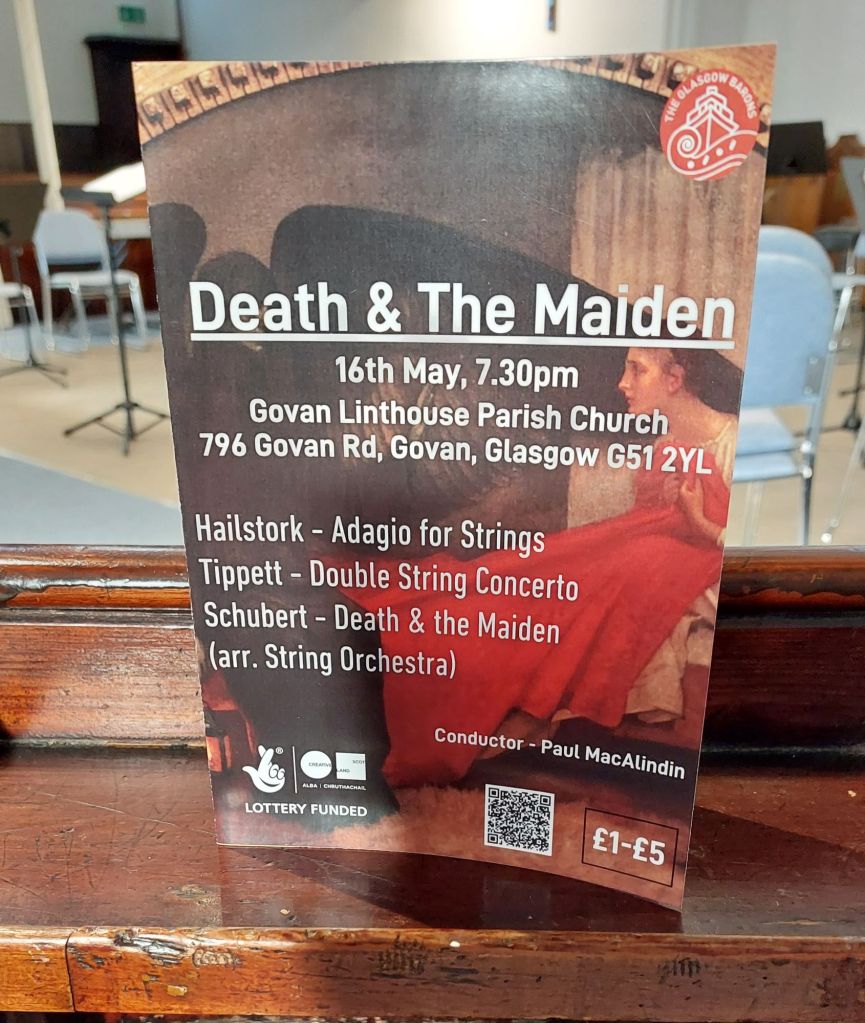
The Thursday evening concert was in my home neighbourhood, on a day when I was working from home. I discovered that the Glasgow Barons were doing an orchestral concert. The first piece was by Hailstork, a BIPOC composer whose name I had literally just encountered that week whilst sourcing music repertoire: how could I resist? And Schubert’s ‘Death and the Maiden’ quartet arranged for string orchestra was sure to be enjoyable. The Tippett, though? I think I need to gain familiarity with it, to appreciate it fully. It probably grows on one.
It was a glorious evening, even before the concert started. I met someone I knew, so I even had company to sit beside me.
And then this afternoon, we went to a Bearsden Choir concert in Glasgow City Halls. Arvo Part’s Salve Regina, a new work by Swann, and Puccini’s operatic Messa di Gloria. I sang that in Exeter University Choir back in 1980-2, and I recognised it instantly. It was a great concert; the choir goes from strength to strength, and the two soloists (an RCS alumnus and a student, both on the opera course) were excellent.
Bearsden Choir concert
And here we are, Monday again. Now, the big question is whether to try to get to today’s lunchtime recital! We’ll see…










 Karen McAulay, Musicologist