Dr Karen McAulay explores the history of Scottish music collecting, publishing and national identity from the 18th to 20th centuries. Research Fellow at Royal Conservatoire of Scotland, author of two Routledge monographs.
As I’ve already mentioned, I am currently a Heritage Collections Fellow at IASH – the Institute of Advanced Studies in the Humanities, at the University of Edinburgh. I’m halfway through my Fellowship, and (hopefully) halfway through my trawl of the Thomas Nelson publishers’ archives in search of correspondence about their music publications in the 1940s to 1950s. The book I’m primarily interested in has presented me with a few surprises and thoughts of new directions to pursue, but I shall plough on through the archives until I am sure I’ve captured every whisper about these four little school books.
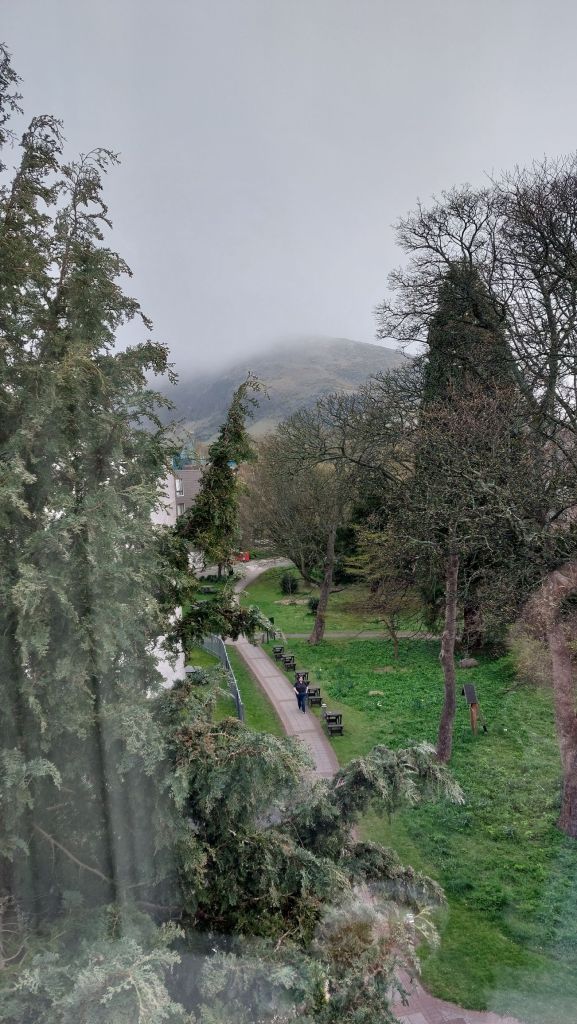
View from the Scholar Hotel
This week, we had the Institute’s 55th Anniversary celebrations, with a focus on Decoloniality. The Institute has just concluded a two-year project on this theme. There was also a session on motherhood and reproductive justice.
Now, you’d think, perhaps correctly, that my Scottish song book and music education focus has little connection with either decoloniality or motherhood. But I did put a lot of effort into broadening the scope of the music collection to include more music by women and composers of colour, whilst I was a Performing Arts librarian at the Royal Conservatoire of Scotland, so I was keen to find out what other scholars in more directly related disciplines have been doing.
I think it’s fair to say I felt a bit overawed! IASH is very interdisciplinary, so there were contributions from all corners of the humanities, and by scholars with far more extensive experience in their fields than I have in mine. But there were contributions from the performing arts, and from heritage collections and archives – I felt more comfortable in these areas, and a bit less out of my depth.
I stayed in Edinburgh overnight to make it less of a rush from Glasgow for the second morning.
In the final session, with contributions from past and present directors, I was impressed by the sheer reach and achievements of this amazing institution, and both proud and humbled to be a Fellow here.
O wad some Power the giftie gie us,
To see oursels as ithers see us!
In the context of Robert Burns’s poem, those lines are exhorting us not to get above ourselves, but taken in a different context, they perhaps offer reassurance that others see something in us that we can’t necessarily see ourselves.
‘They thought I was worthy to be a Fellow – in a very competitive application process?’, I mused. But yes, they did indeed select me, which is a vote of confidence in itself. Sometimes, you need validation by others – it’s hard to be objective about oneself!
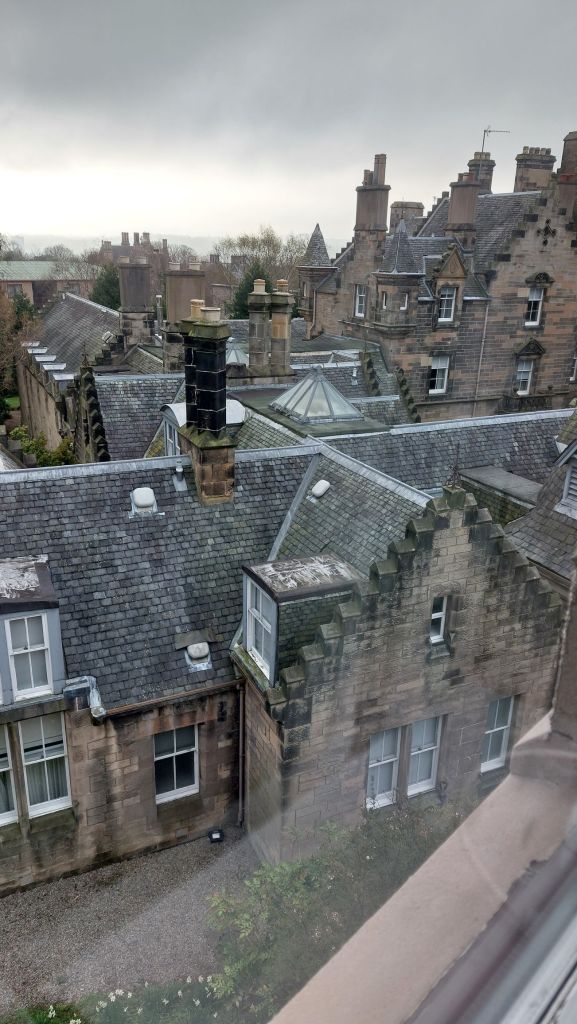
Another view from the Scholar Hotel
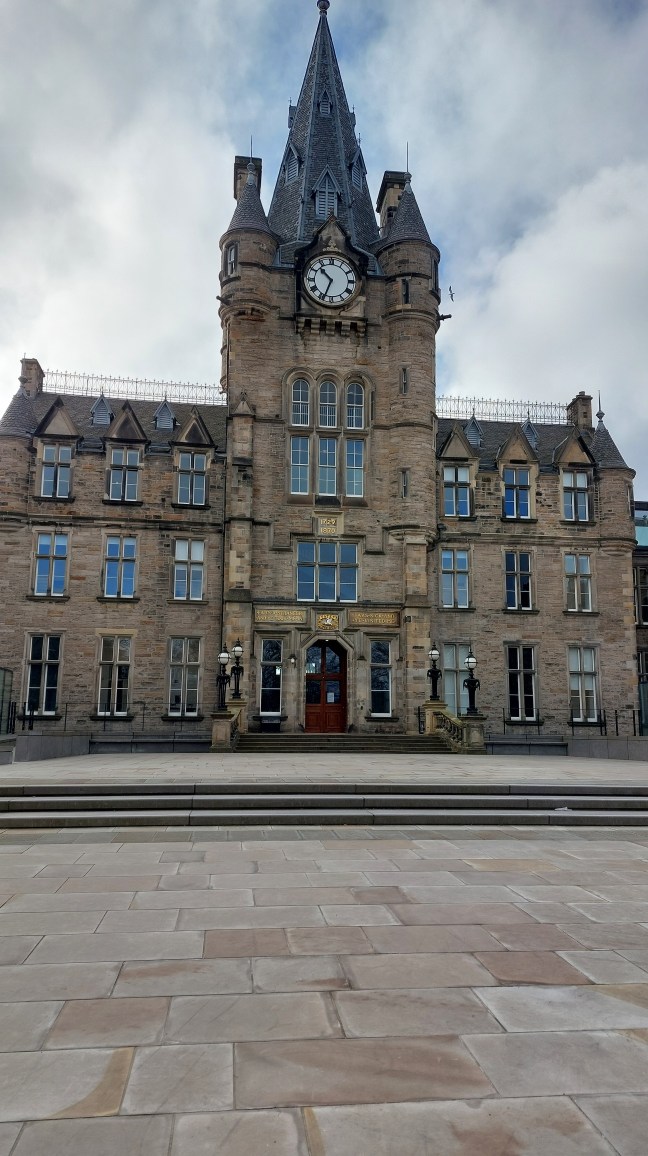
Image at top of post: The Edinburgh Futures Institute
As I’ve mentioned, I’m currently Heritage Collections Research Fellow at IASH, the Institute for Advanced Studies in the Humanities, at the University of Edinburgh. All guest fellows are invited to give a work-in-progress seminar, and it’s my turn on Wednesday 26 March at 1 pm. You can attend in person, or online – more details on the link below. The abstract tells you what my talk is about.
I’ll explain what I’m looking for, and introduce you to some of the individuals I’ve been finding out about. The one thing I can’t predict, is whether I shall by then have found the answer to my prime question!
Last Friday, I submitted an article. Yesterday, I did the minor edits for an accepted article and dispatched that, too.
And today, I headed to Edinburgh and resumed my archival pursuits. The city was initially bathed in golden sunshine, though this didn’t even last until lunchtime. It is certainly a very beautiful city.
Nearly spring in Edinburgh?
Unless you’ve experienced it, you can’t imagine how many brown folders of thin carbon copies will fit into an archival box. Carbon copies are as thin as airmail writing paper. The bulk of this particular box consists of NINETEEN folders of rejection letters just for one year, 1948.
You might think I didn’t need to concern myself about books they didn’t publish, but you never know what snippets about publishing policy or the economic climate – or anything else! – might turn up. (And you’d be surprised at the number of would-be authors who didn’t take a definite refusal AS a definite refusal, but kept writing to argue their case!)
‘Do Forward the Bathing Costume’
That was an unexpected postscript, in one of the letters that wasn’t a rejection. The publisher and author had evidently gone to the swimming baths, and the author went home without his trunks! Irrelevant, but it’s undoubtedly evidence they were on friendly terms, isn’t it?
I did discover – unneccessarily, but amusingly – that in the late nineteenth century, the managing director of this publishing house used to go open-air swimming in Leith before work in the summer. Clearly the tradition had either continued, or been revived, with the opening of the Portobello open-air pool in 1936 …
I read some advice the other day (you’ll have seen it often enough):-
If you aren’t happy where you are working, then leave.
There’s another adage, which is similar on the face of it, which goes like this:-
If you keep on doing what you’ve always done, you’ll get what you’ve always got.
I know there’s value in the first suggestion, but it isn’t always possible, is it? You may be well aware that you’ve probably been in the same job too long, but personal circumstances mean you simply can’t leave. Or your role is so specialised that you would have to relocate, which might not be an option.
This is why I prefer the second adage. Sometimes you have to take a long view, and your Plan B might involve changing direction whilst sitting tight. Get ready for a new role, adjust your mindset accordingly, but accept that it’ll be a while before you make the move.
Alt-Ac-tually
I feel for people at the start of an academic career, with the struggle to get one foot on the ladder. Do you actively want an Alt-Ac career, or do you feel you have no choice?
I wanted to be an academic music librarian. That became my career, but later I regretted not having finished my first PhD and given academia a fair shot.
My Plan B began with getting a PhD. Afterwards, I was very fortunate to get partial secondment as a researcher for more than a decade, whilst remaining in librarianship for the bulk of my week.
Adjust Mindset
It’s not just a question of having the right qualifications. You need to ensure that you believe in yourself as a scholar, and that others see you as a serious academic.
Write the articles;
Publish the book (if appropriate) or chapters,
Attend conferences (partial attendance isn’t ideal but it’s better than non-attendance, if cost or time are problematical);
Give talks, whether scholarly or as public engagement;
Seek opportunities for career development. (I did a part-time PGCert a couple of years after the part-time PhD).
DO NOT, repeat DO NOT, write yourself out of a career option because you believe yourself incapable of it. (Aged 21, I believed I would never be able to stand in front of a class of students. And on what did I base that assumption? I’d just taught English to assorted European students for about a month. I did it. I planned lessons, and stood there, and did it. So who said I couldn’t?! And it gets worse. There weren’t many women doing music PhDs when I was 21. Guys told me it was incredibly hard to break into academia – and I just took their word for it. How naive WAS I?!)
Look instead for opportunities to practise the areas you feel need improvement. You may need to think laterally. Music librarians seldom teach music history, but they do deliver research skills training. Lots of it.
Today
Fast-forward to now. I left Glasgow at 7 am today, in subzero temperatures. Edinburgh is bright, clear and breathtakingly … well, breathtakingly cold as well as beautiful! A freezing cold early start might not sound like a luxury to the average retired librarian. I’ve never wanted to be conventional, though.
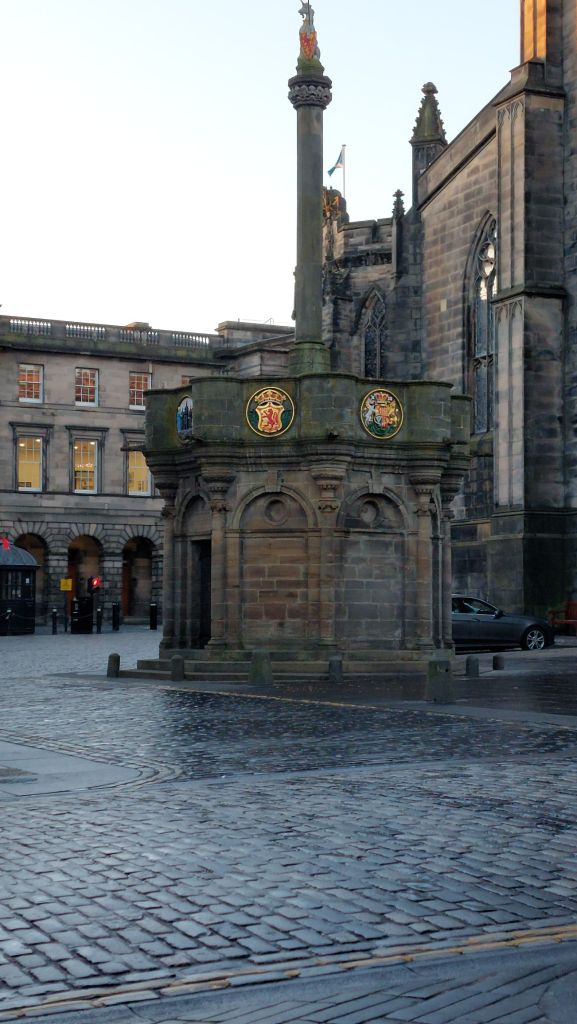
The Mercat Cross, Edinburgh
This is the first week in my IASH Heritage Collections fellowship. For the first time in my career, I’m NOT juggling librarianship and research. I’m part of a vibrant community of practice, and I have both the University Library and the National Library of Scotland just down the road. Thus, today, I saw a set of four Scottish song books that are remarkably hard to find as a set. (Three cheers for legal deposit!)
And last night, the year got off to an even better start, with an article being accepted. Just a few minor tweaks to do, which won’t be difficult.
It feels to me as though my long-term plan might be working out quite well!
Research; then playing for a funeral; dashing home; then over to Edinburgh. A quick stop in the National Library of Scotland, then a social event for new IASH Fellows at Edinburgh University’s Institute for Advanced Studies in the Humanities.
How to dress for such a day? I decided the black suited look was safest, and sallied forth looking one notch cheerier than an undertaker. Ah, well.
I met a friend, unexpectedly, at NLS. It’s the kind of place where you do meet people. (I first met my PhD external examiner there, a few days before the viva back in 2009.) I only had a short while to look at three Glasgow music publications today, but it was long enough. My main target didn’t actually tell me much, really. It was interesting to see it, but it had no obvious connection with ‘my’ Glasgow Victorian ladies.
And then, I met a lot of Fellows researching a lot of different things – it’s quite exhilarating to hear about so much interesting work. I’m looking forward to January 2025.
Fitbit tells me I walked just over 5 miles today. I really must research Edinburgh bus routes between now and January!
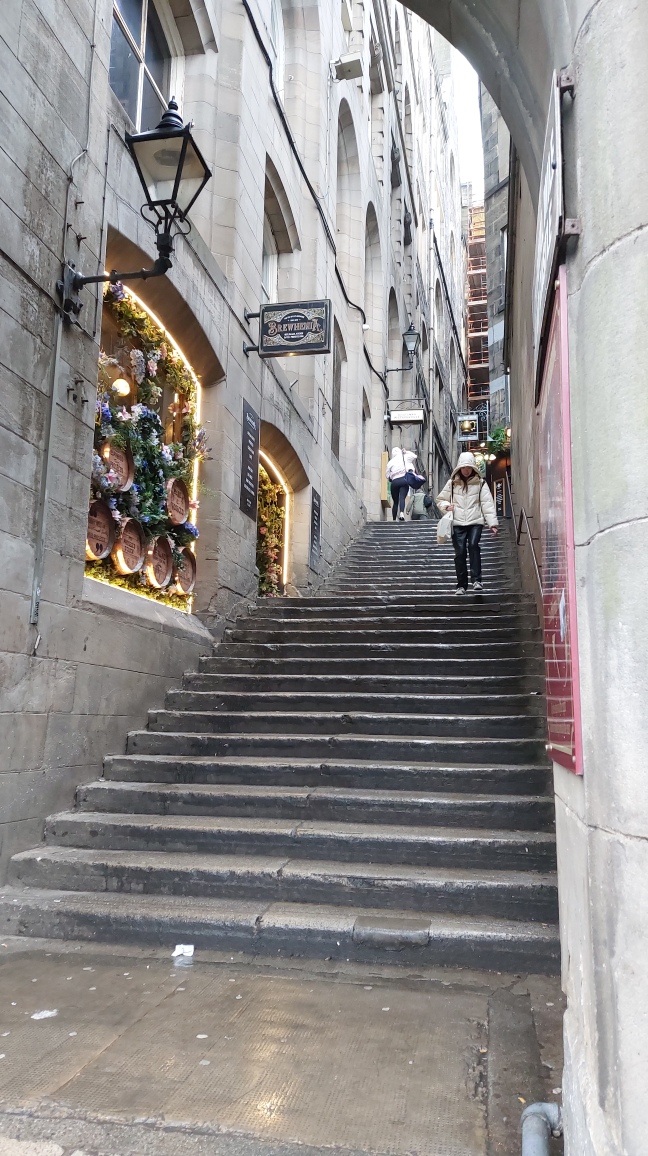
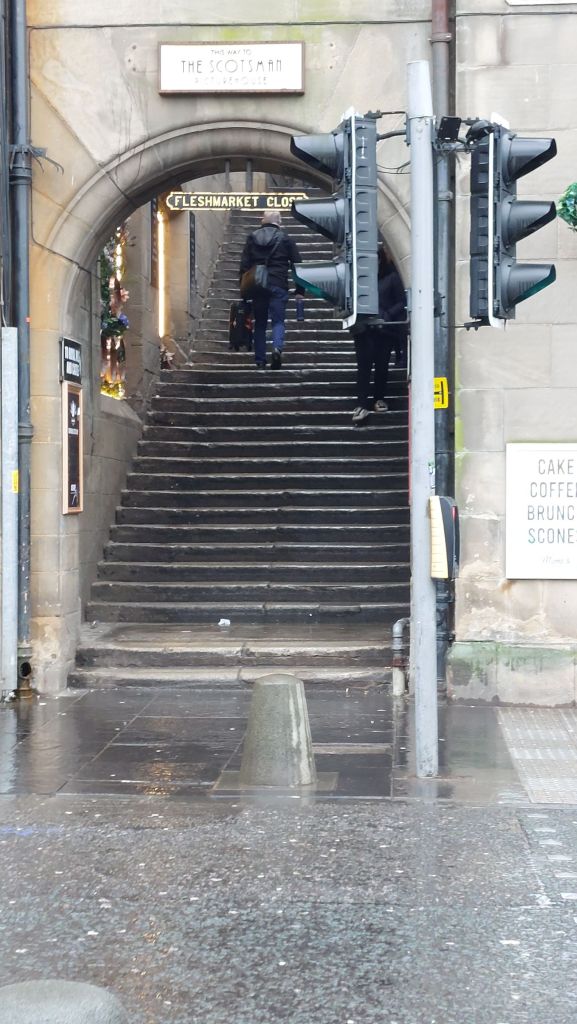
This is Fleshmarket Close in Edinburgh. It’s an absolute killer! I hadn’t ventured up those steps for some years – I swear they’ve got worse – and although my bags weren’t heavy, I was ready for a breather 1/3rd of the way up, and 2/3rd, not to mention at the top! Fitbit says I’ve put in my steps quotient, but annoyingly didn’t count how many flights of stairs I ascended, which is ironic.
But I was on a mission, and I did reward myself with a cuppa when I got to the University Library.
It’s good to go to a different place to study. (The library, I mean, not the cafe …) I think that in itself puts one in a frame of mind to come up with fresh ideas.
It was something of a scoping exercise. Now I need to sit and think about what I found, and its potential as a future research project. Tomorrow will doubtless see me writing away until I get my ideas in order.
I’ll leave you with a couple of publisher’s rejection letters – nothing to do with music or my research. I just stumbled across them, and smiled:-
Publisher to naive would-be authors:-
‘Dear Madam, […] For a book of merely 43 pages, 370 illustrations is excessive …’
Or this one:-
‘Thank you for offering a MSS on Cats and Reptiles. I regret that neither subject would be likely to suit our programme which is chiefly school and expository’.
I wonder if the author ever DID get their MS accepted somewhere?!
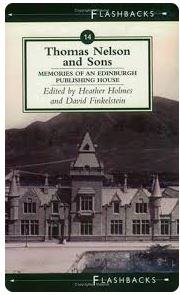
‘Audible’ books are great for someone who is trying to rest their eyes. But the problem starts when the book you want to read isn’t on Audible! Only being able to read a few pages at a time made reading this book a bit more of an endurance test than it needed to be. It wasn’t difficult reading in terms of comprehension – just a bit of an effort for my left eye without the assistance of the right one, which will take a few more weeks to catch up!
Thomas Nelson & Sons: Memories of an Edinburgh Publishing House, ed. Heather Holmes and David Finkelstein (East Linton: Tuckwell Press, 2001) ; Flashbacks series no.14 (Book cover shown above)
In the final pages of the book I’ve recently submitted to my publisher, I have referred to Thomas Nelson and Sons, the Edinburgh publisher. In connection with the research behind that book, I had acquired a copy of the paperback edited by Heather Holmes and David Finkelstein some months ago, but I didn’t read it at the time – because it was clearly not going to inform me about editorial decisions of the sort I was writing about. Nonetheless, I did want to read it at some stage, and I made a start last weekend.
Image from Wikimedia Commons
I learned a lot more about what it was like working in the print works, as recalled by four different individuals who were time-served printers – but I didn’t learn a huge amount more about publishing decisions in general, and there was nothing at all about publishing music. Nonetheless, it was useful; I’ve got a lot more background, and a few more facts and figures. Moreover, it was helpful to read about the demise of Thomas Nelson and Sons in the 1960s, the same decade that saw the decline of Scotland’s music publishing industry.
The ‘Flashbacks’ series is (or was) published by Tuckwell Press in association with SAPPHIRE (the Scottish Archive of Print and Publishing History Records) and The European Ethnological Research Centre. The latter sponsored the series, c/o the Royal Museums of Scotland. I think the National Museums of Scotland publishing page may be out of date, since it says there are six Flashbacks publications to date, yet the book I’ve just read is no.14, and was published in 2001. So far as I can make out, the series ended around 2004, and I think the SAPPHIRE oral history project ended about five years after that. (There are articles by Finkelstein, Sarah Bromage and Alistair McCleery dating from 2002 and 2009.)
As it happens, this was exactly the kind of book that I needed right now. Whilst I’m temporarily out of action, it’s useful to read around a subject without the pressure of needing to take notes. I can do the detailed scholarly work later!
I was just tidying up some loose ends in the chapter I’ve been writing. There was a music professor called John Greig who looked after things at Edinburgh University in between Reid Professors. Friedrich Rieck got the job – Greig didn’t. Within a decade the press was reporting his taking up an organist post in London. Then acting as an external examiner for the London College of Music, and finally principal of his own college – the British College of Music – in 1908. He died within a couple of years of opening it, having funded it largely out of his own pocket, but with a handful of shareholders holding a tiny fraction of the shares.
A contemporary magazine said it was just a money-spinning exercise. Okay, but it did advertise from time to time, notwithstanding Greig’s demise, so it clearly continued at least a little while. I also found reference in an Australian source, suggesting it was went on being a money-spinner for a while.
Here’s the thing: on the face of it, it appears still to be offering music exams to this day. I found reference to a modern professor in the UK, who offers masterclasses to students wishing to take ‘British College of Music exams’; there’s even a masterclass coming up in Ochanomizu, Japan this month (February 2023). However, I suspect that the professor actually means ‘exams offered by British music colleges’ rather than an institution by that name. Capital letters and word order make such a difference!
I don’t really mind. It has absolutely nothing to do with my research, and I stopped before I fell any further down the Alice-in-Wonderland-type rabbit hole. Anyway, I don’t need to mention the institution in a book about Scottish music publishers!
Yesterday (11 June 2022), I travelled through to Edinburgh to a conference at the Scottish Storytelling Centre. The topic was, ‘Towards a Scottish Traditional Music Archive’. I was there in my capacity as Honorary Librarian of the Friends of Wighton. Professionally, I combine two roles as a Performing Arts Librarian and as a Postdoctoral Researcher at the Royal Conservatoire of Scotland. It was unusual for me to be speaking at a conference with neither my Conservatoire librarian nor musicologist hat on.
Much of the discussion was about sound archives and digital preservation, but I was there to talk about the Wighton Collection, which is firmly rooted in physical materials, even if there are also microfilm copies and an online website. If even one person there confessed that they had ‘never heard of the Wighton Collection before’, then it made me wonder how many other people have similarly not heard of it. So, I thought I’d share my talk here on my blog, too. The talk essentially fell into two halves – the background, and some comments about finding aids in general for this kind of repertoire. Here goes for the first half!
PowerPoint title screen: The Wighton Collection, Dundee
I began by explaining that I’ve worked in libraries for nearly four decades, and I’m a Fellow of the Chartered Institute of Library and Information Professionals – so I have a strong librarianship background, as distinct from that of an archivist.
The Wighton Collection lives under the care of the Local History Library in Dundee’s Wellgate library. This is a public library on the top floor of the Wellgate shopping centre, and it’s the Central Library for the city of Dundee. Although I have an honorary role, I don’t have any paid connection with the city of Dundee. My honorary role is to take a professional interest in the Wighton Collection and its curation, and to help answer queries needing specialist input. In this respect, my doctoral and postdoctoral work on historical Scottish music certainly come in useful.
The Wighton Collection consists of about 700 music publications – some are bound together, so there aren’t as many as 700 bound volumes. They were left to the city by Andrew Wighton, a merchant, violin-restorer and music collector who died in 1866. Wighton had initially considered gifting his collection to the Society of Antiquaries of Scotland, but negotiations broke down concerning some of his preconditions.
Dundee adopted the Free Public Libraries Act shortly before Wighton died, and the council accepted Wighton’s bequest with a view to it forming one of the cornerstones of their new public library. I might add that there was some grumbling amongst the councillors as to whether it had been wise to accept so many music books before they even had anywhere to house it properly. The insistence in Wighton’s bequest that it should be stored in a fire-proof room must have been an extra burden.
However, one Dundee councillor made an observation which now seems laughable with hindsight, when he said it would cost three times as much to compile a catalogue as the volumes were actually worth.
Wighton’s collection has proven to be a jewel in the crown as far as the city library service is concerned – the books are almost beyond value, and certainly beyond the cost of cataloguing them. Wighton’s avowed aim was to collect a copy of every Scottish music publication that existed. In correspondence, one of his friends commented that he must have pretty much succeeded, and they were only half-joking. Wighton was an assiduous, and knowledgeable collector, visiting Edinburgh, London and even travelling abroad in pursuit of his hobby. I read in an 1894 newspaper article that, having no descendants to leave his money to, he was able to indulge his book-collecting passion all the more, though I hasten to add that Mrs Wighton was also left comfortably off!
The Wighton collection itself is a finite collection – self-contained in being the collection that he himself amassed. I won’t attempt to highlight particular volumes – suffice to say that about half of the collection consists of very rare eighteenth and nineteenth century Scottish music, but the remainder is equally rare English, Irish and Welsh material along with some ballad operas. As published material, the library is a natural home for it, but there are a few unique items that would be described as more archival – specifically, a few manuscripts that Wighton himself copied – such as his copy of the Blaikie viola da gamba manuscript, which itself is now lost – and a copy of Alexander Stuart’s 1726 publication, Musick for the Scots Songs in Allan Ramsay’s Tea-Table Miscellany. Other unique handwritten materials are textual rather than musical, and include his own annotated copy of Laing’s additional Illustrations of the Lyric Poetry and Music of Scotland (that’s the additional notes Laing contributed to William Stenhouse’s original Illustrations, the companion volume to Johnson’s earlier Scots Musical Museum.) There is also correspondence (mostly incoming, obviously) between Wighton, his fellow book-collecting enthusiasts and specialists (David Laing, William Chappell, and Aberdonian music publisher James Davie), and some letters concerning Dundee municipal matters, in his capacity as a town councillor. This would definitely count as archival material, were it not for the fact that the Wighton material must perforce be kept together – and it has added value as an entire collection.
MILLAR’S ARTICLE, 1894
The Wighton Collection has always been known about by musicologists and scholars of traditional music. Very early on, the books were expertly bound, and have always been kept as a closed access collection, to be used within the library under supervision. As far back as January 1894, the Dundee Evening Telegraph reproduced a lengthy article by the City Librarian, Alexander Hastie Millar, FSA Scot (who lived from 1847-1927), which had originally been published in the Scottish Musical Monthly, highlighting the significance of the collection and its availability for visitors to study.
WILLSHER’S ARTICLE, 1948
1948 saw another profile-raising article by Dundee librarian Harry M. Willsher, ‘The Wighton Collection of National Music’, in the Review of the Activities of the Dundee Public Libraries, ii/July (1948), 12–13. And of course, the collection is mentioned in Oxford Music Online – the former, Grove Dictionary of Music.
More recently, we have seen the development of the Wighton Heritage Centre, along with other initiatives that have enhanced the usefulness and appeal to today’s musicians and scholars, and it’s to these that I turn now.
WIGHTONHERITAGE CENTRE, 2003
The Heritage Centre was master-minded by librarian David Kett. Filling in a space between the Local History Library and another part of the main library, it was opened in November 2003. It’s a beautiful space beside the Local History Library, designed for small, intimate performances such as the Cappuccino Concerts on Saturday mornings, mid-week lunchtime concerts, adult music classes and study purposes. Events have also been arranged to showcase particular volumes in the collection.
FRIENDS OF WIGHTON
All these activities are supported and promoted by the Friends of Wighton. In pride of place, of course, are the locked bookcases containing the treasured Wighton Collection. Whilst the volumes can be examined by bona fide scholars by arrangement with the Local History Library, the books were microfilmed in their entirety some years ago, to lessen the wear-and-tear on the original volumes.
SALLY GARDEN
To make the largest possible impact at the time of opening, a three-year residency – Historical Musician in Residence – was created from September 2003. This residency was held by Dr Sally Garden. Her remit was to oversee a programme of performances and events; to bring together amateurs and professionals; to research the collection; and to raise its profile as an educational resource and opportunity.
The contents of every volume were also indexed around this time – every song, every dance tune – and saved as a massive Excel spreadsheet which was then interrogated via the Library website as the Wighton Database. It’s a vastly useful resource, and one for which I have had many opportunities to be grateful.
However, at some stage, the local authority stopped hosting the database. Undeterred, a search facility was devised by a committee member of the Friends of Wighton, so that the spreadsheet could still be explored.
This was subsequently – in 2018 – superseded by links to four lists:- the complete, 451 page catalogue; the list of imprints (a list by publisher); a title index, and a short-title list. The information is still there, albeit not searchable in quite the same way as the original facility had intended. The links are all accessible via the Friends of Wighton website. A link from the local authority library website leads to the Friends’ page, so if you know where to look, the material is still very much accessible:-
In recent years, the Wighton Collection has been augmented by a few donations, the most significant of which are the Jimmy Shand Collection, and a handsome donation of scores by Stuart Eydmann. Lottery fund money enabled the Friends to buy at auction, a collection of historical scores that had belonged to the late Jimmy Shand. These have been professionally restored and re-bound by a conservation expert, and they’ve also been digitised and uploaded to IMSLP, with links from the Friends’ website and indices to the contents. A few years later, Jimmy Shand junior gave some further scores to the Friends, which I assume the auctioneers had considered of less value. In one sense, they would have observed that only a few of these were of any great age, but at the same time, this secondary collection represents the working collection of a famous musician with local connections, and they are also of an era which has too often been overlooked as neither “ancient” nor “modern”. Without them, a chunk of popular Scottish music history would be missing. In just a few decades, even the music published between 1900 and 1960 will be more than a hundred years old, and of potential interest in ways we can only imagine now.* I’ve made a listing of all the volumes, and some have been bound – it will not be financially feasible for every item to be bound. The pandemic has meant I haven’t yet discussed with the Friends how best to handle the unbound material, or arranged for the listing to be uploaded to the Friends’ website. Similarly, Stuart Eydmann’s donation has been listed, but not uploaded. As life returns to the ‘new normal’, these tasks once again become a priority.
The talk was all about Wighton, not all about me, so I didn’t mention the fact that I’ve just signed a contract to write a book about Scottish music publishing between 1880 and 1950 – but it does mean that I can certainly see the historical value of the secondary Shand collection!
I’m excited to be part of a panel talking about paratext at the forthcoming ISECS Congress, 14th – 19th July 2019, hosted by the University of Edinburgh. Registration is now open, though the detailed programme isn’t yet finalised. (There’s an early bird rate until 30 April.)









 Karen McAulay, Musicologist