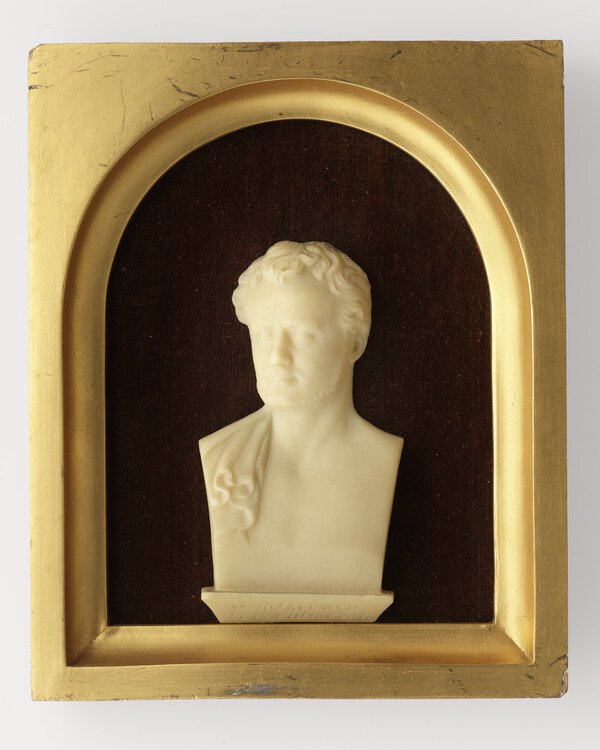
Finally, an article from me after a long spell of apparent silence. ‘Sir John Macgregor Murray: Preserver of Highland Culture, Music and Song’. Folk Music Journal vol. 13 no.1, pp.50-63.
The article started out as a conference paper, but I felt it deserved a wider audience. Let me share the abstract:-
Abstract
Sir John MacGregor Murray is known by Scottish music historians as the man who retrieved Joseph Macdonald’s Compleat Theory of the Scots Highland Bagpipe. This act of transmitting a work about Highland culture was just one instance of the Highland chieftain’s involvement in facilitating the artistic output of his native country. A founder member of the Highland Society of Scotland, he traversed the Highlands in pursuit of James Macpherson’s Ossian poetry, assisted song collector Alexander Campbell in planning his own itinerary in the Highlands and Western Isles, and helped establish a piping competition in Edinburgh. Sir John was one of a number of individuals who played a mediatory role in the collecting and publication of Scottish music. This article outlines Sir John’s role in the codifying and promotion of Highland culture, embracing literary as much as musical endeavours. It also introduces some of the other individuals who played a similar role in Scotland during the Georgian and Victorian eras.
It would be remiss of me not to point out that Routledge’s Black Friday sale makes the e-book version of my book very affordable! (Maybe someone might even buy you it for Christmas?).
Those preferring to read a hard copy might point out to their library that there’s no time like the present…
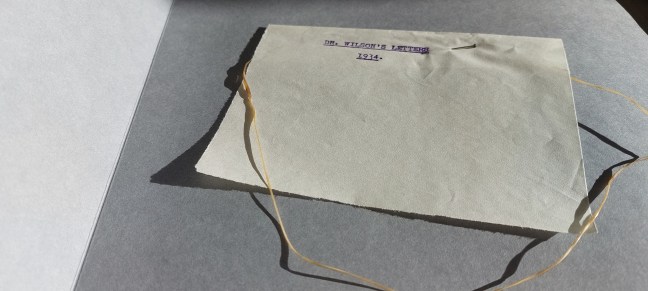
Anyone who has spent any length of time on archival research will agree with me that there are days when nothing of interest really turns up! This week has been a case in point.
On the positive side (and this relates to research time beyond the archives), I used to have ONE spreadsheet listing all the significant names – and relevant dates – of the individuals I’ve encountered over the past year or so, be they Thomas Nelson editors, authors, or connected in some other capacity. I now have a second spreadsheet, charting the weird and wonderful departmental codes appearing on letters and memos to/from the Parkside (Edinburgh) and Pater Noster Row (London) offices; I’ve again listed names associated with those offices. This is likely to be of interest to me, but little interest to anyone else. Still, there’s a quiet satisfaction in having clarified who did what, where and when. Whilst I was working on that, I discovered that one of the earlier editors had previously been an HMI before joining Nelson’s. That was a gratifying discovery, even if he had been a geographer, and had nothing to do with publishing music education materials.
I’ve also continued reading a book about an individual who published a book with Nelson’s in 1935; I’ve borrowed another; and recommended a useful e-book to my home institution library. It hasn’t been a wasted week.
But, glancing through my archival notes and social media postings, there weren’t any significant discoveries. I had a long list of boxes to trawl, in my hunt for interesting correspondence with one particular author, but on Tuesday I realised I’d already seen all that was worth seeing in two boxes, whilst the third box contained ‘the editor regrets’ letters to would-be authors. (A whole boxful of dashed hopes for dozens of would-be authors, ninety-odd years before my own disappointment in an unproductive, rainy day.)
Dutifully Flicking through Pages (FOMO)
Back I went to Edinburgh yesterday, eagerly anticipating fresh discoveries. Did I find the sought-after correspondence? No. There was plenty to amuse, but I can’t say I learned anything more about music education publishing. For example, my curiosity was piqued by a book proposal for a collection of prayers. The editor wrote to a colleague that he didn’t think they wanted any prayers, but he would decide finally when he saw how the would-be author had prayed. I wish I knew what he decided!
I shook my head sorrowfully at the rather naive author who wrote to Nelson’s asking if they published a particular genre of material. I suppose in the 1930s, it was less easy to find out, but could they not have gone into a library or bookshop and ASKED? Again, there was no copy of a response.
Another book proposal that presumably foundered, was the one unappealingly entitled, ‘The Unamiable Child’. I don’t think they offered the author a contract. (More recently, wasn’t the Horrid Henry series so beloved by children and their parents, about precisely such a child? Maybe the earlier hopeful author was just ahead of their time.)
Queen Margaret University / Edinburgh College of Domestic Science
I did, however, come across some correspondence which might be of interest to a historian of domestic science education. It appears to be a long time since anyone seems to have published anything about one of QMU’s earlier forerunners, the Edinburgh College of Domestic Science. (Tom Begg wrote a book, The Excellent Women: The Origins and History of Queen Margaret College, in 1994.) But if you know anyone currently researching it, then I can advise them that 1933 saw a run of correspondence with Thomas Nelson about a book they were producing. I can let them know which folder to consult, if they’d like to follow this up!
Time for Tea
As I approached the end of my second day in the archives, one final memo made me smile. (Again, this had absolutely nothing to do with music – I was just dutifully flicking through pages to ensure I hadn’t missed anything.) A memo was sent to three of Thomas Nelson’s Edinburgh managers in July 1956. They were warned that they might have to entertain a couple of visitors from Melbourne whilst their colleague was away. There were a couple of points that they needed to be aware of. I didn’t read past the first of these!
‘It might be wise to point out that Mr C is a teetotaller’.
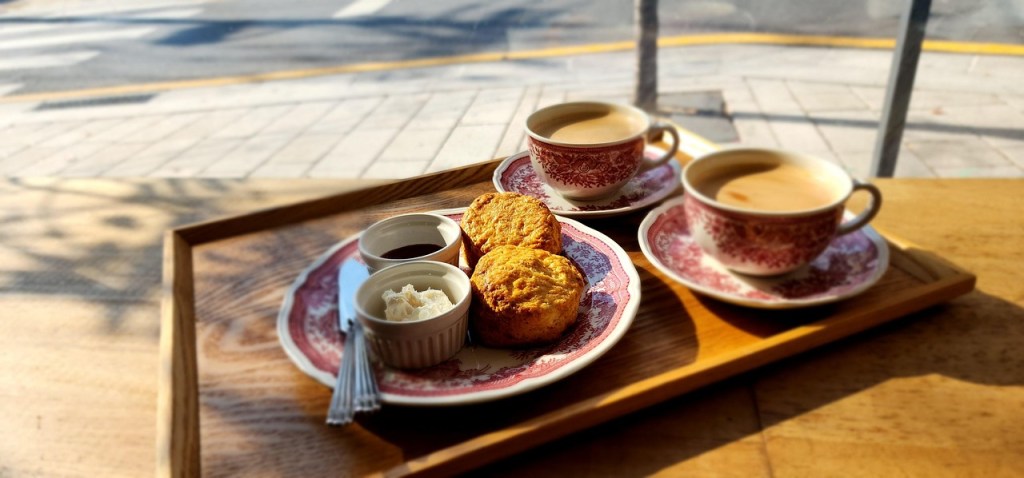
Let’s hope they remembered. Reading between the lines, ‘hospitality’ was clearly not always a cup of tea and a scone!
Earlier this year, IASH blogged about an exciting book that Ben Fletcher-Watson and Jo Shaw would soon be releasing. And yesterday, I attended its launch – the third book of the Dangerous Women project:-
The Art of Being Dangerous: Exploring Women and Danger through Creative Expression (Leuven University Press, 2021) edited by Jo Shaw and Ben Fletcher-Watson
Dangerous Women: fifty reflections on women, power and identity (Unbound, 2022) edited by Jo Shaw, Ben Fletcher-Watson and Abrisham Ahmadzadeh
Women Who Dared: From the Infamous to the Forgotten (Edinburgh University Press, 2025) edited by Ben Fletcher-Watson and Jo Shaw
It was a lovely book launch, and we had excellent speakers, who had all contributed to the book: Jo Shaw, Sara Sheridan, Ruth Boreham and Jo Spiller.
Women who Dared is an anthology of short biographies – all of them historical ‘women who dared’. I chatted with the speakers afterwards, and enjoyed hearing more about their work. There are so very many women of note, whom history has entirely forgotten about, so books like this are both very welcome, and very necessary.
You know how you buy a new car, and suddenly everyone seems to be driving the same white Fiat 500? It’s the same with research topics.
“Enthusiastic collectors of Gaelic songs and Irish harp tunes”
I researched Gaelic song-collectors Anna and Margaret Maclean-Clephane as part of my PhD (2009).
I blogged about the sisters as far back as 2012 in my librarian days, when the Whittaker Library was using Blogspot:- How Far Can a Song Travel? (Author Karen McAulay, Whittaker Live blog, Wednesday, 23 May 2012);
I followed up with an extended article about them (also in 2013). See this excerpt from the article:-
Naturally, the Maclean Clephane sisters are in my Pure institutional repository at the Royal Conservatoire of Scotland. I coined the above phrase, ‘enthusiastic collectors of Gaelic songs and Irish harp tunes’, using it both in my book (p.92) and my article (p.62), both in 2013.
‘While they were still in their teens’
The sisters had a book ‘printed but not published’ while they were still in their teens – you can read about it in my article, p.58. I have to say, the arrangements in their book were – well, okay, but not artistically stylish!
Margaret had a harp – there is actually a Raeburn portrait of Margaret with her harp – see below. Alexander Campbell did say the sisters played, but there’s no portrait of Anna with a harp, so we can’t prove it either way. He didn’t meet them. (There was in fact a third sister, though her musical interest didn’t seem to carry through to adulthood. ) Indeed, Anna wasn’t that hot on the piano, as I recall. They grew up on the Isle of Mull. I’ve driven past the house, Torloisk. It’s massive!
I just love researching and writing about people, particularly musicians! If they’re women musicians, then that’s all the more interesting – so it’s hardly surprising I was drawn to them, and went looking at materials in the National Library of Scotland and the School of Scottish Studies in Edinburgh, and even visiting a manuscript that’s now down in London. (Blog post Women’s History Month 2024. Musicians, this present blog.)
Details of my article
But ever since, these fascinating and talented ladies keep cropping up in my social media feeds. People who’ve read my writings also contact me from time to time. Thanks to the miracles of modern technology, I get notifications that people have consulted my stuff, too … and there’s also a CD whose notes cite me, too:-
The harpist, Masako, asked if she could cite my work – I was very appreciative that she went to the trouble of asking me.
Correctly cited 😀Margaret Clephane … and Masako Art
I spent so long with my early nineteenth-century heroines, but eventually my research took different directions. Not being a Gaelic scholar was just one of the problems I’d encountered! I attended classes in speaking it, at the Conservatoire. I signed up to local authority evening classes at the Gaelic School in Glasgow. But somehow, I never really had time to give it enough attention, despite having been considered good at languages at school and possessing school certificates in – well, several European languages. I understand when someone agrees with me in Gaelic, and can pronounce ‘Torloisk’, for sure, but Gaelic remains beyond me!
But look – now the music is going to be played. That’s exciting!
It’s time for a flashback to this time last year. I went all-out to share a lot of research and resources about women musicians, so this year, I think I’ll share it again! I’ve written quite a bit on the subject, as you’ll see.
Leisure and Pleasure – Everyday life in Second World War Scotland
I don’t often sign up to webinars, but something so closely aligned to my own current research was irresistible.
The History Scotland webinar series is promoted by the History Department at the University of Dundee. The guest speaker today was Dr Michelle Moffat of Manchester Metropolitan University.
And what did I learn? Leisure pursuits didn’t stop in wartime, especially going to the cinema. This is worth knowing. (However, I must be careful not to assume things were exactly the same everywhere. It makes me wonder about central London, for example, where people might have felt more threatened. )
There was also interesting detail about rationing and food shortages, and discussion about how much people in Scotland felt the war was ‘their’ war. (I suspect anyone who had relatives fighting overseas would very much have felt indirectly part of it.)
And a reminder about the Mass Observation Archive. I had forgotten about this, but it’s a crucial resource – I’m going to check it out with some questions that I hope it might help with!
You can tell I’ve spent too long in the late nineteenth century – in the research sense, that is. Dizzy with excitement at the thought of seeing a silent movie – yes, it might actually come to pass, albeit not for a few months – I was almost deliriously pleased to discover that one of my research interests made British Pathe ‘shorts’ during the Second World War. My aim is to contrast two singing careers, started only a decade apart – and here’s the first contrast. One began their career during the First World War and the silent movie era. The other made British Pathe shorts during the Second.
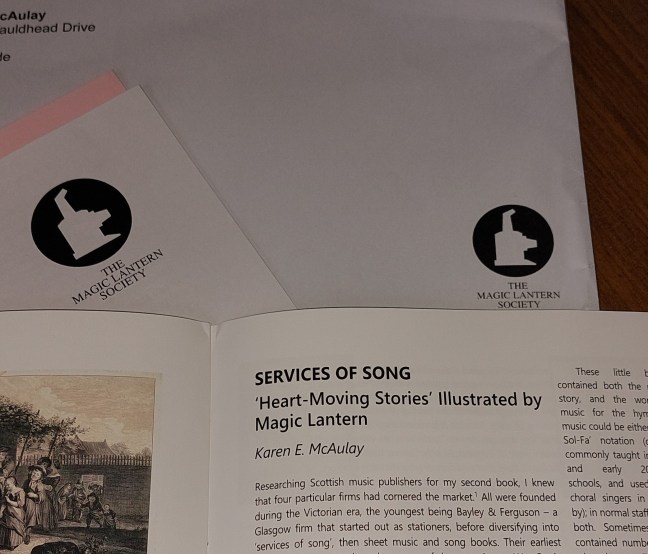
We think we’re so advanced, with our internet and our AI, electric cars and digital sound … but anyone born in the late nineteenth or early twentieth century might have been amazed by their own advances in technology. A fin-de-siecle child treated to a magic lantern show, might have sung along to hymn or Scottish song texts projected on a magic lantern screen, the singing led by whichever grown-up had been co-opted in to help. When silent film came along, any music would be provided by a cinema pianist or a small ‘orchestra’ – possibly no more than a piano trio. What you heard would partly depend on who was playing and the bundle of music they’d brought with them.
But when the children became adults, they would would find themselves listening to the wireless or going out to ‘talking’ movies. Watching, in adulthood, a short film performance by a contemporary star vocalist would have been unimaginable a decade earlier.
However, I must still cool my heels as I wait to see if (and when) the silent movie that I need to see, can be converted into a modern format. Meanwhile, I’m trapped in the nineteenth century with the printed novel that gave rise to the movie. As I read, I wonder how they managed to condense the story into a couple of hours, and then convey the whole plot by wordless gestures.
‘LUCERNA is an online resource on the magic lantern, an early slide projector invented in the 17th century.
‘For more than 350 years the magic lantern has represented and fed into every aspect of human life and every part of the world. It is still used today, both in its original form and through direct descendants like the modern data projector.
‘LUCERNA includes details of slide sets, slide images, readings and other texts related to slide sets, lantern hardware, people and organisations involved in lantern history, and much more.’
Writing a second book has felt quite different from the first time round. The first one developed out of my PhD, so I had my supervisor supporting me as I wrote the original thesis.
Going Solo
But this one? All my own, unsupervised work, arising originally from the thought that someone really ought to write a book about the music published by Scottish publishers in the late Victorian era and the early twentieth century. No-one had written one, so I researched and wrote it myself. I was grateful for my peer-reviewers’ feedback on the first draft, and I know that the final product benefited from the subsequent edits that I made during my Ketelbey Fellowship at St Andrews.
This time, I did my own indexing, too. That was a new experience for me.
Now, to start planning a book launch! Watch this space – I have an idea. Provisional date Monday 11th November, but the details have yet to be finalised!
I’ve written quite a bit about women in musical history, so I’m adding something to the top of this post every couple of days during Women’s History Month – mostly flashbacks to women musicians I’ve researched, but some other discoveries too. (I’ve been shifting things around to a more chronological order, but I’ve always added the new bit first!) You’ll find more musicians than composers in this posting, just because of my own recent research.
Sometimes I look at the history of women musicians from the point of view of good library provision for our readers, whilst at other times my own research interests are foremost. It just depends on the day of the week, because I currently occupy two roles in the Royal Conservatoire of Scotland. For 3.5 days a week, I’m a librarian. For 1.5, a postdoctoral researcher.
15. The Ketelbey Fellowship
It’s a whole year since I learned that I had been awarded the first Ketelbey postdoctoral research fellowship at the University of St Andrews. Scholar Doris Ketelbey was a significant figure in the history of the department. I felt highly honoured to have been the first Ketelbey Fellow from September to December 2023.
14. Representation of Women Composers in the Library
I couldn’t resist adding the open access article I published about my EDI activity in our own Whittaker Library:-
It’s a privilege to shape a library collection, so I’m pleased to have just ordered and catalogued several relevant books this month.
Susan Tomes, Women and the Piano: a History in 50 Lives (Yale University Press, 2024) Read more about it on the publisher’s website, here. In actual fact, it’s the fourth title by this author that we now have in stock. So if readers like this, they might like the earlier three, too!
Margaret C. Watson, Women in Academia : Achieving our Potential. (Market Harborough : Troubadour, 2024). Not a book about women in history, but very much for women in the present day!
Gillian Dooley, She played and sang: Jane Austen and Music (Manchester University Press, 2024). Back to history again.
Women and Music in Ireland / ed. Jennifer O’Connor-Madsen; Laura Watson & Ita Beausang (Boydell Press, 2022)
Moreover, there’s a new Routledge book coming out this summer – I have ordered it for the Whittaker Library. Of course, I may have retired from the Library by the time it arrives. This just means I won’t need to catalogue it! I’ll still be a part-time researcher, so I’ll be able to read it:-
It’s some years now, since a single-minded schoolgirl decided action was necessary. In 2015, Jessy McCabe noticed that Edexel had no women composers in the A-Level Music syllabus, and successfully petitioned to rectify this, via Change.org. I found out about her impressive initiative when I was beginning to start serious work on building up our library collection to include more music – contemporary and historical – by women and people of colour.
Jessy is now a Special Needs teacher. I’m sure she’ll go far.
11. Forgotten Women Composers
Part of academia entails sharing research outcomes beyond the ‘ivory walls’. It’s called public engagement, and that’s the opportunity I seized when my old friend The People’s Friend magazine commissioned me to write a feature back in 2020.
The sound of forgotten music: Karen McAulay uncovers some of the great female composers who have been lost from history’, in The People’s Friend, Special Edition, 11 Sep 2020, 2 p. (Dundee : D C Thomson). I blogged about it at the time (here).
10. Late Victorian Women Musicians
Since my more recent research has focused on the late Victorian era and the first part of the twentieth century, you’ll not be surprised to find that I found some interesting Scottish women musicians of that era! They are forgotten today – but I’ve done my bit to raise their profiles!
Newsletter article, ‘‘Our Heroine is Dead’: Miss Margaret Wallace Thomson, Paisley Organist (1853-1896)’, The Glasgow Diapason, March 2023, 10-15. (You can find this article in full on this blog)
‘An Extensive Musical Library’: Mrs Clarinda Webster, LRAM, Brio vol.59 no.1 (2022), 29-42 (a late Victorian head teacher who founded a music school in Aberdeen, and later did a national survey of music in public libraries – which she presented to the Library Association!)
In October 2023, I pondered about Mr *and Mrs* J. Spencer Curwen (amongst others) in another blog post, when I remarked upon early twentieth century attitudes to folk song.
9. In Praise of Music Cataloguers! Introducing Miss Elizabeth Lambert
Before I started the Claimed From Stationers’ Hall music copyright network, I had spent some months researching the wonderful late 18th and early 19th century music copyright collection at the University of St Andrews. A key resource was the handwritten catalogue in two notebooks, largely compiled by Miss Elizabeth Lambert (later to become Mrs Williams, when she married and moved to London.)
I just love the fact that this earnest young woman (I’m going out on a limb here, but I’m pretty sure she must have been earnest!) created a useful resource which would help everyone get maximum use out of the music repertoire that other libraries were less than impressed by. So we had Elizabeth cataloguing the collection, and numerous men and women, friends of the professors, making use of it. I blogged about her, and eventually wrote an article for the Edinburgh Bibliographical Society, mentioning her again.
‘A Music Library for St Andrews: use of the University’s Copyright Music Collections, 1801-1849’, in Journal of the Edinburgh Bibliographical Society no.15 (2020), 13-33.
The library’s copyright collection of music was a boon for middling class women like headmistress Mrs Bertram, her teacher daughters and their pupils. It does lead one to wonder if they had a harp at the school. I checked their borrowing records for more evidence. They certainly borrowed several volumes which included harp music.
7. Students but not at University? Educating Young Women
It’s time to turn to piano teacher Mr T. Latour. I’d like to refer you to my June 2018 blog post about women in St Andrews using pedagogical musical material in the early 19th century. Possibly the self-same young ladies attending, or having attended Mrs Bertram’s school?! The illustration features a young woman – probably just approaching or about marriagable age – at an upright piano. The abundant floral arrangement atop the piano (quite apart from sending shivers down the housekeeper’s spine every time the young pianist played too enthusiastically) suggests a well-to-do household. Following Latour’s instructions, the pianist has elegantly flat hands …..
T. Latour – Ladies’ Thorough Bass
Latour advises on the seating position, and how to hold ones hands elegantly
6. Not my work – but very timely for WHM 2024]
I’m not posting anything relating to my work today, but I saw mention of a great new article by Dominic Bridge the other day, so I thought I’d share details here. It’s a fascinating read. The Journal for Eighteenth-Century Studies is part of the Wiley Online Library:-
Back in 2018 when I was awarded the AHRC networking grant for the Claimed from Stationers Hall network, I drew up a list of women composers from the Georgian era. There were more than one might have expected – perhaps they only composed a handful of pieces, in many cases, but nonetheless – they composed. You can find the list on a separate page on this blog, here. And you can read more about it in the blogpost I wrote in July 2018,
This lady ran a girls’ school at St Leonard’s in St Andrews. This was NOT the famous and long-established private school that has long stood there, but an earlier enterprise. And Mrs Bertram and her daughters subsequently moved to Edinburgh, to the disappointment of parents of daughters in St Andrews!
The photo portrays a Mrs Bertram of Edinburgh. Chronologically, she could well be ‘our’ Mrs Bertram, and a scholarly bent is suggested by the pile of books at her hand.
2. The Accomplished Ladies of Torloisk
I almost forgot about the musical Maclean-Clephane ladies of Torloisk, which is a stately home on the island of Mull. But how could I forget about them, considering I published a lengthy article about them some years ago?! Luckily, a book of letters by Sir Walter Scott crossed my library desk, and even though it didn’t contain those particular letters, this did remind me of his musical friends in Torloisk!
Karen E. McAulay, ‘The Accomplished Ladies of Torloisk‘, International Review of the Aesthetics and Sociology of Music, Vol. 44, No. 1 (June 2013), 57-78
Today, I’d like to introduce a woman composer who predates most of the individuals I’ve encountered. Professor James Porter applies his considerable intellect to produce this in-depth article:-
‘An English Composer and Her Opera: Harriet Wainewright’s Comàla (1792)’, Journal of Musicological Research Feb, 2021. Published online: 16 Feb 2021.