A Gift Idea? A Social History of Amateur Music-Making

Stumped for a present for your Scottish music enthusiast? My new book is affordable as an e-book! (Just sayin’ …)

A Social History of Amateur Music-Making and Scottish National Identity: Scotland’s Printed Music 1880-1951

Why did Scottish music publishers produce so many songbooks and dance tunes? Who took Scottish music overseas to the diaspora? How did classical composers interact with local publishers?

I’ve discussed all this and more. Full details on the publisher’s page, link above.

Most Memorable Scottish Songs Today (Library Perspective!)

Preparing for my Good Morning Scotland interview the other day, as I mentioned, I drew up something halfway between a mind-map and a spreadsheet to clarify in my mind how old the songs were, and who they were associated with. I had also – ever the librarian – looked up which of the Whittaker Library songbooks actually contained the songs in question. I wasn’t looking for every copy we had, just a rough overview. I thought you might be interested to see what our library patrons have access to. 

It is significant that there are only two genuinely old songs – the last two, by Sir Walter Scott and Robert Burns. Otherwise, they’re popular songs that are Scottish, but folksongs? Not exactly traditional or old, but certainly much beloved today. So, will there still be popular songs in fifty years’ time? Yes, of course – but maybe they haven’t even been written yet! 

Here is the list – in order of popularity – that Visit Scotland compiled from their recent survey:-

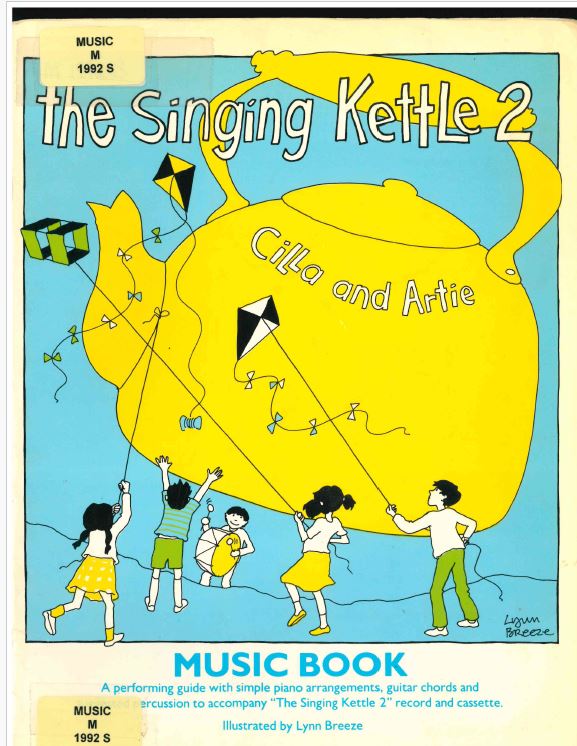
The Singing Kettle, book 2
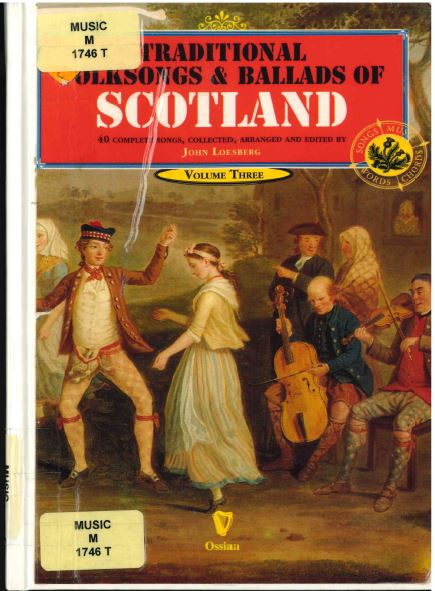
  1. You cannae shove yer grannie aff a bus – it’s in Cilla Fisher and Artie Tresize’s second Singing Kettle music book (1989). Also in Ewan McVicar’s One Singer, one Song (1990) and his Scottish Songs for Younger Children (a words-only book, 2002); and in Traditional Folksongs and Ballads of Scotland Vol.3 (1994).
  2. Donald, where’s your Troosers? Sung by Calum Kennedy and published by our friends Mozart Allan in 1959, and by Andy Stewart, published by Kerr’s in 1960. We listened to Andy’s rendition at home last night – and it still makes us laugh.
  3. Coulter’s Candy – (hint: it’s pronounced ‘Cooters’) in Singing Kettle [book 1]; Katherine Campbell and Ewan McVicar’s Traditional Scottish Songs and Music (St Andrews: Leckie & Leckie, 2001); and Ewan McVicar’s Scottish Songs for Younger Children.
  4. Wee Willie Winkie – I know it, and we have it in the library, but not in the version I know!
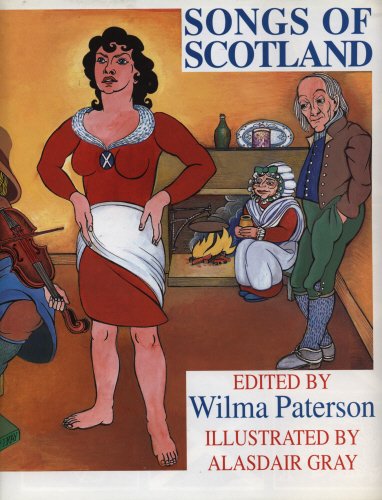
  5. Skinny Malinky – in Wilma Paterson and Alasdair Gray’s Songs of Scotland (1996)
  6. Three Craws – in the second Singing Kettle book; and Jimmie McGregor’s Singing our Own (1970)
  7. The Jeely Piece Song – the library has Adam McNaughtan’s CD, The Words that I used to know (Greentrax, 2000). It’s also known as The Skyscraper Wean and can be found in Morag Henriksen and Barrie Carson Turner’s Sing Around Scotland (1985).
  8. Bonnie wee Jeannie McColl – first sung by Will Fyffe in 1929, and more recently by the Alexander Brothers, it appears in 100 Great Scottish Songs (Dublin: Soodlum,1986)
  9. An oldie: Walter Scott’s, Scots wha’ ha’e – it’s in many, many collections! I found it in Traditional Folksongs and Ballads of Scotland Vol.3; and Wilma Paterson’s Songs of Scotland.
  10. Another oldie; Robert Burns’s My heart’s in the Highlands. People probably know the version sung by Karine Polwart in 2001, and Fara in 2014. There are much earlier versions in printed books, of course, but I suspect not what today’s enthusiasts are looking for!

This is a YouTube link to Karine Polwart’s, ‘My heart’s in the Highlands.

Wilma Paterson’s Songs of Scotland, illustrated by Alasdair Gray
Traditional Folksongs & Ballads of Scotland Vol.3

7 & 8 November  – TWO McAulays in a week (in different places)

It appears both my husband and I are giving presentations in a fortnight’s time!

The evening of Tuesday 7th , Hugh is talking on Zoom about Newcastle trolleybuses, to an enthusiasts’ group in Turin.* (Sadly for him, he’s sitting in Glasgow, not Turin, to do it!)

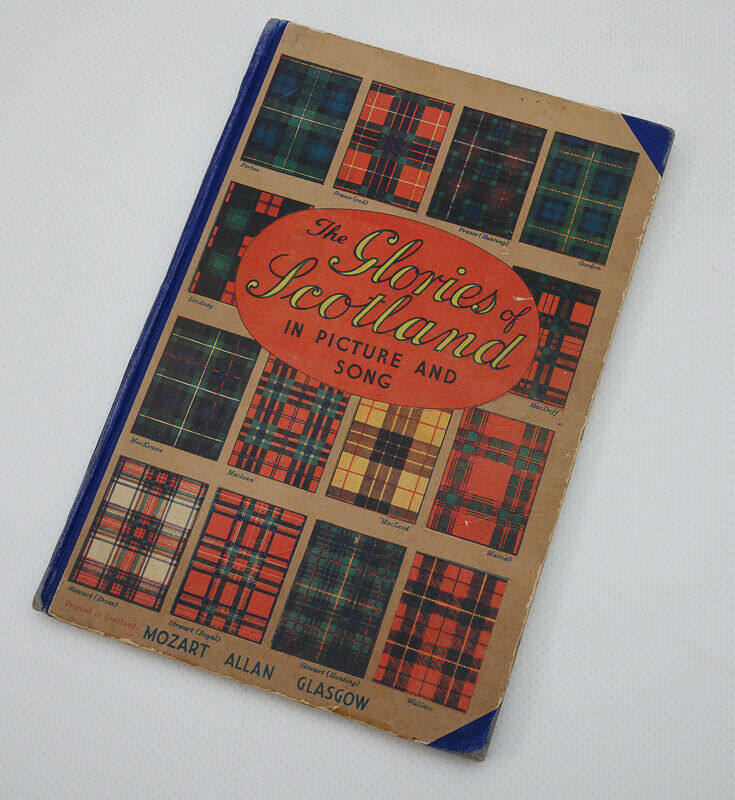
Less than 24 hours after that, I shall be giving a talk about a couple of Mozart Allan Scottish songbooks, in the Gifford Room (at the University of St Andrews’ Laidlaw Centre) on Weds 8th at 2.30 pm.

The Glories of Scotland in Picture and Song: compiling a book with the 1951 Festival of Britain in mind

https://www.st-andrews.ac.uk/assets/university/music-centre/documents/music-events.pdf

The Glories of Scotland is a ‘snapshot in time’, as I shall explain. It has connections with another contemporary Mozart Allan title, and also with the Festival of Britain.  Admittedly, it doesn’t look particularly special to our modern eyes, but it indirectly tells us a lot about postwar British culture.

As it happens, I’m giving a lecture to the historians later in November, in connection with my Ketelbey Fellowship.  But I’ll be taking a very different tack that time. The music talk on 8 November is about one – okay, two books, whilst the history one covers half a century. And it feels as though, whilst I’ll be introducing history to the music lovers, I’ll be sharing music history with the historians – looking at how contemporary trends were reflected in what Scottish music publishers produced.

I’ve just finished writing my music talk.  On Wednesday, I made a list of all the images I’d need for the PowerPoint, and I had intended on Thursday to see which pictures I had already (as opposed to those I needed to scan), draft the Ppt and do some reading. 

However, I didn’t bargain on Storm Babet. Suffice to say, I got a bus home to Glasgow and spent the afternoon and evening scanning and finishing the slides. No reading got done, but at least the talk and slides are all sorted. Well, apart from timing it …

Postscript. Thankfully, the postie’s delivery of one particular rarity didn’t get drenched in the rain last week. It was only 2/6 in 1950 – I dreaded it getting damaged. Especially as I’m talking about the diaspora intentions of the publisher, and this particular copy comes from France!

* For Hugh’s talk, visit the ATTS Torino Facebook page. https://www.facebook.com/attstorino

Obsession or Precision?

I’ve just ordered a second copy of a cheap, mid-twentieth century Scottish song-book, for what might seem like the flimsiest of reasons:-

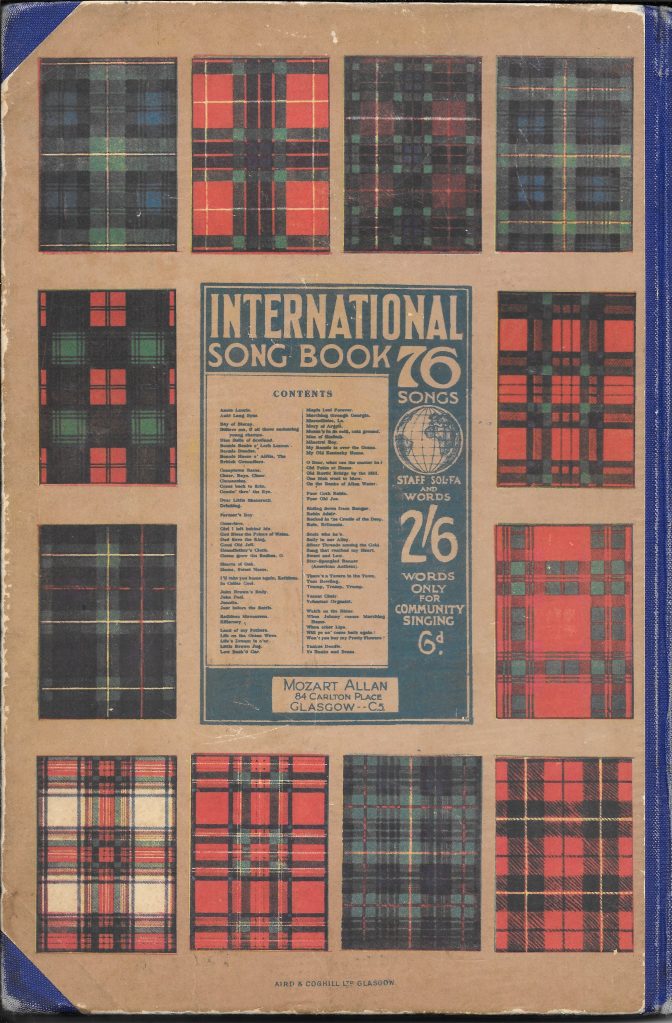
It has the lowest original price I’ve yet seen on the cover, and the National Anthem shows it precedes Queen Elizabeth’s accession to the throne. So, it’s an early copy.

Does this make a difference?

  • For a start, it is evidence of the latest possible publication date for this particular title. (I do have other, newspaper evidence, but here’s the tangible proof!)
  • It forms a kind of pair with another contemporary title, which I’m giving a talk about!
  • I want to see what other publications were being advertised at the time. Adverts did change over time.
  • I’d love to find other unexpected details – an owner’s mark of some kind – but that would be an added extra!

One day, when I’m a happy memory, my family will doubtless ask, Why did she have two copies?! Hopefully someone will defend me with, ‘She must have had her reasons …’

Oh, and where is it coming from?

France!

Print and Tourism

I have contributed a chapter to a forthcoming collection on Print and Tourism, which is being published by Peter Lang.  The completed manuscript will soon be going to the publishers, which is very exciting.  You might ask what a musicologist was doing, writing about print and tourism?  Well, it won’t be long before all is revealed. 

I had enormous fun writing this chapter, and I think folk will enjoy reading it.  It’s different.  Well, that’s hardly surprising, given the subject matter, but I’ve placed it in a wider cultural context than my usual more musicological offerings, and I’m really looking forward to seeing it in print.

A Question for You: What’s significant?

The topic arose from a book I acquired during lockdown.  Ironically, it was only a couple of weeks ago that it dawned on me that not only would we need to buy the essay collection for RCS’s library, but we’d also need a copy of the book which inspired it! I can’t think why that didn’t occur to me sooner, but it is on order and on its way, so I’ll be cataloguing it very soon. We’ll have it well before the essay collection is finally published!

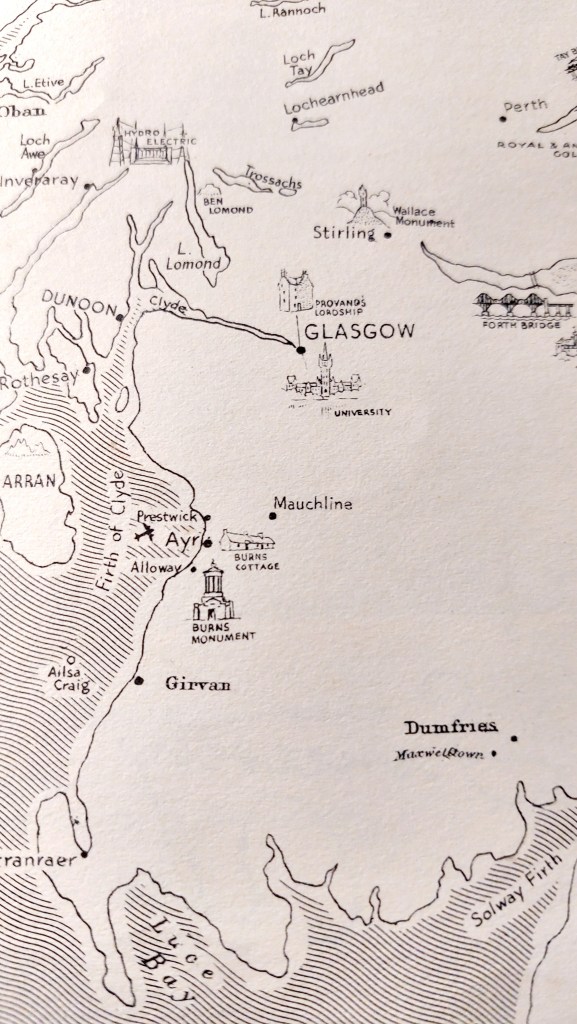
So, your challenge is this: Can you work out what is significant about this map?!

I would never, ever have dreamed, when I went to Exeter to start my first, unfinished doctoral studies on mediaeval English plainsong and polyphony, that I would end up completing a different PhD thirty years on, and writing and being published on such a very different topic!

Has Anyone Got This Music?!

It’s just a wee song written by a 1950s Scottish comedian – ‘Let Scotland Flourish’, by Alec Finlay. Yes, published by Mozart Allan (who else?!)

I found a picture of the cover – oh, yes! But I really would like to see inside, and also the back of it! There’s every probability it’s just a “variety theatre” kind of song – it may have a Scottish flavour. But I’d still like to see for myself …

A Gift for a Musical Friend? Or a Disappointment!

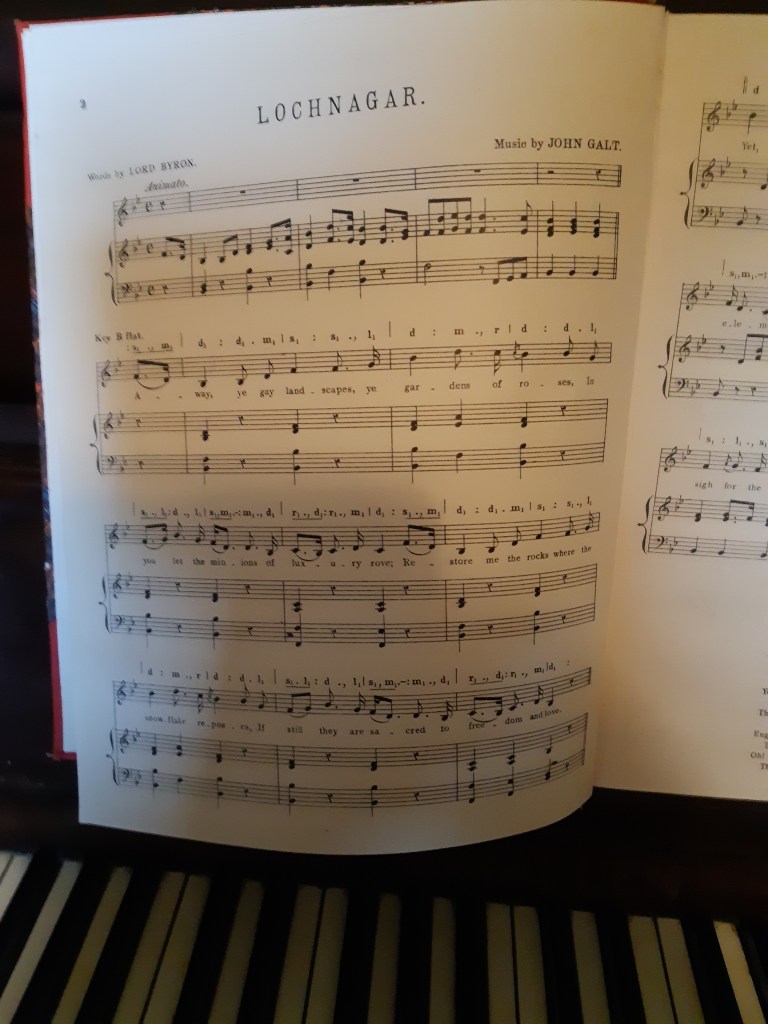
Lochnagar

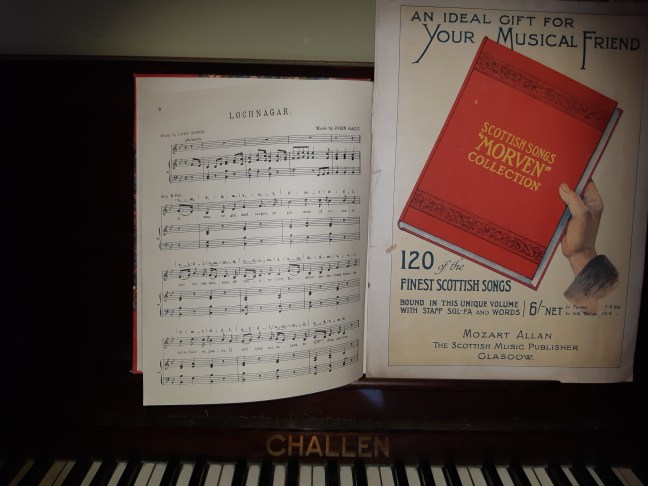
My lovely new book sits on the piano looking, frankly, grand. Diagonal tartan paper on top of cloth-bound covers, the red cloth spine and corners peeping out tantalisingly, and a gold-embossed title. It does indeed look like the advertisement’s promise of being a great gift for a music-loving friend.

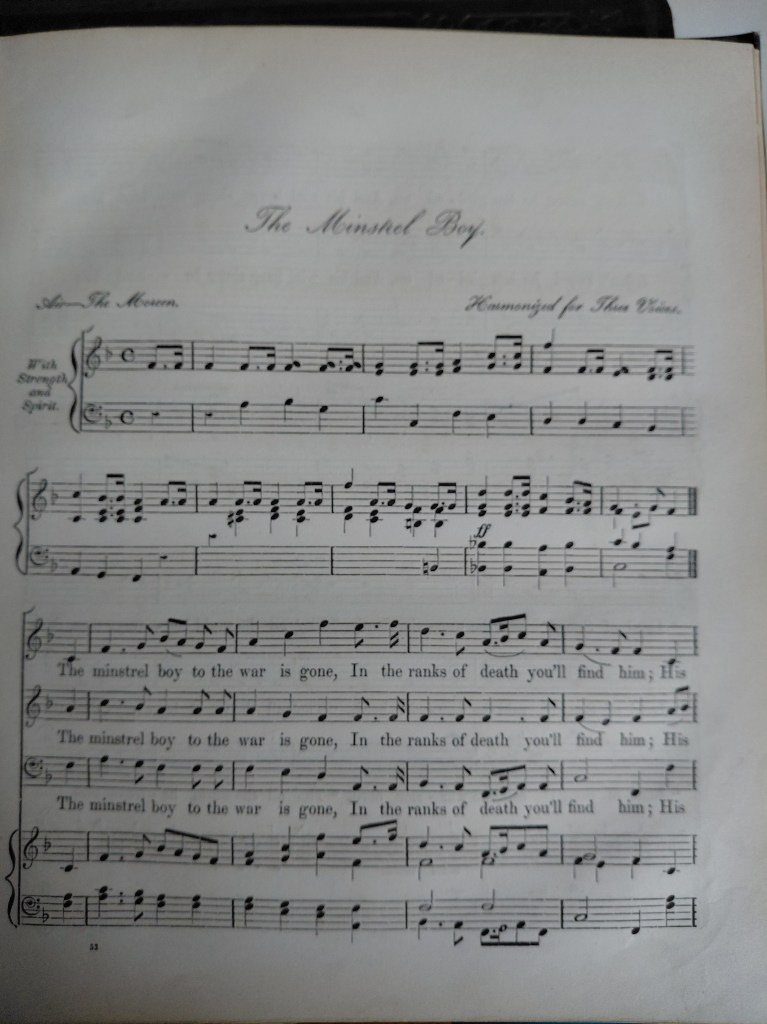
I have my own set of questions that I always ask when I open a new book of Scottish songs, and I’ll apply the same tests to “Morven” as I would any other book. But first, I played a couple of tunes from “Morven” this evening. My heart sank. Then Himself called through to me, “What on earth’s THAT you’re playing?” And with reason! The arrangements aren’t bad, technically, but they’re unbelievably prosaic. To be fair, they aren’t too demanding, so they’re accessible at least.

Listen to the introduction of Oh for the bloom of my own native heather, and you’ll see what I mean:- https://soundcloud.com/karen…/oh-for-the-bloom-of-my-own

My next step is to see how long Mozart Allan went on advertising it! It was first published in the 1890s, and my advertising leaflet with ‘An ideal gift for your musical friend’ is from the mid 1920s – but it would appear my copy of the vocal score was owned by someone in 1951. It’s in good condition, so perhaps it WAS still being sold then. (The address could place it anywhere between the late 1920s and the mid 1960s.)

I’m just a little bit sorry for all those countless musical friends who, nearly a century ago, eagerly opened their new book of Scottish songs, and found a batch of well-known songs in plain, unimaginative settings! You know that feeling?

A Word to the Wise

I needed to buy some music for church this weekend. And to console myself (because it wasn’t really my favourite kind of music), I ordered some old Mozart Allan music too.

  1. If ordering from Amazon, note that they may not tell you something is for “easy piano”. To avoid receiving insufficient notes, look VERY CAREFULLY at the photo of the book. Hal Leonard seem to put “EASY PIANO” in very small print at the top of the cover. Two of my purchases have had to return to Amazon.
  2. If ordering from Abe, be very careful to check that what you’re ordering actually IS music, or you’ll get No Notes At All. You didn’t know Mozart Allan produced word-books? Well, actually, I was aware of this. And now I have another one!
  3. Maybe you have absolutely no interest in where secondhand music came from, but as a point of interest, my Mozart Allan word book came super speedily from Derry, whilst another publication is going to come all the way from Canada. Considering it’s a promotional publication, that’s a fair indication that Mozart Allan advertised pretty widely, isn’t it?!

Weekends are Dangerous

There’s going to be a lot of activity at my front door in the next few days. I confess I had a spending spree. First, I ordered new, not-terribly-exciting organ music (needs must, but not my own taste!) … and then I had to console myself with some old Mozart Allan scores. Ironically, I won’t be playing a couple of them publicly, but I feel I can’t write about delicate, topical issues without seeing these old scores for myself. Not out of any remote sense of liking them, but because it wouldn’t be right to address the issues without knowing exactly what the publications are like. No second-hand, reported commentary for me.

To counterbalance those, I ordered some Scottish piano tunes and an advertising brochure which has to come all the way from Canada. These will give me considerable pleasure!

When Less is More (Blog to Book)

Returning visitors to these pages may find the content thinner than it used to be. Now that I’m working on my next book, I want my best content to be honed to perfection and triple-checked before I commit it to print. Rather than leave extended writings – which I posted as ‘work in progress’ – sitting on the internet, I’ve pruned what is here. In general, I continue to research the topics I posted here (Scottish music publishers James Kerr, Mozart Allan and many others, and interrogations of cultural issues), and any new details or dates which I didn’t know at the time of blogging, could potentially change what I originally wrote. And also, of course, I want readers of the book to be surprised and delighted by new insights that no-one knew before!

I shall continue to blog, of course. How could I not? I have so many ideas buzzing round my head that it’s hard keeping them all to myself!