Dr Karen McAulay explores the history of Scottish music collecting, publishing and national identity from the 18th to 20th centuries. Research Fellow at Royal Conservatoire of Scotland, author of two Routledge monographs.
Friday was a great day. Or should I say, Friday afternoon was a great afternoon?
A short research visit to the Mitchell Library was followed by discussion of my forthcoming RCS research contract – to enable me to continue researching part-time after I leave the library – followed by a trip to Glasgow Uni for the launch of the Books and Borrowing Database. It’s a fantastic resource, and I’ve watched the project with interest. (website: https://borrowing.stir.ac.uk/)
A bit of networking over a glass of wine and some cheese straws, then I headed home with a distinct lightness in my step. It wasn’t just the glass of wine! I felt as though I’m finally adjusting myself into who I’m meant to be.
I like to think I’ve been a good librarian. I do believe I have. But if I am honest, I chose librarianship because I couldn’t see myself as an academic. I am an object lesson in not writing oneself off at the age of twenty-four. If you’re like I was, or you know someone like I was, tell yourself/them to have more self-belief.
I’m giving my annual lecture on Scottish song books tomorrow. Just shows that I can lecture. Indeed, I’ve read countless papers over the past two decades.
Just think how many books I needn’t have catalogued, if I’d been braver and more determined at twenty-four. (I’m still cataloguing them – feeling a bit pressured, if I’m honest!)
On the other hand, how many intriguing enquiries I’d have missed, not to mention unexpected surprises amongst the book and music donations … there have been some advantages.
Image: Wikipedia picture of Hereford Cathedral Chained Library
I’ve written quite a bit about women in musical history, so I’m adding something to the top of this post every couple of days during Women’s History Month – mostly flashbacks to women musicians I’ve researched, but some other discoveries too. (I’ve been shifting things around to a more chronological order, but I’ve always added the new bit first!) You’ll find more musicians than composers in this posting, just because of my own recent research.
Sometimes I look at the history of women musicians from the point of view of good library provision for our readers, whilst at other times my own research interests are foremost. It just depends on the day of the week, because I currently occupy two roles in the Royal Conservatoire of Scotland. For 3.5 days a week, I’m a librarian. For 1.5, a postdoctoral researcher.
15. The Ketelbey Fellowship
It’s a whole year since I learned that I had been awarded the first Ketelbey postdoctoral research fellowship at the University of St Andrews. Scholar Doris Ketelbey was a significant figure in the history of the department. I felt highly honoured to have been the first Ketelbey Fellow from September to December 2023.
14. Representation of Women Composers in the Library
I couldn’t resist adding the open access article I published about my EDI activity in our own Whittaker Library:-
It’s a privilege to shape a library collection, so I’m pleased to have just ordered and catalogued several relevant books this month.
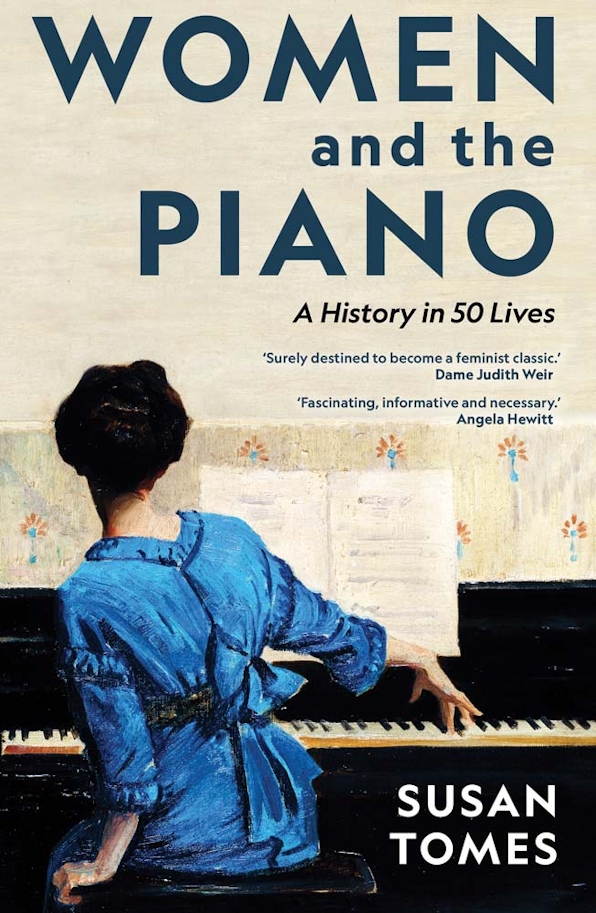
Susan Tomes, Women and the Piano: a History in 50 Lives (Yale University Press, 2024) Read more about it on the publisher’s website, here. In actual fact, it’s the fourth title by this author that we now have in stock. So if readers like this, they might like the earlier three, too!
Margaret C. Watson, Women in Academia : Achieving our Potential. (Market Harborough : Troubadour, 2024). Not a book about women in history, but very much for women in the present day!
Gillian Dooley, She played and sang: Jane Austen and Music (Manchester University Press, 2024). Back to history again.
Women and Music in Ireland / ed. Jennifer O’Connor-Madsen; Laura Watson & Ita Beausang (Boydell Press, 2022)
Moreover, there’s a new Routledge book coming out this summer – I have ordered it for the Whittaker Library. Of course, I may have retired from the Library by the time it arrives. This just means I won’t need to catalogue it! I’ll still be a part-time researcher, so I’ll be able to read it:-
It’s some years now, since a single-minded schoolgirl decided action was necessary. In 2015, Jessy McCabe noticed that Edexel had no women composers in the A-Level Music syllabus, and successfully petitioned to rectify this, via Change.org. I found out about her impressive initiative when I was beginning to start serious work on building up our library collection to include more music – contemporary and historical – by women and people of colour.
Jessy is now a Special Needs teacher. I’m sure she’ll go far.
11. Forgotten Women Composers
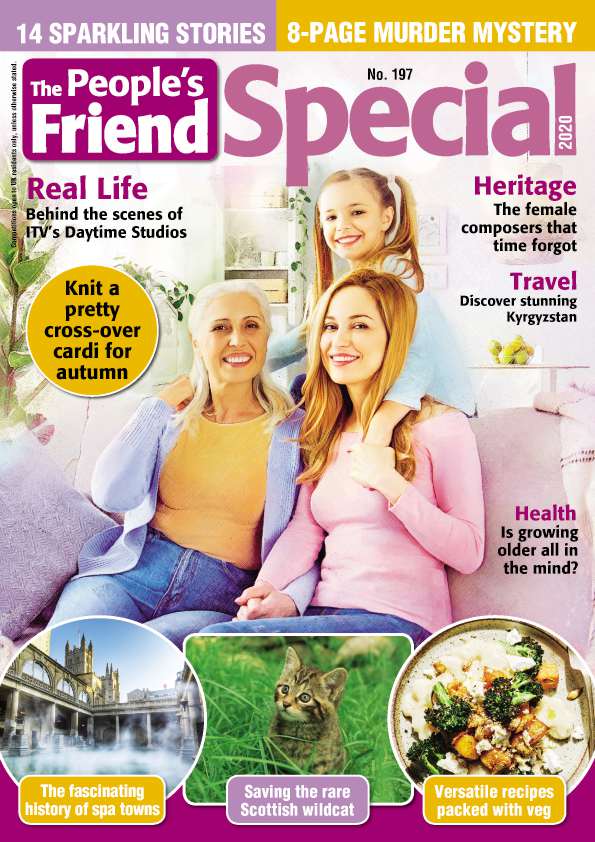
Part of academia entails sharing research outcomes beyond the ‘ivory walls’. It’s called public engagement, and that’s the opportunity I seized when my old friend The People’s Friend magazine commissioned me to write a feature back in 2020.
The sound of forgotten music: Karen McAulay uncovers some of the great female composers who have been lost from history’, in The People’s Friend, Special Edition, 11 Sep 2020, 2 p. (Dundee : D C Thomson). I blogged about it at the time (here).
10. Late Victorian Women Musicians
Since my more recent research has focused on the late Victorian era and the first part of the twentieth century, you’ll not be surprised to find that I found some interesting Scottish women musicians of that era! They are forgotten today – but I’ve done my bit to raise their profiles!
Newsletter article, ‘‘Our Heroine is Dead’: Miss Margaret Wallace Thomson, Paisley Organist (1853-1896)’, The Glasgow Diapason, March 2023, 10-15. (You can find this article in full on this blog)
‘An Extensive Musical Library’: Mrs Clarinda Webster, LRAM, Brio vol.59 no.1 (2022), 29-42 (a late Victorian head teacher who founded a music school in Aberdeen, and later did a national survey of music in public libraries – which she presented to the Library Association!)
In October 2023, I pondered about Mr *and Mrs* J. Spencer Curwen (amongst others) in another blog post, when I remarked upon early twentieth century attitudes to folk song.
9. In Praise of Music Cataloguers! Introducing Miss Elizabeth Lambert
Before I started the Claimed From Stationers’ Hall music copyright network, I had spent some months researching the wonderful late 18th and early 19th century music copyright collection at the University of St Andrews. A key resource was the handwritten catalogue in two notebooks, largely compiled by Miss Elizabeth Lambert (later to become Mrs Williams, when she married and moved to London.)
I just love the fact that this earnest young woman (I’m going out on a limb here, but I’m pretty sure she must have been earnest!) created a useful resource which would help everyone get maximum use out of the music repertoire that other libraries were less than impressed by. So we had Elizabeth cataloguing the collection, and numerous men and women, friends of the professors, making use of it. I blogged about her, and eventually wrote an article for the Edinburgh Bibliographical Society, mentioning her again.
‘A Music Library for St Andrews: use of the University’s Copyright Music Collections, 1801-1849’, in Journal of the Edinburgh Bibliographical Society no.15 (2020), 13-33.
The library’s copyright collection of music was a boon for middling class women like headmistress Mrs Bertram, her teacher daughters and their pupils. It does lead one to wonder if they had a harp at the school. I checked their borrowing records for more evidence. They certainly borrowed several volumes which included harp music.
7. Students but not at University? Educating Young Women
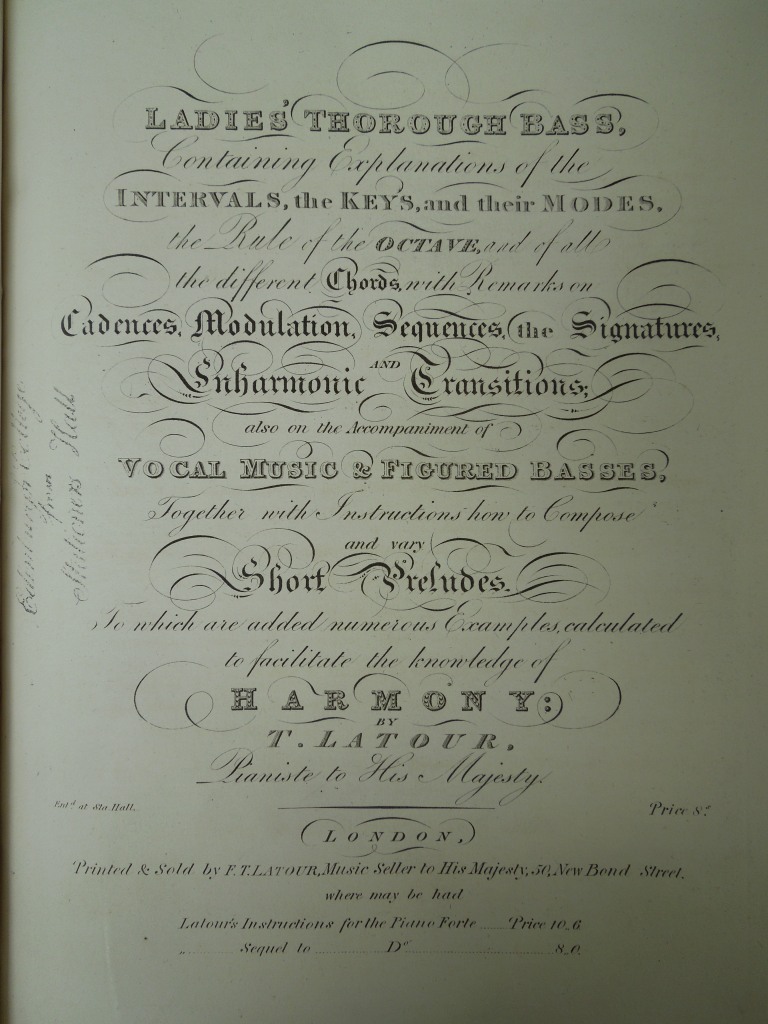
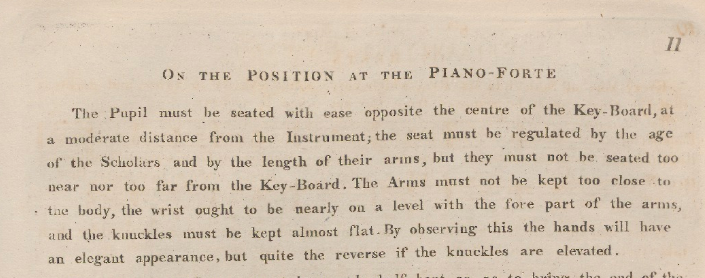
It’s time to turn to piano teacher Mr T. Latour. I’d like to refer you to my June 2018 blog post about women in St Andrews using pedagogical musical material in the early 19th century. Possibly the self-same young ladies attending, or having attended Mrs Bertram’s school?! The illustration features a young woman – probably just approaching or about marriagable age – at an upright piano. The abundant floral arrangement atop the piano (quite apart from sending shivers down the housekeeper’s spine every time the young pianist played too enthusiastically) suggests a well-to-do household. Following Latour’s instructions, the pianist has elegantly flat hands …..
T. Latour – Ladies’ Thorough Bass
Latour advises on the seating position, and how to hold ones hands elegantly
6. Not my work – but very timely for WHM 2024]
I’m not posting anything relating to my work today, but I saw mention of a great new article by Dominic Bridge the other day, so I thought I’d share details here. It’s a fascinating read. The Journal for Eighteenth-Century Studies is part of the Wiley Online Library:-
Back in 2018 when I was awarded the AHRC networking grant for the Claimed from Stationers Hall network, I drew up a list of women composers from the Georgian era. There were more than one might have expected – perhaps they only composed a handful of pieces, in many cases, but nonetheless – they composed. You can find the list on a separate page on this blog, here. And you can read more about it in the blogpost I wrote in July 2018,
This lady ran a girls’ school at St Leonard’s in St Andrews. This was NOT the famous and long-established private school that has long stood there, but an earlier enterprise. And Mrs Bertram and her daughters subsequently moved to Edinburgh, to the disappointment of parents of daughters in St Andrews!
The photo portrays a Mrs Bertram of Edinburgh. Chronologically, she could well be ‘our’ Mrs Bertram, and a scholarly bent is suggested by the pile of books at her hand.
2. The Accomplished Ladies of Torloisk
I almost forgot about the musical Maclean-Clephane ladies of Torloisk, which is a stately home on the island of Mull. But how could I forget about them, considering I published a lengthy article about them some years ago?! Luckily, a book of letters by Sir Walter Scott crossed my library desk, and even though it didn’t contain those particular letters, this did remind me of his musical friends in Torloisk!
Karen E. McAulay, ‘The Accomplished Ladies of Torloisk‘, International Review of the Aesthetics and Sociology of Music, Vol. 44, No. 1 (June 2013), 57-78
Today, I’d like to introduce a woman composer who predates most of the individuals I’ve encountered. Professor James Porter applies his considerable intellect to produce this in-depth article:-
‘An English Composer and Her Opera: Harriet Wainewright’s Comàla (1792)’, Journal of Musicological Research Feb, 2021. Published online: 16 Feb 2021.
Conference: Reading and Book Circulation, 1600-1800
I am just back from a fabulous library history conference at the University of Stirling. Even better still, I was the lucky recipient of a generous bursary from the CILIP Library History & Information Group, meaning my attendance was fully funded.
I had many pages of notes to read through and reflect upon before I wrote my report – so many excellent papers to think about. My AHRC networking grant not so long ago was about music in libraries ca.1790-1836, and although I’m currently writing about more recent music publications, it was very interesting to see what else was happening whilst “my” legal deposit library music was being accumulated in libraries in England, Ireland and Scotland.
‘Claimed from Stationers’ Hall’ frock makes a comeback for the conference!
And of course, there was the networking. After the pandemic, lockdown, working from home, hybrid working and so on, it was quite a treat to be able to spend time with kindred spirits for two whole days!
My report will appear in the LIHG Newsletter in June 2023 – it’ll appear online on the LIHG pages hosted by CILIP. This might mean that only members can read it, but maybe I can write a summary of it to share here, once the whole report has gone live.
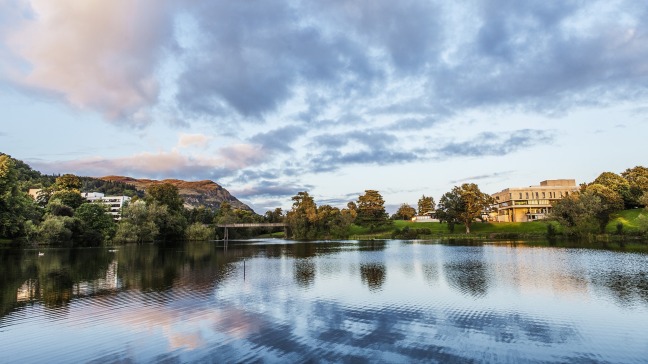
Image of Stirling University Campus by 昕 沈 from Pixabay
Last night I gave a lightening talk as one of eight speakers at the latest HoPIN webinar. It’s the History of the Printed Image Network, so my Scottish music collections were slightly off the beaten track, but you know me – my mission is to ensure that anyone picking up an old Scottish music volume knows exactly what they’re getting into! And it was certainly interesting to hear about other people’s research into different aspects of printing.
This link summarises the scope of topics, even if the event is past! HoPIN Webinar 11 (hosted by the University of Wolverhampton).
The next HoPIN webinars are on 15 September and 17 November.
SHAMELESSLY sharing this call for papers, word for word. Maybe one of the Claimed From Stationers Hall networkers might feel inspired to talk for five minutes?
“Speaking at a conference is a big step on your career journey & lightning talks are an ideal way to dip your toe in the water. We’re searching for speakers for 5-min lightning talks CILIP’s Copyright Conference (18 May, online).”
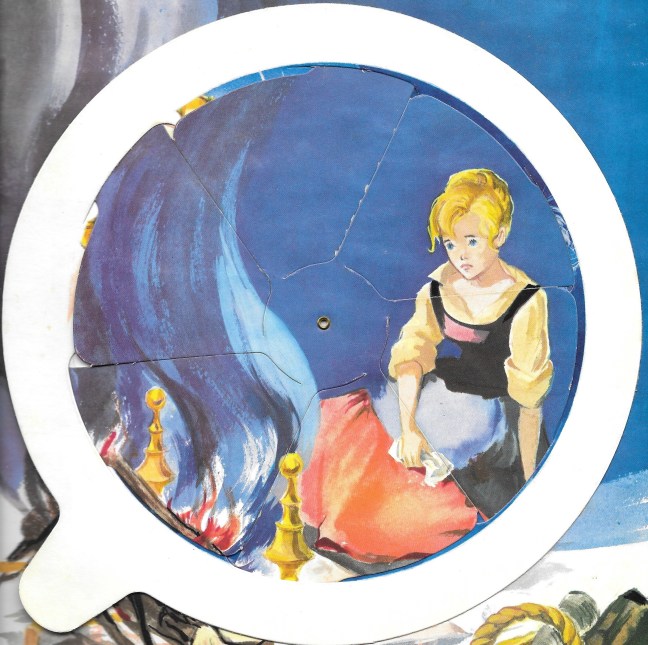
Again with perfect timing, my ‘Cinderella’ article is just published in my professional organisation CILIP’s Catalogue and Index issue 201 (December 2020). This originated as a conference paper that I gave earlier this Autumn. It’s open access, so you can read it online right away. (I shall be adding it to our RCS Institutional Repository as well, goes without saying!)
A visit to see the University of St Andrews’ Copyright Music collection led to my undertaking research into the history and contents of several hundred bound volumes of music. They’re intriguingly supported by contemporary Georgian and Victorian borrowing records, allowing us to see exactly who borrowed what, and when. We can piece together some details about how exactly the materials were borrowed, and the archives even hold a handwritten catalogue dating from 1826, which would have shown borrowers what was bound into the individual volumes.
However, since St Andrews was only one of a number of legal deposit libraries in this era, this raised the question as to what the others did with the music they were entitled to. An AHRC grant enabled me to pursue this further by founding the Claimed From Stationers’ Hall research network.
Modern catalogues became a prime research tool, enabling the network to explore what survives to the present day. However, it soon became apparent that not all libraries retained – or even claimed – music that was registered at Stationers’ Hall. Moreover, it has recently come to light that when music was added to stock, or when cataloguing took place, some interesting decisions were made by our Georgian and Victorian predecessors. Furthermore, early 21st century funding for retrospective online cataloguing failed to cover all the surviving music.
Inspired by a British Library big data project looking at British music published over the centuries, I had aspirations for a big data analysis of surviving legal deposit music, but the incomplete availability of automated catalogue records means that this ambition is currently not feasible, although cataloguing is still being updated, and the time may come when such a project can be revisited.
In the meantime, this research demonstrates the value of library cataloguing metadata not only in enabling readers to trace particular publications, but also for exploring a large corpus of music that was originally accepted by libraries almost as a by-product, of considerably less importance than the learned tomes which the universities were keen to claim for their students and professors’ use. You could say that Cinderella has at last made it to the ball!
In collaboration with Corrina Readioff (University of Liverpool), I’m one of the founder members of the Eighteenth Century Paratext Research Network. Corrina has been doing most of the hard graft in setting up this network! Do take a look, and if you’re interested in any aspect of paratextual research (Corrina researches epigraphs, illustration and chapter headings, whilst mine is musicological research into music of the same era – and other members’ interest span a wide range of topics) – do get in touch. The more the merrier!
First up – a call for papers for a forthcoming eighteenth-century conference. A panel will be convened ….
Network members are enthusiastically typing away at the moment, as the deadline for our Brio special issue looms closer! I’ve done a couple of book reviews, and have one more to tackle. Today, I was thinking about matters as apparently disparate as copyright, romanticism, bootlegging and modern recording techniques. Does that sound weird or intriguing to you? I thought it was an excellent book – but you’ll have to wait until the next issue of Brio to read my review!!
Woohoo! It’s deadline time. As you know, we’re contributing a special issue of Brio for IAML (UK and Ireland) on the Claimed From Stationers’ Hall theme. We agreed to have all writings completed by the end of August, and contributors up and down the UK and Ireland have been – and are – eagerly scribbling their considered thoughts on different aspects of the topic.
Brio does have a very general set of guidelines for contributors, but when it comes to referencing, the main requirement is to be clear and consistent within each article. Here’s a pdf of the guidelines, along with a quick screenshot of the first footnotes in the article on Edinburgh University Library’s music collections, already contributed by Alasdair Macdonald and Elizabeth Quarmby-Lawrence, Vol.55 no.2 (‘From General Reid to DCRM(M): Cataloguing the music collections of Edinburgh University Library, Part 1, The early Reid Professors and the first catalogues, 1807-1941)’, 27-49.
If the pdf doesn’t open for you, please let me know!
If you’re reading this but you’re not (yet) a member of IAML, then you might like to know more about us.








 Karen McAulay, Musicologist