Time to Reflect

My research has been on hold whilst I recover from eye surgery. Firstly, a UK ‘fit note’ says you’re unfit to work (and research is work); and secondly, my good eye soon tells me if I’ve placed too many demands on it. It’s weird to look at a computer screen when one eye  is compensating for the other one (that doesn’t fully focus and has an obstruction in the form of a black gas bubble). 

So, no research reading, though I have bought a couple of books for later.  But that doesn’t stop me thinking. I can’t help doing that.

The other evening, I started a very short list of potential research directions. I can’t proceed with any of them until (a) I am back at work, (b) I can get to various libraries and archives, and (c) I get the go-ahead to drive.

Each potential direction requires me to venture along the path to see what’s round the corner.  Not just, whether there’s enough to research, but whether there might be an interested audience for it. For example, there are two Scottish women musicians I’d like to know more about  – a Victorian and an Edwardian.  One never was a big name, except in her locality.  The other did enjoy fame, but she is virtually forgotten today.

Or, two Scottish music publishers with religious inclinations.  Does anyone care today, apart from me? I’m interested in what exactly they published; and whether they ever interacted in any way.  But is anyone else interested? (I had these hesitations about my mediaeval music research, decades ago. It was possibly one of the reasons it foundered.)

In any of these topics, I have to place the subjects into their social and cultural context, if I am to demonstrate relevance or significance in the grander scheme of things.  My motivation is to examine what these individuals and firms’ music and activities tell us about the era in which they lived and worked.

But then there’s the question of impact. I don’t have to so much as open my laptop, let alone a book, to start worrying that I haven’t yet come up with a mind-blowing angle that will knock the world’s socks off!   Moreover, there is no conceivable way I can make any of my research relate to climate change; saving the earth’s resources; social good or benefit to health.  

And so I sit, blurrily gazing into the middle distance, reflecting! I have the go-ahead to return to work on Monday. Blurrily!

Image by nateen08650 from Pixabay

Researchers and Television – an opportunity

I had the opportunity to attend an event sponsored by AHTV and the Arts and Humanities Research Council this week. It took place at the Barbican Centre on Wednesday 5th February, so I travelled down the previous evening, and back to Glasgow on Thursday. The whole purpose of the event was to provide academic researchers with an opportunity to meet with TV professionals, and to learn more about getting one’s research discovered and disseminated through the medium of television.

It was a most informative day. I must confess to feeling a little star-struck when I realised that the keynote address was by Bettany Hughes, whom I’ve seen and admired on television history programmes. Similarly, hearing about the making of ‘Suffragettes’ with Lucy Worsley was fascinating – even if Lucy herself wasn’t actually there! I also availed myself of the opportunity to have a speed meeting with a TV professional.

I’d genuinely love to have the opportunity to get the Claimed From Stationers’ Hall network research out to a wider audience, but my first problem is the fact that we need big names or significant events to hang our story on. However, our primary heroine – Elizabeth Williams, nee Lambert – was, on the face of it a complete nonentity in terms of big names or big achievements. It goes without saying that she wasn’t a nobody in my opinion! (See A Labour of Love for Miss Lambert, also on this blog.) Of course, we know that her music catalogue was significant and highly useful to the music lovers of St Andrews in the late Georgian era. It made the collection much more easily navigable, and hence more useable.

In the wider scheme of things, it demonstrates the importance of work that goes on behind the scenes in libraries to this day. Very few professional cataloguers have a prominent public profile, and Miss Lambert certainly wasn’t a professional of any kind – she was paid a tiny amount for producing a catalogue, and that appears to be the sum total of her ‘official’ involvement. She married at a fairly late age and went off to join her husband, his mother and brothers, in Islington – and there’s not a lot more known about her life apart from her gift of her shell collection to the Natural History Society of Northumbria not long before her death. You could say that her life went as unnoticed as the vast majority of women of her era (and indeed subsequent eras), and yet those two handwritten music catalogue volumes do have significance in their own way.

We have to bear in mind that this veritable mountain of legal deposit music wasn’t exactly what most Georgian university officials wanted in their libraries – it was the books on law, theology, medicine and science that they had their eyes on. The St Andrews professors maybe took a different attitude to most, in allowing non-university music lovers to borrow music through the good offices of their professorial friends. The collection that was clearly important to Miss Lambert was heavily used by both men and women – I interrogated the music in terms of what was most borrowed by various categories of readers. Considering that there were parallel collections in several other legal deposit libraries, we were keen to compare what survived elsewhere, but nowhere else are there borrowing records or evidence of such intensive use. So many stories – but can I argue the case for a television documentary? Well, let’s see!

And … Send!

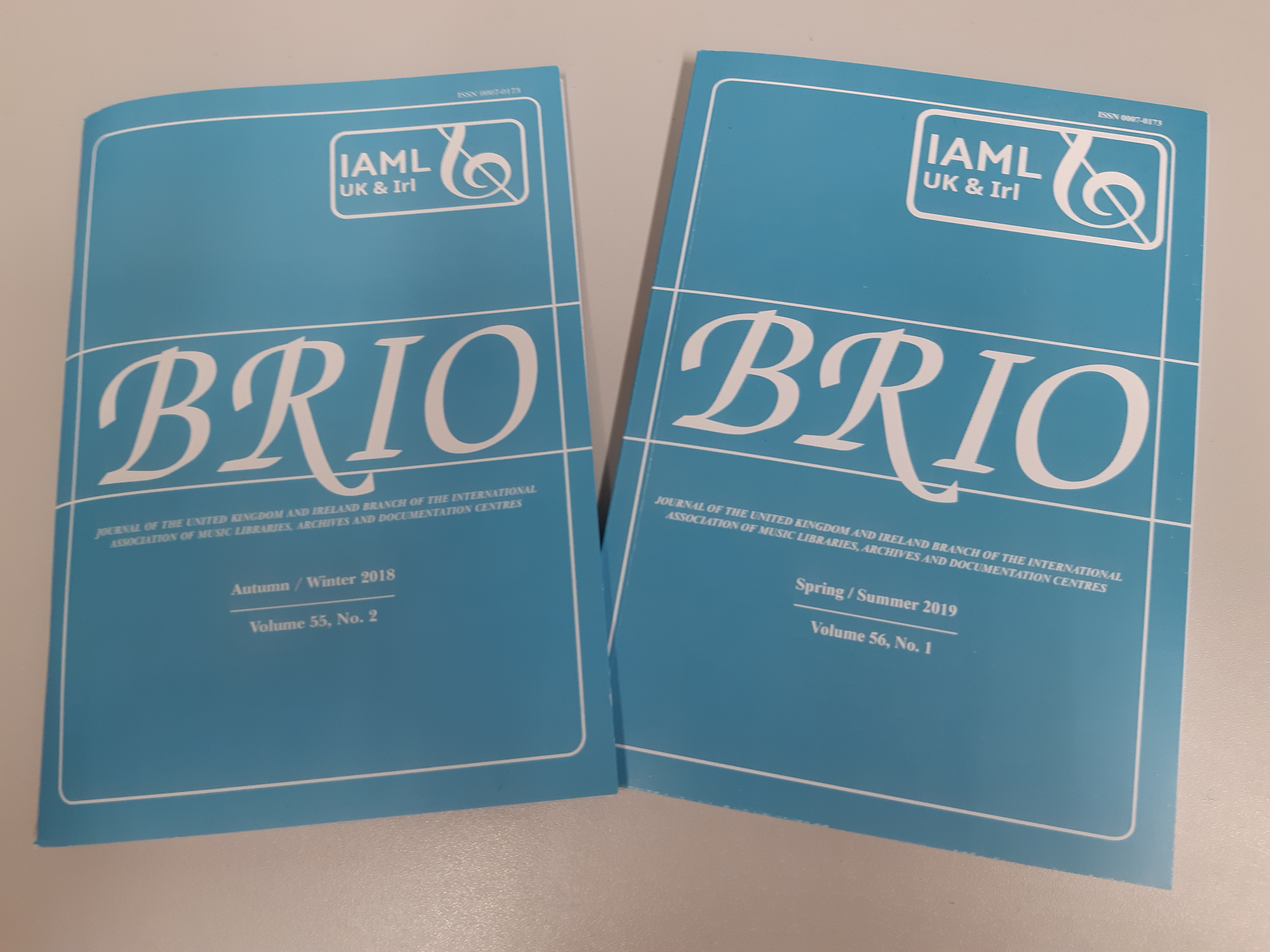
2019-08-08 10.06.13That’s it, folks.  Martin and I have given the Brio “Special Issue” proofs the final thumbs up, and they’ve gone off to the printer.  No going back now … your special issues are well and truly on their way.  (They look slightly different to those pictured here, but I won’t spoil the surprise!)

Have You Met Your Original Objectives?

fishmosaic

One of the questions asked by ResearchFish – the private limited company responsible for collecting data about everyone’s grant-funded research – is this:-

“Have you met your original objectives?”

It’s a multiple-choice answer: Yes; No; Partially; or Too early to say.  I’ve devoted quite a bit of time to asking myself this question, and I believe that yes, I have achieved what I set out to achieve, with the help and support of all those who have involved themselves in the Claimed From Stationers’ Hall music research network.

fishmosaicThe project sought, in the first instance, to identify the patterns of survival of the Georgian music copyright material. Whilst aware that perhaps only one quarter of all Georgian-era published music was actually registered at Stationers’ Hall, we now have a very clear overall picture of the survival patterns of the registered musical material in historical legal deposit libraries, with the most obviously complete collections being at the British Library, the Bodleian and the University of Glasgow, and with the University of St Andrews’ collection close behind them.  Cambridge and Aberdeen University Libraries, and the National Library of Scotland have rather less, but cataloguing is incomplete, whilst Edinburgh University retained only a very modest amount of the copyright music that they received. (There’s a magnificent spreadsheet, and the music is now gradually being fully catalogued.)

Three libraries seem not to have retained music, for historical reasons tied up with the institutions themselves: Trinity College Dublin made a decision not to claim music; King’s Inns, also Dublin, was a legal library, and it is impossible to tell whether the unexpected small holdings of music arrived through legal deposit or by other means; and the theological Sion College’s surviving holdings, now in Lambeth Palace Library, appear not to have had any copyright music by the time of transfer.

fishmosaicSecondly, the project sought to identify where collections may not yet be catalogued online, to establish the extent of the work outstanding in order to facilitate access to the material in library special collections via Copac. We now have a clear picture of where holdings are not yet catalogued online; and until the time when the bulk of this material ­is retrospectively catalogued, big data analysis would perforce be somewhat misleading. On a more positive note, interest has been expressed in attempting to rectify this situation at four of the libraries, and the increased interest in the repertoire that this project has engendered, has certainly provided motivation.  Some interesting big data analysis was produced using data from the St Andrews material currently catalogued online, and data gathered from historical loan records of the entire St Andrews music copyright collection.  However, no other institution holds comparable loan records.

fishmosaicThe third objective concerned interdisciplinary networking, with the project offering an opportunity for networking by interested parties from all relevant disciplines, seeking to explore the history of British-published music in all British legal deposit libraries. Extensive networking, in person, via electronic means, and in print, has raised the profile of this repertoire. A workshop at the Royal Conservatoire of Scotland brought together librarians from most of the historical copyright libraries, together with interested scholars from the fields of musicology, big data analysis and digitisation of resources, and library history.

Papers have been given at a number of conferences, with the possibility of more in future months; and relationships have been forged both nationally and internationally with individuals and with relevant organisations:- librarians, particularly in music libraries and special collections; book and library historians; musicologists, folklorists and copyright specialists; and contact with Stationers’ Hall itself.  In short, a wide range of people have been introduced to this project at the various events I’ve spoken at, from scholars of various disciplines, to librarians in different kinds of libraries, to folklorists, copyright specialists, local historians and genealogists, and users of archives.

fishmosaicA fourth objective was to draw together documentation in support of the interdisciplinary study of such collections’ history, by compiling a bibliography for the shared use of both librarians and scholars, which would itemise both archival sources and existing scholarship and writings on these music collections for future exploitation by scholars of various disciplines. A substantial bibliography has been compiled, detailing scholarship on all aspects of historical music copyright and legal deposit, also embracing some of the wider context of copyright legislation, and pertaining to music in individual institutions. Histories of individual libraries have been included, with the extent of archival documentation at the University of St Andrews standing out above most others, particularly in terms of the use made of the music copyright collection there.  This bibliography, currently online via the present network blog, will also very soon be made available via the institutional repository, Pure, at the Royal Conservatoire of Scotland.

fishmosaicA fifth objective was to introduce and promote these collections and their research potential at interdisciplinary meetings and via appropriate publications. To this end, the study day at the Royal Conservatoire of Scotland in March 2018, afforded delegates the opportunity to share knowledge about individual collections; to look ahead to future collaborative possibilities; and to reflect upon the need for further retrospective cataloguing; and to listen to a performance of some Napoleonic-era songs by women composers.

Themes arising from the study of this repertoire, and mentioned at the study day, have also been explored in subsequent conference papers and blogposts (both for this blog, and also as a guest blogger on others), demonstrating how the copyright collections provide a wealth of source material for studying the social and cultural history of music, eg the role of women in creating as well as performing music in the Georgian era; early music pedagogical repertoire; or the writing of popular songs and marches as a cultural response to the Napoleonic Wars.

The study day resulted in a commitment to produce a guest co-edited issue of Brio, the music librarianship journal of the International Association of Music Libraries’ UK and Ireland branch; authors have agreed to provide material in time for the November 2019 issue.

fishmosaicLastly, the project sought to foster the performance of music from these collections, encouraging network participants to consider small-scale local events to showcase this material. A performance of some Napoleonic songs composed by women had already taken place both in St Andrews and at the University of Glasgow before the commencement of the network proper, and two of these songs were performed at the study day itself. The opportunities posed by this kind of material have also been outlined in spoken conference and seminar papers, and the possibility of further educational outreach to under-18 year olds is still currently under discussion.  Key issues are that, whilst librarians are custodians of the rare musical materials, it would require collaboration between librarians, musicologists and performers to research the collections in order to present particular historical themes, and to facilitate live performances. Furthermore, the exploitation of music through performance is probably more likely to take place beyond, rather than in, individual libraries, thus making the coordination of such events more complicated than they might initially appear – but assuredly not impossible!

fishmosaicIn summary, the stated objectives of the Claimed From Stationers’ Hall networking project have certainly been met.  The challenge now, of course, is to examine the findings and, taking all considerations into account, to determine the most promising directions for future research!

blue-turquoise-mosaic.jpg


Research Impacts: Asking You!


fishmosaic

The other day, I blogged about research outcomes.  Much joy has been experienced in the logging of these – it’s actually quite rewarding to look back and see what has been achieved in one and a half days a week.  (Okay, some was admittedly achieved in evenings and weekends as well.  But an outcome’s an outcome, isn’t it?!)

However, if you’ve had an opportunity to glance at my recent guest-blogpost for IAML (UK and Ireland Branch), you’ll realise that the outcomes are only one side of the story.  So, today I’ve been contemplating research impacts.  This project has made networking connections with loads of people, libraries and organisations, so there’s no denying there has been impact within academia … but what about beyond the ivory towers?!  Some of the organisations have a preponderance of researchers, but others certainly embrace both academia and those in non-academic circles.

So, here’s my appeal to you: if you’ve been enjoying following the project, and you feel we’ve in any way influenced you in your academic OR non-academic existence, I’d positively love to hear from you.  I know I haven’t been blogging into a void, because people do respond to what they see … but I’d hate to think I had overlooked some impact or influence that was worth shouting about!  Similarly, do let me know what you’d like to happen next.

I’ve allowed comments on this post – but any form of communication, social-media or otherwise, would be very warmly welcomed!  Thank you.

Research Outcomes

At a time when all researchers earnestly and diligently record and submit outcomes and fishmosaicoutputs for ResearchFish, I wonder how I could intimate the activities that have been initiated for 2019 as well?!  This month, I’ve submitted abstracts in response to FOUR conference calls for papers.  I’ve started thinking about another potential project.  But I’ve also got several things already in the pipeline, written during the research grant for Claimed From Stationers’ Hall – and indeed, a few that have been in the pipeline for much longer than that!  (Inspired by ResearchFish – not that this particular piece of writing has anything to do with my present research – I have just enquired about some encyclopedia entries that I wrote in 2016, and was relieved to hear that publication is (in encyclopedic terms) imminent.  It’ll be good to strike them off my “pending” list!)

Isn’t it frustrating when your outputs are significantly greater than have actually reached fruition or publication!

Ah well, back to ResearchFish, and I’ll see if I’ve missed anything off the present list!

Researchfish – Little Fish in a Big Pond

When one is awarded a grant by a major research body, obviously accountability is a fishmosaicvery important consideration.  To that end, activities have to be logged on the poetically-named but very definitely serious Researchfish website.  All big scholarly funders use it, asking for details of such matters as publications arising out of the research, further funding, engagement activities (there’s quite a bit I can enter here!) and so on.

At first sight, it’s a bit intimidating, but once I’d downloaded a list of “Common Outcome Types with sub-types”, and crossed out the columns in which no-one would remotely expect me to have outputs (Medical Products, Interventions and Clinical Trials, or such Research Tools as Biological samples, or human models of mechanisms or symptoms), it didn’t look quite so bad.  I do feel a bit like a little fish in a big pond compared to people winning major awards to find cures for horrific diseases, design new space rockets, or solve the greater political and social conundrums of our age.  Still, one has to start somewhere!

So, my activity for the rest of today will be to go through the list I’ve already compiled, and add the various presentations, blogs and guest-blogposts, and so on, and just see how far I get!  For one-and-a-half days a week over 13 months, it looks okay – well, in my opinion, at any rate!  As I’ve said often enough before, watch this space.


Latour – Piano Professor & King’s Pianiste

Followers of this blog will know that you can look at historical piano teaching materials in the libraries that hold legal deposit collections.  Nowadays, there are a handful of big national and university libraries in the UK that still receive one copy of everything published, under statutory legislation.  But there are other libraries – especially in Scotland – that also received this material, until the beginning of Queen Victoria’s reign.

Theodore Latour was pianist to King George IV – Victoria’s uncle.  He taught privately and at girls’ schools, played and composed, and also wrote some piano tutor books.  As it happens, Emily Bronte had music by Latour in her collection, including one of his books of progressive exercises, although I haven’t examined that particular publication.  (Robert K. Wallace mentions it, in his Emily Bronte and Beethoven: Romantic Equilibrium in Fiction and Music.)

It’s possible to find copies of some of Latour’s works online via Google Books, IMSLP or Archive.org, so if you’re interested, we could point you in the right direction.

I have been experimenting with other ways of talking/writing about the Stationers’ Hall Georgian legal deposit music corpus. Here are my Saturday afternoon efforts.  Have you tried any such audiovisual presentations in your own research?  Do you find them helpful?