Dr Karen McAulay explores the history of Scottish music collecting, publishing and national identity from the 18th to 20th centuries. Research Fellow at Royal Conservatoire of Scotland, author of two Routledge monographs.
If this book could speak, it would just say something mysterious and enigmatic. It wouldn’t give everything away all at once.
So … as you know, I’ve been ploughing through archival records. On Friday afternoon, I’d just got to an interesting volume. But before I’d examined all the pertinent pages, I left (because the reading room was closing) – just wishing it was Tuesday morning!
I’d unearthed a change of personnel at the publisher’s. Over the weekend, I’ve learnt all sorts of interesting facts, most of which – truth to tell – have nothing related to Nelson’s Scots Song Books. (They can’t have – they’re subsequent to these books’ publication.) On the other hand, it significantly adds to the human interest, and gives a kind of forward-looking context. And I truly believe that the more context you can give, the more relatable the ultimate story is.
I look forward to Monday, because it’s a Glasgow-based research morning. But Tuesday? I want to get back to that volume in Edinburgh, and there are other sources I am keen to access. Roll on Tuesday.
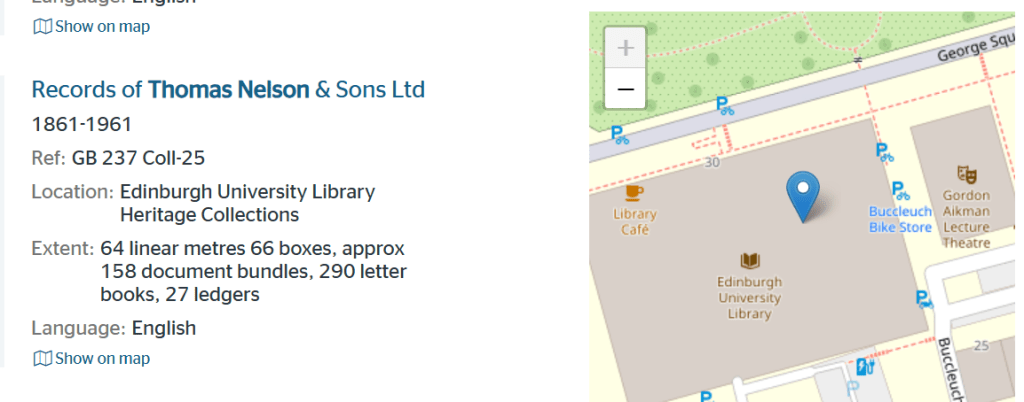
As I’ve already mentioned, I am currently a Heritage Collections Fellow at IASH – the Institute of Advanced Studies in the Humanities, at the University of Edinburgh. I’m halfway through my Fellowship, and (hopefully) halfway through my trawl of the Thomas Nelson publishers’ archives in search of correspondence about their music publications in the 1940s to 1950s. The book I’m primarily interested in has presented me with a few surprises and thoughts of new directions to pursue, but I shall plough on through the archives until I am sure I’ve captured every whisper about these four little school books.
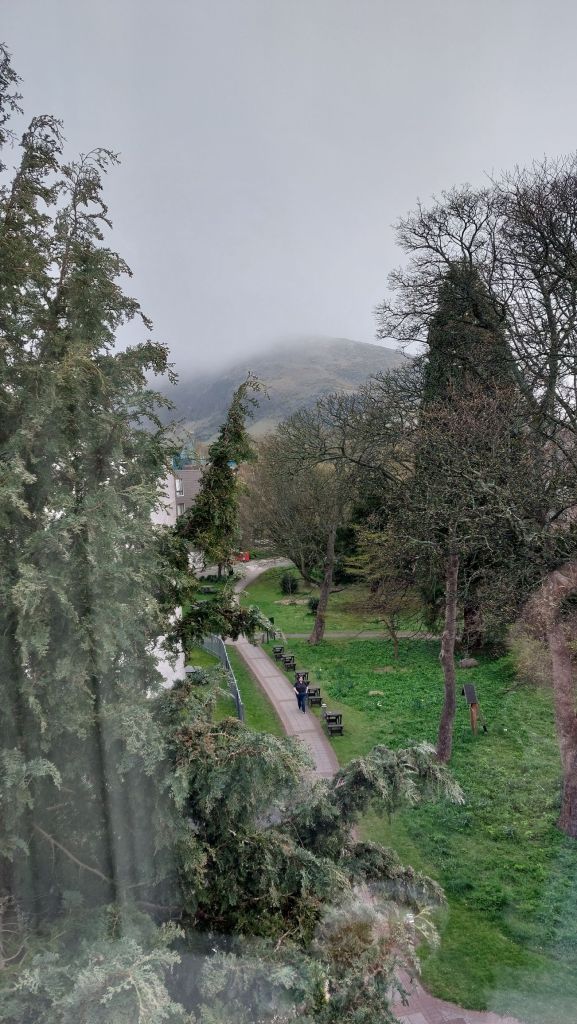
View from the Scholar Hotel
This week, we had the Institute’s 55th Anniversary celebrations, with a focus on Decoloniality. The Institute has just concluded a two-year project on this theme. There was also a session on motherhood and reproductive justice.
Now, you’d think, perhaps correctly, that my Scottish song book and music education focus has little connection with either decoloniality or motherhood. But I did put a lot of effort into broadening the scope of the music collection to include more music by women and composers of colour, whilst I was a Performing Arts librarian at the Royal Conservatoire of Scotland, so I was keen to find out what other scholars in more directly related disciplines have been doing.
I think it’s fair to say I felt a bit overawed! IASH is very interdisciplinary, so there were contributions from all corners of the humanities, and by scholars with far more extensive experience in their fields than I have in mine. But there were contributions from the performing arts, and from heritage collections and archives – I felt more comfortable in these areas, and a bit less out of my depth.
I stayed in Edinburgh overnight to make it less of a rush from Glasgow for the second morning.
In the final session, with contributions from past and present directors, I was impressed by the sheer reach and achievements of this amazing institution, and both proud and humbled to be a Fellow here.
O wad some Power the giftie gie us,
To see oursels as ithers see us!
In the context of Robert Burns’s poem, those lines are exhorting us not to get above ourselves, but taken in a different context, they perhaps offer reassurance that others see something in us that we can’t necessarily see ourselves.
‘They thought I was worthy to be a Fellow – in a very competitive application process?’, I mused. But yes, they did indeed select me, which is a vote of confidence in itself. Sometimes, you need validation by others – it’s hard to be objective about oneself!
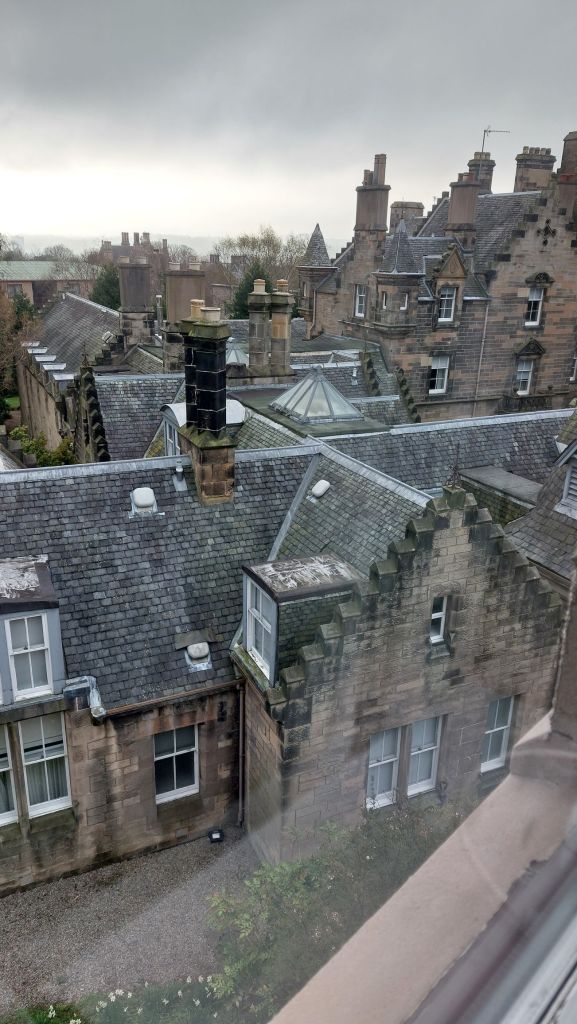
Another view from the Scholar Hotel
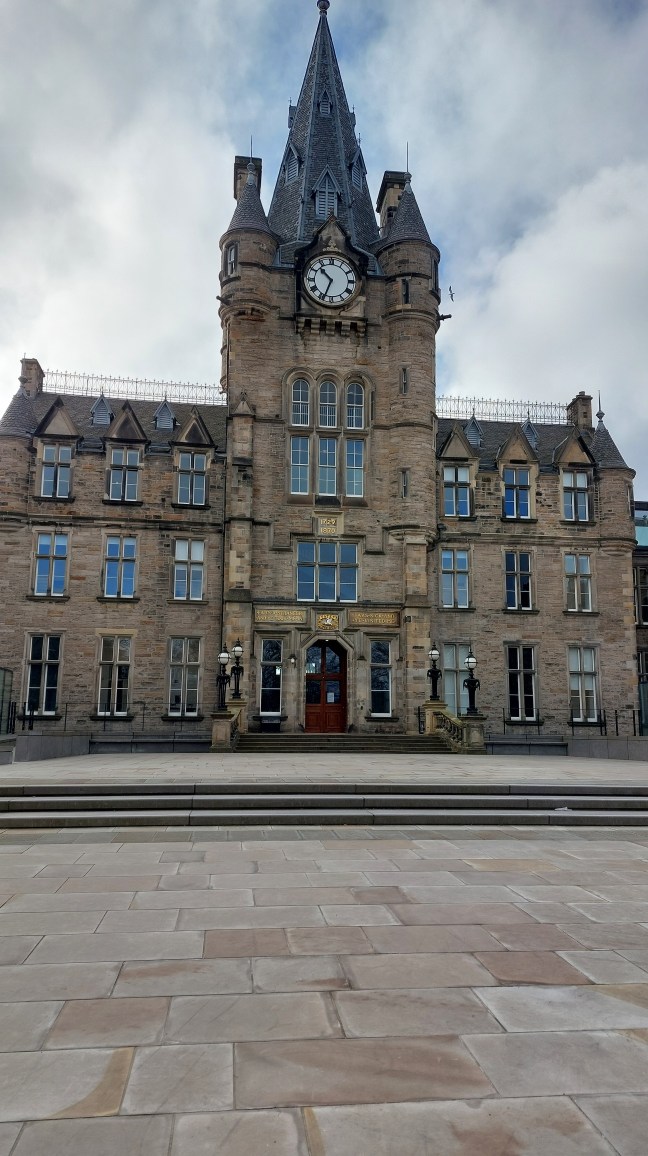
Image at top of post: The Edinburgh Futures Institute
As I’ve mentioned, I’m currently Heritage Collections Research Fellow at IASH, the Institute for Advanced Studies in the Humanities, at the University of Edinburgh. All guest fellows are invited to give a work-in-progress seminar, and it’s my turn on Wednesday 26 March at 1 pm. You can attend in person, or online – more details on the link below. The abstract tells you what my talk is about.
I’ll explain what I’m looking for, and introduce you to some of the individuals I’ve been finding out about. The one thing I can’t predict, is whether I shall by then have found the answer to my prime question!
Last Friday, I submitted an article. Yesterday, I did the minor edits for an accepted article and dispatched that, too.
And today, I headed to Edinburgh and resumed my archival pursuits. The city was initially bathed in golden sunshine, though this didn’t even last until lunchtime. It is certainly a very beautiful city.
Nearly spring in Edinburgh?
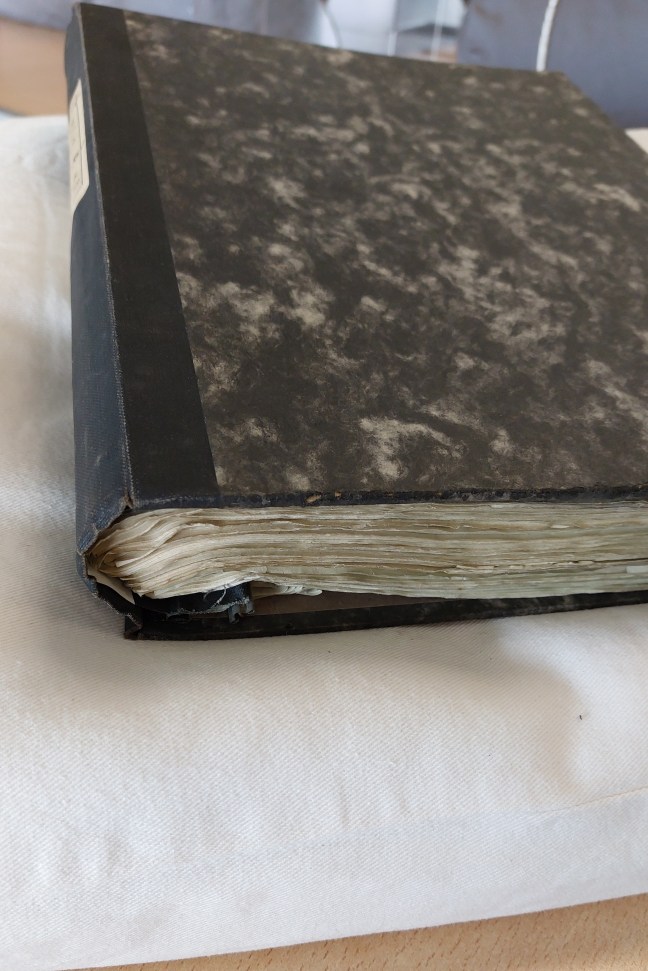
Unless you’ve experienced it, you can’t imagine how many brown folders of thin carbon copies will fit into an archival box. Carbon copies are as thin as airmail writing paper. The bulk of this particular box consists of NINETEEN folders of rejection letters just for one year, 1948.
You might think I didn’t need to concern myself about books they didn’t publish, but you never know what snippets about publishing policy or the economic climate – or anything else! – might turn up. (And you’d be surprised at the number of would-be authors who didn’t take a definite refusal AS a definite refusal, but kept writing to argue their case!)
‘Do Forward the Bathing Costume’
That was an unexpected postscript, in one of the letters that wasn’t a rejection. The publisher and author had evidently gone to the swimming baths, and the author went home without his trunks! Irrelevant, but it’s undoubtedly evidence they were on friendly terms, isn’t it?
I did discover – unneccessarily, but amusingly – that in the late nineteenth century, the managing director of this publishing house used to go open-air swimming in Leith before work in the summer. Clearly the tradition had either continued, or been revived, with the opening of the Portobello open-air pool in 1936 …
My new schedule entails thinking about an Edinburgh publisher whilst I’m in Edinburgh, and writing about various other aspects of my research on my Glasgow days.
I have an article I’m actively gearing up to write; another requiring tweaking; a couple more requested; and lastly, a new avenue for which I’ve identified a journal, but not yet completed the research. Quite a bit of writing!
But first, in the first article, we have the soprano and her repertoire. And her ‘go-to’ encore. And if you thought I got excited about magic lanterns – new technology for late Victorians – well, you can imagine my excitement at the thought that I may need to watch a silent film soon.
Why? A musicologist watching something in silence? What does silence have to do with music (apart from John Cage’s 4’33”, of course)?
You see, I think this film may have influenced her choice of encore. So, firstly, I’m awaiting an eBay copy of the novel on which the movie was based. And then, I’m waiting to find out if I can watch the movie without leaving Scotland.
She wasn’t a film actress herself, so my whole quest is a bit tangential – I’m not thinking about nipping down to London unless it’s absolutely unavoidable. But I could …
Meanwhile, I reflect that watching silent moving pictures must have been enormously exciting if you had grown up with the occasional magic lantern show. And when, in due course, talkies came in … it’s hard to imagine how amazing that must have been. Small wonder that printed music took a bit of a nosedive in the late 1920s – the options for entertainment outside the house were expanding all the time.
I’m eagerly awaiting news of my chances to watch this intriguing spectacle!
I read some advice the other day (you’ll have seen it often enough):-
If you aren’t happy where you are working, then leave.
There’s another adage, which is similar on the face of it, which goes like this:-
If you keep on doing what you’ve always done, you’ll get what you’ve always got.
I know there’s value in the first suggestion, but it isn’t always possible, is it? You may be well aware that you’ve probably been in the same job too long, but personal circumstances mean you simply can’t leave. Or your role is so specialised that you would have to relocate, which might not be an option.
This is why I prefer the second adage. Sometimes you have to take a long view, and your Plan B might involve changing direction whilst sitting tight. Get ready for a new role, adjust your mindset accordingly, but accept that it’ll be a while before you make the move.
Alt-Ac-tually
I feel for people at the start of an academic career, with the struggle to get one foot on the ladder. Do you actively want an Alt-Ac career, or do you feel you have no choice?
I wanted to be an academic music librarian. That became my career, but later I regretted not having finished my first PhD and given academia a fair shot.
My Plan B began with getting a PhD. Afterwards, I was very fortunate to get partial secondment as a researcher for more than a decade, whilst remaining in librarianship for the bulk of my week.
Adjust Mindset
It’s not just a question of having the right qualifications. You need to ensure that you believe in yourself as a scholar, and that others see you as a serious academic.
Write the articles;
Publish the book (if appropriate) or chapters,
Attend conferences (partial attendance isn’t ideal but it’s better than non-attendance, if cost or time are problematical);
Give talks, whether scholarly or as public engagement;
Seek opportunities for career development. (I did a part-time PGCert a couple of years after the part-time PhD).
DO NOT, repeat DO NOT, write yourself out of a career option because you believe yourself incapable of it. (Aged 21, I believed I would never be able to stand in front of a class of students. And on what did I base that assumption? I’d just taught English to assorted European students for about a month. I did it. I planned lessons, and stood there, and did it. So who said I couldn’t?! And it gets worse. There weren’t many women doing music PhDs when I was 21. Guys told me it was incredibly hard to break into academia – and I just took their word for it. How naive WAS I?!)
Look instead for opportunities to practise the areas you feel need improvement. You may need to think laterally. Music librarians seldom teach music history, but they do deliver research skills training. Lots of it.
Today
Fast-forward to now. I left Glasgow at 7 am today, in subzero temperatures. Edinburgh is bright, clear and breathtakingly … well, breathtakingly cold as well as beautiful! A freezing cold early start might not sound like a luxury to the average retired librarian. I’ve never wanted to be conventional, though.
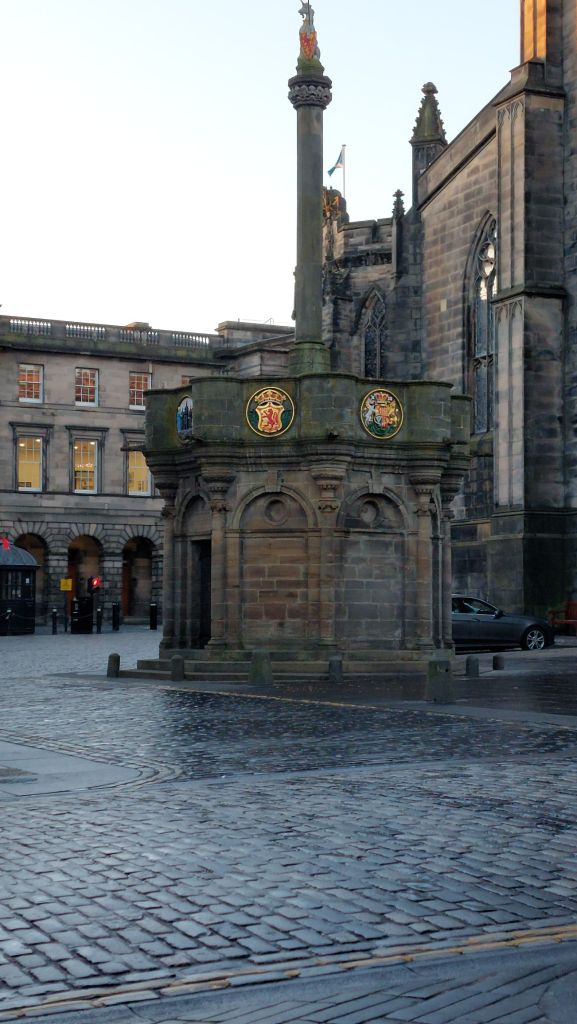
The Mercat Cross, Edinburgh
This is the first week in my IASH Heritage Collections fellowship. For the first time in my career, I’m NOT juggling librarianship and research. I’m part of a vibrant community of practice, and I have both the University Library and the National Library of Scotland just down the road. Thus, today, I saw a set of four Scottish song books that are remarkably hard to find as a set. (Three cheers for legal deposit!)
And last night, the year got off to an even better start, with an article being accepted. Just a few minor tweaks to do, which won’t be difficult.
It feels to me as though my long-term plan might be working out quite well!
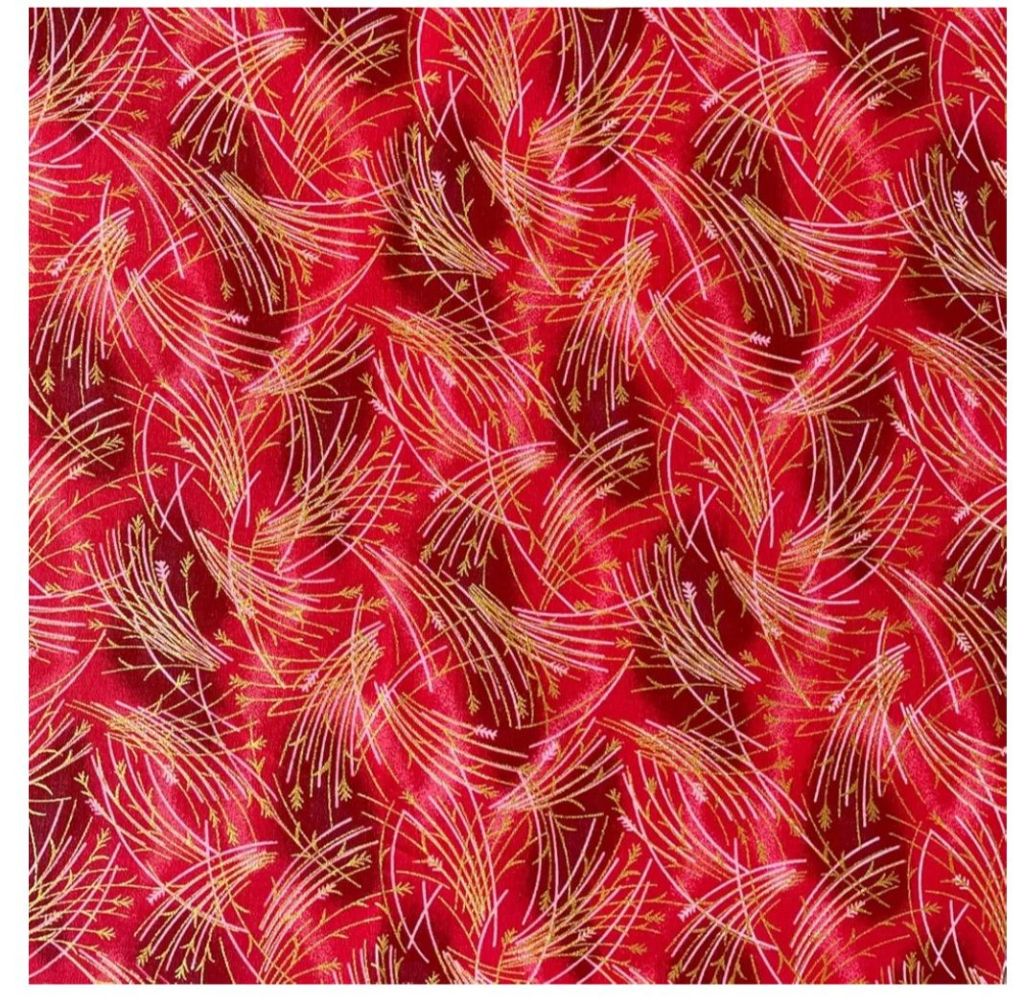
To end the holiday, I started some patchwork, which will end up as a jacket. I had some fabric remnants given to me by my elderly mother, and I picked out colours and designs that went well together. Because it’s inspired by the Victorian crazy patchwork style, my challenge is to ensure that the different fabrics appear random, but are fairly evenly distributed across each piece.
As I went along, I was thinking about my ‘random pattern’, and making connections: ‘See, if I have this HERE, then I need that THERE, but not there … ‘
I feared I needed more fabric, and the hunt online was harder than I expected. Mum’s fabric was tastefully collected, and I couldn’t ruin the thing with cheap, uninspiring ‘ditsy’ prints. I dislike even the word, ditsy! What I was looking for was something the right colour, available almost immediately, and (crucially) that made my heart sing.
The whole exercise made me think of my research. I look at the information I’ve found, and try to find patterns. When I’m hunting down more detail, again, I’m looking for the ‘aha! That’s it!’ moment, when something fits into what I know, or hopefully augments it.
Here I have this singer and her repertoire. What did she sing? When? How often? Are there times when she sang more of one genre than another?
I’ve been down so many rabbit holes this week. If she sang THIS song, then did she know the lyricist (probably not, though their lives had interesting parallels), or did the lyrics mean more to her because of their subject matter? Did she know the individual for whom it was written? She did, at least by name! (They sang at the same concert.) Some parallels in their lives, too. Did she sing the song that was referenced within the song? Yes! (It’s a bit ‘meta’, I must admit, but I find it interesting.) It’s just one song, not by a composer I’d expected to encounter, but the connections are intriguing.
So far, so good. But there was still the question of another song she sang literally a couple of hundred times. In looking for a pattern, I got myself into a whole new-to-me subject area. Does it make my heart sing? I can’t say, yet. There’s still something I need to know. It might be significant, or it could be a red herring.
Maybe I should do some more patchwork, to calm myself down.
But there’s another parallel. I may not need quite as much extra fabric as I’ve ordered. (Or as much data …?)
I attended a meeting about grant applications, today. There was lots of good advice, including the development of a five-year career plan. A very sound suggestion. However, most early career researchers are really at the start of their research career, whilst I? I’ve done less research in my research career than a full-time researcher – obviously, as I got my PhD aged 51, and since then I’ve mostly been a 0.3 researcher – and my research development has thus been spread over a longer period. Similarly, I do have some teaching experience, but not an enormous amount. So …
In planning the next five years, young researchers have different parameters (making a good start, developing their strengths, possibly more able to relocate geographically, possibly without family responsibilities), whilst old ones are trusting they’ll still be fit and well in five years’ time; might not be able to relocate; and might well have family or caring responsibilities. (Should the plan also have the equivalent of a runaway truck ramp or escape lane, in case personal circumstances change unexpectedly?!)
Over the Hill? Which Hill?!
Maybe over one hill, but there are other hills to climb!
Five years at the start of a working life are different from five years somewhere nearer the end. I want to go on forever! Realistically, that’s impossible. (I might live another three decades, but who can say if I’ll still be researching at 96?!)
However, I read a posting the other day about the use of metaphors in health care, and I can see a parallel for scholars here; they talk about a journey with an illness, whilst we use metaphor to talk about our research journey.
To continue with the journeying, travelling metaphor: I climbed the librarianship hill as far as I could get. I didn’t reach the top, but I made reasonable progress. Looking around, I saw other hills I’d like to climb. You could say I’ve used the state retirement age as an opportunity to come down from the library hill, so I can spend more time climbing elsewhere.
I’d like to write another book. But I’ve only just published my second; I need at least three or four more years to do enough research into a new topic to merit a book. And I haven’t decided what exactly it will be about yet, though this might well become apparent in the next year or so.
Despite all this, a five-year research plan does seem desirable. I must apply myself to devising it!
The truth of the matter is, I’ve had five months of it, and I still haven’t got the hang of it! What have I done? Revised my second book, and had a book-launch when it was published. Written and submitted a very long article. Done some of the research for another, which won’t be quite as long. Mulled over yet another idea, still to be fleshed out. Peer-reviewed a research proposal. Done some maternity-cover teaching on campus. Given a research exchange talk at RCS, and been a keynote speaker in Birmingham. Visited my aged parent, twice.
And I’m now gearing-up to my IASH Heritage Collections fellowship at the University of Edinburgh from January to June next year.
I haven’t yet had a suitably semi-retirement-related holiday, although I’m sure I should have done something to mark my change in status! The truth of the matter is, I retired from librarianship, but I’ve no intention of retiring from research for a good long while yet. I got a new contract as research fellow, two days after I retired from the library. (I did have ONE day of not being employed!) So, I don’t feel retired, except when I wake up and think, Oh good, I don’t have to dash out for a bus at 7.45 am today! I seem to be constitutionally incapable of restricting my research activities to 1.5 days a week – it’s what I like to do.
If one thing is certain, I have watched not a minute more daytime TV than the lunch-hour watching that has been our custom since the pandemic forced me to work from home. And I’m getting better at not checking my work emails…
‘She’s living her best life’, as my former line-manager observed at the awarding of my honorary RCS fellowship.
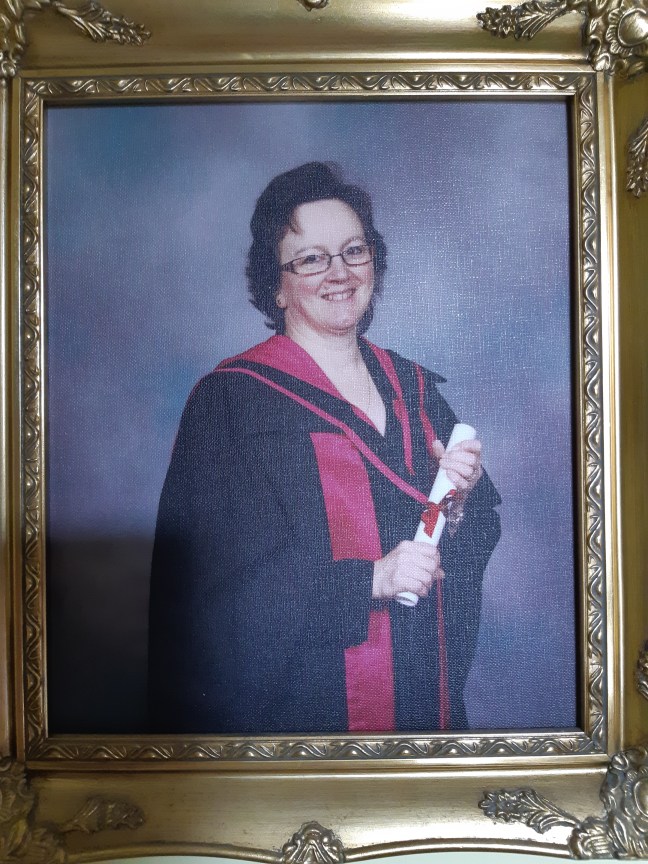
Facebook has just reminded me it’s 15 years since my doctoral graduation. Heavens, where did the time go?
Two Knees and a PhD
Summer 2009 was quite a summer! I submitted my thesis. He had two knee replacements, three months apart. He walked comfortably at my graduation ceremony.
Baking is not really one of my strengths!
Since then? Too much to enumerate. The thesis became a book. I contributed chapters to others’ essay collections. I published another book last month.
Why would a Librarian want a PhD?
Someone asked that, before I even started. I think I’ve demonstrated why.
Why would a Librarian want a PGCert?
Someone asked that, too. It seemed a good move at the time, and I have recently been doing a little teaching cover, proving that this wasn’t such a bad idea, either.
If one thing is certain, I wouldn’t now have a semi-retired existence as a postdoctoral research fellow, if I hadn’t found three old flute manuscripts in a cupboard that was being dismantled, a couple of years before I started the PhD.












 Karen McAulay, Musicologist