Autoethnographical? Autobiographical? Reflective?

Well, the ‘Scottish Entertainment’ took place yesterday – attended by sixty to seventy people, if you include our [small] choir. A great time was had by all. There was lots of community singing, along with a couple of choir items, and a smattering of solo items (two spoken, two sung solos, and the concertina.)  And, of course, haggis, neeps and tatties in the middle of the entertainment.  Our pastoral care committee organised the whole event  – I just coordinated the entertainment bit!

It wasn’t a research event, and I can’t exactly call it public engagement – it wasn’t in any sense designed for, or linked with, my research. (Although, as I’ve mentioned, my little introductions were informed by my research!) So, I don’t think I can call this autoethnographical or practice-based research, but I can certainly reflect upon the whole experience.

Timing

I planned two equal ‘halves’ for either side of the meal. It wasn’t a full-scale meal, as such, but I underestimated how much time we’d spend eating. The first half of the entertainment was almost spot-on: we only had to leave one item until after the meal. However, the second ‘half’ had to be significantly cut back (mostly by omitting verses) – so I could really have made it a good bit shorter.

Feedback

The feedback was gratifying. Our repertoire went down well, as did the solos.  I shall respect the soloists’ privacy, so I won’t elaborate further on that point. 

My own debut as a soloist surprised me as much as everyone else, though.  ‘I didn’t know you sang’, someone said. ‘Nor did I – I’ve never sung a solo in public before!’

I chose a song within my range, and the concertina piece was likewise as simple as I could find!  Considering that I took up the concertina during lockdown, with the deliberate aim of having a ‘folk’ instrument for just such an occasion, it was gratifying to be able to play to an appreciative audience.

People were still talking about the event today, which was lovely to hear.

Repertoire

Remember that I did a BBC Scotland radio interview 13 months ago, discussing the top ten Scottish songs of nowadays, the results of a Visit Scotland survey? I didn’t even consult that list for our own afternoon entertainment. There was some, but not a lot of overlap – but I’m happy that the songs chosen by myself and the choir, went down well with our audience.  We had a few Burns songs, a few from the early 20th century, some from the middle and a couple from towards the end of it.

And if we were to  do another event, well, there’s still that Visit Scotland list to draw on!  There is bound to be variation, depending on the sample of people surveyed – whether they are young or old, whether they had children or taught children in schools, and so on.

Thinking about the Forthcoming Entertainment  …

On LinkedIn, public-speaking coach Alex Merry recently posted these tips on making a great presentation. It occurs to me that some of these tips will be equally applicable to the Scottish song entertainment that I’m leading later this month.

Alex Merry’s Presentation Tips

In my case, it’s not a presentation at all – I just need to introduce the songs we’re singing.  So it’s categorically not about me. But I do need to be lively and relatable.  Start with a short sentence and a pause? I hadn’t thought of that, but it should be easy to factor in.

Fun? Oh, yes. I have a few ideas! 💡 Well, props, really. I’m going to need one of those big, reusable supermarket bags.  And I have an abundance of stories, so that’s all right.

My only problem is this: I’m a bit embarrassed about my Englishness.  I’ve lived in Scotland more than half my life.  Scottish national music is my specialism, and I’m secure in my subject – but this is a fun entertainment, not a demonstration of knowledge, and my accent is all wrong.  So … do I bring attention to it jokingly, or put it to the back of my mind? My personal view is that you should never draw attention to your weaknesses.  What would you do?  Stuart Chater on LinkedIn makes a good argument for NOT being ashamed of your accent.

And the song I’m going to sing? (It wasn’t my idea, someone asked me.)  It’s short. It’s within my vocal range. But I can no more sound Scottish than fly!

Someone please tell me I’m over-thinking this!

A Non-Research Event

Remember un-conferences? They were popular a few years ago.

Well, now I’m co-ordinating a Scottish song event, but it’s for entertainment, and not remotely connected with my research. Does that make it an ‘un-research’ event? Anything I might say about these songs will have been learned during my research career.  (I  grew up in England – it wasn’t my childhood repertoire.) 

Community Singing

It’s interesting, all the same.  For a start, I am interested in community singing in an early-twentieth-century sense, but my own practical experience of secular community singing is limited. The forthcoming gig may well trigger new trains of thought. (Let’s discount leading congregational singing from the organ, which I’ve done for decades.)

Repertoire

The preparation has been interesting, too. We have collectively chosen the repertoire: some old, some from the 1950s and 60s, and some that our children would have learnt at school.  It bears out my findings that the repertoire of favourite Scottish songs does change with every generation. 

We’re also channelling Sir Hugh Roberton and his Orpheus Singers for a couple of choral items, but an even earlier choral arrangement felt too dated.  You have to know about the west of Scotland’s intimate acquaintance with Roberton’s repertoire to appreciate why those settings go down so well to this day.  Somehow, his particular brand of close SATB singing has endured in a nostalgic kind of way, where earlier settings have fallen by the wayside.

Authenticity

It gets better.  We’ve debated different versions of the lyrics, and odd discrepancies in tunes.  In other words, we re-enacted all the chatter about authenticity and correct versions that has been rolling on for, shall we say, 250 years or more?

And the Squeezeboxes?

Accordion

I debated with myself whether to go all authentic with an accordion accompaniment in appropriate songs, but I don’t think I’m that brave.  Singing a solo is brave. A couple of concertina tunes is positively reckless. But the accordion is probably getting left at home. (Although, if you listen carefully between now and then, you might catch me attempting a few strains of ‘The Song of the Clyde’ in private … Jimmy Shand I’m certainly not!)

This is a new adventure for me.  More anon.

Alec Finlay: the ‘Pocket Harry Lauder’

This blog post is an edited excerpt from the research Exchange Talk I gave at the Royal Conservatoire of Scotland on 11 November 2024.

Inside the song-book, The Glories of Scotland, the foreword was followed by a full-page signed photo of a popular Scottish singer and comedian, Alec Finlay. The University of Glasgow’s Scottish Theatre Archive, characterises the latter as, ‘The pocket Harry Lauder’, and ‘Scotland’s gentleman’, describing his comedy as, ‘delightful, couthie and kindly’.

His was an international variety act; significantly, he toured America in late 1950.

If he was known as the ‘pocket Harry Lauder’, it was for a logical reason: a colleague of mine pointed out that Finlay, who clearly modelled his act on the variety superstar, Harry Lauder, even went so far as dressing like him, ‘wiggly stick’ and all.

Harry Lauder, from Wikiwand.com

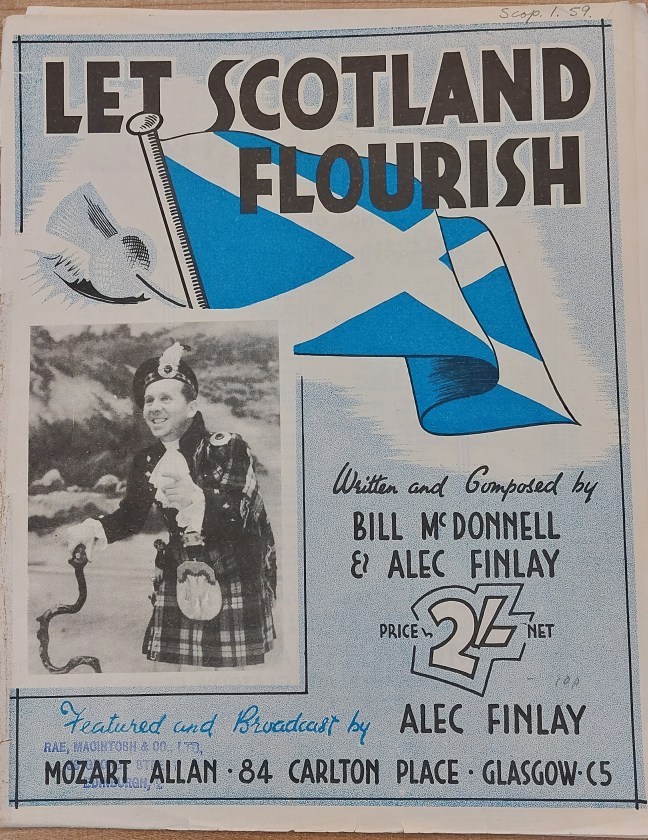
A song is linked to the signed photograph of Alec Finlay at the front of the book. The photo is captioned ‘Scotland’s own comedian’, with Finlay in typical pose, full Highland dress, wiggly stick, and a blurred Scottish vista behind him. Beneath the photo, and alongside his signature, is the name of a song, ‘Let Scotland flourish’, composed and sung by Alec Finlay.

Sure enough, opposite a picture of Edinburgh’s Princes Street supplied by the Scottish Tourist Board, page 71 bears the words of the chorus – not the music, just the lyrics!:-

‘Let Scotland flourish / In all the years to be / The land that I was born in / Will aye be dear to me / Caledonia I adore you / Tho’ I travel the wide world o’er / My home is where my heart lies / Scotland ever more.’

It’s there, ‘by kind permission of Alec Finlay’, and it was written and composed by Bill McDonnell and Alec Finlay. At the foot of the page, we read that the ‘complete words, music and Solfa are available for 2/- from all music-sellers.’ It was published by Mozart Allan – who also published The Glories of Scotland.  The British cover appears at the top of this blog post.  (There was another for the overseas edition. )

‘Let Scotland flourish’ is a typical Scottish waltz of the era.  Finlay was a hit in America in 1950; and  selling the song as a single piece of music would make commercial sense.

In the recording of the song, published by Scottish Clan Records in New York, Finlay sings in the broad Scottish brogue that contemporary American listeners would have expected to hear.

YouTube audio – enjoy!

Dr Karen McAulay Exchange Talk and Book Launch at RCS, Glasgow 11 Nov 2024

Looking forward to my Exchange Talk and Book Launch next Monday, I made a wee promotional video! Maybe I’ll see you there, if you’re in/around Glasgow.

Click to Book tickets

Click for The book’s details

Francis George Scott – Would he make it into your Music Case?

This post was originally written for the Whittaker Live library blog in July 2023.

A few weeks ago, I was thinking about the Scottish song settings by Francis George Scott (1880-1958).  Opinions seemed to be divided about his output, but this composer – who for most of his career taught music at Jordanhill Teacher Training College in Glasgow – arranged and composed dozens and dozens of songs.  He worked […]

Francis George Scott – Would he make it into your Music Case?

The Sweetest Words (to an Author)

I just received an email containing the sweetest words!

“We will proceed with the final production and notify you when the book is delivered from our end.”

Does this mean – the End is Nigh?! (As far as my second monograph goes, at any rate!)

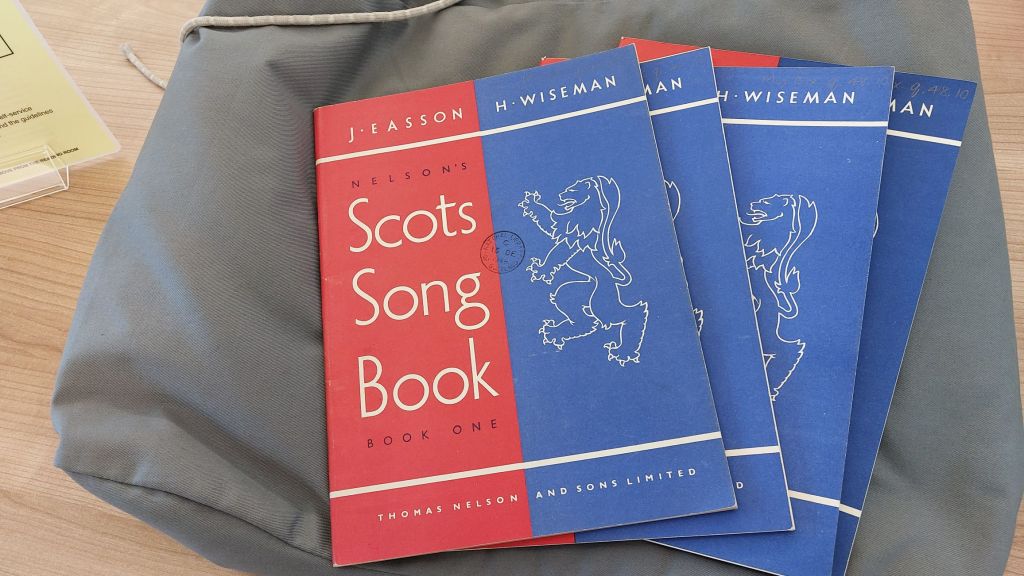
I knew there was this vast mass of cheap, popular music books, many containing what used to be called ‘national songs’, dating back to the late 19th century and the first half of the 20th. I decided a book needed to be written, and wrote it. I can’t wait for it to make its entry into the world!

Meddle the Thistle Wha Daur! (Old Poem, New Thistle)

Thistle against a white wall with graffiti reading ;'Vibe'

Our neighbours have a high white wall. There’s a tall thistle growing there, and some young joker has scrawled above it, ‘VIBE’. I don’t know if they were consciously referencing the metaphor of a prickly thistle to represent Scottish, and most particularly, Glaswegian identity, but – hey, they wrote it directly right above that thistle, so who knows? I took a photo anyway – it was too good an opportunity to miss.

Every time I walk down the road or get into my car, there it is, and every time it reminds me of a poem by one of ‘my’ Scottish song-writers. He published his book of poems in 1894, and it’s well out of copyright, so I can share it with you. Just look at that last verse – there’s a proud, very nationalist Scot for you!

“I’m a Scot and I carena’ wha’ kens it, Juist meddle the thistle wha’ daur,

They’ll maybe get mair than they wantit, An Scotia be little the waur …”

To be honest, I’m more interested in the poet for his work as an Edinburgh music teacher, than as a poet or local historian, but it’s all part and parcel of who he was. Two different musicians set this song to music – one was really pretty uninspiring, but the other one’s not too bad! (Well… musically competent, not remotely ‘Scottish’ sounding, nor particularly memorable, but competent.)

The poet-teacher gets a significant mention in my forthcoming book, especially his views about children singing Scottish songs.

I have just sent the manuscript back to the editor with my own amendments to the copy-editing, so watch this space! Now to turn back to the question of the second index … which I drafted a few weeks ago, but which now needs fine-tuning before I get the proofs back to link my index-terms to the publisher’s page numbers!

Image by Ralph from Pixabay

Speed-Dating 40 Scottish Music Collectors in an Hour

For a number of years, I’ve given an annual talk to RCS students, about how different generations looked upon, collated and collected and published Scottish songs and tunes. The snappy, official title is ‘Transformations’, but when I was revising it for this year’s presentation, I decided to compile a list of all the people (and a few extra titles) that I would be mentioning. Forty of them! So, I’ve added a new, unofficial subtitle: Speed-Dating 40 Scottish Music Collectors in an Hour. Okay, not exacty forty people, but forty lines in the list. I was quite surprised. I would imagine the individuals themselves might have raised an eyebrow, too.

It was the last time I’d give a lecture as a Performing Arts Librarian. Admittedly, not the last time I hope to give a lecture as a researcher, but certainly the final one with a library hat on! The librarian accordingly played a tiny bit of Beethoven’s Johnnie Cope from memory, along with a few chords from Marjory Kennedy-Fraser’s Sleeps the Noon in the Deep Blue Sky (score open), and blithely announced that she saw no need to inflict her rendition of Debussy’s La Cathedrale Engloutie upon her audience for comparison.

The song-books are all in the library. (Yes, including Blackie’s Scottish Song: its Wealth, Wisdom and Social Significance, 1889, and a modern reprint of Chambers’ The Songs of Scotland prior to Burns, with the Tunes, originally 1862.)

More than anything, the lecture epitomises me as a hybrid. I’m a librarian  – I acquire and curate these resources. As a scholar, I contextualise them into cultural history.  It wouldn’t be the same talk if I occupied only one of these roles. 

The subject of my forthcoming monograph  – amateur music making and Scottish national identity – only actually got a brief mention. But it was there. Maybe I’ll need to do a more extensive revision at some point!