Now, About a Fifth Book of Scottish Songs?

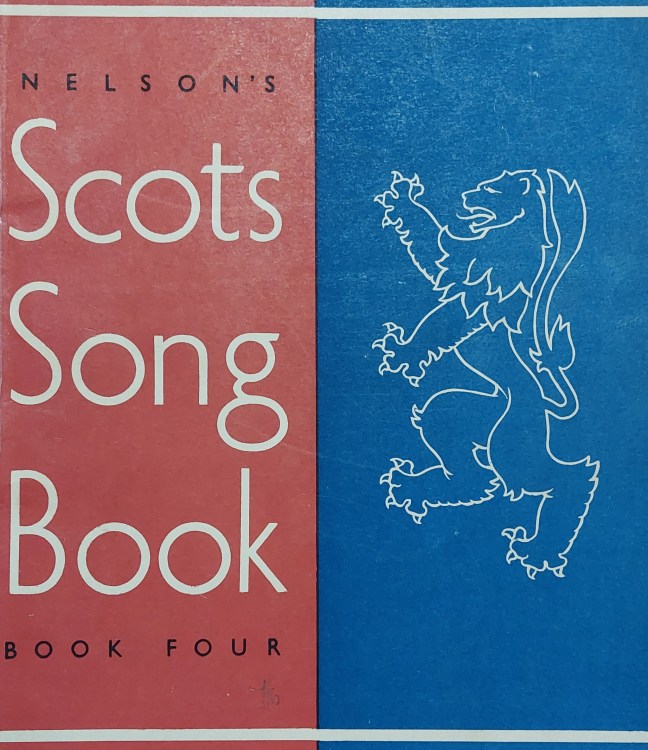
Nelson's Scots Song Book, Book Four. The last in the series.

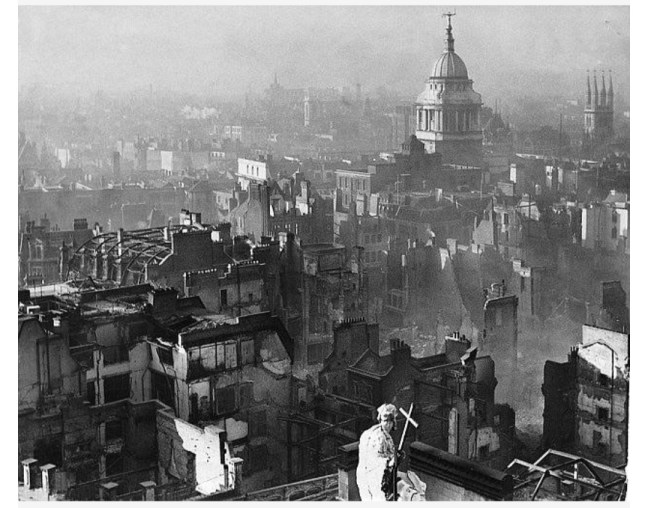
Yesterday, I highlighted the 85th anniversary of the Blitz that destroyed Paternoster Row on Sunday 29th December 1940 – and with it, Thomas Nelson’s London premises.

Today, 30th December, we leap forward to 1954. The Second World War had ended nine years earlier. The country was picking itself up again, and James Easson and Herbert Wiseman had published four books of Scottish songs in the series, ‘Nelson’s Scots Song Book, primarily for school use. I’ve done a lot of research into this series, during my Heritage Collections visiting Fellowship at IASH in the University of Edinburgh, so I’m sure you’ll understand that I won’t be saying much about it today – all will be revealed in due course! However, I can reveal that Easson seems to have written a letter to his editor on 30th December 1954, with the expectation of compiling a fifth book. The letter is no longer extant, but the carbon copy of their reply survives.

There was no fifth book.

The Blitz – 85 Years ago, Tonight

This week in Scottish publishing history:-

There ain’t no Paternoster Row

Those were the words of a London Bobby (policeman) the following day, when someone asked about the bombing damage.

Luckily, Thomas Nelson had moved quite a few staff up to their Edinburgh offices at the start of the Second World War,ย  but some remained in London. But the London offices at 35-36 Paternoster Row were destroyed in the Blitz, on Sunday 29 Dec 1940.ย 

I find myself wondering how strange – indeed, traumatic – it must have been, to head into work the next morning and find first of all, that public transport was disrupted, and then later, by whatever means, to learn that the firm’s premises were flattened.

Temporary premises were found with another publisher, Duckworth at 3 Henrietta Street.  Not until 1954 were larger premises found for Nelson’s at 36 Park Street, in Mayfair.

Publishing in flames on Paternoster Row

Listen to the first episode of this series on Radio 3, 5th May 2025 (14 mins). Series: Books for Brighter Blackouts:- ‘As the BBC marks the 80th anniversary of VE Day, Professor Emma Smith uncovers five unexpected stories about how World War Two changed books, publishing and reading forever.’ The essay is about that very night of destruction. I was thrilled to find that Professor Smith interviews Professor Andrew Pettegree, an eminent authority in the University of St Andrews; and Liam Sims from the University of Cambridge; amongst other experts.

Mystifying Timewarp Challenge

It’s not as though I’m unaccustomed to what I’ve been doing in odd moments for the past few days.  Over the years, I’ve opened dozens, indeed hundreds of old song books and other music publications, trying to read their prefaces, annotations and harmonic arrangements as though I were a contemporary musician rather than a 21st century musicologist.  Looking at music educational materials is likewise not new to me.

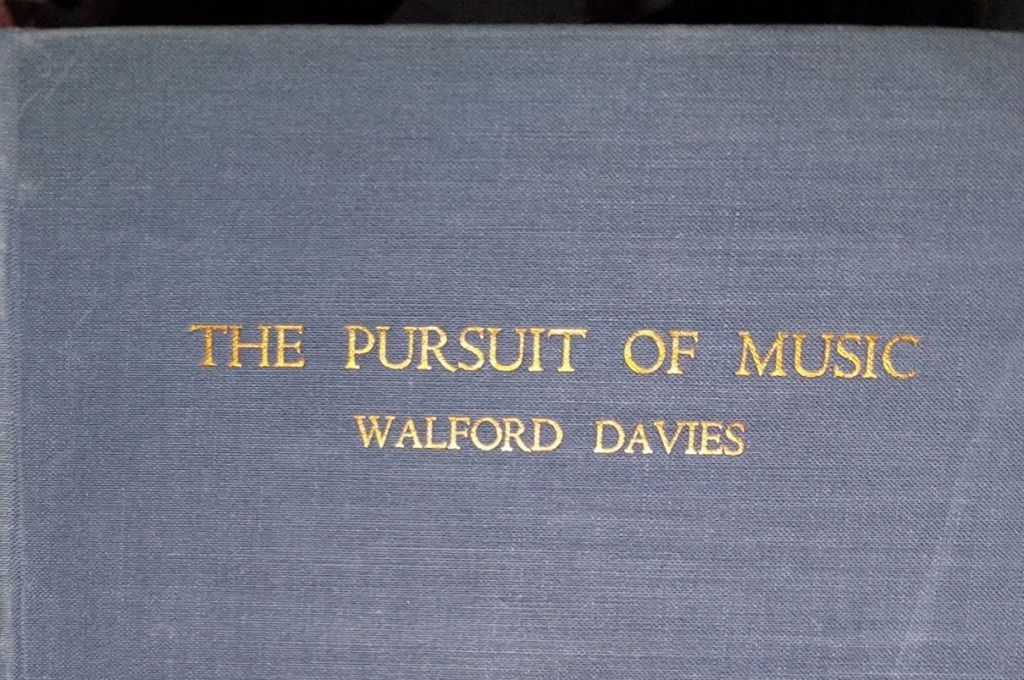
Enter Dr Walford Davies and his The Pursuit of Music

He was the first music professor at the University of Aberystwyth, but he was also hugely popular in the 1920s-30s through his broadcasting work – fully exploiting the new technology of wireless and gramophone for educational purposes, and to share his love of music with the ordinary layman wishing to know more about all they could now listen to. This book was written after he’d mostly, but not entirely retired.

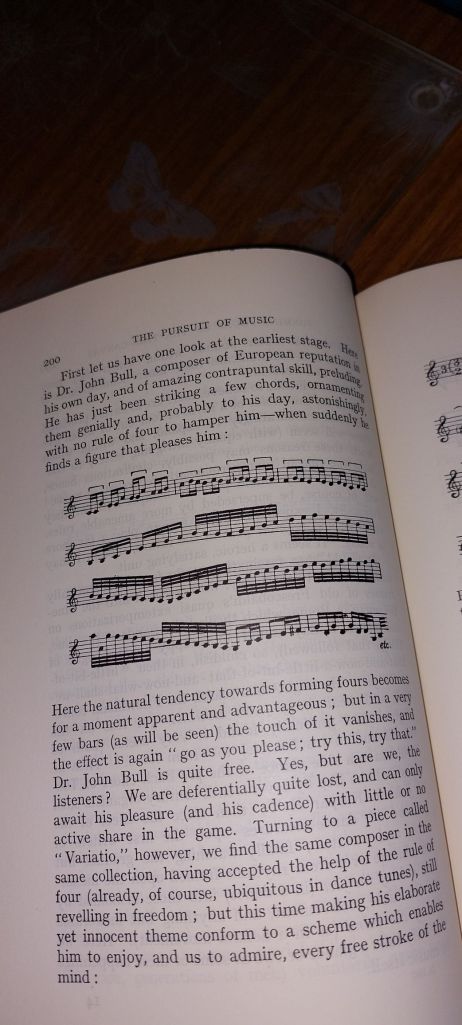
It wasn’t exactly what I expected! If I thought he would write about what made the Pastoral Symphony pastoral, or Die Moldau describe a river’s journey, I rapidly had to change my expectations. 

His audience was apparently not just the average layperson, but also young people in their late teens, not long out of school. If the reader didn’t play the piano, they were urged to get a friend to play the examples for them.  (Considering the book is over 400 pages, you can imagine how long they’d be – erm – captive!)

Dedication

And this was aesthetics, 90 years ago. I struggled to get into the mindset of a layperson wanting to know what music (classical, in the main) was ‘about’, without knowing what a chord was, or realising that music occupies time more than space. Would I have benefited from that knowledge? Would being told in general terms what the harmonic series was, have helped me appreciate the movements of a string quartet? Or Holst’s The Planets?

It wasn’t about musical styles over the years. I didn’t read it cover to cover, but neither did it appear to explain musical form and structure as I would have expected.

Davies’ biographer, H. C. Colles, did comment that it was a mystifying book, and suffered from the fact that the authorโ€™s strengths were in friendly and persuasive spoken, not written communication.

I’ve only heard snatches of his spoken commentary, so I can’t really say.ย  Apart from which, Colles made an observation about Davies’ written style. Colles was a contemporary authority who knew Davies personally – and he may have been picking his own words carefully, so as not to cause offence. My own disquiet is more a matter of content:ย  was it what his avowed audience needed, to start ‘understanding music’?

I think I have been mystified enough.

I wonder what the Nelson editors made of this book by one of the great names of their age? They published it, and I think regarded him as a catch, but what did they actually think?!

And did the layperson, assuming they got through the 400+ pages, lay it down with a contented sigh, feeling that now they understood music?

Archival Truths: the Reality of Archival Research

White puzzle with black gap where the missing piece should be.

I can say this very succinctly!

That which you seek may not be there.

Indeed,

That which you seek may not exist.

You can look as hard as you like, for as long as you like, with as much concentration and determination as you can muster from every inch, every fibre of your body … but not everything you want to find, will have survived to the present day, whether in archives or attics, boxes or basements.

Thus, the Thomas Nelson archive may have a handlist, but even the handlist (a second or third version of a handlist made by unknown hands at some point in the past) may document items that no longer exist. I struck lucky with my searches for correspondence about the four Nelson Scots Song Books (1948-1954). Of course, I still don’t know if there was further correspondence between the song book editors (by which I mean the compilers), as well as that between the compilers and Nelson’s in-house editors. But I found enough to be interesting, and to document the general story of their coming to fruition. It is possibly significant that they were published post-war, by the educational department editors, who had all been in Edinburgh for years by now.

However, for the past few weeks, I’ve been looking for correspondence between the author of a 1935 (ie, pre-war) book aimed at the general reader, and Nelson’s in-house editors. There was correspondence as early as 1932 – I know that much, but I can’t find it. Not only have I completely failed to find it, but we’ve discovered at least half-a-dozen boxes are missing. I bet you anything the missing correspondence is (was) in one or more of those missing boxes! Now, Nelson had offices in Edinburgh and London. The editorial staff for educational materials seemed to have been based in Edinburgh before the Second World War, whilst some – but not all – of the other editorial staff joined them from London’s Pater Noster Row at the start of the war. Thus, my 1935 book – not a school textbook – may have been edited from the London office, not in Edinburgh. Hold onto that knowledge.

Missing in Enemy Action?

When the London offices were bombed, the remaining London editorial staff, including the juvenile literature department, were found temporary office accomodation with another publisher. If my missing correspondence was lost either during a move to Edinburgh, or during the London raids, or in the general upheaval that followed, then they will never be found.

Ironically, when I was researching in the British Museum for my Masters degree, there was a particular Augustinian plainsong manuscript that I desperately needed to see – I’d travelled from Exeter to see it. But I filled in the paper slip (this was 1980 – that’s how you did it) – and got the slip back, marked ‘Missing in Enemy Action’. I rather think I have come up against the same problem again!

And the handlist? The original copy could even have been made by Nelson’s own staff, maybe in Edinburgh, but incorporating letters that had come up from London.

There remain four ‘temporary boxes’ at the end of the sequence, which may contain my prey. And a handful of other boxes that I can’t look at until the next time I’m in Edinburgh. But I’m preparing myself to accept the almost inevitable. In this particular instance,

That for which I search may not exist at all.

Imperial War Museum image (copyright ยฉ The Family Estate (Art.IWM ART 16123) – I can only share the link).

Good Days and Bad Days in the Archives

Anyone who has spent any length of time on archival research will agree with me that there are days when nothing of interest really turns up! This week has been a case in point.

On the positive side (and this relates to research time beyond the archives), I used to have ONE spreadsheet listing all the significant names – and relevant dates – of the individuals I’ve encountered over the past year or so, be they Thomas Nelson editors, authors, or connected in some other capacity. I now have a second spreadsheet, charting the weird and wonderful departmental codes appearing on letters and memos to/from the Parkside (Edinburgh) and Pater Noster Row (London) offices; I’ve again listed names associated with those offices. This is likely to be of interest to me, but little interest to anyone else. Still, there’s a quiet satisfaction in having clarified who did what, where and when. Whilst I was working on that, I  discovered that one of the earlier editors had previously been an HMI before joining Nelson’s. That was a gratifying discovery, even if he had been a geographer, and had nothing to do with publishing music education materials.

I’ve also continued reading a book about an individual who published a book with Nelson’s in 1935; I’ve borrowed another; and recommended a useful e-book to my home institution library. It hasn’t been a wasted week.

But, glancing through my archival notes and social media postings, there weren’t any significant discoveries. I had a long list of boxes to trawl, in my hunt for interesting correspondence with one particular author, but on Tuesday I realised I’d already seen all that was worth seeing in two boxes, whilst the third box contained ‘the editor regrets’ letters to would-be authors. (A whole boxful of dashed hopes for dozens of would-be authors, ninety-odd years before my own disappointment in an unproductive, rainy day.)

Dutifully Flicking through Pages (FOMO)

Back I went to Edinburgh yesterday, eagerly anticipating fresh discoveries. Did I find the sought-after correspondence? No. There was plenty to amuse, but I can’t say I learned anything more about music education publishing. For example, my curiosity was piqued by a book proposal for a collection of prayers. The editor wrote to a colleague that he didn’t think they wanted any prayers, but he would decide finally when he saw how the would-be author had prayed. I wish I knew what he decided!

I shook my head sorrowfully at the rather naive author who wrote to Nelson’s asking if they published a particular genre of material. I suppose in the 1930s, it was less easy to find out, but could they not have gone into a library or bookshop and ASKED? Again, there was no copy of a response.

Another book proposal that presumably foundered, was the one  unappealingly entitled, ‘The Unamiable Child’. I don’t think they offered the author a contract. (More recently, wasn’t the Horrid Henry series so beloved by children and their parents, about precisely such a child?  Maybe the earlier hopeful author was just ahead of their time.)

Queen Margaret University / Edinburgh College of Domestic Science

I did, however, come across some correspondence which might be of interest to a historian of domestic science education. It appears to be a long time since anyone seems to have published anything about one of QMU’s earlier forerunners, the Edinburgh College of Domestic Science. (Tom Begg wrote a book, The Excellent Women: The Origins and History of Queen Margaret College, in 1994.) But if you know anyone currently researching it, then I can advise them that 1933 saw a run of correspondence with Thomas Nelson about a book they were producing. I can let them know which folder to consult, if they’d like to follow this up!

Time for Tea

As I approached the end of my second day in the archives, one final memo made me smile. (Again, this had absolutely nothing to do with music – I was just dutifully flicking through pages to ensure I hadn’t missed anything.) A memo was sent to three of Thomas Nelson’s Edinburgh managers in July 1956. They were warned that they might have to entertain a couple of visitors from Melbourne whilst their colleague was away. There were a couple of points that they needed to be aware of. I didn’t read past the first of these!

‘It might be wise to point out that Mr C is a teetotaller’.

Let’s hope they remembered. Reading between the lines, ‘hospitality’ was clearly not always a cup of tea and a scone!

Tray containing tea and scones
Hospitality

Image by Dayoung Seo from Pixabay

One Book. One Story – about the Book itself

Woman reader looking up thoughtfully

(Do I live in the 1950s these days?!) I’ve been tracing a woman who briefly worked for publisher Thomas Nelson in Edinburgh in the mid-1950s. Yesterday, I found a memo from her to one of the managing directors. Instructed to throw a book away if she couldn’t find a use for it, she promptly did find a use for it, giving it to the library of the Glasgow training college where she had previously worked.

I admired her honesty in telling him, because there was probably no need to report back on what happened to a book that was clearly regarded as inconsequential. It came from the Toronto branch of Nelson’s, and was about important Canadian educationalists; I can see why it might not have been much use in the Edinburgh office. (She had, in fact, travelled back from Montreal at the age of 16 – I have no idea how long she’d been there – so maybe he knew this, and thought she’d be interested in this combination of a country she’d visited, as well as a topic she knew well.)

Nonetheless, she did tell him, and reported that not only did the college librarian thank her, but her former boss at the college had commented that it was a title she’d actually been looking for. My interest was piqued, and I checked Jisc Library Hub Discover. Sure enough, the college has since been absorbed into a university, but the university library still has that book – the only copy in the UK. It has survived 72 years and at least one library relocation. I wondered if it had subsequently been borrowed by that senior training college lecturer – the one who had been looking for it?

Apparently not! The book has no trace of ever having been borrowed. Let’s hope she at least sat and read it in the library!

Image by Bianca Van Dijk from Pixabay

Jobs for Girls and Boys in the 1950s

Yes, I’m afraid I have been distracted in my archival search for the editor of some teaching materials.  I identified a run of box files for the right years, but it turns out not to be from the editorial team. The sales department was obviously crucial, once the books were ready to market and sell, but if my present quarry had only had any evident input into one solitary published title, then frankly those boxes probably don’t concern me in my present research.

Nonetheless, I inspected four boxes fairly closely, before deciding to stop looking at the boxes from 1953. 

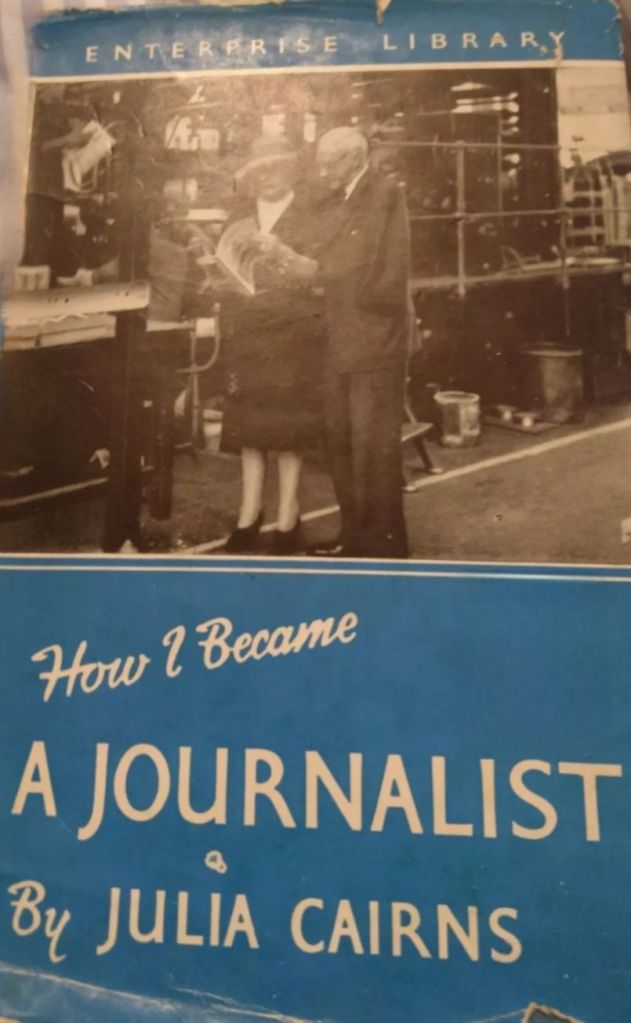
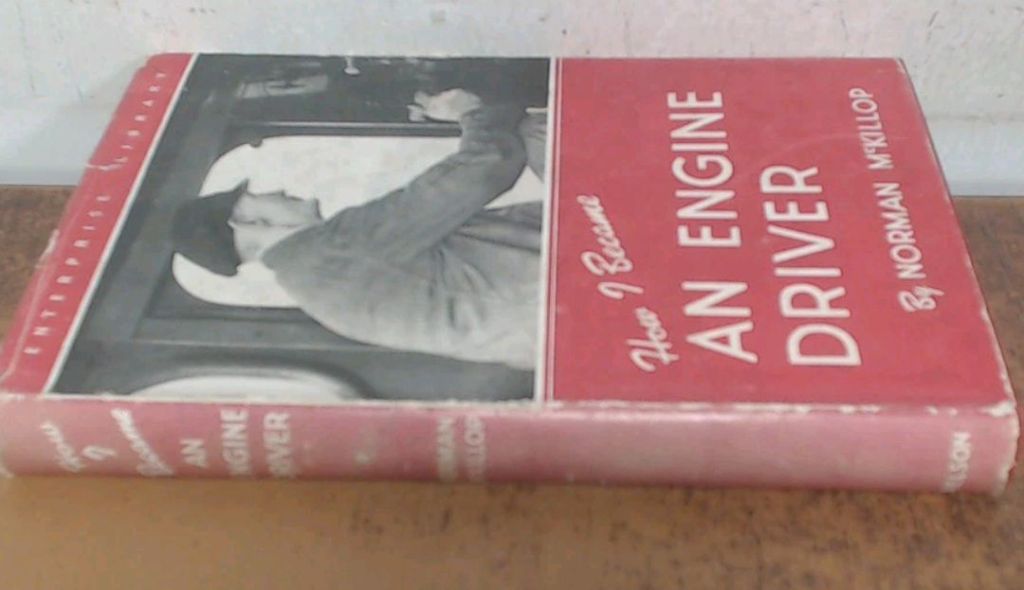
In passing, in the ‘Nelson Juniors’ series, I  encountered some careers-related books from the 1950s. The choices – apart from that of journalist – are rather stereotyped! On the other hand, the girls seem to have more choices … curious, that! Maybe they meant to publish more titles, before the series rolled to a halt with the ‘engine driver’ in 1960.

Found on eBay!
Yes, also on eBay

How I became a … (by women authors)

  • Ballet dancer
  • Fashion model
  • Journalist
  • Librarian
  • Nursing Sister
  • Air Stewardess

How I became a … (by male authors)

  • Cricketer
  • Detective
  • Engine Driver
Also on eBay!

The first and last of these seem to have attracted some interest! The ballet book was reviewed in an American dance magazine – Dancing Star, by the editor of a British magazine called Ballet Today. The Ballet Annual wanted to review it. (A lot of announcements were sent to relevant organisations and individuals.) Moreover, The Psychologist Magazine wanted to review both the ballet book and How I became a Nursing Sister. (Nursing, I can understand. But reviewing a children’s book about the career of ballet dancer? Was it to gain insight into a young ballerina’s mind …?)

And even if nowadays, it looks pretty mundane, Meccano Magazine and The Model Engineer both requested review copies of How I became an Engine Driver.ย  The Stephenson Locomotive Society were also sent a review copy, along with 2750: Legend of a Locomotive, and they promised to publish a review in the Society’s Journal. Indeed, Thomas Nelson sent a presentation copy of the book to the Lord Reay Maharashtra Industrial Museum in Bombay in response to a request for books for the museum library being set up there – just that one book!

Image by Alana Jordan from Pixabay

Aha! New Arrival all the Way from Arran

Once used in an Edinburgh school, a wee Scots song book (pupilโ€™s edition) found its way to a shop on the Isle of Arran, then back to the mainland to me in Glasgow.

1, 2 … still looking!

If you ever find any of these in the back of a school cupboard, or bookshop,ย  or car boot sale, or Granny’s attic …

… please do let me know!  I’m trying to get complete set! There were four books for the kids, and four for teachers.

Don’t Give Up Too Soon

I have a tiny cutting on my pinboard, which reminds me that,

Many of life’s failures are people who did not realise how close to success they were when they gave up. – Thomas Edison

It’s painfully true in life, but it’s also particularly pertinent in archival research!

Yesterday, I was trawling the most random of files. To be fair, a couple were even labelled ‘Miscellaneous’ in the handlist. However, they date from an era I need to know more about, so I was going to look at them!  I entered a rabbit warren of curiosities.

  • Rejections, marked ‘Refused’, or ‘Returned’
  • Objections:- ‘You interviewed my son and sent him for a medical before deciding he was too old for an apprenticeship. Why?’ [My precis, not a quote]
  • Union matters. ‘If you don’t join the union, you put yourself and us in a difficult position  because we can’t work alongside you’ [again, my summary]
  • Sob stories, like the widow whose friends said her story ought to be made into a film, or a book. Apparently, she was robbed and then incarcerated in a lunatic asylum in America, and now she wanted Nelson’s to publish her story of those calamities … (‘Refused‘)
  • Inks
  • Plant (machinery)
  • An Indian paper mill under the mistaken impression that Nelson’s were interested in a collaboration  …

By 4 pm, I had a splitting headache, and was quickly flicking through pages as fast as I dared – the paper was fragile, and I still  didn’t want to miss something important.

Why not admit defeat and give up on this box file?, I mused. There was nothing relevant in it. Interesting, but irrelevant.


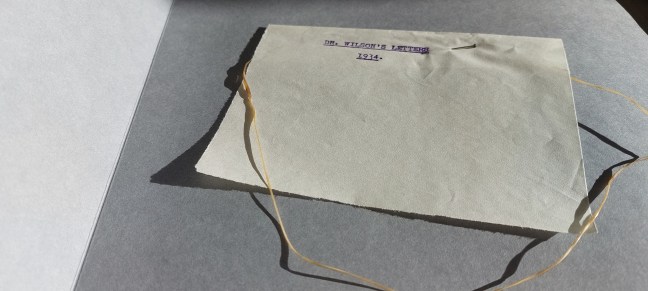
Note signed by composer Peter Warlock
Note from Warlock to a song book compiler

Then I saw it. A beautiful little note from no less than British composer Peter Warlock! In the grand scheme of things, it’s not of huge significance – it’s just an apology for his delayed response,  and a request to correct a small detail before publication  – but it does confirm the editor’s identity (something I hadn’t yet managed to do, apart from finding a footnote in someone else’s biography), and it reminds me  that I should index the Nelson collection that contains Warlock’s unison choral song. 

This handwritten note from March 1929 was written less than two years before  Warlock died on 17 December 1930, aged only 36.  He is thought to have committed suicide over a perceived loss of his creativity.  I believe he was something of a tortured soul, though I’m not familiar with his detailed biography.

I so very nearly didn’t find this note! Yet again, that maxim has proved true. Dogged persistence wins every time.ย  The tragedy is that Warlock (Peter Heseltine) was too tormented to be able to keep going at all. What else might he have achieved? How much more might he have written?

Identifying ‘The Large Book on Music’: How Large Must a Book be, to be Considered, ‘Large’?

The Music Man

In the late 1920s, Thomas Nelson’s were just starting to work with the music specialist who would turn out to be very helpful to them over the next couple of decades. As I mentioned, I’ve been trying to find the very first letter that passed between them.ย  Moreover, the Nelson’s editor had told his line-manager at the outset (in the mid-1920s) that he hoped this individual would be helping with ‘the large music book’. Now, this is delightfully vague, isn’t it? Nelson’s wouldn’t be publishing anything that I’d call ‘large’ in the way of printed music for several years.

And Another Music Man!

On Friday, I stumbled across editorial correspondence from 1929 about revising an earlier book about music – one useful to individual students, possibly beyond school age – but not a school classroom text-book. When I get my hands on it, I expect to find that it’s a fairly standard Nelson printed book size. If this was ‘the large book’ (Possibility A), then it was only ‘large’ by comparison with slimmer materials intended for the classroom. Moreover, our music man was NOT the person who ended up revising it. His first contribution was something slimmer, and more classroom-based. But this book does perhaps better fit the timescale of a publication being projected in the late 20s.

It’s so easy to imagine up a sequence of events, with what is really insufficient evidence.  After all, there could be another projected ‘large book’ (Possibility B) that never actually happened!

My working theory for Possibility A, is currently that even if they approached the first guy to revise a book, then for whatever reason, he wasn’t ultimately offered or didn’t fancy the commission. The chap who did do it was certainly a good choice, in any event – a knowledgeable scholar rather than a gifted practitioner and pedagogue.

There’s nothing for it – I must continue leafing through early correspondence in search of that initial letter!  But I’ve also ordered a copy of the book that the scholar revised.  After all, it’s another Nelson music publication.   I need to know about it, too, whether it’s the ‘large’ book or otherwise.