Dr Karen McAulay explores the history of Scottish music collecting, publishing and national identity from the 18th to 20th centuries. Research Fellow at Royal Conservatoire of Scotland, author of two Routledge monographs.
You know the story of the shoemaker and the elves? He goes to bed, exhausted, and wakes to find the little elves have done all his outstanding work? Oh, I wish!
Technically, my book is meant to be finished by the end of July. I’ve written quite a bit of the last chapter, but it goes without saying that that’s not the end of the process!
Writing the conclusion;
Tidying the introduction;
Checking the whole thing – for content, and also against the style guide;
Converting footnotes to endnotes;
Sorting the bibliography…
I’m also handling the comms for an international congress – it begins on 31 July.
Of course, there’s also the day-job to be done! And domesticated things don’t just stop. Garden hedges grow regardless of everything. Aargh!
And I have a whole magazine issue to proofread ASAP. (This task was accepted on my behalf – literally nothing to do with me!)
Daily Countdown
Now, the book deadline has been engraved on my brain for a long time. I’ve also known the congress date quite a long time. But believe it or not, it’s only just dawned on me that both dates coincide, and that therefore 38 days’ countdown for one thing would be 38 days for the other. Strange how the realisation suddenly makes it all the more stressful! All I can do is keep doing what I can. A colleague asked me the other day, what were my plans for this summer … ?
‘Finish a book’, I whispered. One way or another!
Alas, I don’t feel indomitable today. More like, a bit hopeless, faced with the mountain in front of me.
My talk for the Scottish Graduate School of Arts and Humanities was incredibly well-attended. It was lovely to be able to talk about one of my specialisms to people who were genuinely interested. My thanks to you for attending, if you were one of those people! At least one individual had just started their bibliography, so hopefully I was able to share some useful tips.
I’ve uploaded my PowerPoint and text to my Conservatoire Pure account – our institutional repository – please click here.
If anyone tried to sign up, but experienced a problem getting into the meeting, please contact me via the SGSAH Summer School organisers.
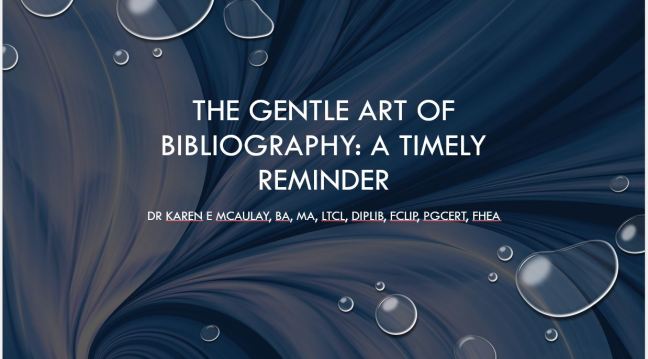
An entirely new venture for me: I’ve offered to give a talk at the Scottish Graduate School for Arts and Humanities Summer School later this month – next week, to be precise! It’s a summer school for all Arts and Humanities doctoral researchers in Scotland. When the opportunity came up to participate, I initially wondered if I had any expertise that I could share, leaving aside my own niche research interests. But then it occurred to me that people seem to enjoy my talks and writing about the process of research, as much as my talks about the research itself, so the obvious thing was to talk about one of my favourite things – bibliography. A lot of people have signed up – I’m so pleased.
Today felt like a good day to get it written, powerpoint and all.
I might share the talk later, after it has actually taken place. For now, here’s a taster for any Scottish postgraduate researcher deciding which talks to attend!
“Have you ever forgotten where you read something useful? You know the scenario – whilst you’re searching for something, whether on the web, in the library or in a database, you flick past something that’s perhaps only of tangential interest, only to realise later that it was more significant than you thought. Or you’re just killing time, so you’re not in full scholar-mode, and you find something interesting that is so relevant that you just know you’ll be able to find it again? But you can’t.
Isn’t it an awful feeling?”
When I submitted my proposal for this talk, I had to describe the learning outcomes. Here’s what I’m aiming to do:-
Learning Outcomes:- By the end of this session, participants will have a greater understanding of the options available to them, in terms of building, maintaining and deploying a bibliography in scholarly writing. By the end of this session, participants will also understand the importance of starting to build one’s bibliography at the earliest opportunity.
The government moved the goalposts – when I started work, I imagined I’d have retired by now. Instead, I’ve worked an extra five years, with one more to go. I shall hit 66 in summer 2024. I don’t want to retire entirely, but I must confess I’m utterly bored with cataloguing music! (Except when it turns out to be a weird little thing in a donation, perhaps shining a light on music education in earlier times, or repertoire changes, or the organisation behind its publication – or making me wonder about the original owner and how they used it … but then, that’s my researcher mentality kicking in, isn’t it?!)
Status Quo: Stability and Stagnation
Everyone knows I’m somewhat tired of being a librarian. Everyone knows that my heart has always been in research. Librarianship seemed a good idea when I embarked upon it, and it enabled me to continue working in music, which has always been my driving force. But the downside of stability – and I’d be the first to say that it has been welcome for me as a working mother – has been the feeling of stagnation. No challenges, no career advancement, no extra responsibility. Climbing the ladder? There was no ladder to climb, not even a wee kickstep! (I did the qualification, Chartership, Fellowship, Revalidation stuff. I even did a PhD and a PG Teaching Cert, but I never ascended a single rung of the ladder.)
In my research existence, I get a thrill out of writing an article or delivering a paper, of making a new discovery or sorting a whole load of facts into order so that they tell a story. I love putting words on a page, carefully rearranging them until they say exactly what I want them to say. I’m good at it. But as a librarian, I cannot say I’m thrilled to realise that I’ve now catalogued 1700 of a consignment of jazz CDs, mostly in the same half-dozen or so series of digital remasters. (I’d like to think they’ll get used, but even Canute had to realise that he couldn’t keep back the tide. CDs are old technology.)
The Paranoia of Age
But what really puzzles me is this: when it comes to the closing years of our careers, is it other people who perceive us as old? Is age something that other people observe in us? Do people regard us as old and outdated because they know we’re close to retirement age?
Cognitive Reframing (I learnt a psychology term!)
Cognitive reframing? It’s a term used by psychologists and counsellors to encourage someone to step outside their usual way of looking at a problem, and to ask themselves if there’s a different way of looking at it.
So – in the present context – what do other people actually think? Can we read their minds? Of course not. Additionally, do our own attitudes to our ageing affect the way other people perceive us? Do I inadvertently give the impression that I’m less capable? Do I merely fear that folk see me as old and outdated because Iknow I’m approaching retirement age? A fear in my own mind rather than a belief in theirs?
How many people of my age ask themselves questions like these, I wonder?
Am I seen as heading downhill to retirement? Increasingly irrelevant? Worthy only to be sidelined, like the wonky shopping-trolley that’s only useful if there’s nothing else available?
Is my knowledge considered out-of-date, or is it paranoia on my part, afraid that I might be considered out of date, no longer the first port-of-call for a reliable answer?
When I queue up for a coffee, I imagine that people around me, in their teens and early twenties, must see me as “old” like their own grandparents. And I shudder, because I probably look hopelessly old-fashioned and fuddy-duddy. But is this my perception, or theirs? Maybe they don’t see me at all. Post-menopausal women are very conscious that in some people’s eyes, they’re simply past their sell-by date. I could spend a fortune colouring my hair, and try to dress more fashionably, but I’d still have the figure of a sedentary sexagenarian who doesn’t take much exercise and enjoys the odd bar of chocolate! (And have you noticed, every haircut leaves your hair seeming a little bit more grey than it was before?)
Similarly, I worry whether my hearing loss (and I’m only hard of hearing, not deaf) causes a problem to other people? Does it make me unapproachable and difficult to deal with? I’m fearful of that. Is it annoying to tell me things, because I might mis-hear and have to ask for them to be repeated? Or do I just not hear, meaning that I sometimes miss information through no fault but my own inadequate ears? Friends, if you thought the menopause was frightening, then believe me impending old age is even more so. I don’t want to be considered a liability, merely a passenger. And I know that I’m not one. But I torment myself with thoughts that I won’t really be missed, that my contribution is less vital than it used to be.
Gazing into the Future
Crystal Ball Gazing
I wonder if other people at this stage would agree with me that the pandemic has had the unfortunate effect of making us feel somewhat disconnected, like looking through a telescope from the wrong end and perceiving retirement not so much a long way off, as approaching all too quickly? The months of working at home have been like a foretaste of retirement, obviously not in the 9-5 itself (because I’ve been working hard), but in the homely lunch-at-home, cuppa-in-front-of-the telly lunchbreaks, the dashing to put laundry in before the day starts, hang it out at coffee-time, or start a casserole in the last ten minutes of my lunchbreak. All perfectly innocuous activities, and easily fitted into breaks. But I look ahead just over a year, and realise that I’ll have to find a way of structuring my days so that I do have projects and challenges to get on with.
Not for me the hours of daytime TV, endless detective stories and traffic cops programmes. No, thanks! Being in receipt of a pension need not mean abandoning all ambition and aspiration. I want my (hopeful) semi-retirement to be the start of a brand-new beginning as a scholar, not the coda at the end of a not-exactly sparkling librarianship career. If librarianship ever sparkles very much!
I’m fortunate that I do have my research – I’m finishing the first draft of my second book, and looking forward to a visiting fellowship in the Autumn. As I wrote in my fellowship application, I want to pivot my career from this point, so that I can devote myself entirely to being a researcher, and stop being a librarian, as soon as I hit 66. And I want to be an employed researcher. I admire people who carve a career as unattached, independent scholars, but I’d prefer to be attached if at all possible!
Realistically, I will probably always be remembered as the librarian who wanted to be a scholar. At least I have the consolation of knowing that – actually – I did manage to combine the two.
This is not a spoiler alert! I haven’t finished yet; I’m just about at the end of Chapter 5, with two further chapters to go. I’m not about to reveal how it ends, either, because (a) I don’t want to spoil it for you and (b) what if the closing chapters end up in a different overall order?
I’m thinking about structure, really. When you’re writing about a subject that had a rise, a heyday and a decline, it’s going to be hard to end on a high. I’ve been pondering about which order to place the last three chapters in the book, and it came down to this:-
Option 1: Up-Down-Up (and Down)
Antepenultimate chapter: Hey look, they also did this!
Penultimate chapter: But they missed a trick here.
Ultimate chapter: Even though they also did THIS (and I find it so exciting), their heyday was over.
Option 2: Up-Up still Higher but Peaking – Down
Antepenultimate chapter: Hey look, they also did this!
Penultimate chapter: AND they engaged with this! It’s really exciting, but perhaps the writing was on the wall.
Ultimate chapter: And they didn’t do this. Would it have made a difference? Possibly not, in view of the wider context.
My instinctive feeling is that the Rise-Fall curve of the second option is going to be more satisfying for the reader. Indeed, as I was writing this post, I stumbled across a website about ‘story arcs’, with six different arc shapes being outlined. Admittedly, we’re only talking about my last three chapters, and I’m writing non-fiction, not a story with a plot. (In a previous existence, I wrote and published over thirty short stories, so I do have an interest in the genre, in a retrospective kind of way. But that’s irrelevant today.) Nonetheless, if we’re thinking about arcs, then …
My first option isn’t even described, so it can’t be a recommended option! Let’s call it the Tennis Ball Bounce. On the other hand, my second option is a classic ‘Icarus / Freytag’s Pyramid (rise then fall)’ arc.
Vol. 11 No. 1 (2023): Special Issue on Breaking the Gender Bias in Academia and Academic Practice
Special Issue of JPAAP exploring and addressing issues, dimensions and initiatives related to ensuring a greater gender parity and representation within academic institutions, academic and academic-related work, and related professional practices. Guest edited by Alexandra Walker and Keith Smyth. (Published:2023-02-22)
I still don’t know if this kind of post is helpful. To anyone who hasn’t many/any visible outputs, reading someone else’s list of what they achieved is probably the very last thing they need to brighten their day – and I apologise. You’ve probably achieved other, equally or even more important things, which didn’t take the form of words on a page!
From my vantage point, as a researcher who sentenced herself to a career in librarianship, not necessarily as a first choice but what seemed at the time to be a reasonable one, I look at other academics’ lists of achievements and struggle not to compare myself – although realistically I cannot achieve as much research in 1.5 designated days a week as the average full-time academic. My research line-manager is more than content, so maybe I should remind myself of that more often.
So, what have I achieved?
As a librarian, I have spoken at two conferences, a panel discussion and as staff training for another library, about EDI (Equality, Diversity and Inclusion) in our own library. I have a paper being published in an academic journal next year, on the topic of women composers in libraries; but my proudest achievement was actually in sharing a song by a Victorian woman teacher in the junior department of the Athenaeum, that I had discovered in a research capacity, and which a singing student eagerly learned and presented as one of their competition entries in a recent singing competition at RCS. Discovering something, having someone else declare it lovely, and hearing them perform it beautifully, is a very special privilege.
Still hatching
As a researcher, I have another paper forthcoming in an essay collection, though I can hardly list details here before it has even gone through the editorial process. And another magazine article which has been accepted for 2024. Can’t include that either. Nor can I yet include the monograph I’m halfway through writing. I’ve done a ton of work in that respect, but it doesn’t count in a retrospective list of successes!
I’ve also applied for a grant which I didn’t get, and a fellowship for which the deadline is just today, so no news on that front for a little while.
That leaves this little list, the last item of which appeared through my letterbox at the turn of last year, so I’ve cheekily included it here again.
Forthcoming
‘Representation of Women Composers in the Whittaker Library’, Journal of Perspectives in Applied Academic Practice. Arises from a paper given at the International Women’s Day Conference hosted by the University of the Highlands and Islands, 2022. Peer-reviewed and pending publication.
Arrived
‘Alexander Campbell’s Song Collecting Tour: ‘The Classic Ground of our Celtic Homer’, in Thirsty Work and Other Heritages of Folk Song (Ballad Partners, 2022), 180-192
‘Burns and Song: Four New Publications’, Eighteenth Century Scotland, no. 36 (June 2022),12-15.
‘Strathspeys, Reels and Instrumental Airs: a National Product’, in Music by Subscription: Composers and their Networks in the British Music Publishing Trade, 1676–1820, ed. Simon D. I Fleming & Martin Perkins. (Routledge, 2022), 177-197
Meanwhile, as an organist, I’ve completed my first year in Neilston Parish Church, which has been a very healing experience. I love it there! This Christmas has seen three of my own unpublished carols being performed, one in Neilston and two in Barrhead; and earlier in the autumn I contributed a local-history kind of article to the Glasgow Diapason, the newsletter published by the Glasgow Society of Organists. Another publication! Might as well add it to the list:-
‘Trains, Trossachs, Choirs and the Council: Neilston Parish Church’s First Organist’, in The Glasgow Diapason Newsletter
Confession time. Sewing is my relaxation of choice, often influenced by something I’m researching. This year’s project, a Festival of Britain canvas-printed linen piece, relates to the aforementioned chapter that I’ve contributed to someone’s book.
I know I would get more research writing done if I didn’t sew in my leisure time, but I need that for my mental health. Swings and roundabouts…
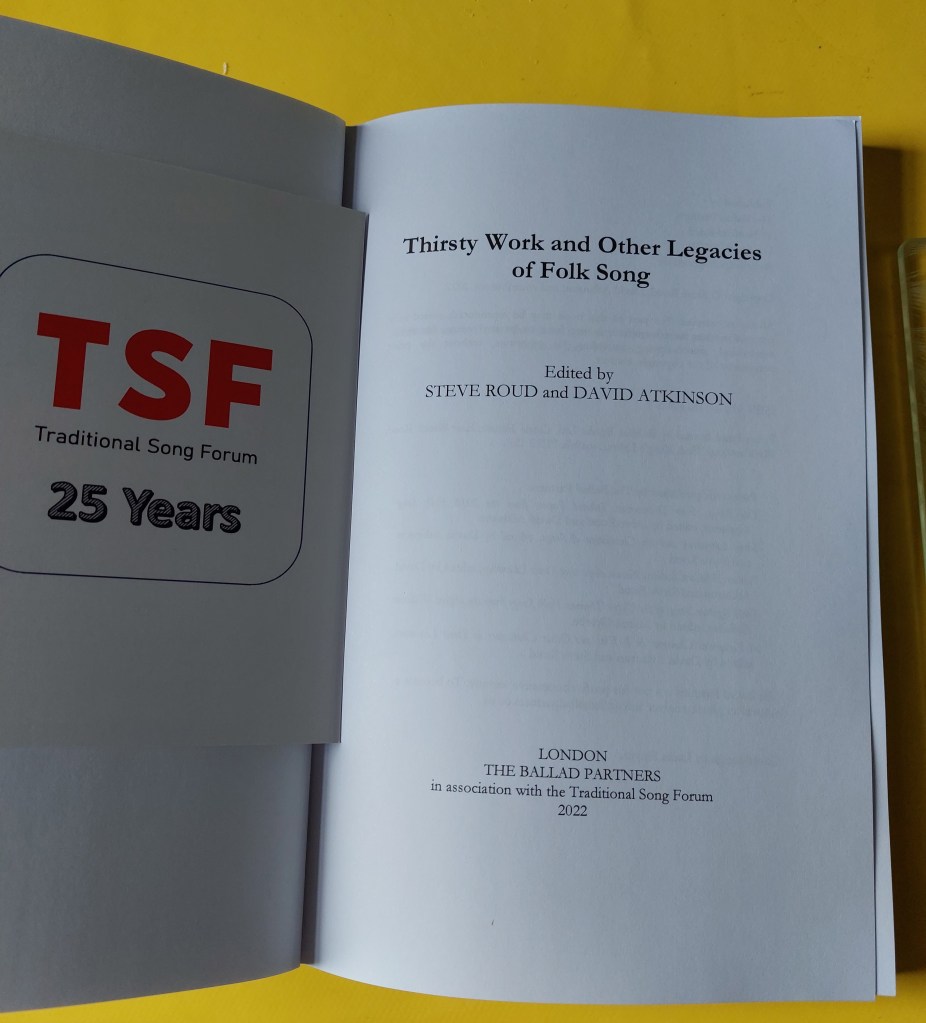
I’ve just received my own copy of a new publication by Ballad Partners, Thirsty Work and Other Heritages of Folk Song, which contains my most recent Alexander Campbell article: ‘Alexander Campbell’s Song Collecting Tour: ‘The Classic Ground of our Celtic Homer’. There’s a section on Campbell and his musicianship – an entirely new angle which I spent some time contemplating during lockdown.
I have just catalogued a copy for the Royal Conservatoire of Scotland Library – I listed the contents there, so I’ll repeat the list here for your interest. If you would like to purchase a copy of the book, please visit the Ballad Partners’ website. (I’m unconnected with the publishers – I am just one of the contributors!)
CONTENTS
Thirsty work: traditional singing on BBC Radio, 1940-41 / Katie Howson — From Tyneside to Wearside: in search of Sunderland songs / Eileen Richardson — Sam Bennett’s songs / Elaine Bradtke — Newman and Company of Dartmouth and the song tradition of Newfoundland’s South Coast / Anna Kearney Guigne — Railwaymen’s charity concerts, 1888-89 / Colin Bargery — Picturing protest: prints to accompany political songs / Patience Young — ‘That is all the explanation I am at liberty to give in print’: Richard Runciman Terry and Songs from the Sea / Keith Gregson — Drawing from the well : Emma Dusenberry and her old songs of the Ozarks / Eleanor Rodes — Alexander Campbell’s song collecting tour : ‘The Classic Ground of our Celtic Homer’ / Karen McAulay — ‘Don’t let us be strangers’ – William Montgomerie’s fieldwork recordings of Scottish farmworkers, 1952 / Margaret Bennett — ‘No maid in history’s pages’ : the female rebel hero in the Irish ballad tradition / Therese McIntyre — Who is speaking in songs? / David Atkinson
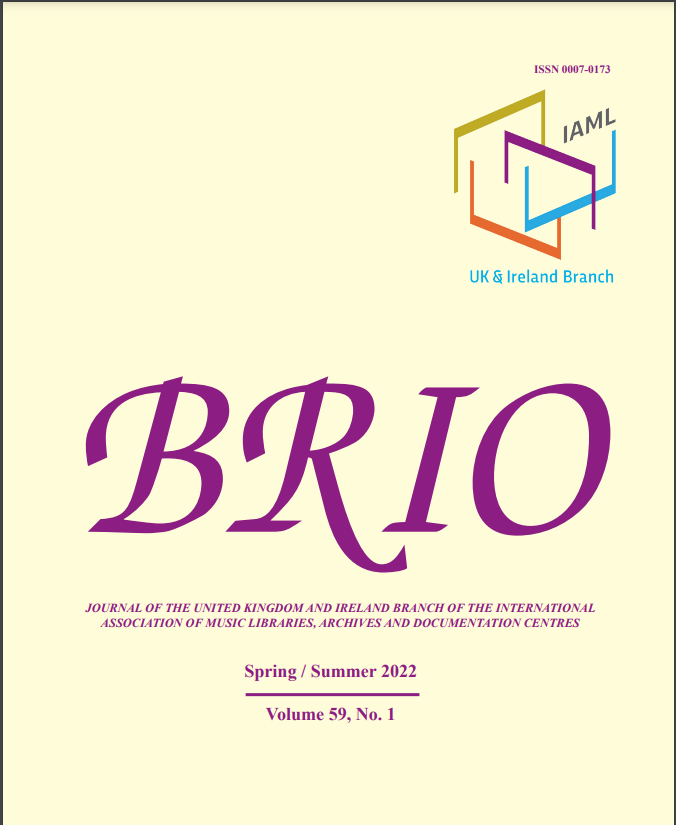
My latest article is on the IAML(UK & Ireland) website, in the members’ area, but paper copies will land on subscribers’ doormats and music library shelves this week! It’s about a strong and determined Victorian music teacher, who survived domestic abuse and made a remarkable career for herself – and I reveal her survey of music in Victorian public libraries, that I discovered literally by digging around online. (I’m rather pleased with this one – and it’s illustrated!)
Here are the details and the abstract:-
McAulay, Karen E., ‘An Extensive Musical Library’: Mrs Clarinda Webster, LRAM, in Brio Vol.59 no.1, 29-42
Although there has been the perception that middling-class women’s lives were confined to domestic circles, there are plenty of examples that directly challenge this idea. The late Victorian Clarinda Augusta Webster ran a music school and a school for young ladies. She escaped domestic violence, overcame personal tragedy, and created a highly successful career first in Aberdeen and then in London. She published, gave talks, was active in professional circles, and travelled both to Europe and America. She also conducted a ground-breaking survey on music library provision in late nineteenth century Britain, delivering her findings to the Library Association. Although her report has not been traced in its entirety, many of its findings were reported in newspapers, enabling us to piece together the results of her investigations. This article celebrates the sheer determination of a talented woman to make the most of her skills and create opportunities for advancement. It also demonstrates the perceived importance of music in wider late Victorian life.
It should be possible to read this Brio article in a music library somewhere near you, and it will also eventually appear on the RCS research repository (Pure). But if you can’t get sight of a copy, please feel free to message me and I’ll share the proofs.












 Karen McAulay, Musicologist