Dr Karen McAulay explores the history of Scottish music collecting, publishing and national identity from the 18th to 20th centuries. Research Fellow at Royal Conservatoire of Scotland, author of two Routledge monographs.
I haven’t had a foreign holiday in years, but I haven’t really been very good at taking a decent break at home, either. As long as I was sharing myself between librarianship and research, my annual leave tended just to support my research habit. But this year, I’ve done substantially more research.
I decided that this year, I would have to do better when it came to taking a deliberate break.
I’ve continued to pursue domestic projects, stayed abreast of family preoccupations, done some more weeding (so much weeding!), and read a great book, BeingMortal, by Atul Gawande. This was lent to me a couple of weeks ago, and it proved well worth devoting the time to. But by Thursday, I was itching to go on another outing. A holiday surely has to involve going places, if only locally.
I fancied tea beside a river. ALL I typed into Google was, ‘tea’, and it came up with the ideal cafe. Does it read minds? We didn’t even know there WAS a small loch at Gartcosh, so this was a pleasant surprise. It turns out there’s also a garden centre, which might be useful to know in future.
I’ve also visited a friend, and when I got home, I found that the book I ordered the other day had arrived.
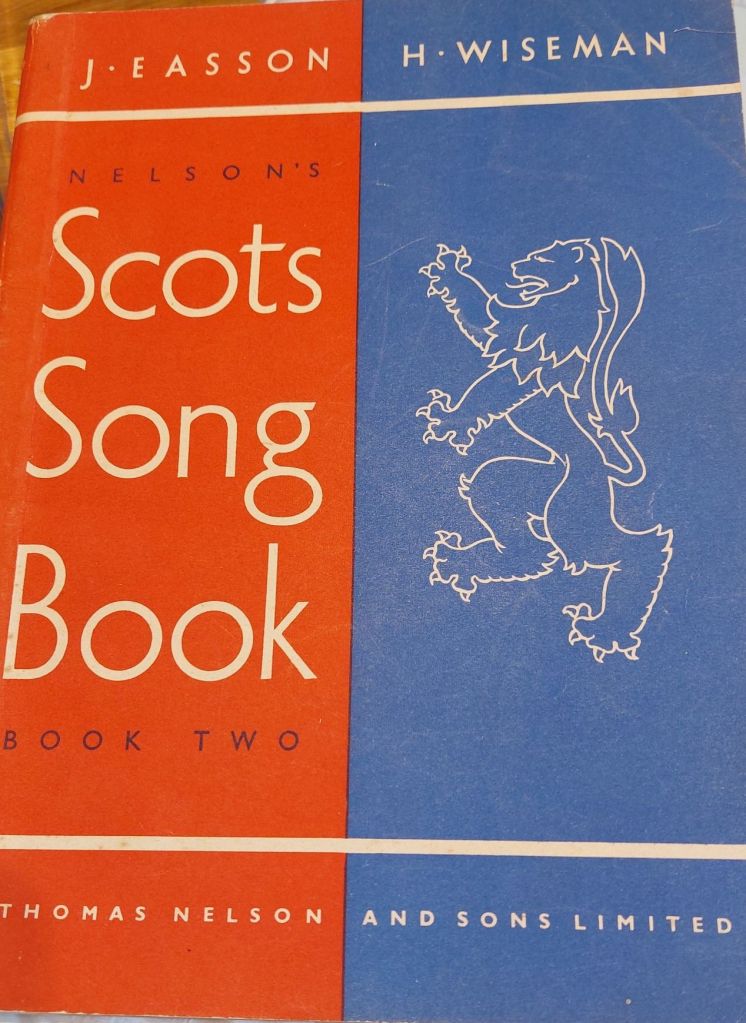
Well, this was fatal. It’s a song book. I looked right through it, looked up the two lady composers and their illustrator, played the songs over, then decided I’d better write down what I had discovered. An enjoyable use of an evening, but this hardly counts as taking a deliberate holiday from research! Indeed, it merely piques my interest as to how the ladies ended up writing their book. Did the friends reach out to the publisher? Or vice versa? Or did someone put them in touch?
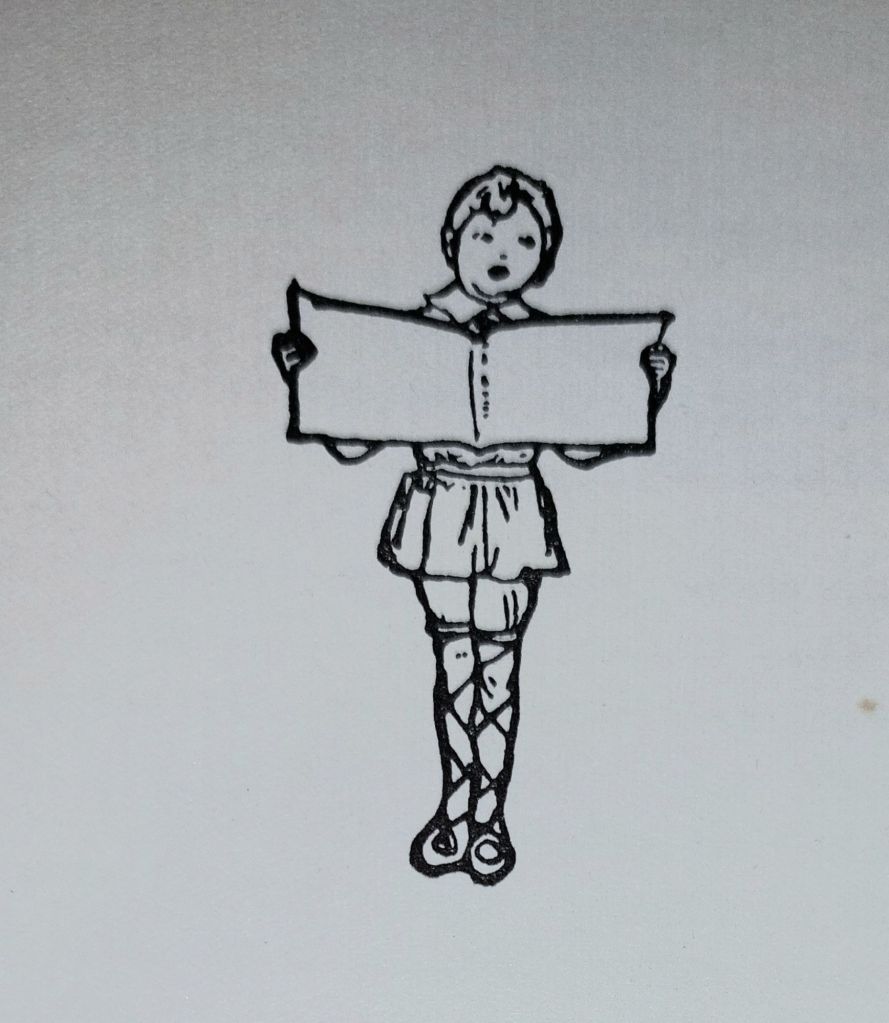
The Thomas Nelson ‘child singing’ motif
Meanwhile, my crowded bookshelves have an extra book, and I need to remember that I’m taking a holiday!
As I mentioned, I feel I can’t actually go away on holiday in case I’m called to go down south. So, peacefully minding my own business in Scotland, I thought I’d just aim to do something enjoyable, useful or both, every day of my break. (My other intention is to sort out my sleeping patterns.)
Monday, we had to wake early, but otherwise I made a good start – we had afternoon tea out.
Tuesday, I aspired to a day beside the sea, but I was thwarted – just one of those things. But I started sewing a waistcoat, and compiled a list of tradesmen for a much-needed project. Enjoyment and productivity, as you see.
And today? I woke at 5.30 am and couldn’t get back to sleep.
Still, I’ve finished the waistcoat – it didn’t take long. Pursued the home project a bit further, and rewarded myself by ordering a book. And then I made a start on the garden. But it doesn’t exactly feel as though I got the enjoyment-productivity ratio quite right. I’ll have to do better.
It’s a whole year since I retired from librarianship, and started my new contract as a part-time postdoctoral fellow at the Royal Conservatoire of Scotland. Do I miss librarianship? No, I’m afraid I don’t! And am I going to give a step-by-step account of my first year not being a librarian, able to focus entirely on research? No! (I’ve blogged so much about my research that you, dear reader, have already read countless highlights.)
Along with my research, I did a little maternity cover supervising some undergraduate dissertations – that was interesting and enjoyable, and I was proud to see ‘my’ students graduate this week. (Humour me – I’ve never been able to talk about ‘my’ students before, even if it was only for one module.)
And I took up my IASH Heritage postdoctoral fellowship at the University of Edinburgh in January. Originally planned to be for six months, it has been extended over the summer, so I’m certainly not done yet with Thomas Nelson’s educational music publishing activities.
Help me Determine my Prospective Audience?
Indeed, I’m contemplating what exactly I shall do with all the information I’ve gathered – do I write a scholarly article? Keep going and consider a book as research output? And for whom would it be written? Educational historians? Social historians? Musicologists? If you’re any of these categories – or indeed, some other category – say, a historian of publishing – it would be immensely helpful if you could respond via this blog and let me know in what way it would interest you. Any feedback will help me determine my prospective audience. I’d be really grateful.
I have two follow-on ideas which I am going to pursue this summer, along with some more archival research.
But first – I need a holiday!
I’ve saved up the bulk of my annual leave so that I could take the next four weeks off this July. Family concerns mean I’m not able to consider ‘a holiday’ abroad, or indeed staying away anywhere that involves significant outlay, just in case I had to come back hastily – but a break is called for. Last summer – partial retiree or not – I had a book to nurse through to completion, and the Christmas break was a disaster, with everyone around me succumbing to flu. (I didn’t. But I’m really no Florence Nightingale, so it was tough.) Yes, I definitely need a break.
Know When to Take a Break
I should put my research hat aside for the next four weeks. Apart from the ongoing concerns, my sleeping patterns are messed up with the early rising needed for my Edinburgh research days, and I am beset with insufficient sleep, broken nights and weird dreams.
Burning the Candle at both Ends?
When I finally wake in the morning and it’s time to get up, almost my first thought is consumed by whatever I’ve been thinking about the previous day.
But who WAS she?
So, this morning’s question was:- ‘But who WAS she?’ Some sneaky Googling turns into a lengthy trawl of deep and darkly forgotten corners of art and music history to track down the composer of some tunes for early years classes. Until it really is time to do something real (the family laundry). And as I get on with daily chores, the little voice says, ‘No, you know some people she was associated with. And that she was a composer. Isn’t that enough? It isn’t. How did Thomas Nelson the publishers know about her, for a start?’ She’s not a major player in my cast list, but I’m still curious about her. Am I capable of forgetting about her until August? I’m not sure that I am!
Meanwhile…
I need to spend some time researching fun things to do that aren’t research-based!
As I’ve indicated, I’m blogging less at the moment, due to preoccupations unrelated to research.
Don’t they say that there’s calm at the very centre of the storm? So, theoretically, if there’s chaos all around, but I sit quietly in the middle of it, it should be peaceful and still?
Rubbish! Either that, or I haven’t precisely located the epicentre of the storm in order to sit in it. I know that many would say, ‘when there’s nothing you can do, you just have to put it to the back of your mind.’ Easier said than done.
My research, of course, is a dependable solace. So I put my phone on ‘do not disturb’ whilst I visited two libraries yesterday, and settled into what should have been a lovely, calming day, as indeed it was – until I encountered my nemesis …
A microfilm reader.
As anyone knows, the linear nature of microfilm storage goes with the territory, as it does with film or audio tape. Whether you’re looking for a page in a weekly journal from the furthest end of the date range, or looking at every single ‘books reviewed/received’ section, it’s going to take time.
Scroll, Scroll, Scroll …
Even with varying speed scroll facility – I was still trying to locate a three-word book title. The journal has no index. I haven’t finished looking yet. I did find two entries, which makes me all the more determined to try to find another two – which may or may not be there.
But the other, additional problem is a visual one. I wear varifocals. Only the bottom of my lenses are the right focal length for reading. But the top of the microfilm reader is at least as tall as me. Moreover, it’s very bright, and the effort of focusing combined with the brightness resulted in a searing pain that meant I had to reach for sunglasses as soon as I stepped outdoors.
Too much light!
I’ve used eye-drops. But it still hurt this morning and turned, predictably, into a migraine. And if I want to complete my search, I have to put myself through it all again on Tuesday. (It’s my research. I may have some light sensitivity after last year’s macular surgery, but I am not visually impaired, so it’s up to me to just get on with it, if I want to trace what I’m looking for.)
Meanwhile, the chaos whirls around me, but perhaps I should find something more easy on the eyes, to take my mind off it!
As regular readers will know, my IASH Fellowship concerns the history of the Nelson’s Scots Song Books.
I’ve seen all four of the teacher’s books in libraries; and possess one teacher’s edition of my own, plus one pupil’s edition – not the same volume number. And I’m going to some lengths to track down the other three of each edition. I want to be able to show them when I talk about them, so I simply must keep looking.
Today, I headed to town, feeling as though I ought to be riding a pony and tootling a hunter’s horn, to the sound of La Chasse or the William Tell Overture. (The heavens opened between subway and second-hand bookshop, somewhat spoiling my fantasy. Urghh!)
But hunting with a pack of hounds would have been no good at all, for you have to creep up on these rare beasts very, very softly. Pretend to be looking at something else, as you slowly extend your arm towards the shelf. And then, whilst it’s relaxed with its defences down, grasp it quickly and hold on tight.
Captured!
I examined it disbelievingly. Yes! I now have the teacher’s edition to go with my pupil’s edition of Vol.2. (Actually, I also found some other useful material that wasn’t published by Thomas Nelson.)
And then I turned round. On a table, if you please, there sat another Nelson music book that I’ve been reading about. Not a song book, but interesting just because it was published around the same time, by the same Nelson editors. It was as though it was waiting for me to find it.
Did I celebrate with a coffee? Now, what do you think!
There are times when scholarship doesn’t so much take a back seat, as slide over into the passenger seat. I’m still working on my research, but I may not blog as frequently for a short while.
Do you want any more Flora Woodman, or have I said enough?! I published an article earlier this year – same subject matter as my paper today, but certainly not the same piece of writing:-
‘The ‘Scottish Soprano’ and the ‘Voice of Scotland’: the Importance of Nationality to Flora Woodman and Robert Wilson’, History Scotland Vol.25 no.1 (Spring 2025), 74-81
Public library e-magazine apps may still provide access to the issue, though History Scotland is no longer published. I believe you can access it via the former publisher, too. Let me share the message I received from History Scotland a few weeks ago:-
“As you may know, the Spring 2025 issue of History Scotland will be the last issue of the magazine. Thank you so much for your support over the years.The good news is, we’ll still be exploring Scotland’s past in our expert webinars and our monthly history newsletter, and there is still a huge range of back issues of the magazine for you to enjoy…
“Visit the pocketmags.com website and you can download back issues going back to 2010. How to buy back issues:
I made a McKinnon tartan sash as a ‘prop’ for my talk. That was Flora’s mum’s family tartan, going back a few generations. Flora said it – I haven’t verified this! It also bears the Scottish Clans Association of London badge – oh, I take these things seriously! (If you are reading this after the event but missed it – I only wore the tartan sash for 15 seconds to show how it would be worn. Minimal cultural appropriation was committed.)
As we answered questions after the first three talks, something occurred to me. Flora had something significant in common with her Scottish Clans Association of London audiences. The vast majority of them were of Scottish descent, and – like Flora – quite a few of them would have been born outwith Scotland. To them, she was quite simply, Scottish, the same as they themselves were. No-one was going to accuse her of not really being Scottish, because that would negate their own sense of Scottishness too. If Scottish blood flows in your veins – you’re Scottish, wherever you are.
I know what I’m looking for: any mention of music-related publications from the erstwhile Edinburgh publisher, Thomas Nelson. I found the important things I was hunting down, so now I’m just looking for contextual detail.
These were just a small part of Nelson’s output, of course. So, my plan of action entails identifying likely boxes (or folders, or binders) and methodically going through them. As I go, I encounter tantalising threads that I must not be distracted by: John Buchan copyrights, letters from Enid Blyton and Arthur Ransome, and glimpses of the editors’ daily business.
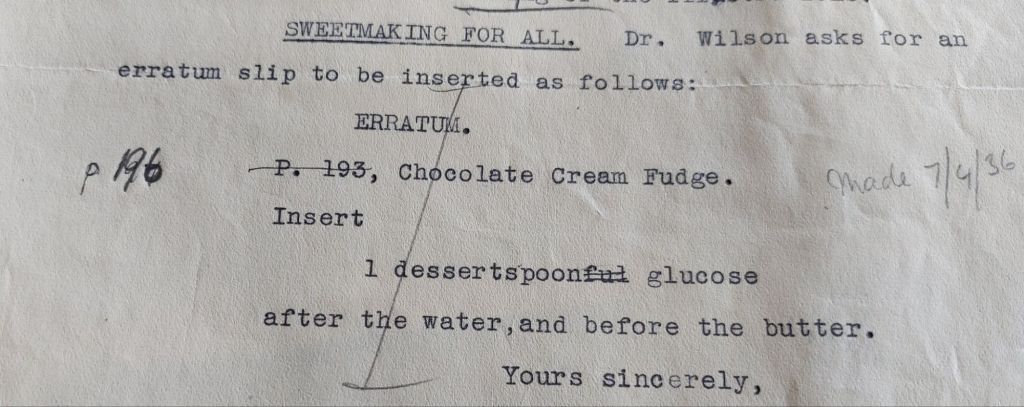
Sweets that would have been less Sweet
Imagine the author’s distress at realising that glucose had been omitted from their confectionery recipe:-
Wanderlust
Meanwhile, it seems Dr Wilson was the only person who could deal with a ‘peppery’ author, but explaining how a travel anthology had gone missing in transit between Bude and Edinburgh would challenge his diplomacy to the utmost. (You have to appreciate the irony.)
Naming no Names
And I was unimpressed by the managing director who had certain issues with women authors. Admittedly, this was the 1930s, but … really, Sir!
Anyway, I’m heading to the University of Surrey/ RMA conference in Guildford today, so all my editors and their authors can rest in peace until next week!
A strange coincidence occurred to me last week – I encountered conductor Landon Ronald in two quite different research contexts.
Firstly, I knew that soprano Flora Woodman appeared in at least a couple of concerts with Landon Ronald (1873-1938), Principal of the Guildhall School of Music. (Possibly more – but I was mainly focusing on her repertoire as I went through her logbook and scrapbooks.) However, I did note in her scrapbooks of press-cuttings, en passant, that she wished it to be clarified that she was not his protegee. Interesting – but there’s really nothing more to be said. If she wasn’t, she wasn’t.
Nonetheless, I had also encountered Landon Ronald in a different context last week. In 1936, Thomas Nelson published a book, Let’s Get up a Concert by Rodney Bennett (1890-1948, father of composer Richard Rodney Bennett) and H. S. Gordon, with a preface by Sir Landon Ronald and Illustrations by Joyce Dennys. Landon Ronald again! Nothing to do with Woodman this time. Indeed, it may not have a great deal to do with Landon Ronald either. I’ve found no evidence that he didn’t author the preface, but I do have evidence that someone else paid a ‘big name’ to put their signature to a preface for another book, in full knowledge that the ‘big name’ could be mentioned in book promotions and would undoubtedly add appeal and authority to the book. If Thomas Nelson allowed one author to do this, who’s to say they didn’t with others too?
Now aged 63, Ronald was still Principal of Guildhall, but he says he no longer promotes concerts. He alludes to his experience of ‘hundreds of orchestral concerts in the Summer Season on Sunday evenings at that most democratic of all holiday resorts, Blackpool’ (yes, Flora performed in Blackpool too) – ‘and an unbroken series of four hundred Sunday afternoon orchestral concerts at the Royal Albert Hall.’ (Plenty more about him on the CHARM website, which is the AHRC Research Centre for the History and Analysis of Recorded Music.)
But back to Bennett’s book. Part Two consists of practical advice to performers: dealing with nervousness, platform technique –
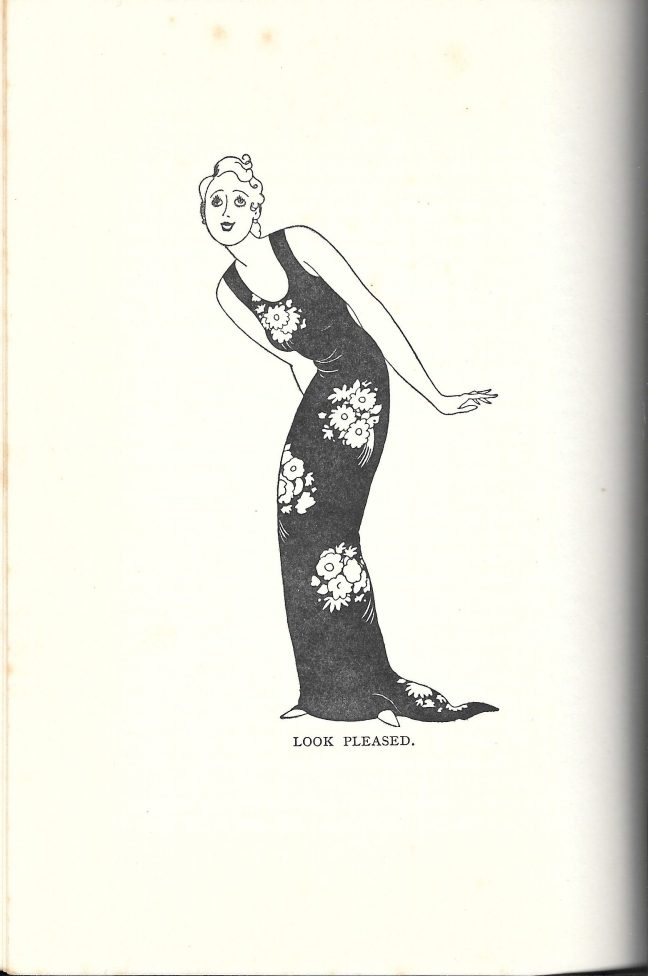
However much you desire to pop off like a frightened rabbit, don’t.
‘Walk like a Dancer’
The eager would-be concert performer is advised to ‘learn from professionals’ (p.135) especially from foreign artists, whom Bennett says are more accomplished in this regard – and about ‘pleasing the eye’ (p.136). You must ‘walk like a dancer’, and ‘support [the man in charge*] with unfaltering loyalty’, whilst pianists should appear to be a ‘natural, kind-hearted, happy human being’.
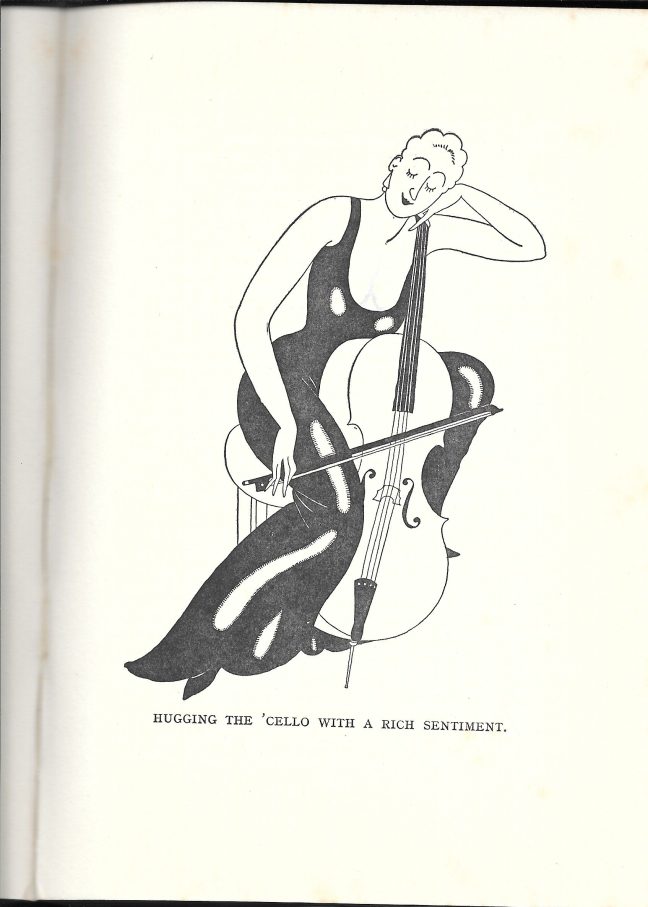
In fact, dated as it seems in some respects, there’s a lot of useful advice in this book. I can only commend the individual who presented it to Penarth County Girls’ School* Library in 1946. It would have been helpful at the time, and a lot of it still is. The illustrations are decidedly tongue-in-cheek, but on the plus side, they don’t patronise the intended audience – advice is always easier taken if the advice giver uses a touch of humour! The artist, Joyce Dennys (1893-1991) was a cartoonist and illustrator. The book perfectly fits into Thomas Nelson’s lists, with their emphasis on providing self-improvement, self-educational material for the intelligent layperson. You might be a teacher needing more guidance on laying on concerts, a nervous and somewhat inexperienced performer, or an organiser of any number of different kinds of musical entertainment, and this title would have plenty of accessible, useful advice.
Of course, platform etiquette would have been second nature to a superstar like Flora Woodman, who would probably have needed little advice after her first few performances. (Neither, I imagine, would she have liked the suggestion that foreign artistes had more stage presence! My gut feeling is that she had it by the bucketful.) She was mixing with professionals of the highest calibre, in Britain’s best concert halls.
I’ve already posted details of some of her fabulous wardrobe, and it would become rather dull if I went on producing lists. But I noticed today how she liked to ring the changes with glamorous accessories. They wouldn’t be wise choices today, but hey, this was a century ago. So – I spotted white fox, ermine, beaver and swansdown, as well as velvet hats, black tulle, hydrangeas, lilacs, pink flowers, a wreath (garland?), and regular adornments of silver (silver what? she doesn’t say). Also, even within a couple of years, she updated her outfits, with ‘second editions’ of her black and white, and pink and pearl ensembles. (Once again, do use your imagination – I’ve given you plenty to work on!)
Meanwhile, excuse me whilst I browse through Rodney Bennett’s book a bit more …
*Yes, Bennett does talk about ‘the man in charge’. It was a different age – don’t shoot me!
Here is some more of soprano Flora Woodman’s concert attire, this time for 1916. I imagine she had a walk-in wardrobe for this collection. (Look back at my previous posting, to see which of her earlier outfits she was still using!) I’m quite sure her admiring mother would be sitting on the bed, nodding in approval, and maybe helping Flora tuck in a wisp of hair, adjust a shawl or the tilt of a hat in front of a full-length mirror before they set out.
In my mind’s eye, this blog post has multiple paper dolls wearing 1916 outfits, or little squares showing the colours of the outfits and hinting at the accessories – a hat here, a fox or ermine stole there (for this was decades before anyone hesitated about wearing fur), or a little sprig of flowers to coordinate with her frock. Sadly, I can’t rise to illustrations like that, so again, please use your imagination!
[illegible] with Blouse, White Fur & hat
Black & White Black hat, Fur Coat Black Velvet
Brown hat, pink jersey? (Presumably with a skirt!) Singing to wounded soldiers in hospital
Green coat & skirt, brown hat, white fox, a blouse Green Coat & Skirt, Pink
Mauve frock and white hat & shoes
Navy blue check and white hat
Pink & pearl Pink with hydrangea
White & pink watersilk White with black Tulle White with ermine















 Karen McAulay, Musicologist