Going Off at a Tangent: an Intriguing Deviation from Research

Straight line with a second, curved line (ending with an arrow)
Image by Bruno from Pixabay

When that book comes from Amazon, I may be distracted. Well, it’s available online already, being very old and antiquated, but how can I refer to an embroidery book online, when I want it open in front of me whilst I sit sewing? I don’t care to read it on a tablet – I want the real thing, or in this case, a reprint of it. (You can’t so easily sit with markers in different pages, flicking between different stitches and patterns, on a tablet. )

What, you might ask, does this have to do with Scottish publishers or educational music? Absolutely nothing. It does have a tangential link to something that was once a research interest – hence my inability to let it go by me.

Watch this space. We’ll soon see if I am up to any of the suggestions in this book! Maybe it’ll arrive in time for the weekend.

Thoughts about Experiencing Plagiarism

Beautiful red apple hanging from tree, ready to be picked

‘Imitation is the sincerest form of flattery’?

I wrote these words as a reflection, but then I wondered if other people might find them helpful. Maybe something like this – or worse (because I realise my experience was slight compared to someone whose whole article, story or book has been plagiarised) has happened to you? There might be folk who would shudder at the thought of laying bare their emotions, their gut reaction, to such a situation. As for me? My ‘words’ are my strength. If my words in the present posting make me look weak as an individual, be assured that I am fully aware of this. They also make me uniquely ‘me’, and who ever gets far by pretending to be other than themselves?

Meanwhile, my situation has been resolved, thankfully. I feel grateful. Grateful for the help. Grateful for the response and correction of the situation.

However, I feel utterly drained.  I’m taking a day’s annual leave because it’s preferable to taking a day’s sick-leave for stress.

I initially headed this posting, ‘Thoughts on detecting plagiarism’. However, ‘on detecting plagiarism’ turns out already to be in the title of someone else’s blog post – Addressing the Inherent Biases in Automated Systems: On Detecting ‘Plagiarism’ (Lancaster University, Ref 2014 Impact Case Studies). I changed my heading. Do read the Lancaster post, if you’re interested. I commend it, even though it’s actually about detecting plagiarism in student submissions, rather than realising your words have been quoted without attribution. I read their blog post briefly last night, and I am not reading it again today. I took no notes, and I have no intention of borrowing anything that was there.


They were literally just a few words, but my own words, and the crux of a 21-page article written 12 years ago. The first full article on the topic. It hurt. And then I started questioning myself:- was I considered so unimportant that my authorship is insignificant? Because, PhD or not, I was ‘merely’ a librarian, hence unimportant? Because I’m now ‘just’ a postdoc research fellow? (That was actually a promotion, by the way!) Because I’m not very famous? Was it because I’m a woman? Because I’m older, and thus considered past it? Because, once published, the words were considered free for the taking? Because, significant or not, they were just a few words, and so temptingly apposite? Low-hanging fruit.

Mulling it over as I got ready for the day, I glanced in the mirror. There I was, an older woman – not ageing particularly stunningly or gracefully, short in stature and wide in figure. My garb was workaday (I was about to sit down to a solitary morning of research, 67 or not). I wore no makeup, and I haven’t been on the latest diet long enough – you wouldn’t notice me if I walked down the street. So there I was. I’m not publicly visible as a performer or composer, unlike a large number of my colleagues. And, as I mentioned, although as a librarian I achieved some visibility in the sectors I worked in – perhaps more visibility than many – librarians aren’t generally known for this quality. We exist to help other people. I’ve not been a librarian for a year now, but I think I probably still carry the aura of invisibility. And when you say ‘librarian’, not many people immediately think, ‘Ah! A researcher. An author. A public speaker.’ Well, there it is!

Image by Bruno from Pixabay

But although librarians might exist to help, to share, to facilitate, they aren’t ghostwriters. Even when they’ve retired from librarianship and are now employed solely as a postdoctoral research fellow.

‘It Says More about Them than it does about You’

And then I reminded myself (I think this is called cognitive reframing) that I didn’t actually know what they were thinking when they used my unattributed words. I can’t read other people’s minds. My identity may not have even been a consideration. And I recalled my latest mantra: that other people’s words and actions speak more about them than about me.

Trigger warning here. I am not preaching when I say that I’m a practising Christian; I’m declaring a fact, which probably does affect my philosophy. (I’m no Evangelical, though – I’m boringly conventional!) I found an intriguing article, ‘3 Reasons Pastors and โ€˜Authorsโ€™ Should Never Plagiarize‘ by David Kakish (12 July 2019). He does make the salient, human point that ‘Plagiarism Fails to Give Honor Where Honor is Due’. Be assured that I’ll be reading it, out of curiosity, but it doesn’t really help the person who has been plagiarised, so I’ll leave it until later! I did do a little web-searching to see if there was a Christian take on low self-esteem. However, I found nothing that resonated, except the grounding reminder that everyone is a unique person for a purpose, so we should embrace what we are rather than wish we were someone else.

I tried not to beat myself up about my own insecurities. I know what I’ve achieved, from a mid-career standing start, against the odds. My words are old enough to be irrefutably mine, regardless. And … well, I can always write some more!


Here are some useful links which I found last night

If your experience is on the more serious end of the scale, these might be helpful. I’m not proposing to offer guidance on dealing with such situations – I’m really not qualified to – but I would urge you to seek support.

Bailey, writing about author O’Hanlon’s dreadful experience, headed his post, ‘The Emotional Toll of Plagiarism’, and my own limited experience endorses that. In my case, a migraine and shall we say, gut reactions, were clearly telling me I was stressed.  Symptoms can be treated, but how much nicer not to have had them at all!

Image by NoName_13 from Pixabay
Oral Transmission of Folk Songs

Wavy lines of music and an artistic interpretation of a fiddle

Attribution and Authorship

When I’m talking to students about oral transmission of folk songs, my take is – perhaps a bit controversially – that I believe a lot of songs were actually written by ONE person. Passed on, passed around, changed certainly, but I don’t buy the idea that they somehow ‘grew’ anonymously or collectively out of the soil. Maybe a group of pals did sometimes sit in the pub, stand in the fields or sit at their looms working up words or a tune, but as often as not, someone ‘wrote’ or devised that song. We just don’t always know who did.

Tune Variants

The other problem, of course, is variants. If you pass things round and they get picked up by ear, or someone writes it down – but not exactly how it was performed by the last person – the tunes change slightly. Or, in times-gone-by, gaps between crotchets got filled in by two stepwise quavers, or an ornament got written out in full. And how do you determine what the ‘right’ version is? I don’t think you can, often enough, though you can certainly try to identify the most common form of a tune.  Or if you’re able to, the earliest printed version. (If Hamish McHamish wrote a song in 1825, then the earliest printed version is most likely to be closest to his intentions. But unless he took his tune to the printer, or published it himself, you can’t be sure. )

The Ravages of Time

So we have at least a couple of centuries in which some tunes had the opportunity to change a multitude of times. (And that’s before an accompanist decided that G7 would be better than E minor at a particular point …) Try and compare a song in three different published collections. It won’t necessarily be exactly the same.

The Strong but Wrong Singer

I also use the modern-day example of my own church organist experience. You teach the congregation a new tune. A strong singer gets something wrong, and thereafter, try as you may, everyone sings Jemima’s version of the tune. That, too, could be construed as oral transmission in action!

(And as for Technology)

Today, we had a new song. The choir had studiously learned it, syncopated rhythms and all. We sang it first as an anthem. Later, we sang it with the congregation. Even the syncopations went moderately well, though I can’t say I was listening out for those who, ‘like sheep had gone astray’ (to quote Handel’s Messiah). There was only one problem: the verses appeared on the PowerPoint in the wrong order, and there was not a thing could be done about it once we’d started. When the choir sang it with the congregation, the latter sang what they could, or what they saw on the screen …. ! Maybe that’s why the syncopations went well – not everyone was actually singing.

All I can do is offer a corrected version of the lyrics for the PowerPoint, and we’ll try again another day. Who knows what might have changed in the meantime?

Fruitful Days

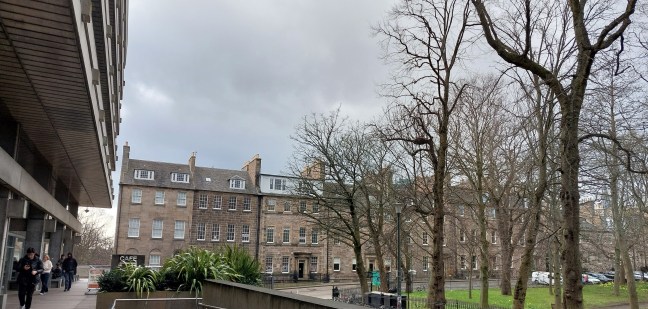
George Square Edinburgh University

Friday

  • Applied for a grant.
  • Wrote a blogpost.
  • Started to update my blog bio.

I think that will do for one day!

Weekend Activity

Who said weekends were restful?! Apart from the usual domesticity, and the organ-playing, I put in some more work on this blog.

  • Finished radically updating my Bio page to better reflect my two career strands.
  • Balanced my historical copyright page (Claimed from Stationers’ Hall) with a new one: Copyright Today. My career trajectory means I take a keen interest in copyright, intellectual property, plagiarism and so on. I might as well keep useful material handy, for myself or anyone else stumbling across this blog.

Two Ladies and a Harp: the Maclean-Clephane Sisters of Torloisk on Mull (and Edinburgh)

You know how you buy a new car, and suddenly everyone seems to be driving the same white Fiat 500? It’s the same with research topics.

“Enthusiastic collectors of Gaelic songs and Irish harp tunes”

I researched Gaelic song-collectors Anna and Margaret Maclean-Clephane as part of my PhD (2009).

  • I blogged about the sisters as far back as 2012 in my librarian days, when the Whittaker Library was using Blogspot:- How Far Can a Song Travel? (Author Karen McAulay, Whittaker Live blog, Wednesday, 23 May 2012);
  • and of course they later made it into my book (Our Ancient National Airs, 2013).
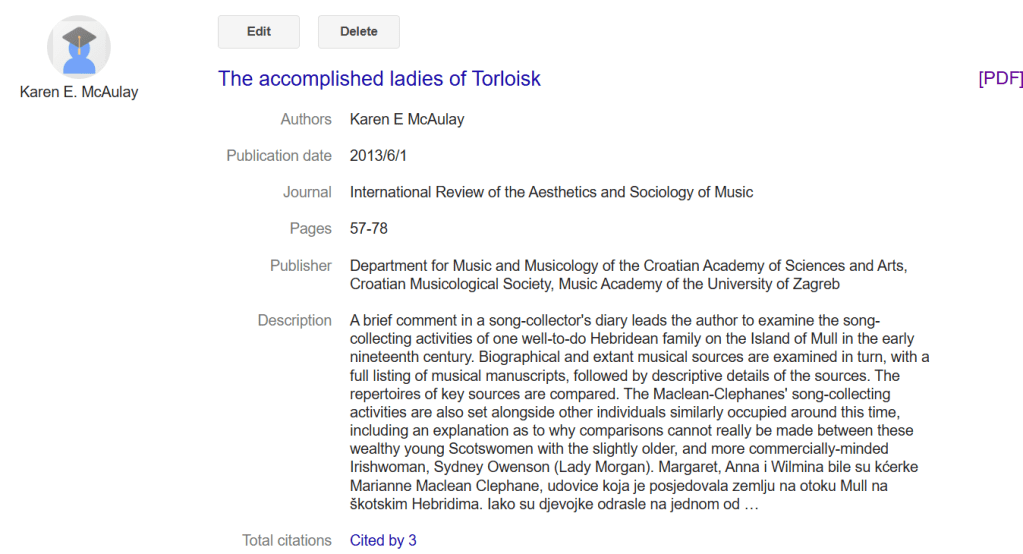
  • I followed up with an extended article about them (also in 2013). See this excerpt from the article:-

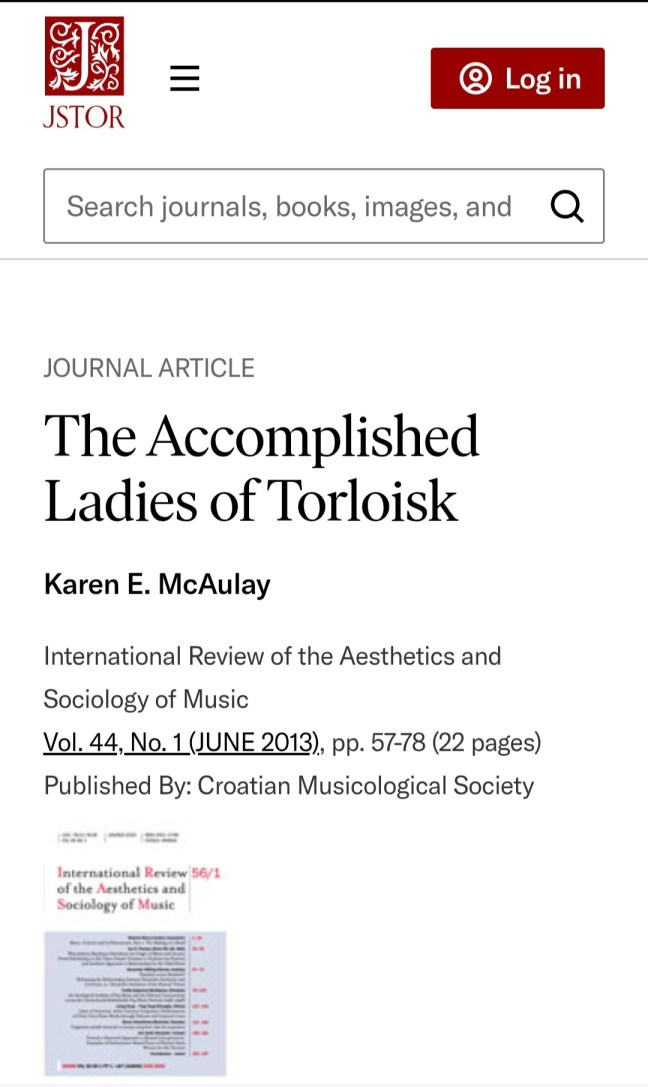
Naturally, the Maclean Clephane sisters are in my Pure institutional repository at the Royal Conservatoire of Scotland. I coined the above phrase, ‘enthusiastic collectors of Gaelic songs and Irish harp tunes’, using it both in my book (p.92) and my article (p.62), both in 2013.

‘While they were still in their teens’

The sisters had a book ‘printed but not published’ while they were still in their teens – you can read about it in my article, p.58. I have to say, the arrangements in their book were – well, okay, but not artistically stylish!

Margaret had a harp – there is actually a Raeburn portrait of Margaret with her harp – see below.   Alexander Campbell did say the sisters played, but there’s no portrait of Anna with a harp, so we can’t prove it either way. He didn’t meet them. (There was in fact a third sister, though her musical interest didn’t seem to carry through to adulthood. ) Indeed, Anna wasn’t that hot on the piano, as I recall.  They grew up on the Isle of Mull. I’ve driven past the house, Torloisk. It’s massive!

I just love researching and writing about people, particularly musicians! If they’re women musicians, then that’s all the more interesting – so it’s hardly surprising I was drawn to them, and went looking at materials in the National Library of Scotland and the School of Scottish Studies in Edinburgh, and even visiting a manuscript that’s now down in London. (Blog post Women’s History Month 2024. Musicians, this present blog.)

Details of my article

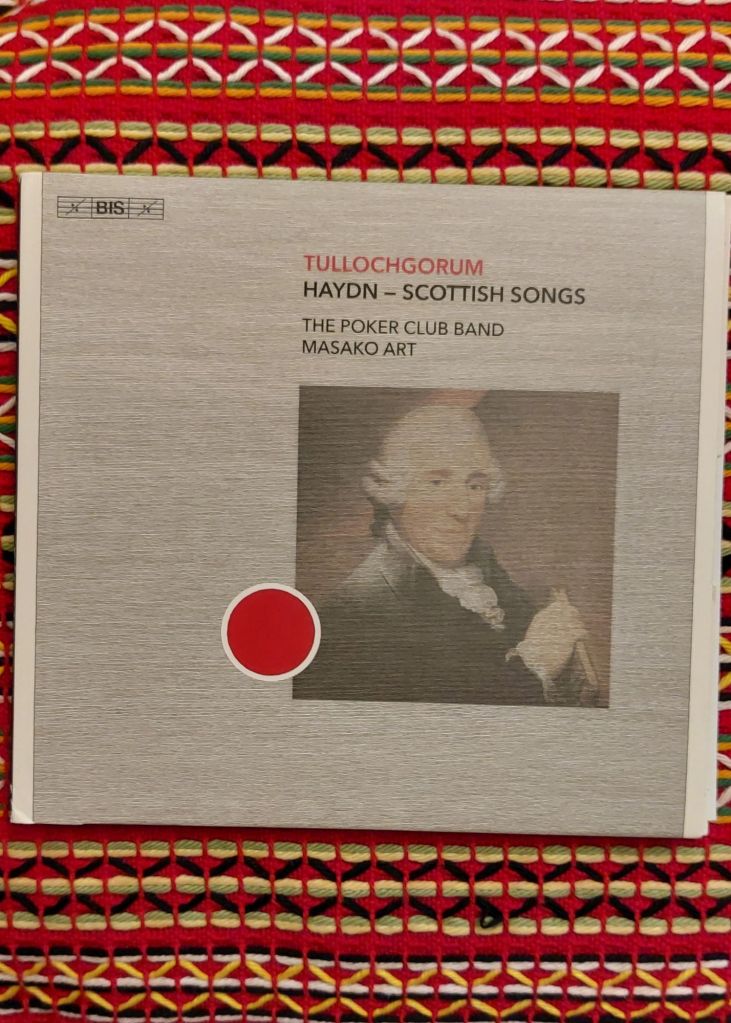
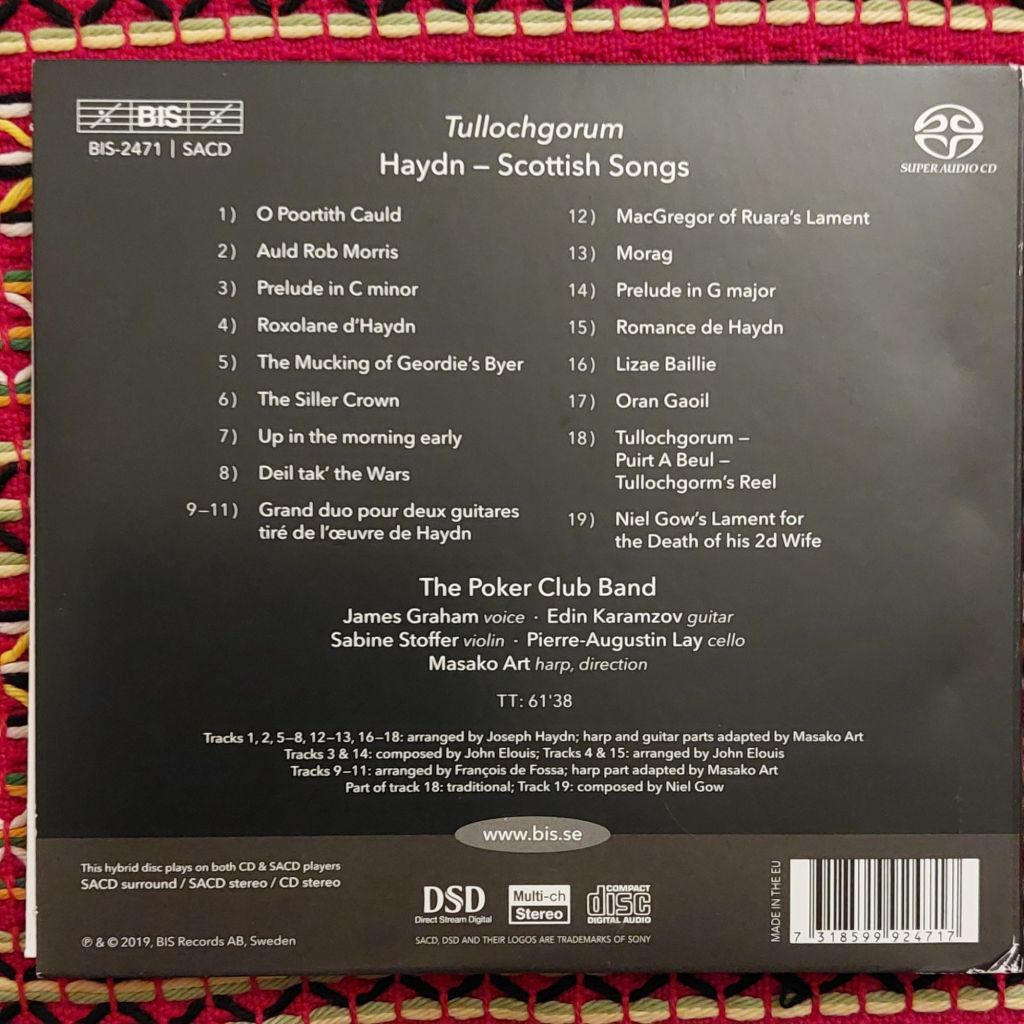
But ever since, these fascinating and talented ladies keep cropping up in my social media feeds. People who’ve read my writings also contact me from time to time. Thanks to the miracles of modern technology, I get notifications that people have consulted my stuff, too … and there’s also a CD whose notes cite me, too:-

Tullochgorum – Haydn – Scottish Songs, by The Poker Club Band and Masako Art (BIS-2471 | SACD

Tullochgorum – Haydn  – Scottish Songs

The harpist, Masako, asked if she could cite my work – I was very appreciative that she went to the trouble of asking me.

Correctly cited ๐Ÿ˜€
Margaret Clephane … and Masako Art

I spent so long with my early nineteenth-century heroines, but eventually my research took different directions. Not being a Gaelic scholar was just one of the problems I’d encountered! I attended classes in speaking it, at the Conservatoire. I signed up to local authority evening classes at the Gaelic School in Glasgow. But somehow, I never really had time to give it enough attention, despite having been considered good at languages at school and possessing school certificates in – well, several European languages. I understand when someone agrees with me in Gaelic, and can pronounce ‘Torloisk’, for sure, but Gaelic remains beyond me!

But look – now the music is going to be played. That’s exciting!

Interpreting Research through Textile Arts

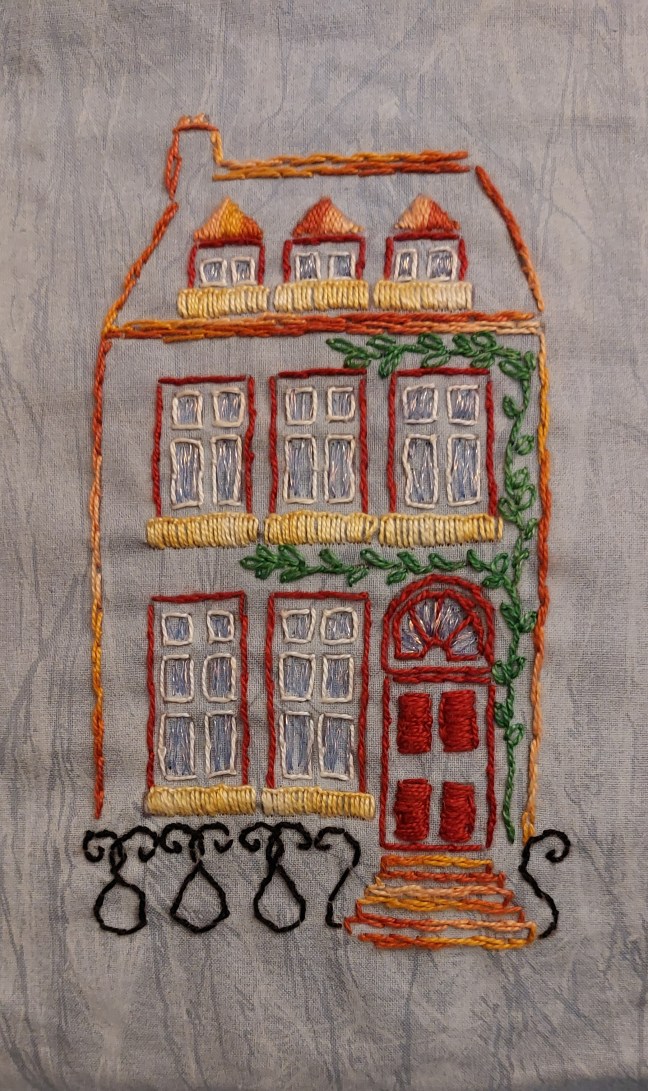
If you’ve visited this blog before, you’ll know I research various aspects of Scottish music history, not textile arts.  However,  when I take a break from research, I often take up needle and thread – it’s relaxing – and what I sew is quite often a reflection of what I’ve been researching. (I can explain the house at the top of this posting – just read on!)

I applied for an international opportunity to make something really big and research-related, a few months ago. I didn’t succeed, but I went on thinking about it.  I’m not following it though, because I would have nowhere to display it if I did make it.  Instead, I have scaled it down both literally and in terms of subject matter.

In place of a large wall-hanging representing my latest research in its entirety, I’m trying a new way of making a cloth book, and focusing on a couple of Thomas Nelson books I’ve encountered. I’m still thinking about educational music books published by Nelson in the second quarter of the twentieth century. 

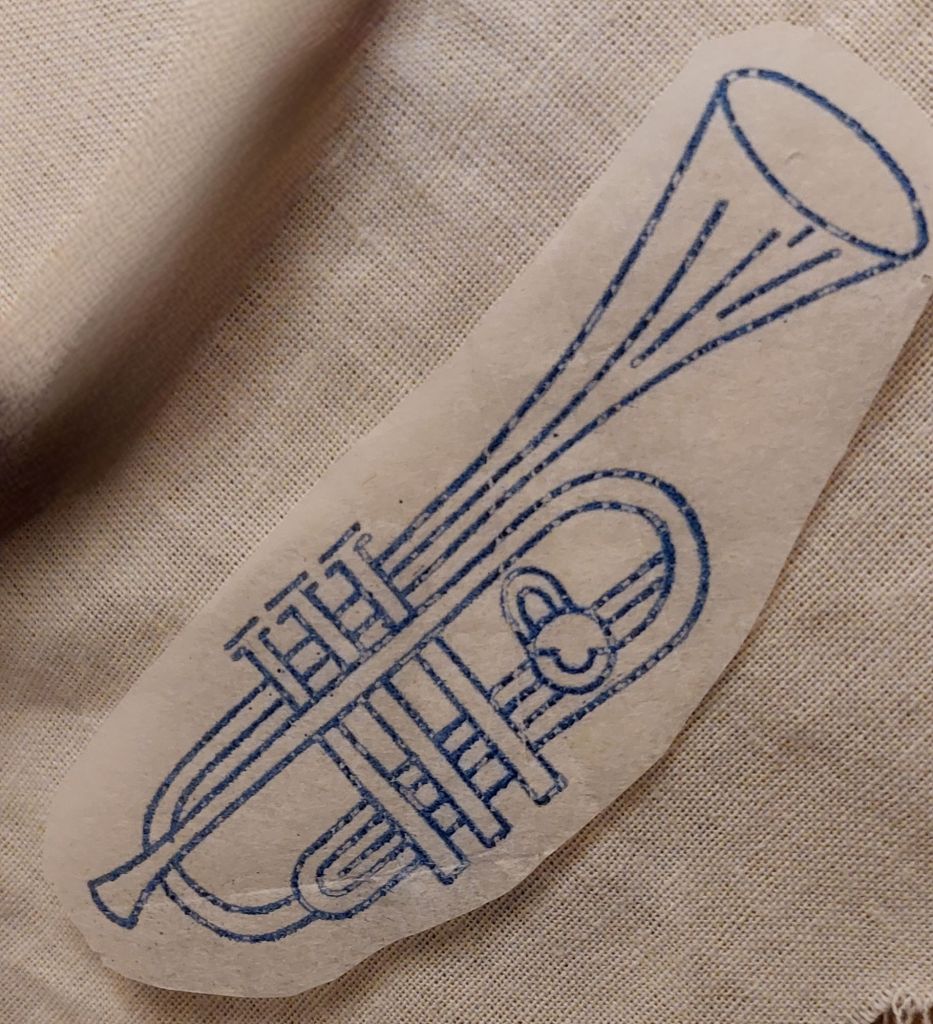
I’m using some iron-on embroidery transfers from my late mother’s collection (the kind where you iron-on a line drawn transfer,  leaving an outline on the background fabric, then work over it), along with a few ideas of my own.

We have only just realised that Mum hoarded things – she was so tidy and methodical that they could be sorted away in that large house, and no-one knew.  Why she kept quite so many embroidery transfers is a mystery.  For needlework teaching purposes? She retired in 1991!  Even I would never get through them, if I live another 30 years.

Anyway, with a bit of ingenuity, I’m finding musical motifs that might have been applicable in the 1930s to 1940s: Percussion bands.  Brass bands. Wind bands. I’ve copied Thomas Nelson’s singing child motif, and the Nelson publisher motif from books I’ve bought on eBay, and no doubt I’ll use the vintage thistle transfers (Scottish symbols) that I acquired from the same source.

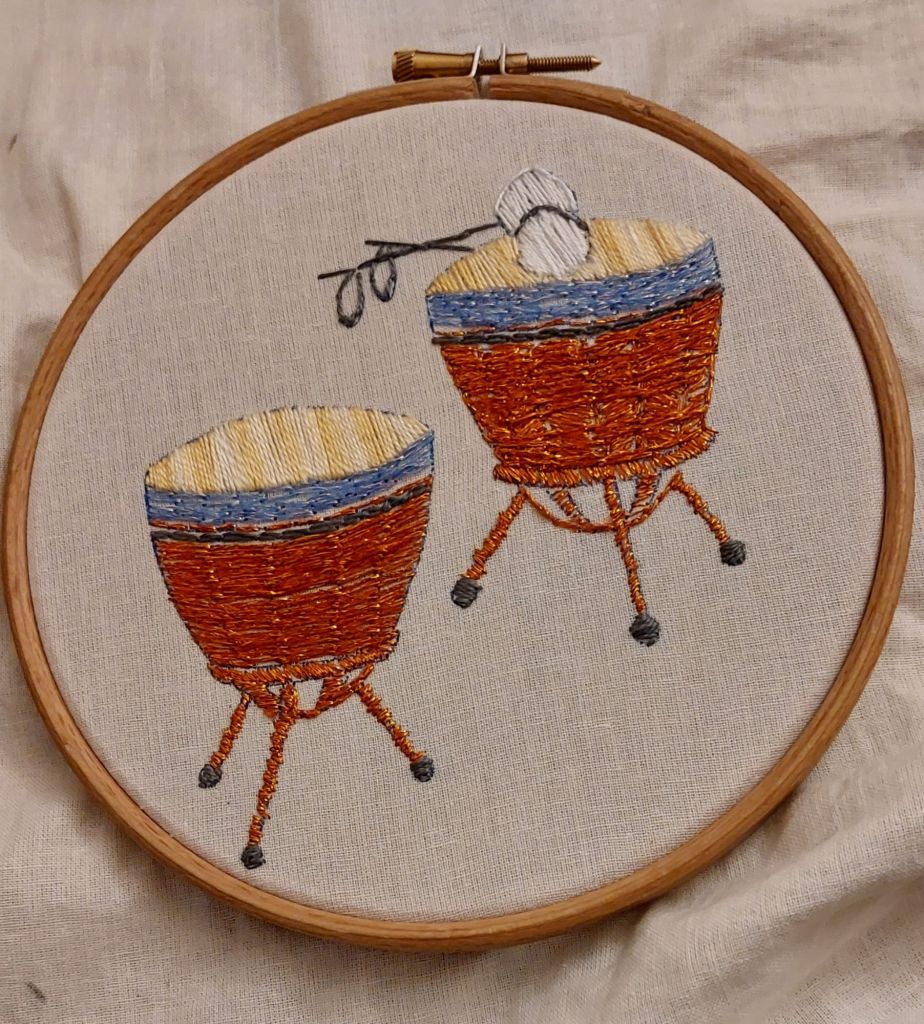
Timpani  – second attempt!

There’s a rather fanciful house from Mum’s stash, which I embroidered against a blue background reminiscent of heavy rain, last weekend – Storm Amy was with us, and I had stayed at home last Friday rather than going to Edinburgh. (A wise choice, as it transpired.)  I need to end up with 20 cloth pages, so I might need to go through the stash again to see if I’ve missed anything, or start embroidering quotes that caught my eye. I’ve done one of those  already.

‘Three Stars and a Wish?’ Forget it!

I have to keep reminding myself that this is something I’m doing for fun, as an amateur, whilst Mum was a professional. As an old-school teacher, she hadn’t encountered the ‘three stars and a wish’ principle, and if it wasn’t up to scratch, she told you. Straight. No gentle preamble about what you had done well.  The ‘Spirit of Mum’ has more than once seen me unpick things because it was plainly ‘not my best’.  And whilst my little rainy-day house is now finished (after some unpicking and reworking), I can’t guarantee that I won’t have another go, just to try to improve it. (Maybe representing a sunny day, next time?) It’s strange how one still feels the weight of parental expectations, and hears the criticism, even when they’re no longer around.  This is probably the root of my perfectionism – but I’m working on it, honest!

The next problem, of course, is where to put my creations …?

From That, to This (the Original Idea)

It would have been a much larger art work!

Original Artistic plan for the work

I proposed to create a 2-dimensional hanging collage. Predominantly in black and greys, it would have depicted archival shelves and resources; silhouettes of editors; and in the foreground, children singing from the Nelson Scots Song Book,and a teacher at a piano.ย  The song-books would reflect the original colours of the Nelson books.ย  A furled blue and white Saltire flag would have occupied a lower corner of the collage.ย  Further details, space permitting, might have included popular motifs: a Highland piper, a thistle, or a Highland dancer; a snatch of a song in music notation, and a few significant editorial words from correspondence.

Explanation

The narrative behind this collage would have demonstrated that even a set of small Scots song books had an ultimate audience or user in mind, deriving from decisions by compilers and editors, and created as part of their day-to-day work amongst other projects. The booksโ€™ contents show the compilers responding to a contemporary urge to educate and immerse young Scots in their traditional culture.ย  Illustrations of resources would have hinted at the sheer quantity of paperwork behind the publications, and would have included stitched representations of bundles of paper, a document file and a correspondence book, whilst small, typically Scottish motifs would, if possible, have reflected (but not reproduced) the well-received line-drawn pictures commissioned for the separate pupilsโ€™ editions of the song books.

The Big Idea: another Book

I’m contemplating writing another book. It’ll be based on my recent researches as an IASH Fellow, obviously. But I’ve had a brainwave of an idea for the final chapter – which involves a bit more research – so the past few days have been dedicated to exploring possibilities. As I now know, from the historical Thomas Nelson point of view as much as my own present existence as a scholar, publishers like publishing things in series. It helps them sell, if readers can see how a book fits into a larger grouping of books. I’ve been thinking about where my book might fit in.

I’ve also had a wee jaunt to Dundee to talk to a scholar of my acquaintance; and today, I sat down to write an email. Who’d have thought it would take most of an afternoon to write an email?! But when it’s important, it’s worth taking some effort in the crafting of it.

‘Faint heart never won fair lady’

Finally, I thought it was just right. I mused that maybe I should leave it and re-read it tomorrow. But no, I must be resolute. So, I did not prevaricate. More of this thrilling story in due course …

Like Buses, Pre-Publications seem to come in Threes

Three blue double decker buses, one behind the other

Since Friday, I’ve been sent three exciting emails:-

  • the proofs of one chunky article that’s due to be published next year;
  • the proofs of a contributed chapter with probably a similar timescale,
  • and another even chunkier article that has now been accepted – but needs a couple of final touches before I send it back to the editor.

Not bad, in two working days with a weekend in between!

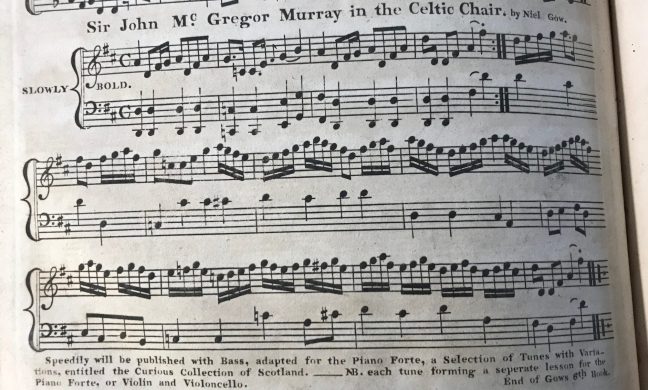
It’s just the way things turn out, but the first article is a late-in-the day return to a paper that I originally gave in 2019 – I waited to be sure that the original conference organisers wouldn’t be needing it. Not only that, but the paper itself had been a return to, and development of, a topic I researched for my PhD and subsequent first monograph, so it has been a long time brewing! I first ‘encountered’ the ghost of Sir John MacGregor Murray some twenty years ago, and a fascinating ghost he turned out to be. He deserves his article in Folk Music Journal next year. Proofs checked and returned already.

Meanwhile, the book chapter expands on work that I did for my own recent second monograph, A Social History of Amateur Music-Making and Scottish National Identity, focusing on a song collection published in time for the Festival of Britain. And the other article picks up on very different threads from that monograph, but also represents a considerable amount of detailed research since then. I look forward to checking the chapter and dealing with the article.

I do have another article due to be published later this year, too. More of that anon.

When you consider that I’m just beginning to think about a third monograph, it’s all a bit dizzying. Mind you, that won’t be happening immediately. I’m still exploring ideas. (Would it be disloyal to say that this is all so much more fun than cataloguing jazz CDs in my earlier existence …?)

Buses photo: Image by Jm TD from Pixabay

One Book. One Story – about the Book itself

Woman reader looking up thoughtfully

(Do I live in the 1950s these days?!) I’ve been tracing a woman who briefly worked for publisher Thomas Nelson in Edinburgh in the mid-1950s. Yesterday, I found a memo from her to one of the managing directors. Instructed to throw a book away if she couldn’t find a use for it, she promptly did find a use for it, giving it to the library of the Glasgow training college where she had previously worked.

I admired her honesty in telling him, because there was probably no need to report back on what happened to a book that was clearly regarded as inconsequential. It came from the Toronto branch of Nelson’s, and was about important Canadian educationalists; I can see why it might not have been much use in the Edinburgh office. (She had, in fact, travelled back from Montreal at the age of 16 – I have no idea how long she’d been there – so maybe he knew this, and thought she’d be interested in this combination of a country she’d visited, as well as a topic she knew well.)

Nonetheless, she did tell him, and reported that not only did the college librarian thank her, but her former boss at the college had commented that it was a title she’d actually been looking for. My interest was piqued, and I checked Jisc Library Hub Discover. Sure enough, the college has since been absorbed into a university, but the university library still has that book – the only copy in the UK. It has survived 72 years and at least one library relocation. I wondered if it had subsequently been borrowed by that senior training college lecturer – the one who had been looking for it?

Apparently not! The book has no trace of ever having been borrowed. Let’s hope she at least sat and read it in the library!

Image by Bianca Van Dijk from Pixabay

Jobs for Girls and Boys in the 1950s

Yes, I’m afraid I have been distracted in my archival search for the editor of some teaching materials.  I identified a run of box files for the right years, but it turns out not to be from the editorial team. The sales department was obviously crucial, once the books were ready to market and sell, but if my present quarry had only had any evident input into one solitary published title, then frankly those boxes probably don’t concern me in my present research.

Nonetheless, I inspected four boxes fairly closely, before deciding to stop looking at the boxes from 1953. 

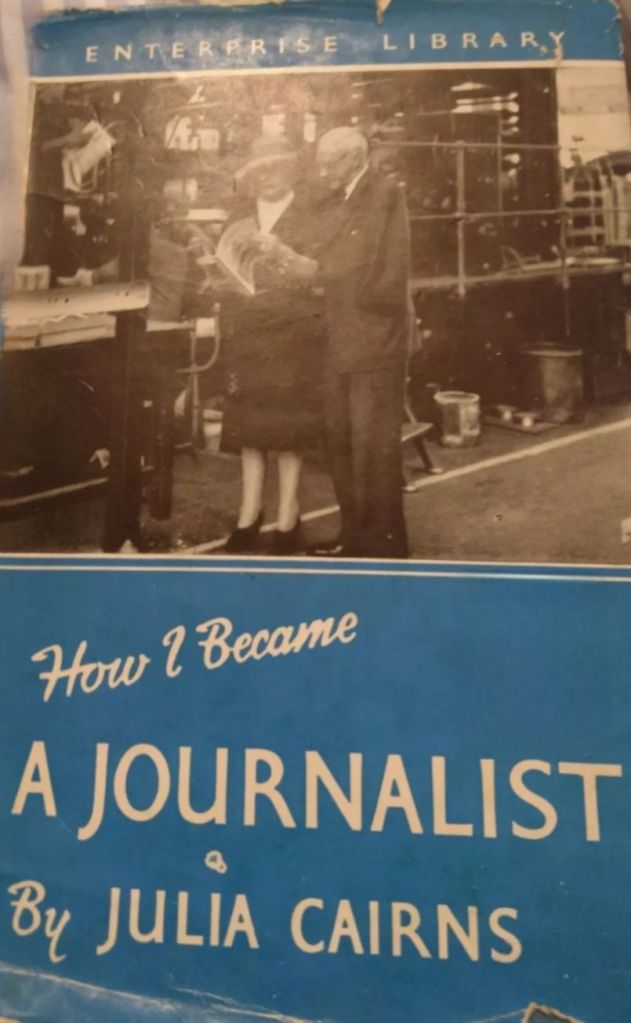
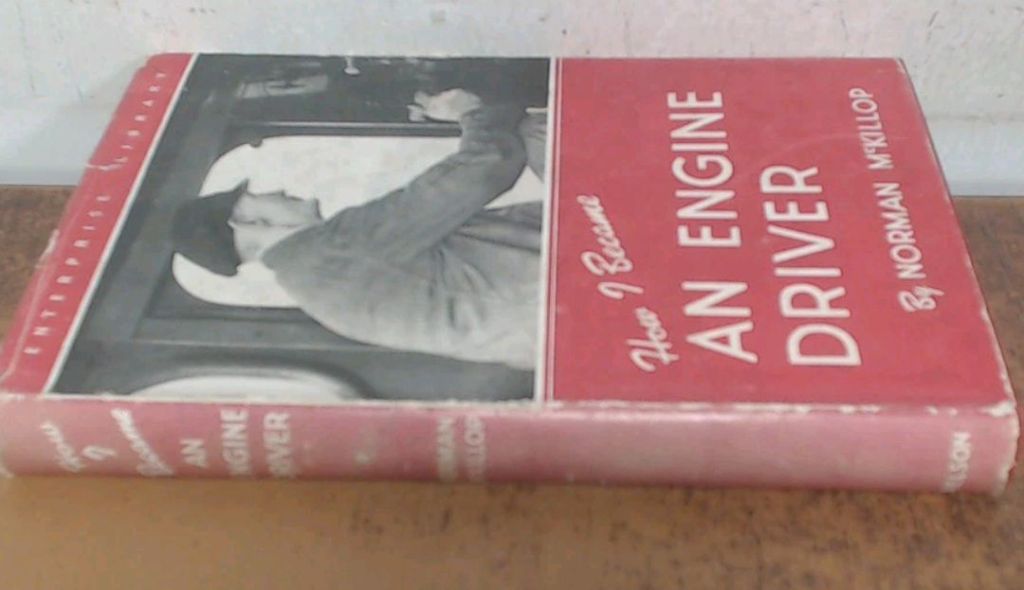
In passing, in the ‘Nelson Juniors’ series, I  encountered some careers-related books from the 1950s. The choices – apart from that of journalist – are rather stereotyped! On the other hand, the girls seem to have more choices … curious, that! Maybe they meant to publish more titles, before the series rolled to a halt with the ‘engine driver’ in 1960.

Found on eBay!
Yes, also on eBay

How I became a … (by women authors)

  • Ballet dancer
  • Fashion model
  • Journalist
  • Librarian
  • Nursing Sister
  • Air Stewardess

How I became a … (by male authors)

  • Cricketer
  • Detective
  • Engine Driver
Also on eBay!

The first and last of these seem to have attracted some interest! The ballet book was reviewed in an American dance magazine – Dancing Star, by the editor of a British magazine called Ballet Today. The Ballet Annual wanted to review it. (A lot of announcements were sent to relevant organisations and individuals.) Moreover, The Psychologist Magazine wanted to review both the ballet book and How I became a Nursing Sister. (Nursing, I can understand. But reviewing a children’s book about the career of ballet dancer? Was it to gain insight into a young ballerina’s mind …?)

And even if nowadays, it looks pretty mundane, Meccano Magazine and The Model Engineer both requested review copies of How I became an Engine Driver.ย  The Stephenson Locomotive Society were also sent a review copy, along with 2750: Legend of a Locomotive, and they promised to publish a review in the Society’s Journal. Indeed, Thomas Nelson sent a presentation copy of the book to the Lord Reay Maharashtra Industrial Museum in Bombay in response to a request for books for the museum library being set up there – just that one book!

Image by Alana Jordan from Pixabay