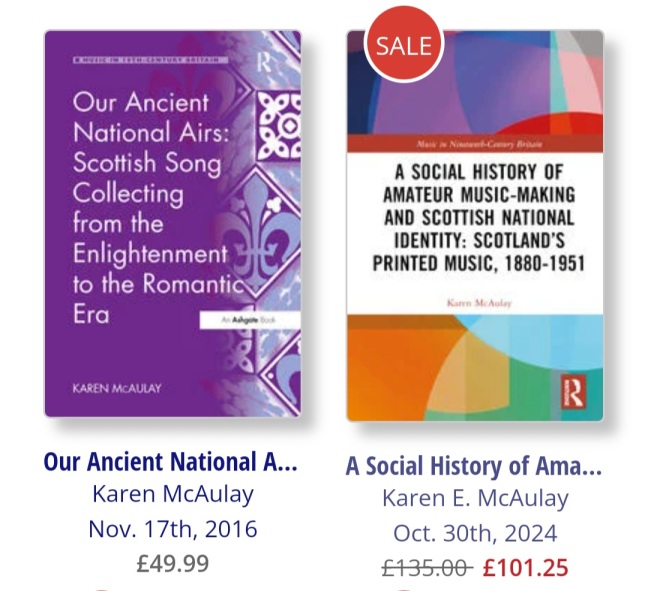
Dr Karen McAulay explores the history of Scottish music collecting, publishing and national identity from the 18th to 20th centuries. Research Fellow at Royal Conservatoire of Scotland, author of two Routledge monographs.
We’ve got several things by Nathan Holder, in the Whittaker Library. Indeed, I even helped arrange for Nate to give an Exchange Talk at RCS a couple of years ago. So, when his latest book was published – based on a poem with the same title, that he wrote in June 2020 after George Floyd’s murder in Minneapolis – I knew we had to get a copy! It was ordered immediately.
The book arrived today, and I’ve catalogued it already. I want to read it! However, I’m not the first in the queue. There was nothing for it – I’ve ordered my own personal copy. I’ll write about it once I’ve read it.
I only have to get through another eight weeks (and one of those is holiday) before I cease to be a librarian. Strangely enough, when there’s a thin chink of light through the slowly opening door, the frustrations of the job seem all the more irritating!
The Pressure to Get Things Done
For example, I’ve been ploughing through a pile of cello music needing cataloguing, and was feeling at least content that the pile was shrinking – when another big pile appeared uninvited beside me. Did you hear the silent scream?
‘We want to squeeze the most we can out of you’, came the joking comment the other week. (It was a joke, I hope!) I feel like a tube of toothpaste. (At least the McAulay is just retiring, to focus on research activities – unlike the empty tube of Macleans, destined for the bin!)
Time for tea yet?!
But this afternoon, continuing to catalogue jazz CDs (I’ve done nearly two thousand in recent years) was enough to drive me almost round the bend. It’s so repetitive, like being on a factory production line – there’s absolutely no creativity in it, and very little job satisfaction! What’s more, peering at the tiny print on the back of the CDs is not easy at the best of times. It’s even worse when my left eye is doing much of the work of the right one whilst it recovers from surgery. Both eyes end up dry and sore, to add to the tedium of the task itself. And then, when I glumly reflect on how little CDs get used these days…
To make things a bit better, I’m trying to come up with fun things that I can inject into the routine of my final few weeks. In recent weeks, I’ve given a NAG (National Acquisitions Group) webinar; attended the Books and Borrowing Database launch; given the Transformations lecture; and there will hopefully be a workshop at the end of this month.
I’m also managing to get to a few lunchtime concerts, to brighten things up a bit more. This week, we’ve had the ‘PLUG’ festival of new student compositions, so on Monday I went to a thoroughly enjoyable concert of music for accordion-plus-one (or two or three) other instruments. Friday, I’ve got a ticket for another concert with a professional ensemble.
I’m racking my brains for other enjoyable activities, but there are limits to what I can come up with! Any sensible suggestions gratefully accepted …?
For a number of years, I’ve given an annual talk to RCS students, about how different generations looked upon, collated and collected and published Scottish songs and tunes. The snappy, official title is ‘Transformations’, but when I was revising it for this year’s presentation, I decided to compile a list of all the people (and a few extra titles) that I would be mentioning. Forty of them! So, I’ve added a new, unofficial subtitle: Speed-Dating 40 Scottish Music Collectors in an Hour. Okay, not exacty forty people, but forty lines in the list. I was quite surprised. I would imagine the individuals themselves might have raised an eyebrow, too.
It was the last time I’d give a lecture as a Performing Arts Librarian. Admittedly, not the last time I hope to give a lecture as a researcher, but certainly the final one with a library hat on! The librarian accordingly played a tiny bit of Beethoven’s Johnnie Cope from memory, along with a few chords from Marjory Kennedy-Fraser’s Sleeps the Noon in the Deep Blue Sky (score open), and blithely announced that she saw no need to inflict her rendition of Debussy’s La Cathedrale Engloutie upon her audience for comparison.
More than anything, the lecture epitomises me as a hybrid. I’m a librarian – I acquire and curate these resources. As a scholar, I contextualise them into cultural history. It wouldn’t be the same talk if I occupied only one of these roles.
The subject of my forthcoming monograph – amateur music making and Scottish national identity – only actually got a brief mention. But it was there. Maybe I’ll need to do a more extensive revision at some point!
Friday was a great day. Or should I say, Friday afternoon was a great afternoon?
A short research visit to the Mitchell Library was followed by discussion of my forthcoming RCS research contract – to enable me to continue researching part-time after I leave the library – followed by a trip to Glasgow Uni for the launch of the Books and Borrowing Database. It’s a fantastic resource, and I’ve watched the project with interest. (website: https://borrowing.stir.ac.uk/)
A bit of networking over a glass of wine and some cheese straws, then I headed home with a distinct lightness in my step. It wasn’t just the glass of wine! I felt as though I’m finally adjusting myself into who I’m meant to be.
I like to think I’ve been a good librarian. I do believe I have. But if I am honest, I chose librarianship because I couldn’t see myself as an academic. I am an object lesson in not writing oneself off at the age of twenty-four. If you’re like I was, or you know someone like I was, tell yourself/them to have more self-belief.
I’m giving my annual lecture on Scottish song books tomorrow. Just shows that I can lecture. Indeed, I’ve read countless papers over the past two decades.Â
Just think how many books I needn’t have catalogued, if I’d been braver and more determined at twenty-four. (I’m still cataloguing them – feeling a bit pressured, if I’m honest!)
On the other hand, how many intriguing enquiries I’d have missed, not to mention unexpected surprises amongst the book and music donations … there have been some advantages.
Image: Wikipedia picture of Hereford Cathedral Chained Library
How could I resist this event?! After all my efforts a few years ago, researching the borrowing of legal deposit music at the University of St Andrews in the early 19th century, I simply HAVE to attend this. It’s somewhat ‘meta’ for a scholar librarian to take a research interest in the borrowing habits of readers who ‘checked out’ centuries ago, isn’t it?
I’ve rearranged my research hours accordingly, so I can finish the week on a research rather than a librarianly note:-
A lovely thing happened this afternoon. I am honoured to have been elected, along with two esteemed colleagues, as an Honorary Fellow of our professional association, IAML (UK & Irl).
When I retire from music librarianship soon, I will have been in post 36 years. But I will actually have been a music librarian for 39 years – and a librarian for almost 40. Where did the time go?
Memories of the Newsletter (Ebay image)
My first ‘role’ in IAML was as Newsletter editor. (Anyone remember Roneo stencils and that pink correction fluid?) And my last has been as Communications Chair. I tell you, blogging is a doddle compared to those stencils!
I’m grateful, and humbled, to have had my efforts recognised. I feel a bit undeserving, but I AM very grateful!
Already a lover of libraries and music!
[The photo? A little girl who wanted to be a librarian like her uncle … because libraries were always her favourite place!]
I’m a rank amateur when it comes to composing, but I quite enjoy the freedom of neither having elevated expectations of myself, nor of being under any pressure to be compared with ‘real’ professional composers!
I wrote a couple of choral pieces about the climate crisis, not long ago. Both have been trialled at workshops run by composer Chris Hutchings in Edinburgh. One was even programmed by a choir putting on a couple of concerts down in England last weekend. That’s beyond exciting. Â
Songs of Hope for a Planet in Peril, St Mary’s Ivinghoe
(Ivinghoe is near Leighton Buzzard – near Luton, to those of us unfamiliar with the locality!)
Workshops
You can hear both being tried out, here. The most recent was, Not like Noah. Before that, I wrote the Extinction Calypso.
Flushed with success, I thought I’d write another piece this year, and I did make a start at the weekend. However, these things can’t be hurried. It is still a work in progress.
Chris Hutchings has put together a website where choirs can find a wide range of different pieces on the subject of climate change – Choirs for Climate. Do take a look!
It’s also Climate Week in the Whittaker Library (where I work) this week. I can’t take any credit for all that’s happening – my capable colleagues set it all up. But of you’re interested, do visit the library blog, here.
How often are we told this? Starting with school exams, in fact ….
So I’m here to remind you of this basic advice. Even if you think you’ve got it right, read it again, and then re-read it. Sometimes things aren’t what they seem on first reading. (Said she, having carefully copied out the instructions, broken them down into separate sub-instructions, compiled a beautiful submission … only to discover that A included B and C, and my word-count would have to be reduced by 40% as a consequence. Computers can tell when your uploaded document is too long!)
I blame myself. I jumped to the wrong conclusion. However, I was pleasantly surprised to discover how easily I lost those surplus words. Anyone need a ruthless editor …?
I’ve just given a webinar for the National Acquisitions Group, ‘Getting Historically Under-Represented Composers and Contemporary Environmental Concerns into Library Stock’.
Earlier today, I took a dislike to one of my slides. It was where I was talking about finding musical compositions on the subject of the climate crisis, and it suddenly dawned on me that a wordsearch slide would be far better than what I had intended. So, I made a ‘wordsearch’, on the spot. It was my first, and I made it very quickly – don’t judge me! Stupidly, I didn’t count how many words I’d hidden. I found twelve related to climate change in some way. But later on, my sister found far more, if you include more general words. Have a go …
There was a time long ago, whilst I was doing a postgraduate librarianship diploma in Aberystwyth, when we all had to go on a week’s study tour. I went to Sheffield, staying with friends, and visiting various libraries with my classmates.
A visit to some archives enchanted me. I can’t remember if they were regional archives or university ones, but those heavy bindings, scrolls, and all the modern accoutrements of white tapes, book cushions and weighted ‘snakes’ – not to mention the questions of conservation and restoration – certainly seemed irresistible in that moment. I would love to have known that conservation was in itself a career. I didn’t know.
On the other hand, I was forced to acknowledge that more legal conveyancing and inheritance documents survive than mediaeval music manuscripts. And some materials looked unmistakably grubby when they reached the archive. Besides, I was already on track for librarianship rather than archives.
Dusty Old Deans
I was half-amused, half-annoyed by a pearl of parental wisdom:-
You don’t want to be an archivist, dear. All you’ll meet is Dusty Old Deans.
Admittedly, I had not so long before been researching mediaeval music and visiting cathedral libraries. I hadn’t encountered a Dean, dusty or otherwise, whom I hadn’t found charming.
So many archives, so little time!
Anyway, I had no reason to visit archives for a couple of decades, until I recommenced researching. I’m no longer a mediaevalist. But Victorian and early 20th century archival materials have turned out to hold their own appeal. Archival correspondence is intriguing, even when it’s conveniently in legible typescript. The biggest attraction of retirement from librarianship is the opportunity of far more research, and hopefully many more hours in archives.Â
I wonder if there’s anywhere I could learn to do conservation …. ?