A Quiet Contribution to Women’s History: Miss Elizabeth Lambert

Seashells of various sizes

At Tuesday’s Women who Dared book launch, mention was made of the Wikipedia ‘Women in Red’ project, to which I once attempted to contribute.  It’s a valuable project; there’s no denying far too few women are represented in Wikipedia.

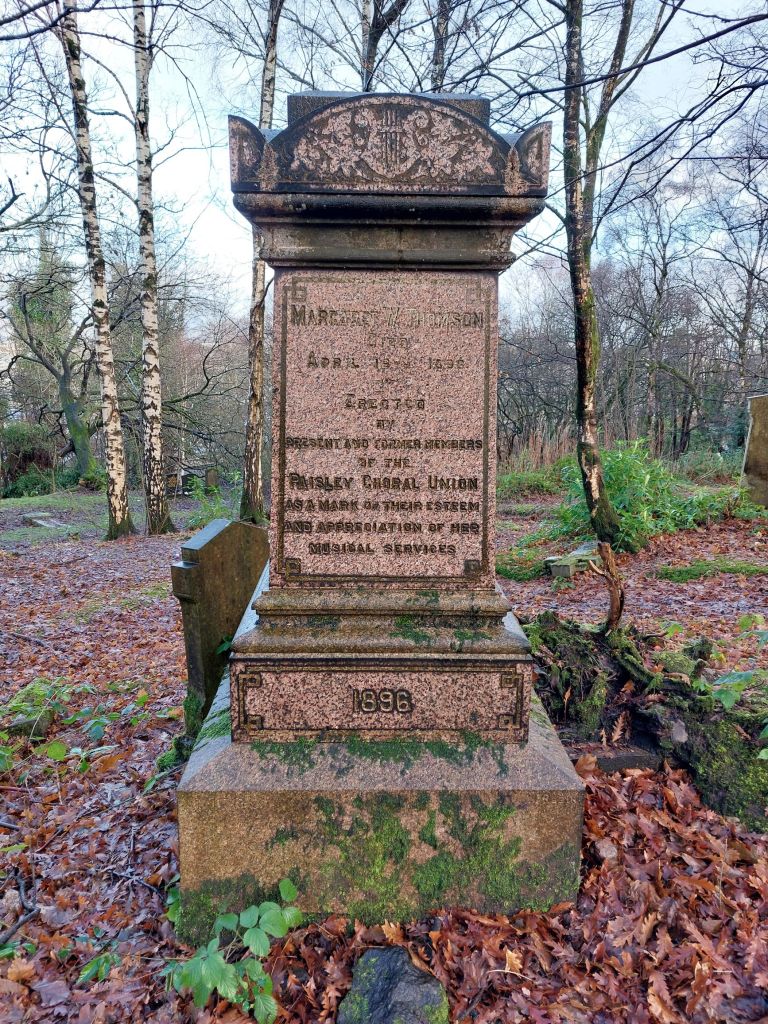
I  got nowhere with my own attempt, as I was the only person who had researched and written about ‘my’ Elizabeth Lambert (married name Williams), so I couldn’t provide the requisite references by respectable authors. She wasn’t ‘daring’, but she definitely made a worthwhile contribution to St Andrews University Library, in cataloguing their legal deposit music so borrowers knew what was available to borrow.  (Her other private interests were interesting, too. She was an acknowledged expert in conchology.) I’m pleased to see she at least has a Wikidata entry now! Anyway, thwarted in my Wikipedia ambitions, I posted a biography on the present blog.

You might also find my article about St Andrews’ Copyright Collection of interest. Again, Miss Lambert gets several honorable mentions. And I found another posting that I’d forgotten all about, this time in 2021 for a University of Stirling research project. I might as well share details of these pieces, to get her a bit more exposure!

[Dangerous] Women who Dared

Earlier this year, IASH blogged about an exciting book that Ben Fletcher-Watson and Jo Shaw would soon be releasing.  And yesterday, I attended its launch – the third book of the Dangerous Women project:- 

The Art of Being Dangerous: Exploring Women and Danger through Creative Expression (Leuven University Press, 2021) edited by Jo Shaw and Ben Fletcher-Watson

Dangerous Women: fifty reflections on women, power and identity (Unbound, 2022) edited by Jo Shaw, Ben Fletcher-Watson and Abrisham Ahmadzadeh

Women Who Dared: From the Infamous to the Forgotten (Edinburgh University Press, 2025) edited by Ben Fletcher-Watson and Jo Shaw

It was a lovely book launch, and we had excellent speakers, who had all contributed to the book: Jo Shaw, Sara Sheridan, Ruth Boreham and Jo Spiller. 

Women who Dared is an anthology of short biographies – all of them historical ‘women who dared’.  I chatted with the speakers afterwards, and enjoyed hearing more about their work. There are so very many women of note, whom history has entirely forgotten about, so books like this are both very welcome, and very necessary.

Edinburgh University Press link

Book launch spoils!

She Started Something! Bamboo Pipes – then the Pipers’ Guild

Front of The Pipers' Guild Handbook

Folks, I got distracted again tonight – beguiled by bamboo pipes, in fact. Let me explain!

Have you heard of Margaret James (1891-1978)? I wouldn’t be surprised if not, but believe me, she really started something in the 1920s. Someone gave the Gloucestershire school teacher a bamboo pipe from Sicily, and she realised this was something that kids could make at school.  They weren’t expensive to make, either.  (I read an observation that they were made from materials readily available in many homes.)**  It apparently took off! Kids liked actually making an instrument then learning to play it.  It was certainly another means of practical music-making. Crafting bamboo pipes briefly became the latest thing in classroom music, or so the literature would have us believe.  Although unmentioned in the Board of Education’s Handbook of Suggestions for Teachers in 1927, either in the music or the handcrafts sections, by 1933 the idea was being recommended in Board of Education literature and by HMIs (His Majesty’s Inspectors).  I do tend to wonder how many pipes were actually being made across the country – did the numbers match the rhetoric? Anyway, Margaret organised courses, wrote books and made at least one recording.  Judging by the number of publications, there surely must have been sufficient interest. This is a quick, but not exhaustive, list of works Margaret had a hand in:-

  • The adjusted treble pipe : the rhyme & reason of it, how to make it (Pipers’ Guild, 1933)
  • Directions for making the bass pipe, with diagrams by N. Gibbs (1936)
  • Directions for making the extended treble and alto pipes (Cramer, 1942)
  • Exercises and airs for pipes (Curwen, 1941)
  • Folk dance tunes : for bamboo pipes / transposed by Margaret James (Novello, 1934)
  • How to make a bamboo pipe [Diagram] (Published for the Pipers’ Guild, ca.1933)
  • The Pipers’ Guild handbook / Margaret James; with drawings and a chapter on decoration / by Nora Gibbs. Cramer, [1932]
  • Supplement 1 to the above, [1932-5]

Indeed, Vaughan Williams even wrote a Suite for Pipes (Oxford University Press, 1947), a quartet which was certainly more difficult than the average school pupil could attempt. Here it is, albeit played by a recorder quartet:-

The bamboo pipes do sound sweet, pastoral, traditional – very ‘English’. (I say that in inverted commas, because the question of what sounds ‘English’ is a whole dissertation in itself. I’m not going there.) Which makes it all the more ironic that her original gifted pipe was Sicilian! Anyway, we can agree that their folksy sound is part of their appeal.

Margaret herself started the Pipers’ Guild, which lasts to this day.  I did wonder if her bamboo pipe-making movement made it as far as Scotland  – was it something Scottish teachers were also doing? Judging by newspaper evidence, the Guild did have a small presence up here, but perhaps not quite as enthusiastically as in England. I won’t hunt further. 

Since my research interests are currently in a Scottish publisher producing educational music materials for a widespread market, then I thought maybe I should see if, or how often pipe-making got a passing mention – because their music editor/advisor was nothing if not on the ball. However, by 1939/40, it appears the humble (and ready-made!) recorder had gained supremacy. See this observation by one of Thomas Nelson’s authors:-

[…], who has done a lot of work on pipe playing in schools, composed pieces for them, and might be asked to write a first book on recorder playing, since they’re attracting more interest than pipes now. […] My own opinion is that there is already sufficient pipe music but not sufficient first stage recorder music.’

Similarly, Thomas Nelson’s four classroom books of My Music Guide (1953) mention recorders, but are silent on the question of pipes or pipe-making. Bamboo pipes evidently remained a minority interest, albeit for a long time.

** Glancing at my own garden canes, I doubt they’re wide enough to do anything with.  I don’t know if our toolbox is equipped for such a project, anyway.

Picture of Pipers’ Guild Handbook sourced from eBay. (I didn’t buy it.)

On Tenterhooks!

As I mentioned, I applied for a grant a couple of weeks ago. I’m waiting to hear how I got on, but it’ll be a while yet.

But today, whilst I was on a bus to Dundee, I was whiling away the time by looking for research-related ephemera. And I found something interesting – it doesn’t change anything about my proposed project, but it would certainly be nice to have.  Thematically, there’s an indirect link.  Chronologically, it’s spot on.  I did nothing about my find immediately, but on the bus home, I couldn’t resist.  I ‘favourited’ it.

Back came a reduced price.

In went my counter-offer.

So, now I’m on tenterhooks.  Will I win the ephemera? Which happens to be overseas, needing to be repatriated.  And which is really only significant with relation to the grant topic …

Watch this space.


And I won the eBay item. Step 1, you could say.  But I’ve just bid for another  …

Image by OJart from Pixabay

Victorian Copyright: the Author Miss Letitia Higgin, and Editor Lady Marian Alford

My new eBay purchase arrived on Sunday afternoon: Letitia Higgin’s Hand Book of Embroidery, published by her employer (the Royal School of Art Embroidery) in 1880, and edited by the Vice President of the Society: Lady Marian Alford. It’s a modern reprint: the original is an appropriately antiquarian price.

The Society had been founded in 1872. Letitia (Lily) was a middle-class young woman needing to earn her own living, who, with two of her sisters, was employed by the Society.  She was promoted to a senior position, and wrote this handbook not for absolute beginners, but for ladies who had learned the basics and needed to know more. The introduction explains that the book answers some of the most frequently asked questions. Brilliant, I thought. This could be just what I need. You know how I enjoy embroidery, even if I’m just a relative beginner.

A Daughter of Margaret Maclean-Clephane

Portrait of Lady Marian Compton, from National Trust via Art.UK
Grant, Francis – Lady Marian Margaret Compton (1817-1888), Viscountess Alford; National Trust, Belton House; http://www.artuk.org/artworks/lady-marian-margaret-compton-18171888-viscountess-alford-176409 National Trust Images via Art.UK

Enter Margaret Maclean Clephane’s elder daughter, Marian (Marianne)!  The book’s editor was none other than a daughter of song-collector Margaret Maclean-Clephane. (Just for the record, Margaret’s married name was Lady Compton, and later Lady Northampton.  That’s why her daughter was Lady Marian Margaret Compton.)  Lady Marian’s musically gifted mother was also a poet.  The family evidently had creativity in their genes. Marian’s aunt Anna was a song and folklore collector too; her other aunt was artistic; and now we find that Marian was a talented needlewoman.

A Copyright Dispute

The guide was so popular that the Society had hoped to produce a second edition, but a copyright dispute between author and editor meant that this didn’t happen.

I sat bolt upright.  We ordinary folk shall never know what the dispute was. (I learnt this much from Wikipedia. See reading list below.) Maybe the Society has archival paperwork that tells more, but I really must not let myself get distracted at the moment!

Giving Credit where Credit’s due

From my vantage point as a 21st century author, it would be easy to feel outrage on Letitia Higgin’s behalf. Had she done all the work and written the whole book, only for Lady Marian Alford to sweep in and add her name to it? Realistically, having a titled name on it would probably have added gravitas and authority in 1880. My guess is that Letitia Higgin did most of the hard work, and Lady Marian put her own titled gloss on it, but I simply don’t know. We can’t jump to conclusions.

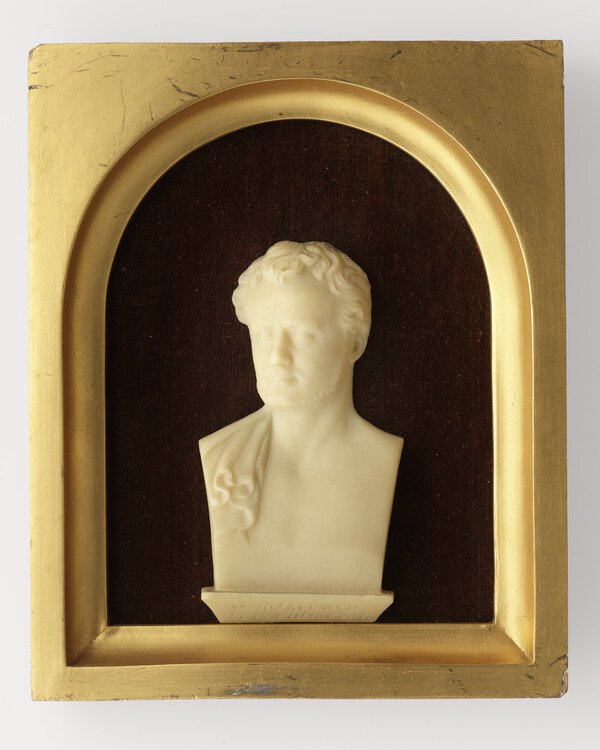
Bust of Lady Marian Compton, from National Trust via Art.UK
Lady Marian Compton (1817–1888), Viscountess Alford
Ernesto Cali (b.1821)
National Trust, Belton House, again via Art.UK.

I do know that Miss Higgin also wrote magazine articles referring to the book, and Lady Marian also authored other works. Neither woman’s expertise is in question.

Anyway, I intended to use the book for the purpose of self-instruction, so I turned the page to find out about needles. It informed me I should use a size 5 needle for crewel work. To be honest, I don’t think I’m doing crewel work (with crewel yarn), but embroidery. With embroidery silk. I had imagined it would be similar, but I imagined wrong.

Five is Larger than Nine

Moreover, Miss Letitia Higgin and Lady Marian Alford didn’t think to tell me that size 5 needles are larger than size 9. I suspect I may have been using the right size for embroidery all along (without knowing a scooby about sizes and numbers), but now I reached for the tiniest size needle, and spent far longer than was reasonable, trying to thread one strand of thread into the eye of a needle that I couldn’t even see. Ughh! I blamed the eye (my own) that can’t even read with glasses.  Eventually I used a needle threader. The thread broke. I did get dressmaking thread through the eye. And I bent the needle before getting the single strand of embroidery floss through the eye.  The eye of the needle was ludicrously, but appropriately small for such a tiny wee needle.

Temporarily giving up on Higgin and Alford, I turned to YouTube.  Thankfully, Sarah Homfray has done a series of YouTube videos about embroidery, and that’s how I learned that 5 was actually larger than 9:-

‘Are you using the right sized needle? I show you how to pick the right one!’

https://youtube.com/watch?v=PtBGZn0yohU&si=LJomNgTXJTZ_hoMT

I shall eventually return to Miss Higgin and Lady Marian Alston.  I’m sure they have useful knowledge to impart, quite apart from the insights into the pastime of embroidery in the late Victorian era. You could buy a marked canvas, which someone at the Royal School of Art Embroidery had prepared and even started off for you. That sounds helpful!

However, today? I’ve signed up to a local evening class. (Although I don’t know if I’ll ever be capable of marking out a canvas to make Higgin’s and Alford’s piano cloth design!)

7. DESIGN FOR A SOFA-BACK COVER OR PIANO PANEL. By George Aitchison. Vincent Brooks Day & Son, Lith. (From Gutenberg website: https://www.gutenberg.org/files/24964/24964-h/24964-h.htm#Page_75

READING LIST

  • Alford, Marian, Needlework as Art (London: Sampson Low, Marston, Searle & Rivington, 1886.)
  • Alford, Marian – other works of local history interest.
  • Higgin, Letitia, ‘Art Needlework’, articles in The Art Amateur (1880) Vol.2 issues 5 and 6
  • Higgin, Letitia, Hand Book of Embroidery, ed. Marianne Margaret Compton Alford (London: Published by Authority of the Royal School of Art Needlework, 1880)
  • ‘Higgin, Letitia’ – Wikipedia entry
  • Homfray, Sarah, ‘Are you using the right sized needle? I show you how to pick the right one!’ YouTube
  • Hulse, Lynne, ‘Higgin, Letitia (Lily) , author and embroiderer’, in Oxford Dictionary of National Biography
  • Northampton, Margaret Compton, marchioness of (d. 1830), Manuscript book of poems, dated 1808-1821, by Lady Compton (Lady Northampton), also transcription of poems, dated 1804-1840, by her sister Anna Jane Douglas Maclean Clephane.] National Trust Libraries – Note on Jisc Library Hub Discover:- ‘Poems stated to be by Lady Compton (as Lady Northampton was known 1815-1828) on pp. 1-47, and by Lady Northampton on pp.113-120; poems by Anna Jane Clephane on pp. 52-110 and 121 to end (many with monogram AJC).
  • Royal School of Needlework. Our History

Going Off at a Tangent: an Intriguing Deviation from Research

Straight line with a second, curved line (ending with an arrow)
Image by Bruno from Pixabay

When that book comes from Amazon, I may be distracted. Well, it’s available online already, being very old and antiquated, but how can I refer to an embroidery book online, when I want it open in front of me whilst I sit sewing? I don’t care to read it on a tablet – I want the real thing, or in this case, a reprint of it. (You can’t so easily sit with markers in different pages, flicking between different stitches and patterns, on a tablet. )

What, you might ask, does this have to do with Scottish publishers or educational music? Absolutely nothing. It does have a tangential link to something that was once a research interest – hence my inability to let it go by me.

Watch this space. We’ll soon see if I am up to any of the suggestions in this book! Maybe it’ll arrive in time for the weekend.

Thoughts about Experiencing Plagiarism

Beautiful red apple hanging from tree, ready to be picked

‘Imitation is the sincerest form of flattery’?

I wrote these words as a reflection, but then I wondered if other people might find them helpful. Maybe something like this – or worse (because I realise my experience was slight compared to someone whose whole article, story or book has been plagiarised) has happened to you? There might be folk who would shudder at the thought of laying bare their emotions, their gut reaction, to such a situation. As for me? My ‘words’ are my strength. If my words in the present posting make me look weak as an individual, be assured that I am fully aware of this. They also make me uniquely ‘me’, and who ever gets far by pretending to be other than themselves?

Meanwhile, my situation has been resolved, thankfully. I feel grateful. Grateful for the help. Grateful for the response and correction of the situation.

However, I feel utterly drained.  I’m taking a day’s annual leave because it’s preferable to taking a day’s sick-leave for stress.

I initially headed this posting, ‘Thoughts on detecting plagiarism’. However, ‘on detecting plagiarism’ turns out already to be in the title of someone else’s blog post – Addressing the Inherent Biases in Automated Systems: On Detecting ‘Plagiarism’ (Lancaster University, Ref 2014 Impact Case Studies). I changed my heading. Do read the Lancaster post, if you’re interested. I commend it, even though it’s actually about detecting plagiarism in student submissions, rather than realising your words have been quoted without attribution. I read their blog post briefly last night, and I am not reading it again today. I took no notes, and I have no intention of borrowing anything that was there.


They were literally just a few words, but my own words, and the crux of a 21-page article written 12 years ago. The first full article on the topic. It hurt. And then I started questioning myself:- was I considered so unimportant that my authorship is insignificant? Because, PhD or not, I was ‘merely’ a librarian, hence unimportant? Because I’m now ‘just’ a postdoc research fellow? (That was actually a promotion, by the way!) Because I’m not very famous? Was it because I’m a woman? Because I’m older, and thus considered past it? Because, once published, the words were considered free for the taking? Because, significant or not, they were just a few words, and so temptingly apposite? Low-hanging fruit.

Mulling it over as I got ready for the day, I glanced in the mirror. There I was, an older woman – not ageing particularly stunningly or gracefully, short in stature and wide in figure. My garb was workaday (I was about to sit down to a solitary morning of research, 67 or not). I wore no makeup, and I haven’t been on the latest diet long enough – you wouldn’t notice me if I walked down the street. So there I was. I’m not publicly visible as a performer or composer, unlike a large number of my colleagues. And, as I mentioned, although as a librarian I achieved some visibility in the sectors I worked in – perhaps more visibility than many – librarians aren’t generally known for this quality. We exist to help other people. I’ve not been a librarian for a year now, but I think I probably still carry the aura of invisibility. And when you say ‘librarian’, not many people immediately think, ‘Ah! A researcher. An author. A public speaker.’ Well, there it is!

Image by Bruno from Pixabay

But although librarians might exist to help, to share, to facilitate, they aren’t ghostwriters. Even when they’ve retired from librarianship and are now employed solely as a postdoctoral research fellow.

‘It Says More about Them than it does about You’

And then I reminded myself (I think this is called cognitive reframing) that I didn’t actually know what they were thinking when they used my unattributed words. I can’t read other people’s minds. My identity may not have even been a consideration. And I recalled my latest mantra: that other people’s words and actions speak more about them than about me.

Trigger warning here. I am not preaching when I say that I’m a practising Christian; I’m declaring a fact, which probably does affect my philosophy. (I’m no Evangelical, though – I’m boringly conventional!) I found an intriguing article, ‘3 Reasons Pastors and ‘Authors’ Should Never Plagiarize‘ by David Kakish (12 July 2019). He does make the salient, human point that ‘Plagiarism Fails to Give Honor Where Honor is Due’. Be assured that I’ll be reading it, out of curiosity, but it doesn’t really help the person who has been plagiarised, so I’ll leave it until later! I did do a little web-searching to see if there was a Christian take on low self-esteem. However, I found nothing that resonated, except the grounding reminder that everyone is a unique person for a purpose, so we should embrace what we are rather than wish we were someone else.

I tried not to beat myself up about my own insecurities. I know what I’ve achieved, from a mid-career standing start, against the odds. My words are old enough to be irrefutably mine, regardless. And … well, I can always write some more!


Here are some useful links which I found last night

If your experience is on the more serious end of the scale, these might be helpful. I’m not proposing to offer guidance on dealing with such situations – I’m really not qualified to – but I would urge you to seek support.

Bailey, writing about author O’Hanlon’s dreadful experience, headed his post, ‘The Emotional Toll of Plagiarism’, and my own limited experience endorses that. In my case, a migraine and shall we say, gut reactions, were clearly telling me I was stressed.  Symptoms can be treated, but how much nicer not to have had them at all!

Image by NoName_13 from Pixabay

Oral Transmission of Folk Songs

Wavy lines of music and an artistic interpretation of a fiddle

Attribution and Authorship

When I’m talking to students about oral transmission of folk songs, my take is – perhaps a bit controversially – that I believe a lot of songs were actually written by ONE person. Passed on, passed around, changed certainly, but I don’t buy the idea that they somehow ‘grew’ anonymously or collectively out of the soil. Maybe a group of pals did sometimes sit in the pub, stand in the fields or sit at their looms working up words or a tune, but as often as not, someone ‘wrote’ or devised that song. We just don’t always know who did.

Tune Variants

The other problem, of course, is variants. If you pass things round and they get picked up by ear, or someone writes it down – but not exactly how it was performed by the last person – the tunes change slightly. Or, in times-gone-by, gaps between crotchets got filled in by two stepwise quavers, or an ornament got written out in full. And how do you determine what the ‘right’ version is? I don’t think you can, often enough, though you can certainly try to identify the most common form of a tune.  Or if you’re able to, the earliest printed version. (If Hamish McHamish wrote a song in 1825, then the earliest printed version is most likely to be closest to his intentions. But unless he took his tune to the printer, or published it himself, you can’t be sure. )

The Ravages of Time

So we have at least a couple of centuries in which some tunes had the opportunity to change a multitude of times. (And that’s before an accompanist decided that G7 would be better than E minor at a particular point …) Try and compare a song in three different published collections. It won’t necessarily be exactly the same.

The Strong but Wrong Singer

I also use the modern-day example of my own church organist experience. You teach the congregation a new tune. A strong singer gets something wrong, and thereafter, try as you may, everyone sings Jemima’s version of the tune. That, too, could be construed as oral transmission in action!

(And as for Technology)

Today, we had a new song. The choir had studiously learned it, syncopated rhythms and all. We sang it first as an anthem. Later, we sang it with the congregation. Even the syncopations went moderately well, though I can’t say I was listening out for those who, ‘like sheep had gone astray’ (to quote Handel’s Messiah). There was only one problem: the verses appeared on the PowerPoint in the wrong order, and there was not a thing could be done about it once we’d started. When the choir sang it with the congregation, the latter sang what they could, or what they saw on the screen …. ! Maybe that’s why the syncopations went well – not everyone was actually singing.

All I can do is offer a corrected version of the lyrics for the PowerPoint, and we’ll try again another day. Who knows what might have changed in the meantime?

Fruitful Days

George Square Edinburgh University

Friday

  • Applied for a grant.
  • Wrote a blogpost.
  • Started to update my blog bio.

I think that will do for one day!

Weekend Activity

Who said weekends were restful?! Apart from the usual domesticity, and the organ-playing, I put in some more work on this blog.

  • Finished radically updating my Bio page to better reflect my two career strands.
  • Balanced my historical copyright page (Claimed from Stationers’ Hall) with a new one: Copyright Today. My career trajectory means I take a keen interest in copyright, intellectual property, plagiarism and so on. I might as well keep useful material handy, for myself or anyone else stumbling across this blog.

Two Ladies and a Harp: the Maclean-Clephane Sisters of Torloisk on Mull (and Edinburgh)

You know how you buy a new car, and suddenly everyone seems to be driving the same white Fiat 500? It’s the same with research topics.

“Enthusiastic collectors of Gaelic songs and Irish harp tunes”

I researched Gaelic song-collectors Anna and Margaret Maclean-Clephane as part of my PhD (2009).

  • I blogged about the sisters as far back as 2012 in my librarian days, when the Whittaker Library was using Blogspot:- How Far Can a Song Travel? (Author Karen McAulay, Whittaker Live blog, Wednesday, 23 May 2012);
  • and of course they later made it into my book (Our Ancient National Airs, 2013).
  • I followed up with an extended article about them (also in 2013). See this excerpt from the article:-

Naturally, the Maclean Clephane sisters are in my Pure institutional repository at the Royal Conservatoire of Scotland. I coined the above phrase, ‘enthusiastic collectors of Gaelic songs and Irish harp tunes’, using it both in my book (p.92) and my article (p.62), both in 2013.

‘While they were still in their teens’

The sisters had a book ‘printed but not published’ while they were still in their teens – you can read about it in my article, p.58. I have to say, the arrangements in their book were – well, okay, but not artistically stylish!

Margaret had a harp – there is actually a Raeburn portrait of Margaret with her harp – see below.   Alexander Campbell did say the sisters played, but there’s no portrait of Anna with a harp, so we can’t prove it either way. He didn’t meet them. (There was in fact a third sister, though her musical interest didn’t seem to carry through to adulthood. ) Indeed, Anna wasn’t that hot on the piano, as I recall.  They grew up on the Isle of Mull. I’ve driven past the house, Torloisk. It’s massive!

I just love researching and writing about people, particularly musicians! If they’re women musicians, then that’s all the more interesting – so it’s hardly surprising I was drawn to them, and went looking at materials in the National Library of Scotland and the School of Scottish Studies in Edinburgh, and even visiting a manuscript that’s now down in London. (Blog post Women’s History Month 2024. Musicians, this present blog.)

Details of my article

But ever since, these fascinating and talented ladies keep cropping up in my social media feeds. People who’ve read my writings also contact me from time to time. Thanks to the miracles of modern technology, I get notifications that people have consulted my stuff, too … and there’s also a CD whose notes cite me, too:-

Tullochgorum – Haydn – Scottish Songs, by The Poker Club Band and Masako Art (BIS-2471 | SACD

Tullochgorum – Haydn  – Scottish Songs

The harpist, Masako, asked if she could cite my work – I was very appreciative that she went to the trouble of asking me.

Correctly cited 😀
Margaret Clephane … and Masako Art

I spent so long with my early nineteenth-century heroines, but eventually my research took different directions. Not being a Gaelic scholar was just one of the problems I’d encountered! I attended classes in speaking it, at the Conservatoire. I signed up to local authority evening classes at the Gaelic School in Glasgow. But somehow, I never really had time to give it enough attention, despite having been considered good at languages at school and possessing school certificates in – well, several European languages. I understand when someone agrees with me in Gaelic, and can pronounce ‘Torloisk’, for sure, but Gaelic remains beyond me!

But look – now the music is going to be played. That’s exciting!